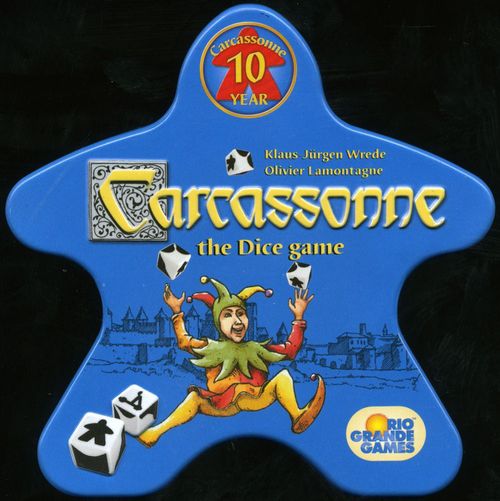
Carcassonne: The Dice Game
Carcassonne: The Dice Game Rulebook
Table of Contents
Table of Contents
Contents
- 9 Carcassonne dice, all with the same 6 sides: 4 city, 1 knight, 1 catapult
- 1 pad
- 1 pencil
Overview
In the Carcassonne dice game, the players cleverly use dice rolls to try to build closed cities as large as they can - the bigger, the better.
Playing the Game
The players roll the dice in turn order. The players choose a start player who begins and takes all 9 dice. On a player's turn, he rolls dice up to 3 times and then scores his result (see Scoring). He then passes the dice to his left neighbor, who continues the game.
A player rolls all the dice before him on his first roll. If he rolls 1 or more catapults, the player passes those dice immediately to the player to his left (he may not re-roll the catapults nor score points for this roll).
When a player rolls knights and city segments, he may set them aside or re-roll them as he chooses.
When a player sets city segments aside, he must immediately build a city with them. The player may not rebuild already built city segments.
Knights, once set aside, may not be re-rolled.
If a player collects 3 or more knights, he may choose not to score this turn and then double his score for the next turn. He keeps 1 knight and passes all other dice to his left neighbor. In his next turn, the player adds the knight die to the dice passed to him and rolls them. Thus, each player may have a knight, reducing the dice for others.
Example: End of the Turn
The player collected 3 knights. He keeps one and passes all other dice on. He does not score points for the city he built.
City Building
The player tries to build as large a city as possible with the dice he rolls. During the scoring, he scores the number of dice in his largest city.
City Building Rules
- The black parts are the city segments.
- Black parts are played next to black parts and white parts next to white parts.
- Once a die is used to build, it may not be re-rolled.
Example: City Building
- First roll: the player immediately passes the catapult to his left neighbor. The player uses 4 of the dice to build a city. He re-rolls the 2 knights and 2 other city segments in the hope to increase the size of his city.
- Second roll: the player immediately passes this second catapult to his left neighbor. With 2 city segment dice, he adds to his city. The player cannot use the knight and chooses to end his turn and score the largest city he built.
Scoring
After a player has rolled 3 times or chooses not to roll again, he may score his turn. The rules for scoring are:
- Only the dice of the largest closed city are scored. If the player did not build a closed city, he scores no points.
- If the player had a knight at the beginning of his turn, he scores double the points.
- The points are recorded on the score pad.
Scoring Table
| Dice in largest closed city | Points |
|---|---|
| 3 dice | 1 point |
| 4 dice | 3 points |
| 5 dice | 6 points |
| 6 dice | 10 points |
| 7 dice | 15 points |
| 8 dice | 21 points |
| 9 dice | 28 points |
Example: Scoring
The player scores his largest city, which has 6 dice and, thus, scores 10 points.
Game End
As soon as a player has scored 42 total points, the game ends and that player is the winner.
Special case: if a player rolls 9 catapults during his turn, he wins immediately, regardless of the points he scored so far in the game.
Transcriber note: the printed rulebook has the typos "dice roles" (for "dice rolls", in the Overview), "points are recording" (for "recorded", in Scoring) and "keeps1 knight" (for "keeps 1 knight", in the Playing the Game section). These are corrected here; the rest is transcribed as printed. The scoring table is set out from the printed page 7 list.