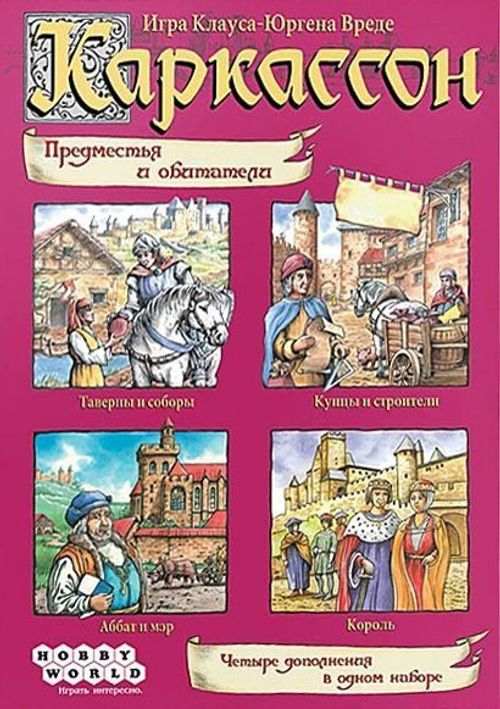
Carcassonne: Suburbs and Residents (Russian Edition)
Carcassonne: Suburbs and Residents (Russian Edition) Rulebook
Table of Contents
Table of Contents
Overview
The expansions in this box are used with the base game of Carcassonne. In each game you may use one or several of the expansions; they all combine with each other.
The brochure describes the components of each expansion and the rules for playing with them. These rules supplement but do not replace the standard Carcassonne rules: all rules of the base sets remain in force when the expansions are used. To review the standard Carcassonne and Hunters and Gatherers rules, see the respective base editions.
The box also contains an expansion for Carcassonne: Hunters and Gatherers, the Scout. It does not fit the standard Carcassonne game, only Hunters and Gatherers. Its rules are printed on a separate sheet that fits into the Hunters and Gatherers box, and that sheet is not transcribed here.
Inns and Cathedrals
Components
- 18 land tiles marked with a magenta follower icon
- 8 gray followers
- 6 double-sided score markers
- 6 large followers, one in each player color
Setup
Shuffle the land tiles of the base game together with the land tiles of this expansion.
In addition to the normal followers, each player receives one large follower in their color.
New Land Tiles
New tiles are placed by the usual rules: field to field, road to road, city to city. Some tiles show structures that give extra points.
Lakeside Inn (6 tiles). If at least one lakeside inn is adjacent to a completed road, the robber on that road gives its owner 2 points for each tile the road passes through. If the road is not completed by the end of the game, the robber scores nothing at final scoring.
- Example (first diagram): the blue player scores 6 points.
- Example (second diagram): the blue player scores 6 points.
- Example (third diagram): the road is not completed; at game end the blue player does not score for it.
A second, third, or any further inn next to the same road does not increase its value: if the road is completed, it still scores 2 points per tile.
Cathedral (2 tiles). If a completed city contains at least one cathedral, the knight in that city gives its owner 3 points for each tile on which the city lies and for each pennant within it. If the city is not completed by the end of the game, the knight scores nothing at final scoring.
- Example: the blue player scores 24 points.
- Example: the city is not completed; at game end the blue player does not score for it.
A second cathedral in the same city does not increase its value: if the city is completed, it still scores 3 points per pennant and per tile.
Other tiles.
- A tile with four separate city sections.
- A tile on which this inn stands only by the right road section.
- A monastery splits the road into two sections.
- Two short branches are not counted as road sections; robbers may not be placed on them.
- A crossroads divides the road into two sections.
- The border of the field runs here.
Large Follower
Large followers are placed on tiles by the same rules as ordinary followers. If several players claim a road, city, or field when it is scored, a large follower counts as two ordinary followers.
After scoring, large followers return to their owner's supply, like ordinary followers, and can be used again later. A large follower left on a field stays there until the end of the game, like an ordinary farmer.
A large follower does not increase the value of the object it stands on. It matters only when determining who owns a road, city, or field.
- Example: only the blue player scores points for the road.
Followers for a Sixth Player
The gray followers allow a sixth player to join the game.
You may use these followers even if you play without the Inns and Cathedrals expansion.
Score Markers
These double-sided markers simplify scoring. When your scoring marker goes around the track a second time (reaching 50 and beyond), take one of these markers and place it in front of you with the "50" side up. If you go around a third time, turn it to the "100" side. Take new markers as needed.
You may use these markers even if you play without the Inns and Cathedrals expansion.
Traders and Builders
Components
- 24 land tiles marked with a magenta pig icon
- 20 goods tokens (9 wine, 6 grain, 5 cloth)
- 6 pig followers in different colors
- 6 builder followers in different colors
Setup
Shuffle the land tiles of the base game together with the land tiles of this expansion.
Sort the goods tokens by type and place them in a general supply next to the scoring track. In addition to the normal followers, each player receives one pig and one builder in their color.
New Land Tiles
New tiles are placed by the usual rules: field to field, road to road, city to city.
Cities with goods. Some city sections are marked with a goods symbol: nine tiles show wine, six show grain, and five show cloth. When a city containing at least one goods symbol is completed, points are scored as usual. Then the player whose tile completed the city takes from the supply one goods token of the matching type for each symbol in that city, and places the tokens face up in front of them. At game end they may score extra points for these tokens.
A player who completes a city receives its goods even if they have no knight in it, and even if no knights are in it at all.
- Example: the red player completes a city. The blue player scores 10 points for his knight, and the red player takes two grain tokens and one wine token.
Other tiles.
- A tile with three separate city sections.
- A bridge is not a crossroads and does not divide a road into two sections. On this tile there are two road sections, one running from top to bottom and the other from left to right. The bridge divides the field sections. On this tile there are four separate field sections.
- A monastery divides a road into three separate sections.
- One road section meets a city, and the other ends in the middle of a field. The road and the bridge divide the fields on this tile into three separate sections.
Goods Tokens
Accumulated goods tokens bring their owners victory points at game end. The player who collected the most wine tokens receives 10 points. The players who accumulated the most grain or the most cloth tokens also each receive 10 points. If several players are contending for first place in a type of goods, each of them receives 10 points.
- Example, two players (the brochure's scoring table): the blue player holds 4 wine, 2 grain and 2 cloth tokens; the red player holds 4 wine, 3 grain and 2 cloth tokens. Wine is tied, so both players score 10 points for it. Red has the most grain, so red scores 10 points and blue scores 0. Cloth is tied at 2 each, so both score 10 points. Blue scores 20 points for his tokens and red scores 30 points for his tokens.
Pig
After playing a land tile, you may place a pig on it instead of a follower. A pig is placed only on a field where at least one of your farmers already stands, and it stays there until the end of the game.
If you score points for a field on which your pig stands at game end, each completed city bordering that field gives you 4 points instead of 3.
- Example: the blue player became the owner of the field. The pig lets him score 4 points for each completed city bordering this field; here the blue player scores 8 points. The red player did not manage to hold the field, so the pig does not help him and he scores nothing.
A pig is not counted as a farmer and is not considered when determining the owner of a field. If a field has several owners, the pig gives extra points only to its own owner.
Builder
After playing a land tile, you may place a builder on it instead of a follower. A builder is placed either on a road where at least one of your robbers stands, or in a city where you have at least one knight.
- You may place a builder on a road or in a city where followers or builders of other players are also present.
- The distance between the builder and your robber or knight does not matter.
- If a builder returns to your supply, you may use it again.
- A builder cannot be placed on a field or on a monastery.
A placed builder allows its owner to take two turns in a row. This works as follows:
- The player places a robber on a road (or a knight in a city).
- On one of the following turns, the player places a tile that continues the road (extends the city) and places a builder on it.
- Later, the player places a tile that continues or completes the object on which the builder stands. Having finished this turn as usual (placing a follower and scoring the completion of the object if needed), the player immediately takes an extra turn by the usual rules: draws a new land tile, places it, and places a follower and scores points if needed.
- Example: 1. The player places a robber. 2. The player places a builder. 3a. The player continues the road with the builder. 3b. The player immediately takes an extra turn, placing a new tile.
Further rules for the builder:
-
A player may not take more than two turns in a row, even if the extra turn continues or completes an object with their builder.
-
The builder returns to its owner's supply as soon as the object on which it stands is completed. Until then, the player receives an extra turn each time they continue the road or extend the city with their builder.
-
A tile played during an extra turn does not have to be placed next to the previous one.
-
If your first turn completed an object with a builder, you may place the builder during the extra turn.
-
Example: 1. The player places a robber. 2. The player places a builder. 3a. The player completes the road with his builder and places a knight in a city on the same tile. He scores points for the road and returns the robber and the builder to his supply. 3b. The player immediately takes an extra turn, extending his city with a new tile, and places a builder there (second tile).
A builder is not a follower and is not considered when determining the owner of a road or city.
Abbot and Mayor
Traveling merchants' carts journey along the roads and deliver goods to the cities and monasteries of Carcassonne, while the cities grow and acquire elected mayors. Peasants become prosperous farmers, and the Church raises funds for the struggle for souls by building abbeys.
Components
- 12 land tiles marked with a magenta abbey icon
- 6 abbey tiles
- 6 mayor followers in different colors
- 6 barn followers in different colors
- 6 cart followers in different colors
Setup
Shuffle the land tiles of the base game together with the land tiles of this expansion.
In addition to the normal followers, each player receives one mayor, one barn, and one cart in their color, and one abbey tile.
New Land Tiles
New tiles are placed by the usual rules: field to field, road to road, city to city.
Captions from the brochure:
- A tile with two separate city sections. Note that the city section with a pennant borders the field at the bottom of the tile; this matters when scoring fields.
- A tile with two separate city sections, one with a pennant and one without.
- At the well the road forks. This tile has one road section that continues in three different directions at once. Such a road is not completed until it is closed on all three sides.
- A road meets a city but does not end in it. On each such tile the field is divided by the city walls and the road into three sections.
- A tunnel does not divide a road into two sections; on this tile there is only one road, running from top to bottom. Note that in the upper part of the tile the road divides the field into two sections, and in the lower part it does not. This matters when scoring fields.
- A road ends in the middle of a field.
Mayor
After playing a land tile, you may place a mayor on it instead of an ordinary follower. A mayor is placed only in a city where there are no knights or mayors of any player yet.
When scoring a city on which several players claim ownership, each mayor in it counts as as many ordinary followers as there are pennants in that city. In a city without pennants a mayor has no force.
After scoring, mayors, like other followers, return to their owner's supply and may be used in the future.
- Example: the city has 3 pennants, so the mayor counts as three ordinary followers. The blue player scores 18 points for the city.
A mayor does not increase the value of the city in which it stands; it plays a role only when determining who owns the city.
Strength of followers. When determining the owner of a completed city (or a city not completed at game end), each follower can be considered to have a certain strength:
- the strength of an ordinary follower is 1;
- the strength of a large follower (Inns and Cathedrals expansion) is 2;
- the strength of a mayor equals the number of pennants in the disputed city.
The player whose total follower strength is greater scores points for the city.
Abbey Tiles
On your turn, instead of drawing a random tile and attaching it to the map, you may play your abbey tile. An abbey tile may be placed in any empty space where exactly one land tile fits. This empty space must be surrounded on all four sides (horizontally and vertically) by previously placed tiles. If there is no such gap on the map, the abbey may not be played.
After placing the abbey, you may place one of your followers on it. A follower in an abbey counts as a monk, and points for this object are scored exactly as for a monastery.
An abbey serves as the boundary of all objects located on the adjacent sides of the four neighboring land tiles. If some of these objects were completed after you placed the abbey, points are scored for them by the usual rules.
If you placed the abbey in an empty space already surrounded on all eight sides (horizontally, vertically, and diagonally) and placed a monk in it, return this follower to your supply immediately and score points as for a completed monastery.
- Example: the blue player plays an abbey and completes a road with the robber of the red player. The red player receives 1 point and takes his follower back into his supply. The city below the abbey and the road to its right are closed on the abbey's side but open on the other side, so they are not yet completed.
If, after the land tiles have run out, players still have abbey tiles, they may place them in suitable places on the map. The first player to have this opportunity is the player sitting to the left of the player who placed the last land tile; then play passes clockwise. If a player does not want to place an abbey, or there is no suitable place on the map, that abbey tile is wasted.
After all players have had the opportunity to play an abbey, final scoring begins.
Cart
After playing a land tile, you may place a cart on it instead of an ordinary follower. A cart is placed on a road, in a city, or in a monastery where there are no followers of any player yet, including mayors or other carts. A cart is never placed on a field.
When the completed object on which a cart stands is scored, the cart counts as an ordinary follower. After scoring, the player may either take the cart into their supply or move it onto a road, into a city, or into a monastery adjacent to the object just completed. The object to which the cart moves must be unfinished and must not be occupied by any player's followers. If there is no suitable adjacent object, the player must return the cart to supply.
- Example: the blue player receives 4 points for the road and may immediately move the cart into the monastery or onto the road below. A cart cannot be moved onto the road occupied by the robber of the red player.
- Example: the blue player receives 2 points for the road and may immediately move the cart into an unfinished city. A cart cannot be moved onto a road occupied by the robber of the red player, or onto a completed road.
- Example: the blue player receives 14 points for the city and may move the cart onto the road on the right. A cart cannot be moved onto a completed road.
If several carts stood on a completed object, their owners take them in turn and move them, starting with the player who last played a tile and continuing clockwise.
Barn
Placement
After playing a land tile, you may place a barn instead of a follower. A barn is always placed at the junction of four land tiles, one of which you have just played. All four tiles must meet at field corners: the four corners where the tiles touch must all be exclusively field. The presence of farmers in that field does not matter, but a barn cannot be placed on the same field as another barn. The barn stays on the field until the end of the game.
- Example: the barn can be placed on the left junction. On the right junction a barn cannot be placed, because the four tiles also include city sections at the junction.
Points When a Barn Is Placed
As soon as a barn is placed on a field, the farmers on that field immediately score points, as at final scoring. Each owner of the field receives 3 points for each completed city adjacent to that field. It does not matter whether the owner of the barn scores points from this field. After scoring, each player takes their farmers from that field back into their supply.
If a pig from the Traders and Builders expansion stands on the field, its owner receives 4 points for each completed city instead of 3. After scoring, the pig returns to the owner's supply together with the farmers.
- Example: the blue player has placed a barn. The yellow player receives 6 points for 2 completed cities and takes a farmer back into his supply.
Joining Fields
No farmers may be placed on a field with a barn. If, after a player places a tile, a field with farmers joins the field on which a barn stands, those farmers score points immediately. This time, each owner of the field receives only 1 point for each completed city on that field (or 2 points if they have a pig there). After scoring, the farmers and pigs return to the players' supplies.
- Example: after the tile is added, the red player's farmer ends up on a large field with the blue player's barn. The red player receives 2 points for 2 completed cities and takes the farmer back into his supply.
Final Scoring
At the end of the game, the owner of a barn receives 4 points for each completed city adjacent to the field with the barn. If several players' barns are on one field, each of them receives points for that field in full.
King
Now the builder of the largest city may win the favour of the King, and the player who lays the longest road will have the bandit chief Ataman on his side.
Components
- 5 land tiles marked with a magenta crown icon
- 1 King tile
- 1 Ataman tile
Setup
Shuffle the land tiles of the base game together with the land tiles of this expansion. Set the King and Ataman tiles aside, next to the scoring track.
New Land Tiles
New tiles are placed by the usual rules: field to field, road to road, city to city.
- Example: this tile has two separate city sections, one running from top to bottom and the other from left to right. Remember that when scoring a city, the tiles on which it stands are counted, not the separate sections.
King
The King is a moving tile that goes to the player who completed the largest city (counted by the number of tiles it occupies). As soon as a player completes the first city in the game (whether or not they received points for it), they take the King tile. If later in the game another player completes a city larger than all other cities on the map, the King moves to that player.
At the end of the game, the owner of the King receives 1 point for each completed city on the map.
Ataman
The Ataman goes to the player who completed the longest road (counted by the number of tiles it passes through). As soon as a player completes the first road in the game (whether or not they received points for it), they take the Ataman tile. If later in the game another player completes a road longer than all other roads on the map, the Ataman moves to that player.
At the end of the game, the owner of the Ataman receives 1 point for each completed road on the map.
Reference: Turn Order and Scoring Summary
The brochure's summary page, transcribed. The brochure's tile-inventory chart (the letter codes and counts of every land tile) is a component list and is not transcribed here.
Pieces
- Followers: each ordinary follower and each large follower (Inns and Cathedrals) counts as a follower.
- Special pieces, which are not followers: the builder and pig (Traders and Builders); the mayor, cart, and barn (Abbot and Mayor).
Turn Order
- Draw and place a land tile.
- Place a piece: an ordinary or large follower, or a builder or pig (Traders and Builders), or a mayor, cart, or barn (Abbot and Mayor).
- Score points.
- After scoring, if needed, move the cart.
Scoring During the Game
Completed objects:
- Road: 1 point per tile. Road with an inn: 2 points per tile.
- City: 2 points per tile + 2 points per pennant. City with a cathedral: 3 points per tile + 3 points per pennant.
- Monastery: 9 points.
Fields, when a barn is placed:
- The owner of the field receives 3 points for each completed city on that field, and +1 point for each completed city on that field if they have a pig there.
Fields, when fields join around a barn:
- The owner of the field receives 1 point for each completed city on that field, and +1 point for each completed city on that field if they have a pig there.
Scoring at the End of the Game
Unfinished objects:
- Road: 1 point per tile. Road with an inn: 0 points.
- City: 1 point per tile + 1 point per pennant. City with a cathedral: 0 points.
- Monastery: 1 point for the tile with the monastery + 1 point for each adjacent tile.
Fields:
- The owner of a field receives 3 points for each completed city on that field, and +1 point for each completed city on that field if they have a pig there.
- The owner of a barn receives 4 points for each completed city on the field with the barn.
Goods:
- 10 points for each type of goods of which the player has collected more tokens than anyone else.