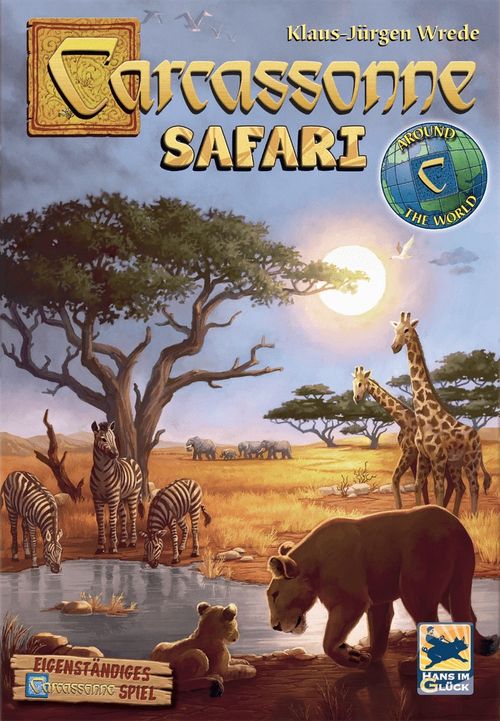
Carcassonne: Safari
Carcassonne: Safari Rulebook
Table of Contents
Table of Contents
Components and Setup
Welcome to Carcassonne Safari! In this booklet, we will guide you quickly through the rules of this latest iteration of the classic Carcassonne.
First, let's take a look at the 72 Landscape Tiles. On them you can see savannahs, animal paths, baobab trees and bush areas, where many animals frolic. All landscape tiles share the same back.
Next we have the 50 Animal Tokens, which show portions of watering holes and are comprised of Lions, Elephants, Monkeys, Giraffes and Zebras (10 each). These tokens (among other things) help you earn points. Combining 4 Animal Tokens creates a Watering Hole, which earns you points (see The Watering Holes).
Shuffle all 72 Landscape Tiles together and place them face down on the table in stacks. The Start Tile (comprised of a 3-sized Landscape Tile) is placed in the center of the table. The game features 2 white wooden Ranger Vehicles (we will refer to them as Rangers for short). These do not belong to any player. Place them in the (for now) empty spaces above and below the Start Tile.
Mix face down the 50 Animal Tokens, and give each player (including yourself) 2 of them. Players place their tokens face up in front of them. The remaining Animal Tokens are placed as a face down supply next to the Landscape Tiles stacks.
Place the 50/100-Point Tokens next to the Score Board.
Finally we have the wooden pieces. There are 30 Meeple figures, 6 in each color: yellow, red, green, blue and black. Give each player (including yourself) 6 Meeples in their chosen color, which form each player's personal supply.
Note: The Meeple figures in Carcassonne: Safari are slightly smaller than those found in other games in the Carcassonne series. Because there are many features to be seen on the Landscape Tiles and Animal Tokens, the smaller Meeple size allows things to be seen more clearly.
In addition, there is 1 Elephant figure in each color, to be used for recording players' scores. Place the Score Board to the side of the playing area, and place each player's Elephant figure on the "0" space. All Meeple and Elephant figures not being used in this game can be returned to the box.
Overview and Goal
What is Carcassonne Safari all about? Players will take turns placing landscape tiles. In this way you will begin to develop features such as savannahs, the bush, animal paths and baobab trees. You will place meeples in the bush, on the animal paths, or on a baobab tree. When a bush area or animal path is completed, you will earn points for different animals. Baobab trees reward you with animal tokens. Use the animal tokens to upgrade your scorings, or to dig watering holes in the savannah. You will score points in many ways, both during the game and at the end of the game. After a final scoring, the player with the most points is the winner. Let's get started!
Gameplay
Carcassonne Safari is played in clockwise order. Starting with the first player, the active player performs the following actions in the order listed below, followed by the next player, and so on. We'll first give you a brief description of the actions you must do during one of your turns. These actions will be detailed as we present the various features of the landscape tiles.
- Place a tile: You must draw exactly 1 landscape tile from a stack and place it face up with at least 1 of its sides adjacent to previously placed tiles.
- Either
- Place a Meeple on the tile you just placed, OR
- Move one of the two Rangers, OR
- Start or expand a Watering Hole.
- Score a feature: You must score any and all features completed by your tile placement.
The Animal Paths
1. Place a tile
The landscape you have drawn shows, among other features, an animal path. Place the tile, keeping in mind that you must place it in such a way that it continues the existing landscape (the tiles already in play).
2. Place a Meeple on the Animal Path
After placing the tile, you may, if you wish, place 1 of your meeples on the animal path shown on the tile, but only if there isn't already another meeple on any section of the path.
3. Score a completed Animal Path
When both ends of an animal path are closed, that path is completed and scored. The end of a path is closed when it meets a bush area, ends in the savannah, or loops onto itself by meeting the other end. Even if your opponent placed the tile that closes the path, this still completes the animal path claimed by your meeple.
The number of points earned depends on the number of different types of animals that lie along the completed animal path. The table below (as well as the Score Board) show the points earned:
| Different animal types | 1 | 2 | 3 | 4 | 5 |
|---|---|---|---|---|---|
| Points | 1 | 3 | 6 | 10 | 15 |
Remember: the total number of animals along the path does not matter for scoring; only count the number of different animal types. After scoring, return your meeple from the path back to your supply.
Improving your scoring: To earn additional points, you may discard exactly 1 Animal Token (of a type that does not appear on the scored path) in order to earn the next higher score on the scoring table.
Example: Your animal path contains a Giraffe, an Elephant and a Zebra (3 different animal types, worth 6 points). You discard a Lion token from your supply. You now score 10 points, as if there were 4 different animals on the path.
We will now explain a little more about the Score Board. In order to keep track of your points throughout the game, mark your points with your Elephant figure on the Score Board. After each scoring, players return any of their meeples from the scored feature back to their supply.
All discarded Animal Tokens are placed face up in a discard pile to the side of the play area. When a player earns an Animal Token (see The Baobab Trees) but there are no more face down tokens remaining in the supply, shuffle the discarded tokens to create a new supply to draw from.
If your Elephant figure circles the score track and crosses the "0" space, take a 50/100-Point Token and place it in front of you with the "50" side face up. After circling the track again, turn the token so the "100" is face up.
The Bush
1. Place a tile
As usual, you draw a tile and use it to continue the landscape. As always, the features on the newly-placed tile must match those on all adjacent, previously-placed tiles.
2. Place a Meeple in the Bush
Next, you check if a meeple already exists in this bush area. If none do, you can place one of your meeples in the bush section of the tile.
3. Score a completed Bush area
A bush area is considered complete when it has no "open" edges, and there are no gaps or holes inside of it. When this happens, score it and earn points for it. The number of points earned depends on the number of different animal types that lie within the bush area, and are calculated exactly as with the animal paths (see the table below or on the Score Board):
| Different animal types | 1 | 2 | 3 | 4 | 5 |
|---|---|---|---|---|---|
| Points | 1 | 3 | 6 | 10 | 15 |
Improving your scoring: As with the animal paths, you may discard exactly 1 Animal Token to increase the number of animal types scored by 1. In addition, each Bird appearing in the scored bush area earns 1 point. After scoring, return your meeple from the bush back to your supply.
Example: Your completed bush area contains a Monkey and a Giraffe. You discard a Zebra token from your supply. This now counts as 3 animal types, which earns you 6 points. Since there are 3 Birds in this bush area, you earn an additional 3 points, for a total of 9 points.
The Baobab Trees
1. Place a tile
If you draw a landscape tile that shows a baobab tree, it is placed following the same rules as any other type of tile. As always, the features on the newly-placed tile must match those on all adjacent, previously-placed tiles.
2. Place a Meeple on the Baobab Tree
You may place a meeple from your supply on the baobab tree on the newly-placed tile. (Your explorer is taking a little rest in the shade of the tree.) If you do place a meeple on the baobab tree, draw 2 Animal Tokens from the face down supply, and place them face up in front of you.
3. Score a completed Baobab Tree
When a baobab tree is completely surrounded by 8 landscape tiles, this signifies that your meeple's rest is over, and you return it from the tile back to your supply.
You do not earn any points from "completing" a baobab tree, but instead you may draw 2 Animal Tokens from the face down supply and put them face up in front of you.
The Rangers
There are two ways to move a Ranger during the game; one way immediately earns points, and the other does not.
1a. Place a tile
You draw a tile and place it in a space where no Ranger lies.
1b. Place a tile AND displace a Ranger
If, after drawing a tile, you place it in a space containing a Ranger (following the usual placement rules), you take the Ranger and place it in front of you temporarily.
2a. Do not place a Meeple
If, after placing a tile, you decide not to place a meeple on it, you may move 1 of the 2 Rangers to another empty space next to 1 or more landscape tiles.
2b. Place a Meeple
As usual, you may place 1 of your meeples on the tile if there is not already another meeple on any section of the same feature (animal path or bush).
3a. Score a completed feature
Score any completed feature as normal. In this case, you do not earn any points for moving the ranger.
3b. Score a completed feature
Score any completed feature as normal. In addition, for displacing a Ranger with your tile placement, you now earn 3 points.
Then return the displaced ranger back to the play area, in an empty space next to 1 or more landscape tiles.
Important: You may only move 1 Ranger on your turn. If you have displaced a Ranger (1b) by placing a tile in its space, you still move it to another empty space (2a) even if you do not place a meeple on the tile. There may never be 2 Rangers on the same empty space!
The Watering Holes
Instead of using the animal tiles to improve your scoring of a completed animal path or bush area, you may use them to dig watering holes in the savannah.
1. Place a tile
You draw and place a landscape tile, according to the usual rules.
2. Start or Expand a Watering Hole
Starting a Watering Hole: Instead of placing a meeple on the newly-placed tile, you may start the construction of a watering hole. To do this, place an animal token from your supply on a free corner of any existing landscape tile (it does not need to be the newly-placed tile). A free corner is one that shows a savannah, and no obstacles such as an animal path or bush area (small shrubs or grasses depicted on a corner of a tile are not considered to be an obstacle). The token must be placed with its straight sides aligned with the edges of the tile. Then place 1 of your meeples on the animal token. For starting a watering hole, you immediately earn 3 points.
Expanding a Watering Hole: Instead of placing a meeple on the newly-placed tile, you may expand a previously-begun watering hole. Place an animal token on the free corner of an adjacent landscape tile so the circle of the watering hole continues to close. When doing this, however, you must use an animal token that shows an animal not already present at this watering hole. All animals in a watering hole must be different. You do not place a meeple when expanding a previously-begun watering hole.
Depending on whether you have placed the 2nd, 3rd or 4th and final animal token at a watering hole, you earn a number of points:
- 2nd animal token: 4 points
- 3rd animal token: 5 points
- 4th animal token: 6 points
Important: You must always place a meeple on a watering hole when starting one.
Special case: You may place an animal token diagonally opposite an existing watering hole. Since the 2 tokens are not touching yet, this is considered to be a separate, new watering hole, and therefore you may place a meeple on it. When the remaining 2 corners are filled by animal tokens, the 2 watering holes become 1 completed hole with 2 meeples on it. In this case, it is allowed for 2 identical animal tokens to exist on it.
3. Score a completed Watering Hole
Once the 4th animal token is placed at a watering hole, it is complete. The owner of the watering hole earns 3 points and returns his meeple from the watering hole to his supply.
If 2 meeples are on the completed watering hole, both owners earn 3 points each. If both meeples belong to the same player, that player only earns 3 points.
More than 1 Meeple on the Same Feature
Through clever tile and meeple placement, multiple meeples can occupy the same animal path or bush area. When such a feature is completed, only the player who has the most meeples in the scored feature earns the points. If there is a tie between 2 or more players for most meeples in a scored feature, all tied players earn the full points for the feature.
Example: Before your turn, you and Blue each have a meeple on 2 separate animal paths. You place a tile connecting both paths with it. The animal path is now complete. There are 4 different animals on the path (Monkey, Lion, Elephant and Giraffe). You discard a Zebra token and earn 15 points. Blue does not use an animal token and earns 10 points.
Example: Before your turn, you and Blue each have a meeple on 3 separate bush areas. You place a tile connecting all 3 bush areas, and also completing it. You decide not to discard an animal token. Therefore, you earn 11 points (6 points for 3 different animal types plus 5 points for the birds). You alone earn the points because you have more meeples in the bush area than Blue. Blue earns no points. You both return your meeples to your supply areas.
Rules Summary
-
- The tile you draw must always be placed so that it continues the existing landscape (features must match).
- In the rare case that you cannot place the drawn tile, return it to the game box and draw a new tile.
- If you place a tile in an empty space containing a Ranger, you must displace him.
-
- You can only place a meeple on the tile you have just placed on your current turn. Remember that you cannot place a meeple on a feature if another meeple already exists on another section of the feature.
- If you place a meeple on a Baobab Tree, you do not earn any points; you receive 2 animal tokens instead.
- If you decide not to place a meeple on the newly-placed tile, you may either start or expand a Watering Hole or move a Ranger.
-
- If a feature is completed, a scoring takes place at the end of a player's turn. After a scoring, all involved players return their meeples from the scored feature back to their supplies.
- A completed Animal Path earns points based on the number of different animal types on the path.
- A completed Bush earns points in the same way as an Animal Path, plus 1 point per Bird in the Bush area.
- A completed Baobab Tree earns 2 Animal Tokens.
- If several players are involved in a scoring, the player with the most meeples in that feature earns the points. If there is a tie for most meeples in a feature, all tied players earn the full points.
Game End, Final Scoring, and Winner
So here we are, at the end of this game of Carcassonne Safari. It's now time to find out who the winner is! The game ends when all landscape tiles have been drawn and placed. This is followed by a quick final scoring, in which players earn points for any meeples remaining on landscape tiles on the following features:
Animal Paths and Bush Areas: Each animal and bird earn the owner of a meeple on the feature 1 point. All animals are counted even if they are the same type(s).
Animal Tokens: Each animal token in a player's supply earns that player 1 point.
Baobab Trees: A meeple on a baobab tree at the end of the game earns no points.
Watering Holes: A meeple on a watering hole at the end of the game earns no points.
The player with the most points after the final scoring is the winner! If several players have the same number of points, they share the victory.
Tile Overview
72 Landscape Tiles, 50 Animal Tokens, 5 50/100-Point Tokens, 1 Start Tile.
If several tiles with the same features layout are present, it is noted which and how many animals of each type occur. The individual tiles are separated by a dash. M=Monkey | E=Elephant | G=Giraffe | L=Lion | Z=Zebra. "–" = no animal. Birds are not listed in the overview.
| Tile | Animals | Count | Tile | Animals | Count | |
|---|---|---|---|---|---|---|
| CS1 | –|– | 2x | CS18 | EL | 1x | |
| CS2 | E | 1x | CS19 | EGG | 1x | |
| CS3 | E|G|G|Z | 4x | CS20 | M|M|G|L|Z | 5x | |
| CS4 | M|E|L | 3x |
Animal Tokens: 10x Monkey, 10x Elephant, 10x Giraffe, 10x Lion, 10x Zebra. Plus 5x 50/100-Point Tokens.
Note: When selecting a title for this game, we deliberately chose "Safari", because nowadays the term "Safari" more commonly refers to the observation of wild animals in their natural environment, rather than big game hunting and killing.