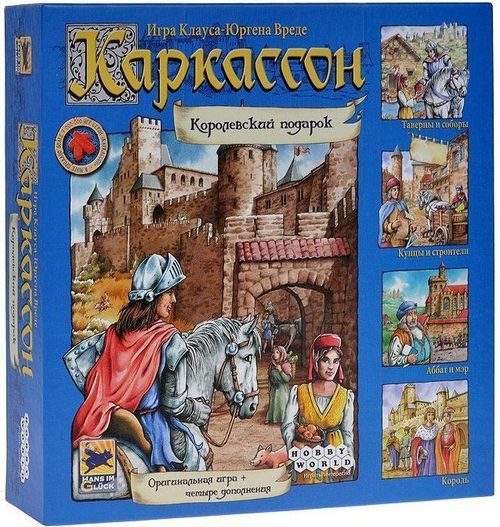
Каркассон: Королевский Подарок
Каркассон: Королевский Подарок Rulebook
Table of Contents
Table of Contents
- Components and Setup
- Game Overview
- Gameplay
- Game End and Final Scoring
- Expansion: Inns & Cathedrals
- Components
- The New Land Tiles
- The Large Meeples
- The Points Tiles
- Expansion: Traders & Builders
- Components
- Setup
- The New Land Tiles
- The Goods Tokens
- Builders and Pigs
- The Bag
- Expansion: Abbey & Mayor
- Contents
- Setup
- The New Land Tiles
- Abbey
- Mayor
- Barn
- Wagon
- Rules for Using This Expansion with Other Expansions
- Expansion: King & Scout
- 7 new cards for Carcassonne
- 5 new tiles for Carcassonne: Hunters & Gatherers
Components and Setup
Welcome to Carcassonne! This rulebook will teach you the game quickly, and when you are done, you will be able to teach and play the game. The first step is setup, which will also introduce you to the components of the game.
The 72 LANDSCAPE TILES show roads, cities, and monasteries, in a field.
- City tiles
- Road tiles
- Monastery tiles
The backs of all the tiles are the same, but the START TILE has a darker colored back, so you can recognize it easily.
Begin setup by placing the START TILE (with the dark back) faceup in the center of the table. Shuffle the remaining tiles and place them facedown in several stacks on the table, so that each player can easily reach them.
Set aside the eight POINT TILES with 50 and 100 sides. You will need them later for scoring.
Place the SCORING BOARD off to the side of the game table.
To finish setup, players gather their meeples. The BIG BOX comes with 48 meeples, with eight of each of the colors Yellow, Red, Pink, Green, Blue and Black.
Each player takes seven meeples of their chosen color to form their supply. Place each player's eighth meeple on the 0 space on the scoreboard. These will be used to track each player's score throughout the game.
Game Overview
In Carcassonne, players take turns placing tiles and expanding the landscape of roads, cities, monasteries and fields, one tile at a time. Players may place their meeples on the individual features of tiles as well (roads, cities monasteries, and fields), where they will become highwaymen, knights, monks, and farmers. Points are earned throughout the game, and the player with the highest score at the end is the winner!
Gameplay
The first turn in Carcassonne always starts with the youngest player, then proceeds clockwise around the table. On your turn, you will perform each of the player actions in order (explained below). Once you've completed all three actions, the player on your left takes his turn.
The Roads
1. Placing a tile:
You must draw exactly one landscape tile from a stack and place so that its edges match the edges of adjacent tiles (i.e., field to field, road to road, etc.)
2. Placing a meeple:
You may place a meeple from your supply on a feature on the tile you just placed.
3. Scoring a feature:
You must score any feature (road, city, or monastery) completed 3 by your tile placement.
The Roads
1. Placing a Tile
You draw the shown tile with three road segments leading to a village. You must place it in such a way that the edges match the edges of the tiles already in play.
2. Placing a Meeple as a Highwayman
After placing a tile with a road, you may place a meeple as a highwayman on one of that tile's road segments, but only if that road is not already occupied by another highwayman.
In the example, the tile you placed did not complete any roads, so no scoring occurs (see action 3. Scoring a Feature), and play proceeds to the next player.
The next player draws a road tile and uses it to complete the road you started. He may not place a meeple on the road to the right of the village since your highwayman already occupies that road. Instead, he places his meeple as a knight in the segment of that tile.
3. Scoring a Road
When both ends of a road are closed, that road is completed and scored. The end of a road is closed when it meets a village, city, monastery, or loops back onto itself by meeting the other end.
In the example, since both ends of the road are now closed, it is now scored. Since you had a highwayman on the feature, you will receive points.
Even though your opponent placed the tile, the road is still completed. When scoring a road, each tile with a segment of that road is worth 1 point. Here, since the road was in three tiles, it is worth 3 points.
Scoring is tracked with the meeples placed on the scoreboard during setup. You move your meeple 3 spaces forward, to reflect the 3 points you just scored.
Whenever your scoring meeple reaches or passes the 0 space, take a point tile, and place it in front of you with the 50 side face-up, flipping the tile to the 100 side if you reach or pass the 0 space again. Continue to take and flip point tiles as necessary if you reach or pass the 0 space additional times.
After scoring, return any meeples that occupy the road that was just scored to their players' supply.
The Cities
1. Placing a Tile
You first draw a tile that you use to expand the landscape. As before, you must place it so that its edges match the edges of tiles already in play (in this case, city to city).
2. Placing a Meeple as a Knight
First, check whether there is already a meeple on that city. Here, there isn't, so you can place one of your meeples on the city as a knight.
3. Scoring a City
After a few more turns, you draw this tile and use it to continue your city (note that the tile is placed so that both the city and field edges match). A city is completed when it is surrounded by walls and there are no gaps inside the city. Since the tile you just placed completes this city, it must now be scored. Because you have a meeple inside the city, you will score points.
When scoring a city, each tile with a part of that city is worth 2 points. Furthermore, each coat of arms (the blue and white shields in the corner of the tile) is worth an additional 2 points. For this city, you score 8 points. As before, the meeple in the scored city is returned to your supply.
The Monasteries
1. Placing a Tile
You first draw a tile, and place it so that its edges match the edges of tiles already in play. Tiles with monasteries often have fields for their edges (though some will have roads as well).
2. Placing a Meeple as a Monk
You can place a meeple on the monastery as a monk.
3. Scoring a Monastery
A monastery is scored when it is surrounded by other tiles. A completed monastery is worth 9 points (1 point for the tile with the monastery, and 1 point for each tile surrounding it).
Use a Meeple, Score a Feature, and Get the Meeple Back
You can place a meeple in a feature you just completed, immediately score it, and then return the meeple to your supply.
To do so, follow these steps:
- Place a tile, completing a feature (such as a road, city, or monastery).
- Place a meeple as a highwayman, knight, or monk on the feature you just completed.
- Score the completed road, city, or monastery and return the meeple to your supply.
Summary
1. Placing a Tile
- You must place your drawn tile in such a way that its edges match the edges of tiles already in play.
- In rare cases, it may be impossible to place the tile you just drew. If that happens, simply return the tile to the box (remove it from the game) and draw a new one.
2. Placing a Meeple
- You can place a meeple only on a feature of the tile you just placed.
- You cannot place a meeple on a feature that is already occupied by one or more meeples.
3. Scoring a Feature
- A road is completed when both ends lead to a village, a monastery, or the road loops onto itself. The tiles with a part of a completed road are worth 1 point each.
- A city is completed when it is surrounded by walls and there are no gaps inside the city. The tiles with a part of a completed city are worth 2 points each, plus an additional 2 points for each coat of arms.
- A monastery is completed when it is surrounded by 8 tiles. The monastery's tiles (the 8 surrounding tiles and the one with the monastery itself) are worth 1 point each.
- Scoring always occurs at the end of a player's turn. At that moment, each player with a meeple in a completed feature scores points.
- After each feature is scored, all players return the meeples that occupied that feature to their supply.
- If there are multiple meeples in a single scored feature, the player with the most meeples is scores full points, and all other players score nothing. In the case of a tie, both players score full points. The conditions in which multiple meeples could occupy the same feature are described on the next page.
Game End and Final Scoring
The game ends immediately after the turn in which the last tile is placed. Players proceed to a final scoring:
- Each occupied but incomplete road is worth 1 point per tile, just like during the game.
- Each occupied but incomplete city is worth 1 point per tile and 1 point per coat of arms, half of their value during the game.
- Each occupied but incomplete monastery is worth 1 point, plus 1 point per adjacent tile, again, just like during the game.
To increase accuracy during final scoring, remove meeples from the landscape as soon as they are scored.
After the final scoring has been resolved, players compare scores. The player with the highest score is the winner.
Expansion: Inns & Cathedrals
A copy of CARCASSONNE is required to play this expansion. You may integrate it fully or partially. It may also be combined with other CARCASSONNE expansions.
Components
- 8 Meeples and 1 abbot (pink). This new set of pawns allows you to play with 6 players.
- 18 Land tiles (marked with a symbol to help you separate and sort your tiles). Among others, these tiles feature 6 inns and 2 cathedrals.
- 6 Large meeples
- 6 Points tiles 50/100
The New Land Tiles
Shuffle the new Land tiles with those from the base game (and any other expansions you wish to use). These tiles are played like those from the base game.
1. Placing a tile
The new Land tiles are placed exactly like those in the base game. Their special function has an impact on step 3.
2. Placing a meeple
The rules for placing meeples are unchanged from those in the base game. The new Land tiles' special features are presented below.
3. Scoring a feature
Scoring a road with an inn on it
When a player completes a road with one or more inns, the scoring player(s) each get 2 points per tile forming this completed road (instead of the usual 1 point per tile).
Example caption: You score 10 points for this road. There is an inn on it and it is a 5-tile road.
Example caption: Here, you also score 10 points, even though there are 2 inns on the road.
CAUTION: At game end, an incomplete road with an inn on it does not score any points.
Final Scoring example caption: This road is incomplete. You do not score any points because there is an inn on it.
Scoring a city with a cathedral in it
When a player completes a city with one or both cathedrals, the scoring player(s) each get 3 points per tile and coat of arms in this completed city (instead of 2 points).
Example caption: You score 27 points for this city. 9 x 3 = 27 points (7 tiles and 2 coats of arms).
CAUTION: At game end, an incomplete city with a cathedral in it does not score any points.
Final Scoring example caption: This city is incomplete. Sadly, you do not score any points because there is a cathedral in it.
Clarifications for some of the new tiles
Example caption: This tile shows 4 different city segments and, in the middle, 1 field with a garden in it.
Example caption: The inn counts for the road heading left and the one heading right, but not the one heading down.
Example caption: This monastery cuts the road in 2 segments.
Example caption: The field ends here.
Example caption: Thieves may not be placed on these two road segments. These segments are only there to cut the field in two.
Example caption: The intersection cuts the road into two segments (top and bottom).
The Large Meeples
During setup, each player adds the large meeple in her color to her supply of meeples.
1. Placing a tile
The large meeple has no impact on placing tiles. Its effects are described in steps 2 and 3.
2. Placing a meeple
Instead of placing a normal meeple on your turn, you may place your large meeple. Placement rules are the same as those for normal meeples.
3. Scoring a feature
When scoring a feature where a large meeple is present, the large meeple is worth 2 normal meeples. (It is as thick as two meeples!)
Hint: Remember that all players with the most meeples in a feature score all the points. If you have more meeples in a feature than any of the other players present, you score all the points, whereas your opponents score nothing.
After scoring, any large meeples in the scored feature are returned to their owner's supply, to be used on any following turn.
Example caption: Placing this tile completes the city. You have a large meeple in the city, and Black has a normal meeple. This means that you have the majority and score 8 points. Unfortunately for him, Black does not score any points.
If you use the large meeple as a farmer (as seen in the supplementary rules of the base game), put it lying down in the field, as you would a normal meeple. The large meeple then counts as 2 farmers in that field.
Example caption: You placed your large meeple in this field as a farmer. Blue only has one normal meeple there. Great move! You alone score 9 points for the 3 completed cities.
The Points Tiles
The Points tiles are used only when scoring features.
3. Scoring a feature
These new Points tiles make keeping track of your score easier. If you manage to complete a lap of the scoreboard (=50 points), you take a Points tile. Put it in front of you on the side that shows 50 points. Then, you continue adding your score normally. At the end of the game, simply add 50 points to your score.
If you manage to go around the scoreboard another time, flip your Points tile to show its 100 side.
Use extra Points tiles if you manage to go around the scoreboard again.
Example caption: You have 48 points and score 4 points. You've completed a lap around the scoreboard and take a Points tile, which you keep in front of you to represent 50 points.
Expansion: Traders & Builders
A copy of CARCASSONNE is required to play this expansion. You may integrate it fully or partially. It may also be combined with other CARCASSONNE expansions.
Source: the official English Traders & Builders rulebook (Z-Man Games edition), transcribed from the PDF distributed by 1jour-1jeu.com.
Components
- 24 Land tiles (marked with a pig symbol), including 9 with Wine, 6 with Grain, and 5 with Cloth
- 20 Goods tokens (9 Wine, 6 Grain, and 5 Cloth)
- 6 Builders
- 6 Pigs
- 1 Bag
Setup
Shuffle the new Land tiles with those from the base game (and any other expansions you wish to use). Place them in multiple stacks, as usual.
Place the Goods tokens as a general supply within easy reach of all players.
The New Land Tiles
The new Land tiles depict new landscape elements that are explained below. These visual features have no impact on steps 1. Placing a tile, 2. Placing a meeple, and 3. Scoring a feature.
- The bridge is not a junction. One road continues from left to right, while the other goes from top to bottom. The roads split the field into 4 separate fields.
- One road ends at the city, while the other ends at the small cottage. The roads split the field into 3 separate fields.
- The monastery splits the roads and fields into 3 separate roads and 3 separate fields.
- This tile features 3 city sections. There is also a field in the middle that may be occupied by a farmer.
The Goods Tokens
The Goods tokens only have an impact on step 3. Scoring a feature. Steps 1. Placing a tile and 2. Placing a meeple are unaffected by them.
3. Scoring a feature
Scoring a city with Goods symbols
Whenever you or another player completes a city featuring Goods tokens, the following occurs:
- You score the city as usual.
- Then, you give the player who completed the city by placing the last tile the depicted Goods (that player is considered that city's trader). This can be any player (the presence of meeples in the city has no impact on this). This player receives one Goods token from the supply for each corresponding symbol in the city.
Important: It does not matter if the player who placed the last tile had any knights in the city, or if any knights were present in the city; it is always the player who placed the last tile that receives the Goods tokens from that city.
Place your collected Goods tokens faceup in front of you.
Example: You have just completed this city. Blue scores 10 points for this city. Since you are that city's trader, you get 1 Wine token and 2 Grain tokens.
Final Scoring
Goods tokens are scored at the end of the game. During final scoring, Goods tokens are scored as follows:
- For each type (Wine, Grain, or Cloth), the player who has the most tokens scores 10 points.
- In case of a tie for a type, tied players each score 10 points.
2-player game example: You score 20 points. Blue scores 30 points.
Builders and Pigs
Builders and pigs are special figures. Before starting the game, add the figures in your color to your personal supply.
These special figures have no impact on step 1. Placing a tile.
The Builder
2. Placing your builder
Instead of placing a meeple, you may place your builder on the tile you have just placed, but only onto a road or city. Note that there must already be one of your own meeples on the feature where you wish to place your builder.
Example: You may place your builder onto that road because you already have a meeple on it.
Your builder is always returned to your supply if you no longer have meeples on that feature. This usually occurs after scoring, but some expansions introduce other ways in which this can happen.
1. Placing a Land tile and getting a double turn
If you place a Land tile that continues the road or city your builder occupies, you may immediately draw and place another Land tile. You place this tile following all the normal rules.
A: You place this tile that continues the road that your builder occupies. B: Then, you draw another tile which you place as usual.
More information regarding the builder
These are detailed rules regarding the builder. Only read them if you have any questions. Even though we only talk about roads, all statements also apply to cities. You simply have to replace, where appropriate, "road" with "city" and "highwayman" with "knight".
- You may place a meeple on both the first and second tile. If you complete the road with the first tile, you may place the newly-recuperated builder onto the second tile (see the example below).
- No chain reactions are possible. If you place the second tile on the road with your builder, you do not get to draw a third tile.
Here is an example that demonstrates the above points. It also clearly shows how to obtain a double turn with your builder:
Turn 1: Place a highwayman. Turn 2: Place your builder.
Turn 3a: You complete the road by placing this tile, on which you also place a knight. Then, you score the road allowing you to take back your highwayman and builder.
Turn 3b: You place your second tile and place your builder on it.
- As long as the road is incomplete, the builder will stay there, allowing you to get a double turn (as described above) the first time you add a tile to that road each turn.
- During a double turn, you may do the following on each turn: 1. Place a tile, 2. Place a meeple, and 3. Score a feature.
- Multiple builders may be on the same road.
- There can be any number of tiles between your highwayman and your builder.
- As long as one of your meeples is on the road, your builder will stay in place. As soon as you have no meeples on the road, return your builder to your supply.
- Your builder may be placed onto a road, then a city, and so on and so forth. However, you may never place your builder onto a monastery or a field.
- Features may be scored after the placement of each tile.
3. Scoring a feature
The builder has no impact when scoring a feature. Builders are never taken into consideration when determining who has the most meeples in a feature. However, your builder is returned to your supply along with the meeple when the feature it occupies is scored.
The Pig
1. Placing a tile
The pig has no impact on tile placement. Its special function comes into play during steps 2. Placing a meeple and 3. Scoring a feature.
2. Placing your pig
You may only place your pig into a field occupied by your farmer.
Example: Since you have a farmer in this field, you may place your pig in it.
3. Final scoring: Scoring fields with pigs in them
Once placed, your pig will stay in its field until game end. Your pig allows you to score more points for the field it occupies at game end. However, for your pig to be worth any points, you must have the most meeples in that field. Unfortunately, the pig itself is not counted for majority. If you have majority in the field with your pig, you score 4 points (instead of 3) for each completed city that borders that field. Pigs belonging to other players have no impact on your scoring.
Example: You have the most meeples in this field. Since your pig is in this field, you will score 4 points per completed bordering city. You score 8 points for 2 completed cities. Blue does not have the most meeples and scores no points.
Note: You are also considered to have the majority (i.e., most meeples) even if you share the majority with another player.
The Bag
1. Placing a tile
Instead of placing the Land tiles in multiple facedown stacks, you can simply put them all in the bag. On your turn, simply draw a tile from the bag and then place it as usual.
The bag is also very well suited to carry Carcassonne wherever you go, allowing you to share this great game with everyone!
Expansion: Abbey & Mayor
A copy of CARCASSONNE is required to play this expansion. You may integrate it fully or partially. It may also be combined with other CARCASSONNE expansions.
Source: the official English rulebook (Z-Man Games edition), transcribed from the PDF.
Contents
- 12 Land tiles (marked with a symbol, to help you separate and sort your tiles)
- 6 Abbey tiles
- 6 Mayors
- 6 Wagons
- 6 Barns
Setup
Each player receives 1 Abbey tile. If you are playing with fewer than 6 players, return the remaining Abbey tiles to the box.
Shuffle the new Land tiles with those from the base game (and any other expansions you wish to use). Place them in multiple stacks, as usual.
Then give each player the following 3 figures in their color: 1 mayor, 1 wagon, and 1 barn. Each player adds these figures to their regular supply of meeples.
The New Land Tiles
The new Land tiles are played like those in the base game.
The rulebook illustrates a few of the new tiles:
- There are two separate cities on this tile. The city with the coat of arms ends after the bridge in the lower field. This is important for field scoring.
- There are two separate cities on this tile.
- The road on this tile is unbroken. The top part of the road separates two fields, the lower part does not. This is important for field scoring.
- This road ends in the field.
- The road on each of these tiles touches the city, creating 3 separate fields.
- The road does not end on this tile. Instead, it branches into 3 directions.
Abbey
1. Placing a tile
If you wish to place an abbey, do not draw a Land tile at the beginning of your turn. Instead of drawing and placing a Land tile, place your Abbey tile.
An abbey may only be placed in an empty space surrounded on its 4 orthogonally adjacent sides. In other words, the abbey may only be used to fill a hole. What is depicted on the 4 adjacent tiles (fields, roads, cities) does not matter; the abbey always fits.
If no such hole exists, you may not place your abbey.
Since 4 tiles are already adjacent to that empty space, you may place your Abbey tile there.
2. Placing a meeple
The abbey behaves like a monastery. You may choose to place a meeple as a monk onto your abbey.
3. Scoring a feature
The abbey completes the side of each tile directly adjacent to it. Once you have placed your abbey (and chosen whether or not to place a monk there), score any features completed by its placement.
The rules for scoring an abbey are identical to those for scoring a monastery.
The road with the blue meeple is complete. Blue scores 3 points.
Mayor
The source prints no step 1 for the Mayor, Barn and Wagon sections; the numbering below is transcribed as printed.
2. Placing a mayor
You may place your mayor instead of placing a meeple. A mayor may only be placed in a city containing no knights or mayors. All other rules that apply to meeples also apply to mayors.
3. Scoring a feature
The strength of your mayor is equal to the number of coats of arms in the city it occupies. If two or more players have meeples in the same city, it is scored as follows:
- Each normal meeple has 1 strength.
- Each large meeple has 2 strength.
- Each mayor has strength equal to the number of coats of arms in the city. If there are no coats of arms, the mayor has 0 strength.
When scoring a city, each player adds the strength of their meeples in the city. The player with the highest strength scores the points for that city. In case of a tie, all tied players score full points.
The value of a city is not affected by a mayor.
When a city is completed, mayors in that city are returned to their respective supplies.
Your mayor has 3 strength (3 coats of arms). The 2 blue meeples add up to 2 strength. You alone score 20 points.
If a city containing only mayors is completed, but with no coats of arms, each mayor has 0 strength and scores no points for the city.
Barn
2. Placing a barn
You may place a barn instead of placing a meeple. If you place a tile that creates a junction where 4 tiles connect to create an open field, you may place your barn directly on that junction. In other words, the corner of each tile forming this junction must only depict a field in order for a barn to be placed there.
You may place your barn on a field already occupied by farmers. You may not, however, place your barn on a field already occupied by another barn. Once placed, a barn remains in play until the end of the game.
The corner of each tile is a field: you may place a barn here.
The corners of both bottom tiles have city segments: you may not place a barn here.
3. Scoring a feature
Farmer scoring after barn placement
If there are farmers in the field where you place your barn, that field is scored immediately, just as it would be at the end of the game. Therefore, the player with the most farmers in that field scores 3 points per completed city in the field. It does not matter which player placed the barn that initiated this scoring.
Then, all farmers occupying that field are returned to their respective supplies.
You place a barn. Blue scores 6 points for the 2 completed cities in the same field and returns her farmer to her supply.
Farmer scoring by field connection
A field occupied by a barn may NOT be occupied by farmers. If you place a tile that connects a field occupied by one or more farmers to a field occupied by a barn, the connected field is scored during the scoring phase of that turn (after 2. Placing a meeple). The player with the most farmers in that field scores only 1 point per completed city.
Then, all farmers occupying that field are returned to their respective supplies.
The tile placed this turn connects both meeples to the barn's field. You and Blue each score 2 points for the 2 completed cities in that field and return the farmers to your supplies.
Barn scoring at game end
At the end of the game, you score 4 points per completed city in the field your barn occupies. If multiple barns occupy the same field, all concerned players score full points.
Wagon
2. Placing a wagon
You may place your wagon instead of placing a meeple. A wagon may be placed most places a meeple may normally be placed (road, city, monastery, abbey), but it may not be placed in a field.
3. Scoring a feature
When scoring a feature (road, city, monastery) a wagon occupies, the wagon is treated like a normal meeple.
After scoring, you may return the wagon to your supply, or you may move it to a directly adjacent unoccupied, incomplete feature (road, city, monastery, etc.). Adjacent, in this case, means that the feature is on the same tile or a tile orthogonally or diagonally adjacent to the tile the wagon is moving from. If there are no such features for your wagon to move to, it must be returned to your supply.
If several wagons are involved in a scoring phase, each concerned player chooses whether to return or move their wagon in clockwise order starting with the active player.
You score 6 points for the completed city and may move your wagon to the monastery above or the road below. You may not move your wagon to the completed road above or to the city (occupied by Blue) on the left.
You score 3 points for the road. Then you may move your wagon to the monastery on the right or the city below.
Rules for Using This Expansion with Other Expansions
Please refer to this page when you have questions regarding how this expansion interacts with other expansions. Until such time, you can safely ignore these clarifications and start playing.
Barn
- Exp. 2 — If you have the most farmers in a field where a barn is placed, you score 1 additional point per completed city (4 points total) if your pig is in that field. Furthermore, if you have the most farmers in a field that becomes connected to a field occupied by a barn, you score 1 additional point per completed city (2 points total) if your pig is in that field. You can place your pig on a tile that connects your farmer to the barn. After scoring your pig, return it to your supply.
- Exp. 3 — A barn may not be eaten by the dragon. You may not place the fairy by a barn. A barn [may] not be placed using a magic portal. (The verb "may" is missing from the printed text; it is supplied in brackets.)
- Exp. 4 — A barn may not be captured by a tower. You may not place your barn on a tower.
- Exp. 6 — If a barn placement triggers a field scoring, you may move meeples from the market in the city of Carcassonne to that field. Score that field as normal, and return all farmers in that field to their respective supplies. If your barn placement triggers a field scoring in which you score no points, you may place a meeple in the city of Carcassonne.
- The pigsty (The River II expansion) only affects field scoring for farmers. Barns do not score additional points from the pigsty.
- Exp. 8 — When scoring a field, whether for farmers or barns, castles are worth 1 more point.
Mayor and Wagon
- Exp. 3 — Both figures may be placed using the magic portal. They may only be placed in features in which they may normally be placed.
- Exp. 4 — Both figures may be captured by the tower. Both figures may not be placed on a tower.
- Exp. 6 — Both figures may be placed in the city of Carcassonne with the following exceptions:
- The mayor may only be placed in the castle quarter.
- The wagon may be placed anywhere but in the market.
- Exp. 8 — Both figures may occupy a castle. However, the mayor (now the lord of this castle) cannot score points for that castle, as that castle does not have any coats of arms.
Expansion: King & Scout
Expansion for Carcassonne. Official Rio Grande Games insert, English, text transcribed from the printed page ("7 new cards for Carcassonne" and "5 new tiles for Carcassonne: Hunters & Gatherers"). The printed heading says "7 new cards" while the body text refers to "5 new landscape tiles"; both are transcribed as printed.
This insert adds new landscape tiles with the King and Robber Baron cards, and new Hunters & Gatherers tiles, to Carcassonne.
7 new cards for Carcassonne
Before the game, shuffle the 5 new landscape tiles with the other landscape tiles. You must play with the basic game and may also play with either or both expansions.
This card shows two separate city segments (one from top to bottom, the other from left to right). Of course, they may be connected by placement of other cards, but count as just one tile, as normal.
The king. At the start of the game, set the king tile to the side. When a player places a card that completes the first city, he takes the king and places it before himself on the table. Later in the game, if another player completes a larger city than any so far in the game, he takes the king. At the end of the game, the player who has the king, scores 1 point for each completed city in the game.
The robber baron works like the king. The robber baron always goes to the player who completed the longest road. At the end of the game, the player who has the robber baron, scores 1 point for each completed road in the game.
5 new tiles for Carcassonne: Hunters & Gatherers
Shuffle the 5 new tiles face down. Each player takes 1 tile, placing it face-up in front of himself. With 2 players each takes 2. Remove the remaining tiles from the game.
Shaman: each turn, the player may remove one of his tribe members from an unfinished river, forest, or meadow and return it to his supply.
The other 4 tiles are played as normal tiles. At any one time in the game, the player may place the tile instead of drawing and placing a tile. When he does, he must place a tribe member (or a hut with Agriculture) on the tile. The figure will remain on the tile during the rest of the game. Otherwise, he may not place the tile.
Scout: once in play, each turn, the player may refuse the first tile he draws (incl bonus tiles). He places the refused tile face down under the stack and draws a new tile, which he must place. When placing: there may be no other gatherers in the forest, as normal. When the forest is completed, the scout counts as a gatherer, but is not returned to the player's supply after scoring.
Dug-out: when a river in this river system is completed (by any player), the owner of the dug-out, scores as many points as the largest lake on this river has fish. When placing: there may be no other fishermen on the river, as normal. When the river is completed, the dug-out counts as a fisherman, but is not returned to the player's supply after scoring.
Hunter on bridge: when scoring, the hunter counts in the meadows on both sides of the bridge. The bridge does not connect the meadows. When placing: there may be no other hunters in either meadow, as normal. The bear is worth 2 points.
Agriculture: at the end of the game, the player scores 1 point for each tile in the meadow, regardless of the hunter scoring. When placing: there may be no hunters in this meadow and no other hunters may be placed in this meadow, as normal.