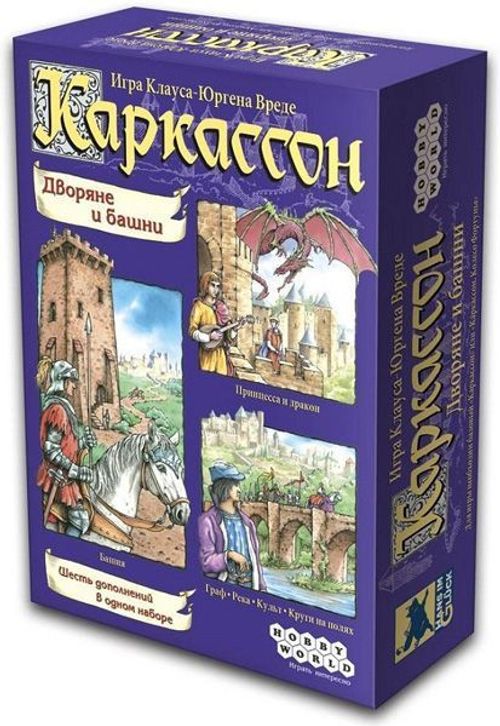
Carcassonne: Nobles and Towers (Russian Edition)
Rulebook PDF: Hobby World (ООО «Смарт») · PDF
Carcassonne: Nobles and Towers (Russian Edition) Rulebook
Table of Contents
Table of Contents
The Tower
The rivalry among the noble lords for the fertile lands of Carcassonne grows stronger. You can now build multi-level watchtowers in fields and cities to take enemy followers prisoner. But be careful: if one of your followers is captured, you will have to pay ransom for it or exchange hostages with your rival.
Components
- 18 landscape tiles marked with the Tower symbol
- 30 tower levels
Setup
Shuffle the landscape tiles of the basic Carcassonne game together with the tiles of this expansion. In addition to the normal followers, each player receives tower levels:
- 2 players: 10 levels each
- 3 players: 9 levels each
- 4 players: 7 levels each
- 5 players: 6 levels each
- 6 players: 5 levels each
Return any unused tower levels to the box; they are not used in the game.
New Tiles
New tiles are placed by the usual rules: field to field, road to road, city to city. Each new tile shows a tower site.
Tile illustrations from the rulebook:
- A road separates fields but not the city. This tile has one road section, one city section and four field sections.
- A road leads to the city without ending in it. The field is divided into three sections by the city walls and the road.
- A tower divides the road into two sections. (Tower site marked on the tile.)
Gameplay
At the start of his turn, a player draws a tile and places it by the usual rules. Then, instead of placing a follower on this tile, he may use one of the following special actions:
- place one of his tower levels on any tile with a tower site, either the tile just placed or one placed earlier;
- add his tower level to any tower already begun;
- place a follower from his supply on any tower already begun, thereby completing it.
Placing a Tower Level and Taking a Prisoner
Whenever a player places a new tower level (starting a tower or building it up), he may immediately take one follower (a normal follower, a Big Follower, a Mayor or a Wagon) prisoner. The player takes the prisoner from the tile on which it stands and places it in front of himself. Pigs and Builders are not followers, so they cannot be taken prisoner. However, if a player's last follower on a road, in a city or in a field is taken prisoner, that player must return to his supply the Builder or Pig from the feature that has been left without his followers.
Exception: followers in castles (from the "Bridges, Castles and Bazaars" expansion) and on special boards (Carcassonne or Wheel of Fortune) cannot be taken prisoner with a tower.
The followers that may be taken prisoner depend on which tower level the player has built. When a player starts a tower (places the first level), he may take a prisoner from any of five tiles: the tile directly under the tower and the four tiles adjacent to it, vertically and horizontally (see the illustration). When a player places the second tower level, he may take a prisoner from any of nine tiles (see the illustration at lower right), and so on. A tower may consist of any number of levels.
Illustration: the red player begins a new tower and takes the blue follower from tile 4 prisoner.
With each new level the player adds four tiles to the area from which he may take prisoners. In other words, the tower's influence extends to the tile beneath it and to as many tiles in each direction, horizontally and vertically, as the tower has levels. Empty spaces in the map and other towers do not limit this area of influence. For example, if in the illustration there were an empty space in place of tile 5, the red player could still take the yellow knight prisoner.
Illustration: the red player builds a second tower level and may take the green follower from tile 1, the blue follower from tile 6, or the yellow follower from tile 9 prisoner.
When a player takes his own follower prisoner, he returns it to his supply and may place it again on a later turn. When he takes another player's follower prisoner, he places it in front of himself. He may not use the other players' followers he has taken prisoner.
Placing a Follower on a Tower
When a player places a follower on a tower, its construction ends: no further levels may be added to it. Players use this action to secure the area around the tower for their other followers. A player cannot simply return his own follower from a tower to his supply, but such a follower may still be taken prisoner by another tower, expelled by the dragon ("The Princess and the Dragon" expansion), and so on.
Prisoners
Players must exchange prisoners at the first opportunity, without any negotiation or deal. As soon as two players hold each other's followers as prisoners, they must exchange them. If one player holds several of the other player's followers, the owner of those followers chooses which one returns to him. Players always exchange followers one for one, regardless of the type of follower.
In addition, on his turn a player may buy one follower back from the prison of one opponent. The player chooses one follower held prisoner, pays its captor 3 victory points (moving his own marker back 3 spaces on the scoring track and the opponent's marker forward 3 spaces), and takes the follower into his supply. A player with fewer than three victory points cannot buy back a prisoner. A player may make this purchase at any moment of his turn, but it is best done before placing followers, since the bought-back follower can be placed immediately on a tile.
The Princess and the Dragon
A dragon descends on the lands of Carcassonne, and the townsfolk flee in fear at the sight of a winged shadow. Only with the help of the fairy can your knights, peasants, monks and robbers stand up to the monster. A beautiful princess turns the heads of the knights, making them abandon their service, and magic portals allow your subjects to appear in the most unexpected places.
Components
- 30 landscape tiles marked with the Princess and Dragon symbol
- 1 dragon token
- 1 fairy token
Setup
Shuffle the landscape tiles of the basic Carcassonne game together with the tiles of this expansion. Set the fairy and dragon tokens aside; they enter the game during play.
New Tiles
New tiles are placed by the usual rules: field to field, road to road, city to city. Each new tile shows one of four symbols: volcano, dragon, portal or princess. What happens when a player places a tile with one of these symbols is described in detail below.
Volcano (6 tiles)
When a player draws a volcano tile, he places it by the usual rules and immediately moves the dragon onto this tile. No other tokens (followers, builders, pigs) may be placed on the tile with the dragon.
Dragon (12 tiles)
When a player draws a dragon tile, he places it by the usual rules and gains the right to place a follower on it (or to use an alternative action, such as moving the fairy). The game is then paused and the dragon's flight begins. Note that this happens before points are scored.
Each player, starting with the player who has just placed the dragon tile and continuing clockwise, moves the dragon token from the tile it occupies to any adjacent tile horizontally or vertically (not diagonally!). Regardless of the number of players, the dragon always takes 6 steps, flying 6 tiles away from its starting position (except when it reaches a dead end). During a single flight the dragon may not enter the same tile twice; keep track of where it has already been. In addition, the dragon may not enter a tile with the fairy (see below), nor special tiles printed on the Carcassonne or Wheel of Fortune boards.
Whenever the dragon lands on a tile with a follower, pig or builder, the owner of that token returns it to his supply. This also applies to followers standing on towers (from "The Tower" expansion), but followers in castles (from the "Bridges, Castles and Bazaars" expansion) are protected from the dragon. If the dragon causes a player to lose his last follower on a road, in a city or in a field, he must also return to his supply the builder or pig from the feature that has been left without his followers (even if the dragon did not reach the tile with the builder or pig). When the dragon's flight is complete, the game continues from the point where it was paused.
Note: if the dragon enters a tile with two followers (possible when one of them stands on a tower), both followers are returned to their owners' supplies. The dragon does not destroy bridges, barns or towers.
Dead end: if the dragon enters a tile from which it cannot continue its flight without breaking the rules, the flight ends immediately.
Important: the dragon does not enter the game until the first volcano tile is drawn. If a player draws a dragon tile while the dragon is not yet in the game, he sets that tile aside and draws another tile instead. As soon as the first volcano is drawn, place the dragon token on it, shuffle all the set-aside dragon tiles back with the other face-down tiles, and continue the game.
Example of a dragon flight. Four players are playing. The dragon is in the lower right corner of the map. Anna places a dragon tile. After placing a follower, she starts the dragon's flight by moving it one tile up. Next, Boris acts: the dragon flies left. Vera moves it down, and Gennady must send it left, since the tiles to the right and above have already been visited by the dragon. Anna also has no choice: the dragon flies up. Finally, Boris moves the dragon up again. The flight is over. The blue and red followers return to their owners.
Portal (6 tiles)
When a player draws a portal tile, he places it by the usual rules and may then place a follower (including a Big Follower, a Mayor or a Wagon) either on this tile or on any other tile that was previously attached to the map. All other placement rules still apply: a follower may not be placed on an already occupied or completed feature, nor on a special tile printed on the Carcassonne or Wheel of Fortune boards. If a player gives up placing a follower in favour of an alternative action (such as moving the fairy), the portal does not give him the right to place a follower in addition.
Princess (6 tiles)
When a player draws a princess tile, he places it by the usual rules. If the city section marked by the princess is joined to a city containing one or more knights, the player may return one follower of his choice (including a Big Follower, a Mayor or a Wagon) from that city to its owner's supply. In this case the player may not place a follower on this turn, nor use an alternative action (such as moving the fairy). If, because of the princess, a player loses his last knight in a city, he must also return to his supply the builder from that city.
If the player does not use the princess ability, he may place a follower on the tile he has just played, by the usual rules.
Note: towers and monasteries are not considered part of a city, even when they stand inside its walls. Followers on such towers and in such monasteries are not affected by the princess.
Other Tiles
A monastery and a city are different features. When placing a follower on such a tile, you must clearly show where you place it. You may place a follower in a monastery even if the city is already occupied. And conversely: if you place a monk in a monastery, a knight may later appear in that city. A monk in such a monastery is not counted as a knight and is not taken into account when determining the owner of the city. A monastery is completed as soon as it is surrounded by eight tiles, even if the city is not yet completed.
A tunnel does not divide a road. This tile has one road section, one city section and two field sections (above and below).
The Fairy
Like the dragon, the fairy is a neutral token that begins the game outside play. On his turn, instead of placing a follower, a player may move the fairy onto any tile with one of his followers (even if that follower stands on a tower). The fairy has three properties:
- The dragon may not enter a tile with the fairy: a follower on such a tile is protected.
- If at the start of a player's turn the fairy is on a tile with that player's follower, the player immediately gains 1 point. This does not happen at the start of an extra turn that a player may get with a builder (from the "Traders and Builders" expansion).
- When a feature (city, road, monastery or field) on which a follower stands with the fairy scores points, the owner of that follower receives an additional 3 points (in addition to the points for the feature itself). The additional points are awarded even if the player did not score points for the feature itself. Then the follower returns to its owner's supply, and the fairy remains on the tile.
The Count
The noble lords send their followers into the service of the Count of Carcassonne, hoping the powerful ruler of the city will help them in their disputes with rivals. But the Count does not forget his own interests: he may refuse to release your followers from the city if he judges that their service is not yet finished.
Components
- 1 Carcassonne board
- 1 Count token
Setup
Place the Carcassonne board in the middle of the table. This board replaces the starting tile: both the first and all later tiles may be placed edge to edge with any matching area drawn on the Carcassonne board. Any features on such tiles score points in the normal way. Return the starting tile of the basic Carcassonne game to the box; you will not need it.
The Carcassonne board shows four quarters: the palace, the church, the market and the smithy.
At the start of the game, place the Count token in the palace. If you are playing with "The River II", place the river in the usual way, with its source next to any suitable tile on the Carcassonne board. Lay the river so that it flows away from Carcassonne: if it begins to curl around the city walls, you may run into difficulties when placing tiles during the game.
Gameplay
When a player places a tile and completes one or more features in such a way that he does not score points himself, but gives at least one point to any opponent, at the end of his turn he may send one follower from his supply to any quarter of Carcassonne (in addition to the normal placement of a follower on the tile just placed). No matter how many opponents score points because of the placed tile, a player may send only one follower to Carcassonne per turn. The player must clearly show in which of the four quarters of Carcassonne his follower stands. Any number of followers of any players may stand in each quarter. A player may send to Carcassonne any follower: a normal follower, a Big Follower (from "Taverns and Cathedrals"), a Mayor or a Wagon (from "Abbot and Mayor").
Note: when taking an extra turn with a builder (from "Traders and Builders"), a player receives the right to send a follower to Carcassonne on that second turn as well (provided that turn also gives points to an opponent and none to him).
A follower sent to Carcassonne may be used on one of the following turns, when any feature is completed (including an unowned one). After a feature is completed, but before its owner is determined, all players have the right to move followers from the appropriate quarter of Carcassonne onto the completed feature, provided the Count is not in that quarter:
- followers from the palace may move into a city;
- followers from the smithy may move onto a road;
- followers from the church may move into a monastery;
- followers from the market may move onto a field (only at the end of the game; see below).
The player to the left of the player whose turn it is moves first. He may move any number of his followers from the appropriate quarter of Carcassonne onto the just-completed feature. Then the other players, clockwise, each get the same opportunity, ending with the player whose turn it is. Then the owner of the completed feature is determined (all special properties of special followers from the expansions, such as the Mayor or the Big Follower, remain in effect), points are awarded for it, and all followers on that feature are returned to their owners' supplies.
Note: because followers are moved out of Carcassonne, several followers of one or different players may end up on the same tile. All of them count when determining the owner of a feature. If this happens with a monastery, its owner is the player who has more followers in that monastery (counting a Big Follower as two ordinary followers).
Followers that the owner decides not to move out of Carcassonne onto the completed feature remain in the quarter where they stood. At the end of the game, followers remaining in Carcassonne do not score points.
The Count
When a player places a follower in Carcassonne, he may move the Count to any of the four quarters of the city. Players may not move followers out of the quarter where the Count stands.
Example: a city has just been completed, but the Count is visiting the palace, so no player may send their followers from the palace into the completed city.
Followers remain in their quarter until the Count leaves it. The Count always stands in one of the four quarters: he cannot leave Carcassonne.
End of Game and Final Scoring
Immediately before final scoring (after the turn on which the last tile is added to the map), players receive a final opportunity to move their followers out of Carcassonne. Note that followers from the market are moved onto fields only at this stage of the game. As usual, players may not move followers out of the quarter in which the Count stands.
Starting with the player to the left of the player who made the last move and continuing clockwise, players move one follower at a time from the quarters of Carcassonne onto the appropriate features. Followers from the market move onto any fields, and followers from the palace, the smithy and the church move onto any unfinished cities, roads and monasteries respectively. Players continue to move followers as long as they wish and are able to do so (this may take several rounds). Then final scoring takes place.
Note: before final scoring, a player may move a follower from the market onto a field with a barn (from "Abbot and Mayor"). Such a follower immediately gives its owner 1 point for each city bordering the field, and returns to the supply (it does not remain on the field until final scoring).
For final scoring, Carcassonne counts as a completed city.
The River II
Components
- 12 river tiles marked with the River II symbol
Setup
Remove the starting tile of the basic Carcassonne game; you will not need it. Do not mix the 12 new river tiles with the others. Instead, find the river source, the river fork and the volcano lake among them and set them aside. Shuffle the remaining 9 river tiles into a separate face-down stack. Place the river source in the middle of the table.
Illustrations: source, fork, volcano lake.
Choose the first player. He places the river fork tile next to the source, continuing the river. Following him, the players clockwise each draw and place one river tile, continuing either branch of the river. After placing a river tile (including a fork), a player may place one of his followers on it by the usual rules. Followers are not placed on the river itself.
When laying the river, observe two additional rules:
- two branches of the river may not merge into one;
- the river may not turn back 180 degrees (in other words, it may not make two right turns or two left turns in a row).
If you cannot place a river tile by these rules, discard it and draw another.
When all the river tiles are on the table, the next player places the volcano lake tile. No follower may be placed on this tile, but immediately afterwards the same player takes one more turn: he draws a tile from the normal stack, places it, and may place a follower on it. Then the game continues as usual.
New Tiles
Pig herds on a field increase its value. When scoring, the owner of such a field receives 1 extra point for each city bordering the field (4 points per city, or 5 points per city if the field holds his pig from "Traders and Builders").
A pig herd does not increase the value of a field at final scoring if a barn (from "Abbot and Mayor") stands on it.
The tavern by the lake increases the value of a road under the rules of "Taverns and Cathedrals", if you are playing with that expansion.
If you are playing with "The Princess and the Dragon", the dragon flies onto this tile immediately after it is placed.
The Cult
Components
- 5 landscape tiles marked with the Cult symbol
Setup
Shuffle the landscape tiles of the basic Carcassonne game together with the tiles of this expansion.
New Tiles
New tiles are placed by the usual rules: field to field, road to road, city to city. All the new tiles show a shrine. When a player places such a tile, he may place one of his followers in the shrine (or on any other free feature on that tile). A follower in a shrine becomes a heretic. A shrine is completed as soon as it is fully surrounded by other tiles (in the same way as a monastery). A completed shrine gives its owner 9 victory points.
Next to each shrine (on an adjacent tile horizontally, vertically or diagonally) there may be no more than one monastery, and vice versa. Keep this in mind when placing shrines and monasteries.
If a player places a shrine tile next to a monastery holding another player's monk (horizontally, vertically or diagonally), and places his heretic in that shrine, the shrine and the monastery enter a rivalry. A rivalry also begins in the reverse situation: when one player's monk appears next to another player's heretic.
In a rivalry, the one of the two features (shrine or monastery) that was completed first wins. It gives victory points to its owner as usual. Then the followers from both rival features are returned to their owners' supplies. The feature that lost the rivalry does not score points for its owner.
If a rival monastery and shrine are completed at the same time, both count as winners and score points for their owners. Rival monasteries and shrines that are not completed by the end of the game score points by the usual final scoring rules.
Note: abbeys (from "Abbot and Mayor") count as monasteries, and all the rules concerning the adjacency and rivalry of shrines and monasteries apply to them.
Apart from the differences described above, shrines (heretics) follow the same rules as monasteries (monks). For example, a follower from the church quarter of Carcassonne may be moved either into a monastery or into a shrine.
Illustrations: a road ends at the shrine. (Tile with the shrine: a shrine divides the road into two sections. In addition, this tile has two field sections, which are not connected through the shrine.)
The Corn Circles
Components
- 6 landscape tiles marked with the Corn Circles symbol
Setup
Shuffle the landscape tiles of the basic Carcassonne game together with the tiles of this expansion.
New Tiles
New tiles are placed by the usual rules: field to field, road to road, city to city. Each new tile shows a circle in a field, of one of three kinds: pitchfork, club or shield.
Illustrations: a crossroads divides the road into three sections. A road ends at a corn circle in a field.
Gameplay
When a player draws a tile with a corn circle, he places it by the usual rules, gains the right to place a follower on it, and scores points for all features completed by this tile. He then chooses one of two special actions:
- A) place a follower from his supply on a tile where a follower of his own already stands, or
- B) take a follower from a tile back to his reserve.
After the player who placed the corn circle tile has chosen one of these actions, all players carry out that action, clockwise, starting with the player to his left and ending with the player who placed the tile.
The kind of circle in the field determines which followers the chosen action affects:
- the pitchfork affects farmers in fields;
- the club affects robbers on roads;
- the shield affects knights in cities.
When carrying out action A, the player must place a new follower on the same section of the same tile where his follower of the matching kind already stands (farmer on farmer, robber on robber, knight on knight).
If, because of action B, a player loses his last follower on a road, in a city or in a field, he must return to his supply the builder or pig from the feature that has been left without his followers.
If a player has no followers that the corn circle would affect, he passes the right of action to the next player immediately.
After the player who placed the corn circle tile has carried out the chosen action, the game continues by the usual rules.
Examples of the Corn Circle Actions
-
The red player places a tile with a shield-shaped corn circle, places a follower on it and chooses action A. Now each player places a follower from his supply onto any tile where he has a knight.
-
The green player places a knight next to the one placed earlier.
-
The blue player has no knights, so he skips this action.
-
The red player decides to place a knight on the same tile he has just placed. He cannot add a follower to the city in the upper part of that tile, since he has no knight there. He could have placed a knight in the city in the upper left corner of the map.
-
The green player places a tile with a pitchfork-shaped corn circle, places his follower, scores 6 points for the completed city and removes his knight. Then he chooses action B: each player must take back one farmer.
-
The blue player takes his farmer back to his supply.
-
The red player does the same.
-
The green player has no farmers in play, so this action does not affect him.
Tile Holder Tower
The cardboard tile tower consists of three parts. Assemble it as shown in the illustration (assembly instructions are omitted from this translation). We recommend keeping the tower assembled.
During play you may use the tower as a holder for landscape tiles. Shuffle the tiles at the start of the game and fill the tower with them. You may draw tiles from the top or the bottom of the stacks; the first option is preferable, so that the stacks do not fall apart.