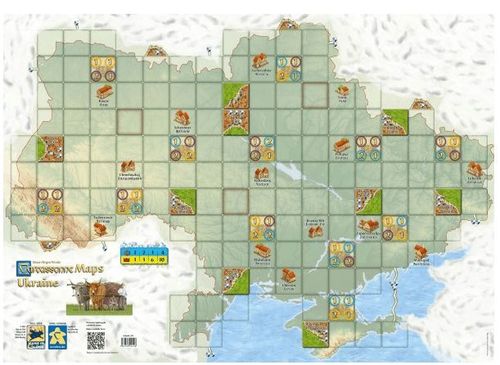
Carcassonne Maps: Ukraine
Carcassonne Maps: Ukraine Rulebook
Table of Contents
Table of Contents
Components
- 1 Carcassonne Map. In addition, you need:
- Tiles | We recommend playing with the base game tiles and the first and second expansion. Of course, you can combine everything you want to try. For each map there is a recommendation of a number of tiles you could use. It is better to play without the additional rules and meeples of the expansions and to use only the tiles.
- Meeples | If possible, every player should use 9 instead of 7 meeples (+1 meeple on the scoring board).*
* If you need additional meeples, you'll find everything you need in our webshop cundco.de
Overview
There are several start-squares on each map. On each square there is a small town and they are with a red edging. You should start with at least 2 start-squares. Take the starting tile (with the darker backside) and one or 2 random tiles and place all of them on 2 to 3 start-squares. You start your game by placing your first tile next to these tiles.
If you play after the base game rules and without the Maps-Chips expansion rules, you simply ignore the additional prints on the maps (e.g. the wine bottles on the France Map, the colored lines on the Ibérica Map, Islands on the Benelux Map, etc.). The general rules stay the same, and some new rules are added.
(Note: to make it easier to read we will be using the words large city and town even if those words do not always represent reality.)
General Rules
1. Placing a Land tile
You're only allowed to place a tile on a preprinted square. As usual, you have to place a tile next to an already placed one.
Large Cities
On squares with printed large city tiles (Berlin, London, Paris, Amsterdam or Barcelona) you cannot place tiles. As soon as you place a tile next to a city tile it is connected. From now on, everybody can place a tile next to the city tile.
Towns
Squares with towns (with a small house, for example Bremen, Bordeaux, Oxford, Strasbourg, Utrecht, Salamanca,...) count as normal squares. You are allowed to place tiles according to the general rules. On some Maps the rules for these tiles differ. You find some variants on page 3. (Printed as "page 3"; the variants are in the Variants section below.)
Border squares with adjacent city or road
Wherever there are cities or roads printed on the "border" of the map you have to place a compatible tile.
Border squares without connection
The "border" of the map is neutral which means that you are allowed to place your tile the way you want if there are no preprinted cities or roads. In this case, it doesn't matter how you place your tiles (with regard to the border).
Ferry routes
If you have connected a ferry route with a road, everybody is allowed to continue this connection on the other end of the road.
2. Placing a Meeple
After having placed a tile you are allowed to place a meeple according to the general rules.
3. Scoring a feature
A coat of arms gives you 2 additional points in each scoring no matter if it is part of a road or a city.
1. Large Cities
If you complete a large city you score according to the general rules. Preprinted large city tiles are scored in the same way as a normal city tile. Coats of arms give bonus points.
2a. Border squares with adjacent city or road
Roads which end on the border are automatically completed there. Preprinted roads or cities are scored as normal tiles. Coats of arms give bonus points.
2b. Border squares without a connection
A city, road or field placed on the border (next to clouds or the sea) is seen as completed. You score them according to the normal rules.
3. Ferry Routes
A ferry route gives you 1 point for the road plus the coats of arms on this connection. They are scored when the road is completed.
4. Monastery on the border
To complete and score a monastery on the border it isn't necessary to place 8 adjacent. Only the surrounding squares (also the diagonal ones) have to be filled with tiles. However, only "real" tiles as well as preprinted large cities are scored.
Final scoring
As usual, city tiles and coats of arms of cities or roads which haven't been completed score only 1 point each. Coats of arms of uncompleted roads which end in neighboring countries also score 1 point.
Variants
Towns
You can try to use the following additional rules for the town squares:
a) Placing a tile on top of a town grants you one instant extra tile which has to be placed immediately. This can only be done once within one draw.
b) Placing a tile on top of a town costs two points.
c) When scoring a road, you get 2 bonus points for each town which is still visible and touches your road (horizontally or vertically).
Carcassonne Maps: Ukraine
With this mini-expansion you'll trade like the Chumaks once did and score points. The Chumaks visited different tribes and always brought news, stories and customs along with their goods. Through this common culture and values formed among the inhabitants of the territory of modern Ukraine.
Game materials
30 map-chips (10 each in purple, light blue, orange). You can get the map-chips at www.cundco.de/en/accessories.
We recommend you to play with 115 – 125 tiles (e.g. from the BigBox: Base game (72) + 1. exp. (18) + 2. exp. (24) = 114 tiles).
Game setup
Use 2 of the 3 possible starting slots of your choice. Mix all 30 chips face down. Then place them next to the map as your supply.
Gameplay
The rules of the Carcassonne base game still valid. If you have never played a Carcassonne map, first read the basic rules for the maps: www.cundco.de/Spielregeln/CC-Maps/.
1. Place a land tile
Collect chips
When you place a tile next to a Chumak-square vertically or horizontally, you immediately get 1 or 2 chips from the chip supply and place this chip(s) face down in front of you. You may look at your chips in front of you at any time.
- If a road leads to the Chumak-square, you get 2 chips.
- If you place a tile with the meadow or city side to a Chumak-square, you get 1 chip.
Build on a Chumak-square
If you build on a Chumak-square with a matching tile, you immediately get as many points as the sum of the numbers of all chips lying there (To find out how the chips are placed on the tile, see 3. Triggering a scoring).
Then remove these chips, place your tile on the field and mix the chips back into the supply, face down.
2. Placing a Meeple
After you have placed the tile, you may place a meeple on it according to the usual rules.
3. Triggering a scoring
Trading
If you do not use a meeple on your turn, you may trade instead. You place 1 to 4 matching chips on a free chip space on any Chumak-square. Chip spaces can already be occupied there.
- Each Chumak-square has 4 chip spaces. The more chips you place at once, the more points you get from the trade immediately. The small table on the map will give you an overview.
- If you place 1 chip, you get 1 point.
- If you place 2 chips, you get 3 points.
- If you place 3 chips, you get 6 points.
- If you place 4 chips, you get 10 points.
End of the game and final scoring
Any unused chips will not give you any additional points at the end of the game.