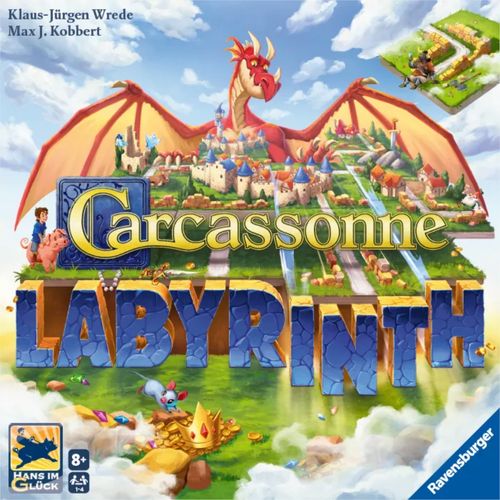
Carcassonne Labyrinth
Carcassonne Labyrinth Rulebook
Table of Contents
Table of Contents
Components
- 1 game board
- 4 meeples in 4 colors
- 4 crowns in 4 colors
- 4 starting tiles (dark back)
- 56 land tiles (light back)
- 32 treasure tiles, 8 in each of the 4 colors
- 32 treasure tokens
- 38 shield tokens
- 1 treasure card and 1 shield card
- 12 quest cards
- 1 player aid
- 1 measuring strip
Learn everything about the base game here. Already played a few times? Try the advanced game! The rules for the single-player game are also included. The single-player base game makes a great tutorial for learning the rules.
Game Setup
-
Place the game board in the middle of the table.
-
Shuffle the 56 land tiles (light back), without looking at them. Randomly select 16 of them and place them face up in the spaces on the game board.
Note: The tiles can face any direction on the game board. The landscape shown doesn't need to fit into the labyrinth.
-
Take land tiles for each player from among the remaining land tiles (light back), according to the number of players (see chart below). Place them face down next to the game board as a general supply pile. This is now the draw pile. Return any remaining land tiles to the box.
Players Tiles 1 10 2 20 3 30 4 40 -
Each choose a color and place the corresponding meeple on the dragon tile at the center of the game board.
Now carry out all of the following steps:
- Shuffle the eight treasure tiles in your color and place them face down in front of you in a pile. This is your treasure tile pile.
- Place the crown in your color next to it. It serves as your tile holder. Take the top treasure tile from your pile. Place it on your crown so that only you can see the treasure you're seeking.
- Take a starting tile (dark back) and place it face up in front of you. It forms the start of your personal landscape.
- Lay the shield card ready next to the game board and place all of the shield tokens on it. Put the treasure card next to it with all of the treasure tokens on it. These are your supply piles.
- Pick the Most Shields (1A) crown quest from among the quest cards. Place it next to the other cards with the side for 2–4 facing up. Then lay the player aid within reach.
Rules (2–4 Players)
The last person to get lost starts; play then continues in a clockwise direction.
When it's your turn, first check which treasure is shown on the treasure tile on your crown. This is the treasure you're seeking.
Then complete the following four actions in this order:
- Insert land tile (required)
- Move and find treasure (optional)
- Extend landscape (required)
- Complete cities and roads (optional)
Then, it's the next player's turn.
1. Insert a Land Tile
Move labyrinth tiles to create a path for your meeple to reach the treasure you seek.
To do this, you must take the topmost tile from the draw pile and place it anywhere in the labyrinth.
Turn the tile any way you want first. The arrows around the edge of the game board show where it can be inserted. Insert the tile so that exactly one land tile is pushed out on the other side of the labyrinth.
If you push your own or someone else's meeple out of the labyrinth, you must immediately place it on the road on the land tile you just inserted on the other side. Note: This doesn't count as a move (see Action 2).
Important: You must insert a land tile during your turn (even if you can reach the treasure you seek without doing this)!
Note for experienced Labyrinth players: You can also insert the land tile where a tile was pushed out in the last turn.
2. Move and Find Treasure
After shifting the labyrinth, you may move your meeple along the labyrinth's roads. You can move onto any tile that you can reach via connected roads. You can also move through forests (e.g. at crossroads). However, you can't move through or onto cities or meadows.
You can move as far as you like and also pass other meeples, stopping on a tile of your choice. It doesn't matter if there's already a meeple there. You can also decide not to move your meeple.
Important: Once you stop moving, you can't move again in this turn.
Finding Treasure
Has your meeple ended its move on the tile depicting the treasure you seek? Great, then you've found it!
Important: You only find the treasure when you end your move on the tile. As a reward, you can add this treasure tile to your landscape (more on this in Extend Landscape). Take it from your crown and lay it face up in front of you.
Then, place the top tile in your treasure tile pile on your crown. It shows the next treasure you must seek.
3. Extend Landscape
Now you must add the land tile you just pushed out of the labyrinth to your landscape.
If you also received a treasure tile, add it now, too. You're free to choose the order you add the tiles in.
Important: You must observe the following rules when adding tiles:
- You can turn the tile any way you like.
- The tile must fit next to at least one tile in your landscape.
- "Fit" means here that on all adjoining sides, a road leads into a road, a meadow into a meadow, or a city into a city.
Special situation: If your tile doesn't fit into your landscape, you must return the tile to the box. You don't receive another tile in its place.
Note for experienced Carcassonne players: A road is shown on almost all of the tiles. Keep this in mind when planning your landscapes!
4. Complete Cities and Roads
Add tiles to complete the cities and roads in your landscape.
A city is complete when it is entirely enclosed by walls so there aren't any "gaps" in it.
A road is complete if all ends lead into a city or forest. It is also complete if it forms a self-contained circular route.
Shield and Treasure Tokens
Once you've completed a city or road, check whether any treasures and/or shields are shown in it.
Then, place one shield token from the supply pile on each shield in the city or next to the road. Place a treasure token on each treasure.
You can complete several cities and roads during your turn.
Note: Place just one token on each shield or treasure shown.
End of the Game
The game ends after the turn when the draw pile is emptied. At this point, you will all have had exactly ten turns.
Now check who has won. Do as follows:
- Crown quest. First, count which of you has collected the most shield tokens in your own landscape. There's a reward for this. Learn more about this in the Fulfill Quests rules below.
- Form a tower. Now stack all of the tiles and tokens from your own landscape to form a tower. Begin with your starting tile, land tiles and treasure tiles, then add the shields and treasure tokens you've collected on top. Set aside any treasure tiles remaining in the treasure tile pile and in the crown.
- Add your meeple or crown. Finally, place your meeple on top of your pile. Whoever fulfilled the crown quest (1) places the crown on their pile instead of their meeple. In the event of a tie, all of the tied players do so.
Now compare the height of all piles including the meeple or crown. The player with the highest tower wins! If there's a tie, then all of the tied players win.
Single-Player Tutorial
Have you now read the rules and want to try playing alone? Try the single-player game as a tutorial!
The rules for the single-player game are the same with the following differences:
Variations to the Rules
When setting up the game, instead of point 9, place your chosen crown quest next to the other cards with the side for 1 facing up. The value with this symbol applies.
Variations to the End of the Game
You may add your crown if you collected at least seven shield tokens in your landscape.
After forming your tower, place the measuring strip alongside your pile with the 7+/12+ symbol showing. It shows how well you did!
Advanced Game (2–4 Players)
The rules for the base game (2–4) are the same, with the following variations:
Variations to the Game Setup
In the advanced game, you can choose from different quests and crown quests. First, select a scenario from the chart:
| Scenario | Crown quest | Quests |
|---|---|---|
| 1. Cities and Roads | 1A: Most Shields | 4A + 5B |
| 2. Harmonious Balance | 2A: Most Cities | 4B + 6A + 7A |
| 3. Long Distances | 3A: Most Roads | 7B + 8A + 9A |
| 4. Square Circles | 1A: Most Shields | 6B + 9B + 10A |
Note: Each quest is described in detail under Quest Cards below.
- Place the crown quest for your chosen scenario next to the other cards with the side for 2–4 facing up.
- Put two or three quests next to the other cards, depending on the scenario.
Free scenario: Try combining quests into new scenarios! Take one crown quest and three quests of your choice, or choose them at random.
- Place shield markers from the supply pile on the spaces for each quest. Note the number of shield markers indicated for each space.
Variations to the Rules of Play
In addition to the four actions, the advanced game includes another action:
- Fulfill quests (optional)
5. Fulfill Quests
Check whether you've completed one or more quests during your turn. If so, take all of the shield tokens on one space of the completed quest card.
If there are different numbers of shield tokens on the spaces of the quest card, take the one with the most. Then, add it to your landscape on the space below the statue shown on your start tile.
Important: If there aren't any more shield tokens on a quest card, you don't receive any shield tokens for fulfilling the quest.
You can fulfill quests more than once. You must entirely meet the requirements again for this, though. You can't use a road or city more than once for the same quest.
Note: For example, if a quest requires five completed cities, you must complete a total of ten cities to fulfill this quest twice. So to fulfill quests 9A, 9B and 10B again, you cannot use any tile twice.
In the advanced game, the shield supply may run out at some point. If you then complete a city or road with a shield, you may take the shield token from any space on a quest card of your choice instead.
Note: Don't take the whole pile, but rather only the exact number you receive for completing it.
Variations to the End of the Game
If you're playing with the crown quest of Most Cities (2A) or Most Roads (2B), the crown is awarded for having the most cities or roads, rather than for the most shield tokens. Check who won the crown quest at the end of the game. In the event of a tie, all tied players may place their crown.
Advanced Single-Player Game
The rules of the advanced game apply with the following differences:
Variations to the Game Setup
When setting up the game, place the crown quest of Most Shields next to the other cards with the side for 1 face up.
Variations to the Rules of Play
5. Fulfill Quests (optional)
Did you fulfill one or more quest cards during your turn? If so take all of the shield tokens from the completed quest card from the space with the fewest shield tokens. You must first select this space. If you complete the quest again, take the shields from the space that now has the fewest.
Note: You must complete the quest again to receive any more shield tokens.
Variations to the End of the Game
For the most shields card (1B), the value is 12+. After forming your tower, place the measuring strip alongside your pile with the advanced 7+/12+ side showing. It shows you how well you did!
Quest Cards
Crown Quests
All crown quests relate to things in your landscape. Cities and roads must always be completed.
- Most Shields (1A) — You have the most shield tokens. Single-Player Game: 7+/12+ Shields (1B) — You have at least seven/twelve shield tokens.
- Most Cities (2A) — You have the most cities. Single-Player Game: 5+ Cities (2B) — You have at least five cities.
- Most Roads (3A) — You have the most roads. Single-Player Game: 5+ Roads (3B) — You have at least five roads.
Quests
- City Size 3 (4A) — Complete a city that comprises exactly three tiles.
- City Size 4 (4B) — Complete a city that comprises exactly four tiles.
- Road Length 3 (5A) — Complete a road that comprises exactly three tiles.
- Road Length 4 (5B) — Complete a road that comprises exactly four tiles.
- Convert Starting Tile (6A) — Fill all eight of the spaces around your starting tile with tiles.
- 4x4 Grid (6B) — Add a grid of four vertical and four horizontal tiles to your landscape. Don't leave any gaps.
- Run to the Dragon (7A) — Move your meeple in the labyrinth to the tile with the dragon in the middle and end your turn there.
- Push Your Meeple Out (7B) — Push your own meeple out of the labyrinth. Place it on the newly inserted tile.
- City Without Treasure Size 5+ (8A) — Complete a city comprising at least five tiles. No treasure may be shown in the city.
- Road Without Treasure Length 5+ (8B) — Complete a road comprising at least five tiles. No treasure may be shown on the road.
- Four Tiles with Shields in a Row (9A) — Have four tiles with shields in a row in your landscape. They may run vertically or horizontally. It doesn't matter if there are shield tokens on it.
Promo Content
Dragon Treasure
While setting up the game, after step 5, shuffle the Dragon Treasure tile in your chosen color into your treasure tile pile. During step 7, add the treasure marker with a dragon to the other treasure markers.
You now have an additional treasure to collect. If you draw the Dragon Treasure tile, you must move to the dragon at the center of the labyrinth.
If you succeed, you can add the treasure tile to your landscape, as usual.
If you complete a city with the dragon, you can place the corresponding marker on it as usual. It is particularly strong, as it is thicker than the other markers.
Promo Crown Quests
All crown quests relate to things in your landscape. Cities and roads must always be completed.
- Largest City (P1A) — You have the largest completed city (most tiles). Single-player: 9+ City (P1B) — Complete a city that comprises at least nine tiles.
- Longest Road (P2A) — You have the longest completed road (most tiles). Single-player: 9+ Road (P2B) — Complete a road that comprises at least nine tiles.