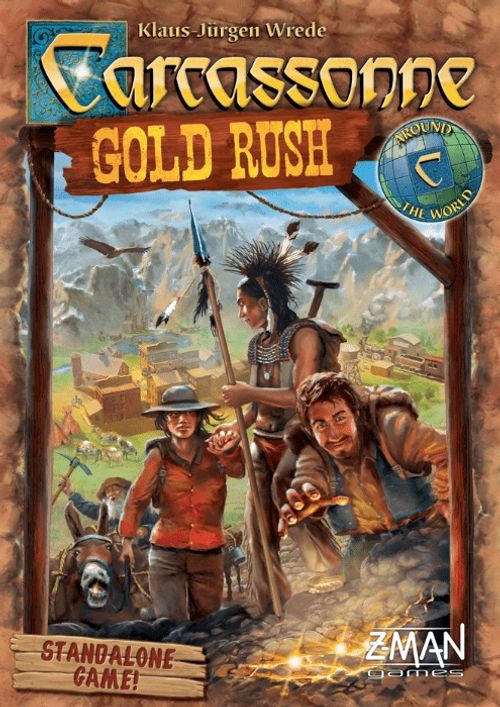
Carcassonne: Gold Rush
Carcassonne: Gold Rush Rulebook
Table of Contents
Table of Contents
Components
- 72 Land tiles (including 1 start tile with a unique back): The tiles show railroad tracks with locomotives, mountains with nuggets, prairies with Native American tipis and herds of horses, and western cities. The symbols on the tiles represent: locomotives, gold nuggets, tipi camps, wild horses, junctions, railroad tracks, mountains, cities, and prairies.
- 25 cowboys (5 in each of the 5 colors): Cowboys are used as gold miners, railwaymen, merchants, and farmers. One cowboy of each color is used as a scoring marker.
- 5 tents (1 in each of the 5 colors): Tents are used to set up camp in the mountains and mine the gold within.
- 1 Scoreboard: Used to keep track of players' scores.
- 63 Mining tokens: These are placed on tiles during the game and "dug up" by the players. On the front they depict gold nuggets (1, 2, 3, or 5 points) or gravel (0 points).
- This rulebook.
Goal of the Game
The players take turns placing tiles. A landscape of prairies, mountains, cities, and railroads will be created, on which the players will place their cowboys in order to score points. Players will search for gold in the mountains, whether or not they have the claim to do so. Once all Land tiles have been placed and final scoring has been completed, the player with the most points is the winner.
Preparation
- The start tile is placed in the middle of the table. Place a Mining token facedown on the mountain. Shuffle the remaining Land tiles and place them in several facedown piles so that they are within easy reach of all players.
- The remaining Mining tokens are placed facedown within easy reach. Ideally, one player should be assigned to placing these tokens as they are needed.
- Each player takes 5 cowboys and 1 tent in their chosen color, placing one of their cowboys on space 0 of the scoreboard.
- The youngest player chooses who begins the game.
Playing the Game
The game is played in clockwise order from the start player. A player takes the following actions in the specified order:
- The player must draw a Land tile and place it according to the rules below (place Mining tokens when and where appropriate).
- a. The player may place a cowboy on the newly placed tile according to the rules below, OR b. The player may place/move her own tent on/to a mountain, OR c. The player may take a Mining token from the mountain where her tent is located. (A player may perform no more than one of the actions detailed in step 2. A player may also choose to take none of the actions detailed in step 2.)
- If, by the placement of a new tile, one or more railroads, mountains, or cities are completed, they are evaluated and scored.
Then, the next player plays his turn.
The rules contained within blue borders are the same as in the original Carcassonne game. Experienced players may skip these sections.
1. Draw and place a Land tile
A player must first draw a Land tile from one of the facedown piles. She may show it to all players (who may advise her of "good" placement opportunities), and then place it according to the following rules:
- The newly placed tile must be placed adjacent to at least one existing tile. Diagonal adjacency is not sufficient.
- Railroad tracks, mountains, and prairies must continue from this newly placed tile to existing adjacent tiles. In the rare case that a drawn tile cannot be legally placed, it is discarded from the game. The player draws a new Land tile to place instead.
Placing Mining tokens
When a player places a Land tile depicting a mountain segment, one or more Mining tokens are immediately placed facedown on that mountain. The number of Mining tokens to be placed is equal to the number of gold nugget symbols on the newly placed tile. For the sake of clarity, all Mining tokens on a given mountain should be kept in a single facedown pile.
To ensure you do not forget to place these tokens, it is recommended to assign this important task to one player.
2a. Place a cowboy
Once a player has placed a tile, she may place a cowboy. The following rules apply:
- Only one cowboy may be placed.
- The cowboy must come from her personal supply.
- The cowboy must be placed on the newly placed tile.
- The cowboy must occupy a single feature. As a railwayman, on a railroad; as a gold miner, on a mountain; as a merchant, in a city; or as a farmer, in a prairie. (For your first game, it is best to play without the farmers.)
- No other cowboy (of another player or your own) may be present on the railroad, mountain, or prairie on which you place your cowboy.
If a player has no cowboys in her supply, she must continue to place tiles on her turn even though she cannot place cowboys. Do not worry: cowboys return to their players' supplies when they are no longer needed on their respective railroads, mountains, and cities (further explained below, see Returning cowboys to their owners).
2b. Pitch a tent
Instead of placing a cowboy, a player may place her tent on the mountain segment of a tile, or move it from one mountain segment to another. The following rules apply:
- The mountain must not be completed.
- The mountain segment of the tile must be vacant (a cowboy may occupy another segment of the same tile).
- Cowboys and tents may still occupy other segments of the same mountain.
- The tent may occupy a newly placed tile or a previously placed tile.
- There is no functional difference between placing a tent from one's personal supply and moving a tent from one tile to another.
2c. Mine for gold
On a turn in which a player chooses not to place a cowboy (2a) or pitch a tent (2b), she may choose to take the topmost Mining token from the mountain where her tent is located. It does not matter which other cowboys and tents occupy that mountain, or who possesses the most cowboys on that mountain. The Mining token a player acquires is placed facedown in front of her. A player may view the value of her acquired Mining tokens at any time, but they will only be added to the player's score at the end of the game.
Attention: If, by the placement of a new tile, one or more railroads, mountains, or cities are completed, proceed to step 3 where these features will be evaluated and scored. Otherwise, the next player clockwise now begins their turn.
3. Evaluating and Scoring Completed Railroads, Mountains, and Cities
A completed railroad
A railroad is completed when its two ends terminate in junctions, cities, and/or mountains, or when it forms a complete loop. Completed railroads can vary greatly in length (few or many segments).
A player whose railwayman alone occupies a completed railroad scores points equal to the "length" of the railroad (number of tiles used). For example, a five-tile railroad is worth 5 points.
A completed railroad with locomotives
If there is exactly one locomotive on a completed railroad, the score for that railroad is doubled. If there are no locomotives, or two or more locomotives on a completed railroad, the score is not doubled.
The scoreboard
All players track their points with a cowboy on the provided scoreboard, with spaces marked 0-49. Should a player acquire 50 or more points in a game, she should lay her cowboy flat to indicate that they have completed a lap of the scoreboard. In this way, a cowboy lying flat on space 1 of the scoreboard indicates a score of 51 points.
Multiple cowboys on a completed railroad or mountain
Through clever tile and cowboy placement, multiple cowboys can occupy a single feature. When such a railroad or mountain is completed, the player who has the most cowboys in a given feature scores the points alone. In case of a tie, all tied players score full points.
A completed mountain
A mountain is complete when it is completely surrounded by prairies (has no open sides), and there are no gaps within. Completed mountains can vary greatly in size (few or many segments).
The player who has the most gold miners on a completed mountain first takes all Mining tokens that remain on the mountain, and then scores 1 point for each gold nugget symbol on that mountain.
In case of a tie, the Mining tokens are distributed among the tied players. The tied players take turns taking Mining tokens, starting clockwise from the current player, and continuing until all Mining tokens have been taken. Then, all tied players score full points for the gold nugget symbols on the mountain.
Tents have no effect on the majority, evaluation, or scoring of a completed mountain. A tent occupying a completed mountain is returned to its owner's supply.
A completed city
A city is complete when all railroad segments (3 or 4) emerging from that city are part of completed railroads.
The player whose merchant occupies a completed city scores 3 points for each completed railroad connected to that city.
Important: A railroad that starts and ends in the same city only adds 3 points to that city's value.
Returning Cowboys to Their Owners
After a railroad, mountain, or city is completed, the cowboys in those completed features are returned to their owners' supplies. These cowboys may be used on future turns.
Due to the sequence of a game turn, it is possible to place a cowboy and have it returned to you in the same turn. In order to do this, one must:
- Place a tile so that it completes a railroad, mountain, or city.
- Place a cowboy from their supply on the newly completed feature (it must not already be occupied by another cowboy).
- Score the completed feature.
- The cowboy is then returned to the player's supply.
The Prairies
(We recommend playing without farmers and prairie scoring for your first game.)
Unlike the other features, players only score points for their farmers in prairies at the end of the game.
Once a cowboy is placed on a prairie, becoming a farmer, it remains there until the end of the game. For this reason, farmers should always be laid flat on the prairies to remind players that they do not return like railwaymen, gold miners, and merchants. The boundaries of a prairie are formed by railroad tracks, mountains, and the edges of outer tiles. (Important for final scoring!)
Game End and Final Scoring
The game ends immediately after the turn during which the last Land tile is placed. Players proceed to final scoring, where they will score points for incomplete railroads, mountains, and cities. Players will also score points for farmers. Finally, the points from Mining tokens will be scored.
Scoring incomplete features
Mountains: First, all tents and Mining tokens are removed from the game. Then, the player(s) with the most gold miners on the mountain scores 1 point for each gold nugget symbol.
Railroads: The player(s) scores 1 point for each tile belonging to the railroad (locomotives have no effect).
Cities: The player scores 3 points for each completed railroad connected to the city.
After each feature is scored, return the cowboys to their corresponding supplies.
Scoring farmers
(We recommend playing without farmers and prairie scoring for your first game.)
The value of each prairie is determined by the number of tipi camps and wild horses occupying that prairie.
- Each tipi camp adds 2 points to the value of a prairie.
- Each herd of wild horses adds 4 points to the value of a prairie.
The player who has the most farmers in a given prairie scores a number of points equal to the value of that prairie. In case of a tie, all tied players score full points, as seen previously with railroads and mountains.
Scoring gold
All players flip over their Mining tokens and score 1 point for each gold nugget depicted on them. Mining tokens depicting gravel score no points.
The player with the most points is the winner. In case of a tie, the tied players enter a staring duel (or contest if there are more than two). The last cowboy to blink wins!
Overview of Land Tiles (72 Tiles) and Mining Tokens (63 Tokens)
The 72 Land tiles include the following distribution (some marked with an asterisk depict differing distributions of tipi camps and wild horses; one tile marked S is also the face of the start tile): tile counts of 7x, 4x, 5x, 4x, 6x, 4x, 2x, 5x (S), 1x, 3x, 3x, 2x, 5x, 2x, 2x, 5x, 2x, 3x, 3x, 1x, 1x, and 2x, totaling the 72 Land tiles.
The 63 Mining tokens are distributed as 10x, 30x, 10x, 3x, and 10x across their gold nugget/gravel values.
Scoring Overview
Features completed during the game:
- Railroad (railwayman) — 1 point per tile. Exactly 1 locomotive: 2 points per tile.
- Mountain (gold miner) — Mining tokens, and 1 point per gold nugget symbol.
- City (merchant) — 3 points per connected completed railroad.
- Prairie (farmer scoring) — 2 points per tipi camp, 4 points per herd of wild horses.
Incomplete features at end of the game:
- Railroad — 1 point per tile (locomotives have no effect).
- Mountain — (discard Mining tokens) 1 point per gold nugget symbol.
- City — 3 points per connected completed railroad.
Game Turn
- Draw and place a Land tile (place Mining tokens on mountains).
- a. Place a cowboy on new tile, or b. Place or move your tent, or c. Take a Mining token (OR none of the three options).
- Score completed features.
Game End
After the last Land tile is placed. Points:
- Points collected during the game
- Points for incomplete features
- Points for prairies
- Points for collected Mining tokens