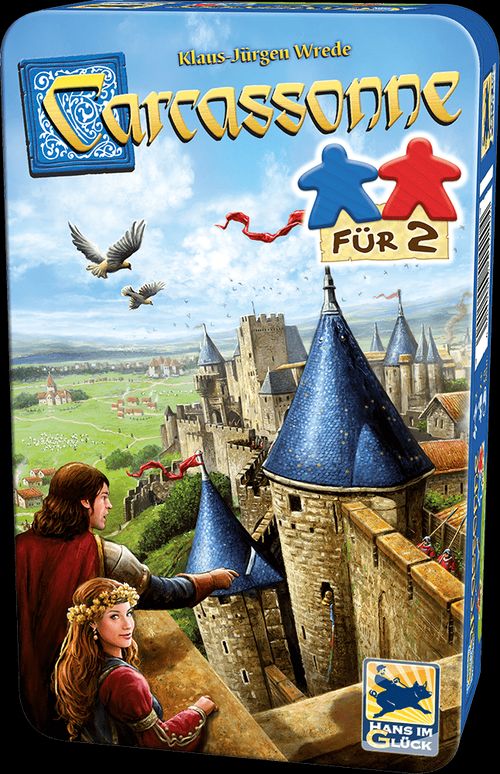
Carcassonne für 2
Carcassonne für 2 Rulebook
Table of Contents
Table of Contents
Game Material and Setup
Welcome to Carcassonne! In these rules, we will guide you quickly through the simple rules of this modern classic. After this short read, you can already show and explain the game to your fellow player.
Then nothing stands in the way of your Carcassonne enjoyment.
First of all, you naturally have to set up the game, but that is quickly done. During setup, we will also tell you something about the contents:
First, let's look at the landscape tiles. The 48 landscape tiles depict roads, cities, and cloisters, all of which stand on a meadow.
Tile with a city — Tile with a road — Tile with a cloister
You don't need to worry about the other elements such as little houses, little figures, etc. These have no significance for the game.
The backs of all the tiles are the same; only the starting tile has a darker coloring so that it can be distinguished from the other tiles.
Tile with normal back — Starting tile with dark back
You begin the setup by placing the starting tile in the middle of the table. Shuffle the remaining tiles and place them face down on the table in several stacks so that each player can easily reach them.
Starting tile — Several stacks of face-down tiles
Also set out a pen and a sheet of paper so that you can note down your victory points during the course of the game.
Finally, let's look at the followers (meeple, pronounced "MEE-pl"), then you're already done with the setup. In the game you will find 12 meeples, 6 each in the colors red and blue.
First, give your fellow player 6 meeples in the desired color. These now form that player's supply (you then take the meeples in the other color for yourself).
In the large original game "Carcassonne", larger and more game material for up to 5 players is included. The base game also contains a scoring track and 2 mini expansions.
Objective of the Game
Before we start with the rules: what is Carcassonne actually about, what is the objective of the game?
Turn by turn, your fellow player and you lay out the landscape tiles. This creates long roads, you build mighty cities, visit cloisters, and farm the fertile land.
You can use your meeples as highwaymen, knights, monks, or farmers. This earns you points during the game, but also at the end. Who has the most points and is thus the winner is only determined after an exciting game, with the final scoring! Let's get started …
Course of Play
In Carcassonne we play alternately, and the youngest player begins. The player whose turn it is always carries out the following actions in the stated order. Then it's your fellow player's turn, and so on.
First, let's list the actions and then explain them one by one. We will do this using the roads, cities, and cloisters depicted on the tiles. So what are the actions?
- Lay a landscape tile: The player must always draw exactly 1 new landscape tile and attach it with one side to the playing area.
- Place a meeple: The player may then place one of their own meeples from their supply on the tile just laid.
- Trigger a scoring: The player must carry out all scorings that result from the placement of their tile.
The Roads
1. Lay a landscape tile
The tile you have drawn shows 3 roads leading away from a village. You attach it to the landscape. You must make sure that the tile fits.
This is the tile you laid. The road fits the road, and the meadow fits the meadow — very good!
2. Place a meeple as a highwayman
After you have laid the tile, you may place a meeple on the road of this tile as a highwayman. This is only possible if there is not already a highwayman on this road.
You have now placed a meeple as a highwayman on the tile you just laid. Since no other meeple is standing on this road, this was possible without any problem.
The road is not yet completed, so for now no scoring occurs (action 3), and it is your fellow player's turn.
They draw a landscape tile and lay it. Since there is already a meeple on the road to the right of the village (your highwayman), your fellow player may not place a meeple there. Instead, they place their meeple as a knight in the city of the tile just laid.
Since the road to the right is already occupied, the blue player decides to place their meeple as a knight in the city.
3. Trigger a scoring
Whenever a road is completed at both ends, the road is scored. The road must end either in a village, a city, a cloister, or in itself. Let's see if there is a scoring: hooray, there is a scoring — the road is completed at both ends!
Even though your fellow player laid this tile, your road was completed. Let's see how many points you get. Each tile of your road earns you 1 point. Since your road is 3 tiles long, you receive 3 points — great!
So that you don't always have to remember your points, you write down the points scored right away. In this case, you note down 3 points on the paper you set out earlier.
After each scoring, you get back into your supply the meeples that took part in that scoring.
You take back the highwayman that just earned you 3 points, back into your supply. The blue meeple remains on the playing area, since it did not take part in a scoring.
Great, you have already understood the most important steps of the game — that wasn't so hard, was it? Now let's look at the other areas:
The Cities
1. Lay a landscape tile
As always, you first draw a tile in order to lay it. Here too, the tile must fit. A city must be attached to an open city.
2. Place a meeple as a knight
Next, you also check here whether a meeple already stands in the city. Since we cannot find one, you can place a meeple as a knight. You laid the tile so cleverly that you extended the open city by 1 tile. The city is still unoccupied, so you can place your meeple there.
3. Trigger a scoring
Let's now skip ahead a bit and assume that you drew this tile on the next turn. Conveniently, you can attach it to your city. This completes the area (in this case the city). Whenever the city is completely surrounded by walls and no longer has a gap, it counts as completed. Since you have a meeple in the city, you now score this city and receive points for it.
Each city tile in a completed city counts 2 points. In addition, each coat of arms in a city counts 2 further points.
You receive 8 points! As with every other scoring, you now get your scored meeples back into your supply.
The Cloisters
1. Lay a landscape tile
As always, you first draw a tile in order to lay it. Here too, the tile must fit. A cloister is always located in the middle of the tile. To lay the tile, you only need to pay attention (as usual) to the edges of the tile.
2. Place a meeple as a monk
At the cloister too, you may place a meeple, which we call a monk. You place it from your supply directly onto the cloister.
The cloister always stands in the middle of the tile. You may lay it here, since the meadow fits the meadow.
3. Trigger a scoring
You score a cloister as soon as it is completely surrounded by tiles. Each tile (including the cloister itself) counts 1 point.
Hooray! With this tile you have completely surrounded the cloister, receive 9 points, and take back your meeple.
Now you already know the most important facts and can play Carcassonne. There are a few small details left, so let's summarize what is important:
Summary
1. Lay a landscape tile
- The tile you have drawn must always be laid so that it fits the landscape.
- Should the very rare case occur that you cannot lay a tile, put the tile back in the box and draw a new one.
2. Place a meeple
- You can only ever place a meeple on the tile you have just laid.
- You must make sure that no other meeple already stands in that area.
3. Trigger a scoring
- A road is always completed when both ends lead into a village, a city, a cloister, or into itself. Each road tile earns 1 point.
- A city is always completed when it is completely surrounded by a city wall and has no gap. Each city tile, plus each coat of arms in that city, then earns 2 points.
- A cloister is always completed when it is completely surrounded by 8 tiles. Each cloister then earns 9 points.
- A scoring is always triggered only at the end of a turn. All players who have placed meeples in completed areas can receive points.
- After each scoring, each player takes back the meeples for which they received points.
- If several players are involved in a scoring, the player who has the majority of meeples on the road or in the city receives the points. Should several players have the same number of meeples in an area, all these players receive the full number of points. (Note: How can this happen? A detailed example follows right away.)
Multiple Meeples in One Area
The tile you have drawn could extend the road. But since a highwayman belonging to your fellow player already stands there, you may not add your own. You therefore decide to lay the tile so that the roads are not directly connected.
In one of the following turns, you draw this tile and attach it to the open road. There are now 2 highwaymen on the road that has thereby been connected. Since the road is now also completed, there is a scoring in which your fellow player and you each receive 4 points.
Hoping to snatch the city away from the blue player, you lay the city tile and place one of your meeples as a knight. This is allowed, since this part of the city is not connected to any other city part in which a knight already stands. If you draw the matching tile on a later turn, you can take over the blue player's city with your two knights.
You are lucky and draw the matching tile to join all the city parts into one large, completed city. Since you now have more knights in the city than your fellow player, you alone receive the 10 points for the completed city. Afterward, both players get their meeples back into their own supply.
End of Game and Final Scoring
Unfortunately, Carcassonne does come to an end eventually … That is of course a shame, but we do want to determine a winner.
The game ends as soon as a player can no longer draw and lay a tile. Then a small final scoring is carried out, and the winner is determined.
As soon as the game is over, there are still points for all areas in which meeples are standing.
- Each road now earns 1 point for each road tile, just as during the game.
- Each open city now earns 1 point for each city tile and each coat of arms, so unfortunately only half as much.
- Each cloister counts 1 point plus 1 point per tile in its surroundings, just as during the game.
- Each meadow earns 3 points per adjacent, completed city. This is the farmer scoring, which we already mention here for the overview. You can ignore this for now and add it in only after a few games. The farmers are explained on the next page.
Final accounting, city on the left: Red receives 8 points for the large open city (5 city parts, 3 coats of arms). Blue receives nothing, since Red has the majority in the city with 2 knights.
Final accounting, cloister: Blue receives 4 points for the unfinished cloister (3 surrounding tiles and the cloister tile).
Final accounting, road: For the open road, Red receives 3 points (3 road sections).
Final accounting, city at the bottom: Blue receives 3 points for the open city (2 city parts, 1 coat of arms).
As soon as you have carried out the final scoring and added up all the points, the winner of your first game of Carcassonne is determined. Congratulations!
Meadows and Farmers
Hello dear reader, have you already played a game or two of Carcassonne? Then you've come to exactly the right place, because with the farmers we'll make your game even more exciting!
First, let's introduce you to the farmers. What would life in Carcassonne be without the important farmers? Let's go through step by step how these work.
1. Lay a landscape tile
As always, you first draw a tile in order to lay it. This time too, the tile must of course fit the landscape. We refer to every green landscape area in Carcassonne as a meadow.
2. Place a meeple as a farmer
We refer to a meeple that you place on the meadow as a farmer. "Place"? Yes, unlike the highwaymen, knights, and monks, you do not stand the meeple on the tiles, but lay it on a meadow. This helps you recognize that you will not get this meeple back, because it only earns points at the end of the game. More on this under the farmer scoring.
Of course, you must also make sure that no farmer already lies in the area where you want to lay your farmer.
The meadows in Carcassonne are separated from one another by cities and roads. In the example, we can see 3 separate meadow areas.
The meadow you have just attached to is really large. It runs from your tile along the road to the city where you already have a knight standing.
3. The scoring for the farmers
As you have already read, the farmers unfortunately do not earn points during the game and also do not return to your supply. So be sparing with your farmers.
Assume the game is over and we are at the final scoring: unlike the other areas in Carcassonne, it is not the meadow tiles that count for points, but the adjacent cities. Each completed city adjacent to a meadow earns 3 points.
On the large meadow of the red and blue player there are 3 completed cities A, B, and C. Both players receive 9 points for their farmers at the end of the game! City D unfortunately was not completed, so it does not count.
Let's see if there are more points for the players, since there are more meadows. On the meadow with two red farmers and one blue farmer, the red player has the majority. Since he has one more farmer on the meadow, he alone receives the points for all 4 cities and gets 12 points. On the small meadow at the upper left edge, the blue player is represented with one farmer. For the two adjacent, completed cities A and B, he receives 6 points.
That was also the whole secret of the farmers. Let's summarize once more what is important:
- Farmers are laid on the meadows.
- Farmers only earn points at the end of the game (in the final scoring).
- Each completed city adjacent to your meadows earns you 3 points.
- Just like meeples in other areas, farmers can be introduced into already-occupied meadows by cleverly laying tiles and thereby connecting the meadows.
- The familiar rules also apply here: whoever has the most farmers on a meadow receives all the points. If both players have the same number of farmers on the meadow, both players receive the points.
A detailed list of all the tiles can be found at www.carcassonne.de. More tips, information, and fantastic ideas can be found at the internet addresses in the next paragraph.