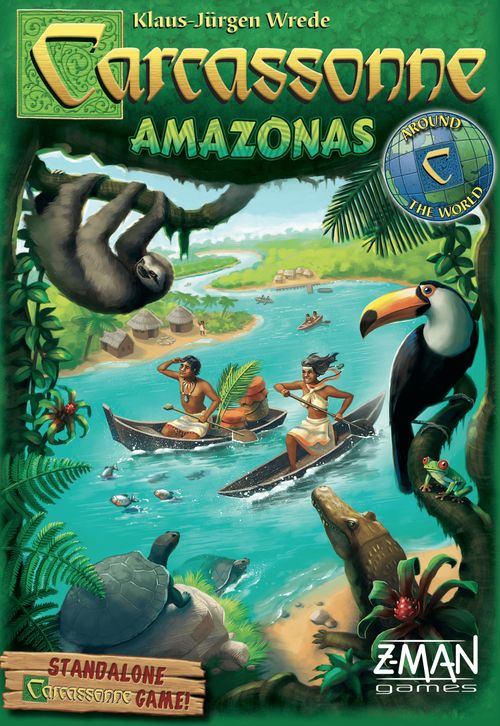
Carcassonne: Amazonas
Carcassonne: Amazonas Rulebook
Table of Contents
Table of Contents
Components and Setup
Welcome to Carcassonne – Amazonas. In this booklet, we will guide you through the rules of this latest iteration of the classic Carcassonne. After reading these rules, you will be able to explain the game to your fellow players and jump straight into the fun of playing Carcassonne. Let's start by setting up the game and presenting the components.
First we have the 65 standard Land tiles. They depict tributaries and villages surrounded by a dense jungle where many animals roam. Examples include a tile with village and jungle with an animal, a tile with tributary and Boat icon, and a tile with tributary and Fruit icon.
To these we add the 15 Amazon tiles. They are also Land tiles, but have a special function during the game — for example, an Amazon tile with caimans and piranhas.
All Land tiles (standard and Amazon) share the same back.
The board (the size of 2 x 4 Land tiles) is the Start tile. Place it on the side that matches the number of players: with 2 or 3 players, there are 16 spaces; with 4 and 5 players, 8 spaces. Place the source of the Amazon River near the edge of the table. Leave enough room between the Start tile and the edge of the table for a minimum of 2 rows of tiles. By the end of the game, the river will have a length of a little over 1 meter (close to 4 feet).
Each player chooses a color and takes the boat in their color. The last player to have gone on a boat ride is the first player (or, alternately, the youngest). Each player puts their boat on the first space of the Amazon River (the source).
Shuffle all 80 Land tiles together (making sure the Amazon tiles are evenly distributed) and place them face down in multiple stacks. Set aside the 4 Amazon double-tiles; they will come into play later. The River mouth tile is also set aside for now and will be used at the end of the game.
At last we have the wooden pieces: the meeples and the camps. There is a total of 25 meeples, 5 in each color: yellow, red, green, blue, and black. There are also 10 camps, 2 in each of those same colors.
Each player takes 4 meeples and the 2 camps in their color to form their personal supply. Then, each player puts their 5th meeple on space 0 of the scoreboard. Any remaining pieces are returned to the box.
Overview and Goal
Before diving into the rules per say, you should know what the goal is in Carcassonne – Amazonas. One after the other, players will place tiles. This is how, one tile at a time, you will discover features (villages and tributaries), the Amazonian jungle, and the Amazon River itself. You will place meeples in villages and tributaries, and your camps in the jungle. At the same time, you will want to move your boat down the Amazon River to get ahead of the other players. You will score points during and at the end of the game. After the final scoring, the player with the most points is declared the winner. Let's get started!
Gameplay
A game of Carcassonne – Amazonas is played in clockwise order. Starting with the first player, the active player does the following actions in the order listed below, followed by the next player, and so on and so forth.
We'll first give you a brief description of the actions you must do during one of your turns. These actions will be detailed as we present the many aspects of the tiles.
- Placing a tile: You must draw exactly 1 Land tile from a stack and place it face up to continue the landscape.
- On this tile you may place… a) a meeple, OR b) a camp. If you do not place a piece, you must advance your boat 1 space on the Amazon River.
- Scoring a feature: You must score any and all features completed by your tile placement.
The Amazon River and Land tile placement restrictions
The most important tile placement rules are:
- the tile you place must continue the landscape (illustration), and
- you may never place Land tiles ahead of the Amazon River mouth.
Initially, there are 10 possible Land tile placements. Once a tile has been placed, you can place other tiles next to it.
The Amazon River also plays an important role in tile placement. At first, the river is only on the Start tile, but you will soon extend it with Amazon tiles, extending at the same time where Land tiles may be placed. Once the Amazon River has been extended, it becomes possible to place tiles in the new row it opens up. You may never place tiles ahead of the river's current mouth.
The Tributaries
1. Placing a tile
You draw the depicted tile with three tributaries starting from a rock. You must place it in such a way that it continues the existing landscape (the tiles already in play). For example, if you've just placed a red-bordered tile, the tributary and jungle must fit with the existing landscape.
2a. Placing a meeple on a tributary
After placing the tile, you may place a meeple on one of that tile's tributaries, but only if the tributary is unoccupied by another meeple.
The Boat Icon
Since you now have a meeple on a tributary with a Boat icon, you must advance your boat on the Amazon River 1 space per Boat icon.
Additional rules for boat movement on the Amazon River
- Boat icons are found only on tributaries. Each Boat icon lets you advance your boat 1 space on the Amazon River. You apply the effect of these icons immediately after placing a meeple on a tributary with one or more Boat icons, or a tile with a Boat icon is connected (by you or another player) to a tributary where your meeple is present. The number of meeples you or other players have on the tributary has no impact on this movement.
- Your boat can only advance on the Amazon River (i.e., it may not move back).
- If you would need to advance beyond the last space on the Amazon River, simply stop on the last space.
- The Amazon River spaces on the Start tile are already connected; each Amazon tile adds 1 space, and each Amazon double-tile adds 2 spaces.
- Your boat must also advance 1 space whenever you do not place a wooden piece on your turn (see "Advancing the boat" below).
- There can be any number of boats on a single Amazon space.
3. Scoring a tributary
When both ends of a tributary are closed, that tributary is completed and scored. The end of a tributary is closed when it meets an intersection, a rock, the Amazon River, or if it loops onto itself by meeting the other end. Even if your opponent placed the tile that closes it, this still completes your tributary. When scoring a tributary, each tile in that tributary gives you 1 point. In addition, you score 1 point for each Fruit icon depicted along that tributary. (For example, a tributary of 3 tiles and 1 Fruit icon scores a total of 4 points.)
It is now time to note your score. You keep track of your score with the meeple you placed on the scoreboard before starting the game. After each scoring, return to your supply the meeple in the feature that was just scored. Should your score exceed 50 points (and, as a result, space 0 of the scoreboard), lay down your scoring meeple to show you have 50+ points. If you pass space 0 again, stand your scoring meeple once more to show you have 100+ points.
The Villages
1. Placing a tile
As usual, you draw a tile and use it to continue the landscape. As always, the illustration must be continued, so a village segment must be connected to an open village (or placed so that it creates a new one).
2a. Placing a meeple on a village
Then, check if a meeple is already in the village. If there isn't, you can place one of your meeples in this village. Since the village is unoccupied, you can place a meeple there.
3. Scoring a village
Assume that a few turns have passed and you draw a tile that you place to continue your village. Since the tile you've just placed completes a feature (here, the village), it must now be scored. A village is completed when it is surrounded by jungle and/or the Amazon River and there are no gaps inside it. Since your meeple is in the village, you also score points.
Each tile in a completed village is worth 2 points. In addition, each Fruit icon is worth 1 point. As usual, the meeple that was in the scored feature returns to your supply. (For example, a village of 3 tiles and 1 Fruit icon scores 7 points: 3 tiles at 2 points each, plus 1 Fruit icon.)
The Camps
1. Placing a tile
Once again, you draw a tile to continue the landscape, making sure that the illustration fits.
2b. Placing a camp
Each player receives 2 camps at the beginning of the game. You may place a camp on a jungle segment of a tile you've just placed. As with meeples, there cannot be any other camps in that jungle. If there are multiple jungle segments, you must choose on which of them to place your camp. Jungles are separated from one another by tributaries, the Amazon River, and villages.
Reminder: you must choose between placing a meeple or a camp; you may not place both.
Once placed, a camp stays on the board until the end of the game, it is only then that it will give you points. At the end of the game, each animal in your camp's jungle will give you 1 point. Place your camps accordingly!
For example, if you've just placed a tile, you may not place a camp on a lower jungle segment because it is connected to the jungle with another player's camp. You may place on the top jungle segment, since that jungle is separated by the tributary and the village.
3. Scoring a Camp
During the game, you do not score any points for camps. Camps are only scored at game end (see "Game End, Final Scoring, and Winner" below). At that point, you will score 1 point per animal depicted in a jungle with your camp.
Advancing the boat
1. Placing a tile
As always, when you place a tile, you must make sure that it fits the landscape.
2. Move your boat
During your turn, if you do not place a wooden piece (meeple or camp), you must advance your boat 1 space down the Amazon River, which is always good for you.
During your turn, if you add Boat icons to one of your meeples on a tributary (placed on a previous turn), add all of those moves together. For example, if your meeple is already on a tributary and you add a tile that connects your meeple to 2 Boat icons, this gives you 2 movements. Because you do not place a wooden piece, you get 1 more movement — therefore your boat will advance 3 spaces on the Amazon River.
We will now see the reasons why you would want to move your boat on the Amazon River.
The Amazon tiles
1. Placing an Amazon tile
Unlike regular Land tiles, when you draw an Amazon tile, you must use it to continue the Amazon River. When you place an Amazon tile, choose between its two possible orientations.
Whenever you draw a tile with a "!," you need to choose an Amazon double-tile. First place the !-tile, immediately followed by an Amazon double-tile (those tiles must always be placed in this order).
Note: because double-tiles are twice as big as normal tiles, they also have 2 spaces for boats.
Note: since there are 3 !-tiles and 4 Amazon double-tiles, there will always be 1 unused Amazon double-tile.
Reminder: whenever you place an Amazon tile, you also expand the area in which Land tiles may be placed (as seen under "The Amazon River and Land tile placement restrictions" above).
2. Place a meeple or a camp, or move your boat
You may place a meeple or a camp on the banks of an Amazon tile. However, the Amazon River itself is reserved for boats and no meeples or camps may be placed on it.
If you place a !-tile and a double-tile, you may place a meeple or a camp only on the double-tile.
As always, if you do not place a meeple or a camp, you must advance your boat 1 space on the Amazon River.
3. Scoring the Amazon
Amazon Scoring
After placing any Amazon tile, an Amazon scoring occurs (instead of a regular scoring):
Caimans and piranhas can be seen in the Amazon River. The owner of the boat furthest down the river (in first place) gets as many points as the sum of caimans and piranhas depicted on the just-placed Amazon tile. The owner of the second boat furthest down the river (in second place) gets as many points as the number of piranhas depicted on the just-placed Amazon tile. If there are several boats in first (or second) place, the tied players score all the points for their respective rank.
Note 1: where the boats are on the Amazon does not matter, only their rank.
Note 2: the Amazon double-tiles have 2 spaces for boats, but count as one tile for the Amazon scoring (i.e., all caimans and piranhas on a double-tile are counted).
For example, on an Amazon tile depicting 3 caimans and 1 piranha: the player in first place (first boat down the river) scores a total of 4 points (3 caimans + 1 piranha). Players tied in second place each score 1 point for the piranha. A player who did not score any points advances their boat 1 space.
Important: After an Amazon Scoring, all players that did not score any points advance their boat 1 space.