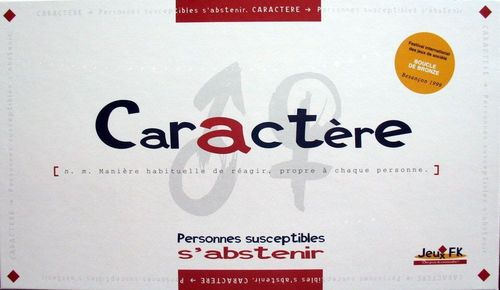
Caractère
Caractère Rulebook
Table of Contents
Table of Contents
Object of the Game
Do you really know your playing partners? Do you know who they really are? And do they know you? What image of yourself do you send them?
These are the questions you will have the chance to answer during the game. The winner is the player who, after going all the way around the board, passes the LAST TEST successfully.
Setup
Number of players: 4 to 10.
Components per player: one pawn, one answer grid, 3 joks (one of each colour).
Start of the game: the players place their pawns on the start square, which corresponds to an EGO question. The youngest player begins, then the player to his left, and so on.
ATTENTION! Unlike other games, you do not move on the board by rolling a die. You only advance when you manage to guess the answer of the Questioned player. In that case you advance one square, or two if the "+2" symbol appears on the card (or, exceptionally, three squares).
Special Squares
The player who is on one of these squares at the start of his turn follows the instructions below:
- +2: advance 2 squares and answer the corresponding question.
- -2: move back 2 squares and answer the corresponding question.
- PREMS: go to the square where the most advanced player is and answer the corresponding question. (If the player is himself the most advanced, he advances two squares.)
- DER: go to the square where the last player is and answer the corresponding question. (If the player is himself the last, he moves back two squares.)
- MELO, EGO or DUO + jok: draw an additional jok and answer the question corresponding to the colour of the square.
ATTENTION! A player never carries out the action required by a square (drawing a card, advancing, moving back or performing the LAST TEST) at the moment he lands on it. It is only when it is again his turn to play, that is, when he becomes the Questioned player, that he carries out the action corresponding to the square he is then on.
A player may for example stop temporarily on a "-2" square but still have the opportunity to advance before being Questioned again. Only if he is still on that square at that moment does he move back two squares.
Last Test
When a player reaches (or passes) the LAST TEST square, he must wait for his turn to perform this test.
At that moment his partners draw the first card from the EGO deck and read it aloud. They answer the question personally. The LAST TEST consists for the player in guessing the answer of each of his partners.
To pass, he must have guessed at least half of his partners' answers (2 answers if he has 3 or 4 partners, 3 answers if he has 5 or 6 partners, and so on).
He is allowed to challenge the answers of one or more players if he doubts their sincerity.
If he does not pass the LAST TEST, the player moves back 3 squares and the game continues.
Questions
The three types of questions concern the character of the participants.
MELO Questions (grey)
Example: In your opinion, who here is the most moody person?
They concern all the participants in the game. The Questioned player answering a MELO question writes on his grid the name of one of the participants. He may name himself.
EGO Questions (blue)
Example: The main quality you expect from a friend is 1. availability, 2. frankness, 3. complicity.
They concern the character of the Questioned player. He has a choice of 3 or 4 possibilities and simply ticks on the grid the box (1, 2, 3 or 4) matching his choice.
DUO Questions (red)
Example: Who around this table would you like to confess to?
They concern either the relationships the Questioned player may have with the other participants, or the opinion the Questioned player has of his partners. The Questioned player answering a DUO question writes his answer on the grid. In answer to this type of question he may never name himself.
For certain DUO questions the Questioned player must give an adjective.
Example: In your opinion, what is the main quality of your neighbour on the right?
In this case, the answers of the players who found an approximate adjective (a synonym) are considered correct.
Procedure
Whether the question is MELO, EGO or DUO, the principle is always the same:
- Player no. 1 draws the first card from the deck matching the square he is on. He reads the question aloud, places it face up on the table, and writes his answer secretly on the grid provided for this purpose. This player is called the "Questioned" player.
- The other players try to guess the Questioned player's answer. They are called the "Detectors".
- Once the Questioned player has written down his answer, each Detector states his guess in turn. The Questioned player gives his own answer last.
- All the Detectors who gave the same answer as the Questioned player advance the number of squares shown on the card. The other Detectors stay on their square.
- The Questioned player also stays in place, except possibly in the case of a challenge (see "Challenge" below).
- Then player no. 2 becomes the Questioned player, and so on until the end of the game.
Attention! Whether or not any player challenges, the Detectors who gave the same answer as the Questioned player advance their pawns on the board.
Challenge
If one of the Detectors has not managed to guess what the Questioned player answered, and he believes the Questioned player was not sincere, he may take the risk of saying: "I challenge!"
In that case the Questioned player must justify his answer by giving examples. The Challenger then gives his counter-arguments. The debate concerns only two players, the Challenger and the Questioned player. It may last some time, and the other players must not intervene.
Then, when the arguments of these two players are exhausted, the other participants judge whether the justification was sincere, coherent and well argued:
- If the Questioned player receives the most votes, he advances 2 squares.
- Otherwise, the Challenger advances 2 squares. In case of a tie, the Challenger advances.
Attention! There cannot be several Challengers. The first player who says "I CHALLENGE!" takes part in the debate with the Questioned player.
Joks
Each player receives 3 joks at the start, one of each colour. The other joks form a draw pile.
A player who does not wish to answer a question may decline by returning a jok of the matching colour. If it is the Questioned player who returns a jok, he then draws another question.
When a player no longer has a jok of a given colour, he is obliged to answer the questions of that category, under penalty of moving back 3 squares.