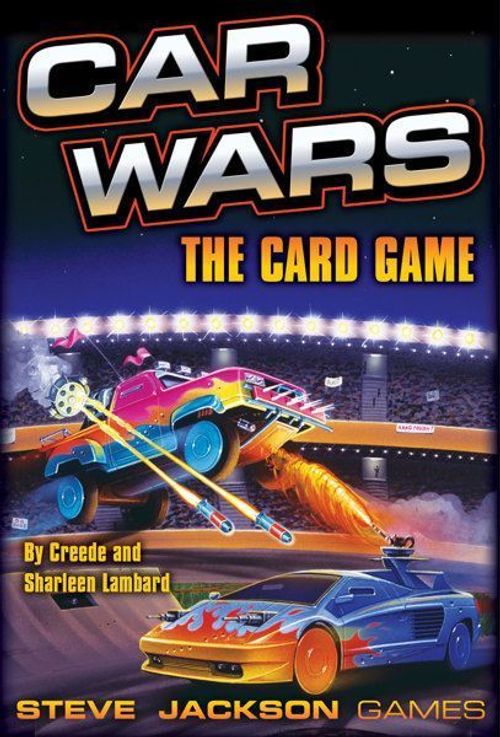
Car Wars: The Card Game
Car Wars: The Card Game Rulebook
Table of Contents
Table of Contents
Overview
In each battle, or duel, the players play cards to damage each others' cars. When one side of a player's car is breached (the armor on that side is destroyed), the car's driver may be attacked! If a car's driver is disabled and unable to operate the car, the player who disabled them scores a kill. When only one car is left (or when time runs out), the duel is over.
New duels continue until one player has scored 60 points to become an Ace!
Components
This game includes these rules; six large Car Cards; and 150 playing cards. There are three types of playing cards: Attack, Armor, and Special.
Attack cards let you attack another player. Each Attack card shows a weapon and the side it hits - front, back, right, or left. In addition, there are four Called Shot cards that will let you attack any side. The bullet-holes at the top of the Attack card, and the number on the card, show how much damage it does.
Armor cards let you reduce the damage done when someone plays an Attack card on you. You cannot play an Armor card before you are attacked. Each Armor card shows one side, and can only be used to reduce damage from that side. For instance, a Right Armor card, played after your right side is hit, will reduce the damage from that attack by 3 points. An Armor card must be played immediately when you are hit, or it doesn't count.
You can also use armor to reduce damage from Specials that do damage, like Autocannon Backfires or Skid Into A Wall.
It is perfectly legal to play two Armor cards at once if you have them. Two Armor cards would stop all damage from any attack. If the Armor cards total more than the damage done, the excess is lost.
Special cards let you do a variety of things. Some (like Tire Shot) may be played only on your turn. Some may be played at any time, including the moment the duel starts. Some may only be played in response to a card played by an opponent. Follow the instructions on each card.
Starting the Game
Each player starts with a Car Card (the large cards with the pictures of cars). These are used to keep track of damage, and of how much damage each part of your car can take. "Right 12," for instance, means your right-side armor can take 12 points of damage before it is breached. (The armor has taken enough damage that the driver is exposed to attacks.)
Shuffle the playing cards and deal five to each player, face down. Set the deck face down in the middle of the table. This is the draw pile. The discard pile will be next to the draw pile.
Note: In a two- or three-player game, remove one of each of the following cards from the deck: Machine Gun Jams, Fireproof Armor, Autocannon Backfires, Dud Missile, Metal Armor, Laser Overheats, Ejection Seat, and Laser-Reflective Armor.
Scrap Them All
The object is to have the last operating car in the game. A car is still operating if it has not escaped, and its driver has not been disabled. It is possible for two or more players to have operating cars at the end of a duel - this is a tie.
Drawing and Playing
Pick up your cards and put them in your hand, keeping them from the prying eyes of your opponents. The player to the left of the dealer plays first. In your turn, draw enough cards to bring your hand up to six cards. Then either:
- Attack;
- Play a Special;
- or Discard.
Attack - You may attack any other player by placing an Attack card in front of that player. If the attacked player can reply to the Attack card (by playing an Armor card or an appropriate Special), that player may do so immediately.
Special - You may play a Fireproof Armor (subject to the rules below), Laser-Reflective Armor, Metal Armor, Laser Overheats, or Machine Gun Jams card rather than playing an Armor card or discarding. (Other Special cards can only be played on someone else's turn.)
Discard - If you cannot attack or play a Special, or you just don't want to, you must place one or more cards in the discard pile in the center of the table. These cards are out of play until the deck is reshuffled. You may not discard at any other time.
The next player to the left now brings their hand up to six cards and attacks, discards, or plays a Special. Play continues to the left.
Attack
The attack is the basic move of the game. To attack an opponent, just play an Attack card (Flamethrower, Autocannon, Laser, Missile, Machine Gun, or Ramming) card on them.
Attack cards do from 3 to 6 points of damage to one side of the target car. This may be modified by a Special, or by an Armor card. If the target player holds any Armor cards for the side of the car which was hit, that player may play them immediately. (You may not play an Armor card later to reduce damage already taken. The Armor card must be in your hand at the time the Attack card is played.) Each Armor card immediately stops 3 points of damage. Heavy Armor works the same way, but stops 6 points of damage.
If the amount of damage stopped equals or exceeds the amount of damage on the Attack card, the Attack card and Armor card(s) are discarded. Otherwise, the Attack card is placed next to the Car card, on the damaged side. Any Armor cards are placed to cover the amount of damage they stopped.
Example: In the first diagram, the player has just taken 6 points of damage from a flamethrower blast to the right side.
In the next diagram, the defending player has offset 3 points of damage with an Armor card.
You may not draw cards at any time except at the beginning of your turn. At that time, you draw enough cards to bring your hand up to six.
Ramming
The Ramming attack is unique. After you ram an opponent, you may immediately play another Attack card in order to shoot them as well. The follow-up Attack card must be for the same side you rammed them on!
If your target plays a Spin or Bootlegger Reverse after you ram them, making you hit them on a different side, you may still follow up with a weapon attack, but it must be against the side where you actually rammed them.
If your target plays a Swerve after you ram them, your ram missed and you may not follow up with a weapon attack. If they do not announce a Swerve after you ram, they cannot then swerve to avoid your follow-up attack . . . you are firing at point-blank range!
Ramming does not damage your own car, but you may not ram an opponent if your own front is breached or if you have lost your tires.
Specials
Some of these cards allow special attacks. Others can be used to cancel an appropriate Attack card. The Fireproof Armor, Laser-Reflective Armor, Machine Gun Jams, Metal Armor, Laser Overheats, Ramplate, and Wheelguards cards must be left in front of players in the "Specials" area (at the lower right hand corner of their Car card) as long as they are in the duel. If a car is eliminated, these cards are gathered up with their other cards and discarded. Specials which do damage are placed on the appropriate side of the target car. All other Special cards are discarded after use.
Autocannon Backfires
You can play this card only when you have just been attacked by an autocannon. Instead of affecting you, the autocannon explodes, damaging the attacker on the side they were trying to hit. They cannot avoid this damage with a Swerve or Spin. If the attacker is eliminated by the backfire, nobody gets credit for the kill.
Bootlegger Reverse
If you play a Bootlegger Reverse card immediately after being attacked, apply the damage to the side of the car opposite from what is printed on the Attack card. If an opponent plays a Skid Into A Wall card, however, the bootlegger ended in a collision. You take 3 points of damage to whichever side the opponent chooses. Armor can be used to protect against this damage.
Card text: Play IMMEDIATELY after an Attack card is played on you. Ignore the location on the card; instead, apply the damage to your OPPOSITE SIDE. Armor may still protect against this attack.
Debris
You can play this card only in response to another player playing Bootlegger Reverse, Swerve, or Spin. The Debris card is placed in the "Tires" damage area of the targeted car and does 2 points of tire damage. If the target of a Debris card immediately plays Swerve, the Debris card is discarded without effect.
Card text: Play on any other player after their successful Bootlegger Reverse, Swerve, or Spin. That player takes 2 points of damage to their TIRES. Debris may be avoided with another Swerve card.
Ejection Seat
This card lets you Escape (see p. 5) immediately, on any player's turn. The Ejection Seat will get you out of harm's way (and out of the duel) even after your opponent's attacks have been launched.
Fireproof Armor, Laser-Reflective Armor, and Metal Armor
These three types of Armor cards may be played at any time during the duel - not just during the holder's turn. You may only play a Fireproof Armor card if you have not yet taken any damage from a Flamethrower card. If you avoided damage on a previous turn by playing two Armor cards at once, or used a Swerve (when the Flamethrower card would be discarded), you may still play Fireproof Armor.
Fireproof Armor also protects the driver against Flamethrower damage, even after the armor has been breached. A Fireproof Armor card even protects against Flamethrower damage to tires. This is an exception to the general rule on the Tire Shot card.
Laser-Reflective Armor cards act in the same way as Fireproof Armor except that the protected car is immune to Laser cards.
Metal Armor cards also act in the same way as Fireproof Armor except that the car cannot be damaged by Machine Gun cards.
Card text: Play at any time, up until you have taken damage from a Flamethrower card. No one may play Flamethrower cards on you for the rest of the duel. If played IMMEDIATELY after a Flamethrower card, it also negates that card.
Machine Gun Jams and Laser Overheats
You may play a Machine Gun Jams card on any foe at any time. The target cannot attack with a Machine Gun, and if they had just played a Machine Gun attack on anyone, that attack fails and their turn is over. That opponent may not play any more Machine Gun cards until they "unjam" their weapon by discarding ALL the cards in their hand. If played IMMEDIATELY after a Machine Gun card, it also negates that card.
The only way for victims of the Machine Gun Jams card to "unjam" their guns is to discard all the cards in their hand on their turn, doing nothing else. They can then draw six new cards at the beginning of their next turn.
Laser Overheats works the same way as Machine Gun Jams, but is played in response to a Laser attack.
Shaken
Play this card after any Ramming attack, whether it is protected by armor or not. Shaken players lose their next turn.
Smokescreen and Paint Spray
The Smokescreen card completely blocks any one Attack card. Play it immediately after an Attack and discard them both.
The Paint Spray is like the Smokescreen, but with two differences: You can only play it in response to attacks from the Back. Also, unless attackers can play a Swerve to avoid the Paint Spray, they must discard their hand immediately and miss their next turn.
Spin
This card lets you move damage from one side to an adjacent side, by maneuvering your car to control where you are hit. You may play more than one Spin at a time, if you have them, to move the damage to the opposite side of the car. You can use Armor cards to reduce the damage on the side where it finally ends up.
Swerve and Skid
If you play a Swerve card immediately after being attacked, you may discard the Attack card - it missed! Instead, you take one point of damage to your tires (place the Swerve card in the "Tires" damage area). If an opponent plays a Skid Into A Wall card on you, however, the swerve ended in a collision, and in addition to the tire damage, you take 3 points of damage to whichever side the opponent chooses! Armor can be used to protect against this damage.
Tire Shot
You may target an opponent's tires with a Tire Shot card. Play this card simultaneously with any Attack card. Apply the damage to the tires rather than to the original hit location. Cards showing tire damage are placed at the lower left corner of the car card. Ignore the location on the card; instead, apply the damage to your opponent's TIRES. Armor does NOT protect against this attack.
Players who use a Swerve card to avoid an opponent's attack will do 1 point damage to their own tires.
Your tires are treated as a single unit. They are destroyed if they take 9 or more points of damage; this is not considered a breach. Regular armor cannot be used to protect your tires. (Exceptions: Fireproof Armor protects tires from Flamethrower damage, and Wheelguards protect tires from tire attacks, but not Swerve damage.)
Players whose tires are destroyed may no longer use Bootlegger Reverse, Ramming, Smokescreen, Paint Spray, Spin, or Swerve cards, nor may they Escape. However, they may still shoot - and they can still win!
Play of the Duel
Breached Armor
When the armor on one side of a player's car takes 12 or more points of damage, it is breached. The player should square the cards on that side of the car and turn them face down to show the breach.
The attack that creates the breach does not affect the driver (even if there is damage left over), but any further attacks to that side will reach the driver unless stopped by armor. You can still play Armor cards on a breached side.
Place Attack cards that affect the driver in a new stack outside the first breach.
Eliminating an Opponent
When the driver takes 5 or more points of damage, that driver has been disabled and can no longer drive the car. All damage, Armor, and Special cards applied to that car, along with its owner's hand, go to the discard pile. The player whose Attack card took the driver out gets credit for a kill. A kill can only be scored with an Attack card - if a player is taken out by a Skid Into A Wall, the points go to whoever played the Attack card that player was swerving to avoid.
Escaping
At the end of your turn, you may announce that you are Escaping from the arena (usually to avoid being eliminated). If your car is still operating at the beginning of your next turn and your tires have not been destroyed, you leave the arena . . . and no one gets credit for eliminating you.
On the turn you declare you are escaping, you take your turn normally. On the next turn, provided you are not eliminated yet and your tires are not destroyed, you escape. You may not do anything else this turn. If you are prevented from escaping, take your turn normally.
An Ejection Seat will allow you to escape at any time, even during someone else's turn.
Reshuffling
Sometimes the players will go completely through the deck without a winner. If this happens, reshuffle the discard pile and turn it over, making a new draw pile. If the players go through the deck a second time, do not reshuffle. All players still in the duel share equally in a tie.
Scoring and Winning
The last player whose car is still in the arena and has not been killed is the winner of the duel. That player scores 20 points. In addition, each player gets 10 points for each car they have eliminated.
If the duel ended in a tie, each player still in the duel at the end gets 10 points.
The Next Duel
When the scoring is completed, gather up the cards. The player to the previous dealer's right shuffles and deals the cards for the next duel. Each player starts the new duel with a fully healed driver.
Play a series of duels until one player reaches 60 points at the end of a round. (If two or more players reach 60 points, the player with the highest number of points wins. If it's a tie, everyone continues playing until someone has broken the tie at the end of a duel.) That player is declared an ACE, and wins the game!
Note: card names referenced in these rules but not described in this rulebook (for example Skid Into A Wall, Dud Missile, Ramplate, and the individual Attack and Called Shot cards) are described by the text printed on the cards themselves, which is not reproduced here.