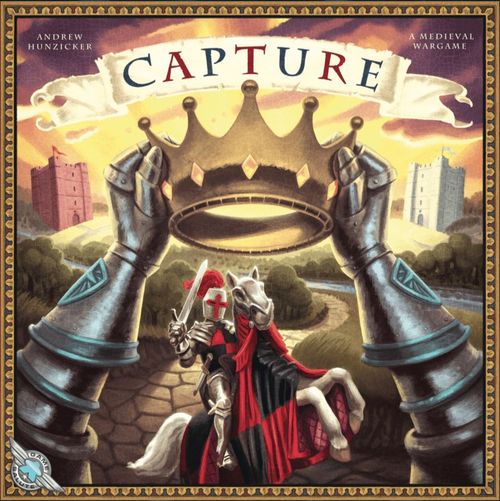
Capture: A Medieval Wargame
Capture: A Medieval Wargame Rulebook
Table of Contents
Table of Contents
Components
- 1 Game board
- 20 Gamepieces (10 Blue, 10 Red)
- 2 Knight stickers (stick under 1 Gamepiece of each color)
- 6 Crowns
- 2 Dice (1 White, 1 Black)
- 2 Catapults (1 Blue, 1 Red) and 4 Boulders
- 18 Treasure Cards
The Teams and the Territories
The gameboard is made up of several rock pathways which wind their way through forests, across two rivers and around two lakes. There are two territories, red and blue. Blue territory is home territory to the blue army and enemy territory to the red army. Red territory is home territory to the red army and enemy territory to the blue army. One player is in command of the blue army and one player is in command of the red army. Each army is made up of 7 Gamepieces: 6 Soldiers and 1 Knight. A Knight is identified by a Knight sticker hidden on the bottom of the Gamepiece.
Set-up
The blue army has 3 Crowns and the red army has 3 Crowns. Each player places their Crowns on each of the three Crown spaces on the gameboard. The Treasure Cards are shuffled and the deck is placed to the side of the gameboard.
Blue always goes first. The blue player now takes 6 Soldiers and 1 Knight from the blue army and places them on any rock in the rock trail in blue territory. It is important to try to remember where you place your Knight. The opposing player does not know the identity of your Knight. (Your Knight is the only Gamepiece that can kill enemy Soldiers.) The extra Gamepieces are then placed to the side of the gameboard. These Gamepieces are your "reserves" may enter the game later. Now the red player goes through this same process. The advantage of placing the red Gamepieces while knowing where the blue Gamepieces have already been placed is compensated for by blue getting to move first.
See the back cover for Alternative Play suggestions.
Order of Play
At the start of the game, blue moves first.
During a turn the active player does the following in this order only:
- They may look at the identity of one of their own Gamepieces (in case they forget where their Knight is located).
- They may play a Treasure Card.
- They roll the dice and move up to 3 separate Gamepieces. If a 4 or 5 is rolled on the white die, then the player also gets to shoot the catapult once.
- The turn ends and the next player starts their turn.
Movement of Gamepieces
During a turn, a player may pick and move any 3 separate Gamepieces from their army according to these rules:
A. Each rock equals one space and Gamepieces can move along the rock trail in any direction. However, a Gamepiece cannot move over the same rock twice in one move.
B. A player rolls the dice at the beginning of a turn. This roll will be for the movement of all of that player's Gamepieces moved during that turn.
The white die is for movement of Gamepieces located in home territory or the Cathedral, and the black die is for movement of Gamepieces located in enemy territory. Each of the three Gamepieces moved during a turn can be moved any number of spaces up to the number rolled on the die. Where a Gamepiece is located (enemy territory or home territory) is determined at the start of a turn. For instance, a Gamepiece which starts in home territory and then moves into enemy territory in one move will only be allowed to move the number of spaces rolled by the white die. Then the next time that Gamepiece is moved, it will be allowed to move the number of spaces rolled by the black die, since it is now located in enemy territory. The Cathedral is neutral territory and a Gamepiece in the Cathedral can choose which die to use.
Example: The Red Player rolls an "11" black die and a "6" white die. They can now move any of their Gamepieces in enemy territory up to 11 spaces for each Gamepiece, and can move any of their Gamepieces in home territory up to 6 spaces for each Gamepiece. However, the player is limited to moving 3 Gamepieces total in one turn, i.e., 2 in home and 1 in enemy territory; or 3 in home only; or 3 in enemy territory only; etc.
C. A Gamepiece can't move over or around any other Gamepiece on a trail.
D. Any home Gamepiece can capture any enemy Gamepiece in their home territory by simply moving onto the space the enemy Gamepiece currently occupies. For example, if a red Gamepiece moves onto a space in red territory occupied by a blue Gamepiece, then the blue Gamepiece is captured. A captured enemy Gamepiece is immediately moved to the home dungeon of the captor. Note: Players can only capture enemy Gamepieces in home territory. While your Gamepiece is in enemy territory, it is vulnerable to being captured, and it cannot capture an enemy Gamepiece.
E. A player cannot move a Gamepiece onto a space occupied by an enemy Gamepiece in enemy territory (otherwise, your Gamepiece would automatically be captured).
F. Gamepieces can be moved along either of the two rivers between the wooden boats on the gameboard. A Gamepiece can only get on or off a river at a boat. Boats are docked at one certain rock which is where a Gamepiece can get on or off the river. To move a Gamepiece onto a boat or off a boat counts as one space. The distance between boats is also one space. A Gamepiece can travel as far on the river in one move as desired but cannot end a move on a boat. Rivers are both 4 spaces in length, and so it is possible for a Gamepiece to move a long distance in one move if the river is used. Bridges can be used only to cross a river, and a Gamepiece can never get on or off a river at a bridge.
G. A Gamepiece can also travel across either lake by using the boats docked on the lake. A Gamepiece can move from one boat to either of the other two boats, and again, each boat counts as one space. However, a Gamepiece cannot end a move on a boat.
H. Any Gamepiece can move over or onto the Cathedral, which is the only neutral space on the gameboard, and is therefore the only space on the gameboard which both a red Gamepiece and a blue Gamepiece can occupy at the same time. The Cathedral counts as one space.
I. The dungeons can only be moved onto by a rescuing Gamepiece, and can never be used as a space for any Gamepiece to move over or onto.
J. Any Gamepiece can land or move over any Crown Space, Knight Space or Treasure Space which count as one space each.
General Rules
Treasure
Whenever a Gamepiece lands on or moves over a rock space in enemy territory marked with a treasure chest symbol, that player draws a Treasure Card from the top of the deck. Treasure Cards remain hidden from the other player until played. Each Treasure Card can be played during any turn starting with the next full turn. Only one card can be played per turn. It must be played at the start of a turn before rolling the dice and moving any Gamepieces. The effects of the card last for the turn they are played on, and then the card is discarded. Once all Treasure Cards have been drawn, the discard pile is shuffled into a new deck.
Example: The Red Player plays the CAPTURE! Treasure Card at the start of their turn and then rolls the dice. During this turn the Red Player can move one of their Gamepieces onto an enemy gamepiece in Blue territory and Capture it, as if they were in their own Red home territory. If the Red Player doesn't roll numbers on the dice that allow them to do this, then they don't gain the benefit of the card. After their turn, the card is discarded.
Knight Spaces
Whenever a Gamepiece lands on or moves over a rock space in enemy territory marked with a Knight symbol, that player adds a Gamepiece from their reserves to the Cathedral.
Catapults
One boulder can be catapulted into enemy territory whenever a 4 or 5 is rolled on the white die or whenever a CATAPULT! Treasure Card is played. Catapults can be shot from anywhere along the back edge of the gameboard but must be completely off the gameboard when fired. (i.e., a player must set their catapult on their side of the board, off the gameboard and shoot across the board to enemy territory).
If a catapulted rock hits and knocks over any Gamepiece in enemy territory, then one of the knocked over Gamepieces is killed and taken off the gameboard. If an equal number of enemy and friendly Gamepieces were knocked over, then a friendly piece is removed. If more enemy Gamepieces were knocked over than friendly ones, then the player who fired the catapult can choose which knocked over Gamepiece to kill (see Killing an Enemy Gamepiece).
A catapulted rock can only kill Gamepieces in enemy territory. If a rock hits or knocks over any Gamepiece in home territory then all distrupted pieces (both in enemy and home territories) are returned to their positions on the board and the rock has no effect. So aim well!
Killing an Enemy Gamepiece
A "killed" Gamepiece is removed from the game permanently. A Gamepiece can be killed in three ways. First, a Knight has the special ability of being able to kill any enemy Gamepiece which it captures in its home territory, rather than merely sending the captured Gamepiece to the home dungeon. So a Knight is primarily a defensive Gamepiece which is more effective when kept in home territory. Also, there is one AMBUSH! Treasure Card which allows a player to kill one enemy Gamepiece in enemy territory as if his piece were a Knight in home territory. Finally, a Gamepiece can be killed by using a catapult (see above).
Capturing an Enemy Gamepiece
See step D of "Movement of Gamepieces" section on page 3.
Rescuing a Gamepiece
A Gamepiece can be rescued from the enemy dungeon in two ways. First, whenever any Gamepiece moves onto an enemy dungeon space, one prisoner is rescued. When this happens, the rescued Gamepiece along with the rescuing Gamepiece both immediately return to the Cathedral where they can be moved on the next full turn. Also, the RANSOM Treasure Card allows a player to rescue one Gamepiece from the enemy dungeon and send it immediately to the Cathedral where they can be moved on the next full turn.
Adding Gamepieces to the Game
Two RECRUIT Treasure Cards allow a player to add a Gamepiece to the game. When a player plays one of these Treasure Cards, they place the Gamepiece in the Cathedral, where the Gamepiece must remain until the next move. Gamepieces can also be added through the eight Knight Spaces on the board (see Knight Spaces).
The Gamepiece is added from those in reserve at the start of the game, if any remain. Any Gamepiece that has been killed during play is permanently removed from the game and cannot be recruited.
Capturing the Crowns
The object of the game is to capture all of the enemy's Crowns by moving them from enemy territory. To capture a Crown, a Gamepiece must move over the enemy Crown, taking the Crown with him. The Crown and the Gamepiece now move together, unless the player decides to leave the Crown and move away from the Crown for defensive reasons.
If a Gamepiece is captured while on the Crown, then the Gamepiece goes to the enemy dungeon (or off the board if killed) and the Crown stays on the current space until moved again by another enemy Gamepiece. Home players cannot move their own Crowns and cannot finish their move on the same space as a home Crown. A Gamepiece can only pick up and move one Crown at a time. While a Gamepiece is moving with a Crown it can never be used to perform any other action, such as capturing or rescuing another Gamepiece, drawing a Treasure card or recruiting a Game piece with a Knight Space.
When a Crown is moved from its home territory it is captured and removed from play. The first player to capture three Crowns immediately wins the game.
Strategy
You must pay attention to both offense and defense at all times to win. Soldiers move far and fast on each turn; therefore, the lead in a game can be deceiving and change quickly. Offense moves faster than defense, but when you take the offensive, you risk losing your Gamepieces to the dungeon or death.
Despite the risk, you must take the offensive to win and you must get Treasure Cards to build your advantage. On the other hand, you must maintain a good defense to the end, or you'll find yourself losing, just as you thought you were about to win. The many strategic turns in this game will keep even the wisest and most clever players on their toes if victory is to be gained…or if the anguish and humiliation of loss is to be avoided.
Alternative Play Options
Capture is a very flexible game system and it's fun to set different challenges. For Advanced Play, or for increasing or decreasing the level of skill, strategy, and length of game, try these options, or invent your own:
Changing up Catapults
Increase, decrease, or eliminate the use of the Catapult in the game. Playing without or limiting the catapult feature makes for much more strategic play. You can reduce the number of catapults by only allowing a roll of "4" to indicate a catapult, or you can eliminate the catapult from the game entirely. Conversely, you can increase the number of rolls that allow for catapults, or the number of shots you get when you are allowed to shoot the catapult; for a game filled with more skill and mayhem! You can also experiment with varied "boulders" (candy works great) for greater or lesser accuracy.
Playing with Pieces
Have one player start with 8 or 9 pieces to equalize different levels of ability. Or have both players start with 8, 9, or all 10 pieces for more complex play.
Have "killed pieces" added back into the game whenever a "Recruit" treasure card is played and/or whenever a Gamepiece crosses over a Knight Space in enemy territory.
You can choose to give no effect to the Knight Spaces.
You can force Gamepieces to finish their move on a Knight Space if they want to Add a Gamepiece or finish their move on a Treasure Space if they want to draw a Treasure Card.
Changing up Crowns
Play for 1, 2 or 3 Crowns.
In normal play, when a player who is carrying a Crown is "captured", the captured player goes to the dungeon and the Crown stays remains where it is. For advanced play, you can move the Crown back to its starting space.
Add More Players
You can have 4 players play by making two teams of two. Each team has one player move Gamepieces in home territory and the other teammate moves Gamepieces in enemy territory.