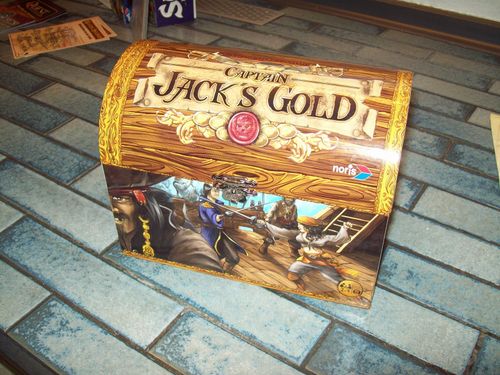
Captain Jack's Gold
Captain Jack's Gold Rulebook
Table of Contents
Table of Contents
Contents
- 4 player boards
- 4 ships in the colour of the player
- 1 die
- 90 sea cards, divided into 3 x 30 cards: coast, passage, high sea
- Pirate's island
- 25 pirate's coins
- 20 letters of Marque (piracy) (see http://en.wikipedia.org/wiki/Letter_of_marque)
- 10 bottles of rum chips
Preparation
Put the pirate's island together with the 25 pirate's coins and the die in the middle of the gaming table. Each player chooses a colour and takes the player board and ship of that colour.
Sort the 90 sea cards and deal them into 3 piles of 30 cards each: 1 pile of coast cards, 1 pile of passage cards and 1 pile of high sea cards. These sea cards are put on one side of the pirate's island. The 20 letters of piracy (Marque) are put on the other side of the island, as shown in the picture of the German rules.
In each sea card pile there are 7 cards with the pirate's chest-skull and crossed-cutlasses pirate symbol at the top of the card. To play the basic game, these cards, together with the rum chips, are put aside and not used. Once players are familiar with the basic rules they can play the advanced version.
Interpretation note: the source's wording at this step ("deal them up ininto") is garbled; the piles are read as dealt into 3 piles, which are then placed face down as the next paragraph states.
The 3 piles of sea cards and the pile of letters of piracy (Marque) are then shuffled separately. The 3 piles of sea cards and the pile of letters of piracy are put face down on the table. Four letters of piracy (Marque) are then drawn and laid face up. The flags and goods you see on the letters of piracy (Marque) have to be collected during the course of the game in order to win.
A good pirate's ship needs sails and cannons. However, your ship's capacity is limited and may not be able to carry all the goods, treasure cards and flags of captured ships you collect. So make good use of it.
At the start of the game each pirate ship has 2 sails and 1 cannon. The sails, shown on the left side of the player board, indicate how many sea cards you may reveal and turn over. The more sails, the more choice you have.
The cannons, shown on the right side of the player board, indicate how many throws of the die you get to capture another ship. The more cannons you have, the more chances you get to capture it.
The ship's hold (loading space) is situated at the bottom of the player board. Your ship's capacity is limited to 7 cards. Important: cards you use for sails or cannons are included in these 7 cards. You may at any time voluntarily discard any cards to free up space in your ship's hold.
Sea Cards
The 3 sets of sea cards represent 3 levels of difficulty. The coast cards, placed nearest to the island, mainly consist of cannons and sails, and the few ships to be captured are not strong. The passage cards are more valuable and tend to contain mostly goods, but are harder to get due to stronger ships which need capturing. The high sea cards are the most valuable, containing mainly flags, but these are the most difficult to capture.
How the Game Plays
The player with the longest beard starts the game. After this the turn passes in clockwise direction.
On his turn, the active player places his ship above one of the 3 piles of sea cards. He takes the top card from this pile, turns it face up for everyone to see and places it on the discard pile.
Note: take care that the green arrow is always in the upper left-hand corner. This is important because it is always the top half of the card that is activated first. Cards can be turned around later in the harbour.
The active player must then decide whether he wants to take this card or not. If he does not take it, he can draw another card.
If he takes the card drawn, this ends his turn. Play then passes to the player on his left.
If he does not take the card, he can continue to draw cards from the chosen pile for as long as he has sufficient sails to allow him to draw cards, or until he draws a card with a "depression" sign (a ship with a red 'X') on it. In that case all his remaining sails become void and he can no longer turn over any more cards.
He can always choose to take the last card turned over, but does not have to, in which case his turn is over.
Be careful to put each card drawn on top of the previous card in the discard pile so that there is only 1 revealed card.
ATTENTION: only the top card of those drawn can be taken.
When the draw pile of any set of sea cards is finished, take the discard pile of that set, shuffle it and use it as the new draw pile.
At the beginning of his turn each player may choose to place his ship above another pile of sea cards. He must then draw and reveal cards from this new pile. Once a pile has been chosen, no cards from other piles may be drawn during the active player's turn.
Taking Cards with Sails, Cannons, Goods or Treasure
When you draw cards with sails, cannons, goods or treasure in the upper half of the card, you can take that card and add it to your ship. Put the sails on the left-hand side of your ship, the cannons on the right-hand side, and all the other cards underneath your ship in the hold. You can only use this new card from your next turn onwards. Make sure that the green arrow in the upper left-hand corner of the card is pointing upwards. You can only place your chosen card in this way up into your ship.
IMPORTANT: You can have at most 7 cards laid out on your ship, sail and cannon cards included.
Taking Ship Cards (Capturing Ships)
Cards with the picture of a ship in the upper half are ship cards. If you draw one of these cards you can try to capture this ship and so get the flags or goods it holds.
To capture a ship you must throw the die and equal or exceed the value of the die shown on the card (next to the cannon symbol). To do this you can try as many times as you have cannons. Count the number of cannons your ship has (player board and cards added together). This is the number of times you can roll the die to succeed.
The value of the sails only counts in the advanced rules.
If you capture the ship, you may put the card beneath your ship in the loading space (hold). Note that any goods or flags from a captured ship are considered automatically activated (and therefore the card does not need to be turned around in the harbour). Whenever you capture a ship with a pirate's coin, take a pirate's coin from the island and discard the sea card on the appropriate discard pile.
If you fail to capture the ship after your maximum number of tries, your ship suffers damage. The player to your left may choose any card with sails or cannons on your ship and discard it to the appropriate sea card discard pile. (NB: he may not remove cards with goods, flags or treasure maps from beneath your ship.) If you have no sail or cannon cards, nothing happens.
A sea fight ends your turn.
In the Harbour: Fulfilling Letters of Piracy (Marque) and Turning Cards Around
From time to time you will have to go into the harbour. This is the only way to fulfil letters of piracy (Marque) and receive the much-needed pirate's gold, or to turn over sea cards in your ship so as to activate the bottom half, which will give you a better advantage.
To go into the harbour, place your ship on the pirate's island at the beginning of your turn. On the island you do not draw sea cards, but you may fulfil letters of piracy (Marque) and receive the appropriate gold. You may also fulfil letters of piracy (Marque) when you have captured the flags of England, France or Spain, or any of the 3 types of goods (cloth, cotton or cocoa), shown on sea cards in your ship collected during play. In exchange for these sea cards you will receive, according to the chosen letter of piracy (Marque), 1 or 2 pirate's coins. Put these on your player board.
Interpretation note: the source gives "coacoaao" for the third goods type; read as cocoa.
The goods or flags you discard have to match the ones depicted on one of the four face-up letters of piracy (Marque). You discard these sea cards on the appropriate discard pile.
When fulfilling a letter of piracy (Marque) you may have to waste goods. For example, if you have a card with 2 cotton and use it to take a letter of piracy (Marque) where you only need 1 cotton, the second cotton on your card is wasted. You cannot use 1 card to fulfil 2 different letters of piracy (Marque).
Once a letter of Marque has been fulfilled, it is discarded from the game and immediately replaced by a new one from the draw deck. The active player is allowed to fulfil this new one if he still has enough goods or flags on the same turn.
In addition to fulfilling letters of piracy (Marque), you can also choose to turn around sea cards on your ship when in the harbour, thus activating their other half. (You can still do this even if you have not fulfilled any letters of piracy (Marque) in this turn.) Take care to put sails on the left-hand side of your ship and cannons on the right-hand side when turning cards over. By turning a card around it is possible to switch sails to cannons and vice versa. (In the harbour you cannot draw any sea cards.)
Collecting Treasure Map Cards and Digging Up Treasure
By collecting sea cards with the treasure map symbol you can also gain pirate's coins. When you have collected 3 treasure map symbols on sea cards, you can claim the treasure and receive 2 pirate's coins. If you claim a treasure, discard the 3 sea cards to the appropriate discard pile. Put the 2 pirate's coins received onto your player board.
ATTENTION: To claim a hidden treasure you do NOT have to be in the harbour. You can claim your hidden treasure in the same turn as you draw sea cards. This may be claimed in the same turn as you get your third treasure card. However, to claim the treasure, each of your cards with the map symbol must be activated. I.e. if you have just collected a sea card with a map which is in the lower half of the card (unless it is on a ship card, in which case it is automatically activated), you will have to wait until you have been to the harbour to turn it around and activate it before claiming your coins.
Boarding Fellow Players' Ships
If you draw a sea card with a boarding sign (a pistol crossed with a cutlass), you can choose to take this card as normal or you can try to board a fellow player's ship that is in the same sea area as yours (i.e. draws from the same sea card draw pile as you). Boarding in the harbour is NOT permitted.
First the active player throws the die up to as many times as the number of cannons he has. Then the other player does likewise. Whoever throws the highest number wins the fight. If the score is equal, the fight is repeated until there is a winner.
The winner may take any one card he chooses from the loser and put this card onto his ship. This can be a sail, cannon, goods, treasure or flag. BEWARE: the card cannot be turned around.
Important: if you choose to board, you do not take the sea card which triggered the boarding, and your turn ends after the sea fight.
End of the Game
The game ends immediately once a pirate gets the required number of pirate's coins. With 2 players it is 10, with 3 players it is 8, and with 4 it is 7. The first to get the required amount wins the game.
Advanced Rules
When you have accustomed yourself to the basic rules, you can go on to play with the advanced rules. For this you will need the cards with the pirate symbol on the top and the rum chips that you set aside for the basic game.
Add the 21 (3 x 7) pirate symbol cards to the appropriate sea card piles, shuffle the 3 decks and put them beside the island as usual.
Interpretation note: the source says the pirate symbol cards and rum chips were "laid on the island" for the basic game, but the basic-game setup sets them aside; the advanced-rules text is followed as printed here.
Sea Fight
To engage in a sea fight with another ship you have to be able to catch up with this ship. Therefore you must have at least as many sails as the ship you are attacking. Count all your sails and compare them to the sails of the ship you want to attack (shown by the number to the left of the sail symbol). If you have fewer sails than the ship you want to attack, you cannot choose this sea card and have to go on drawing other sea cards, provided you have enough sails left to do this.
Important advanced rules: when fighting, instead of throwing the die as many times as you have cannons and choosing the best result from all throws, in the advanced rules only the last throw counts.
If you throw the same cannon value as the ship you attack, you win the fight but suffer damage. The player to your left can remove a sail or cannon card of his choice and put it on the respective discard pile. Playing with the advanced rules makes it harder to win a sea fight, because you not only lose a cannon or sail when you lose the fight, but even if you succeed, if you have tied on the die roll. Therefore it can be useful to keep on throwing the die if you win the fight on a tie, in order to try for a better result. However, remember that each time you throw the die, all the previous results become void.
Sandbanks, Storms and Sea Monsters
If as active player you draw a card with a sandbank, storm or sea monster, you MUST choose this card because you cannot evade it. If you fail, your turn is over but you do not lose a card from your ship. If you win, your turn also ends, but you can put the card onto your ship, thus activating the lower half of the card.
Sandbank: with a sandbank you win if you have at least the same number of cards (counting sails, cannons and cards in the hold) as is indicated on the sandbank.
Storm: your ship must have at least as many sails as the value of the storm.
Sea monster: you must roll the die and equal or exceed the value of the sea monster. You have as many opportunities as you have cannons.
Pirates
A ship carrying a pirate's flag can be used as a joker and can be used for any kind of flag when trying to fulfil a letter of piracy (Marque).
Sailors and Passengers
A good pirate's ship has well-trained sailors aboard. But without rum, not much will be done by them. To activate a sailor's action, you have to have turned the card around beforehand (the source says "remember the use of the island", i.e. the harbour turn-around rules) so that the sailor's half is turned upwards. Then you have to put a bottle of rum on it in order to activate it.
Each time the active player draws a sea card (even if he chooses not to take it) that shows a bottle of rum beneath the green arrow, all other players (i.e. not the active player) may each take a bottle of rum chip out of the stock and place this bottle on an already turned-around sailor sea card of their own, thus activating it. This only applies to sailors which are not permanently activated (i.e. have a grey bottle of rum symbol next to them). More than one bottle of rum can be present on one sailor sea card.
If the sea card is later removed by another player as a result of boarding the ship, the bottles stay in place on the card.
For the following 4 sailors, the bottle of rum is returned to the island after executing the action. These can be identified by the grey bottle of rum symbol on the right side of the sailor's picture. These sailors' actions can be used again once they have again been equipped with another bottle of rum.
- Helmsman: this card may be used once as a card worth 4 sails.
- Cook: with this card you can ignore the depression symbol (which ends a player's turn) and keep on drawing cards. (The cook's action does not count when encountering a sandbank, storm or sea monster.)
- Paymaster: when trying to fulfil a letter of piracy (Marque) in the harbour, you can give one different goods item to that required by the letter of piracy (Marque).
- Lookout: with this card you may choose to take the top sea card of the discard pile instead of drawing a new card.
With the following 4 sailors, a green bottle of rum symbol is already depicted on the right side of the card. Their actions are always available.
-
Quartermaster: your ship's hold becomes bigger and can be used to store 10 cards instead of 7. This card is always active.
-
Carpenter: at the end of his turn, the active player can turn over one of his cards, even if he is not in the harbour.
-
Sail maker: this card counts as 2 sails. It cannot be taken away if attempting to capture a ship is unsuccessful, because the card is placed beneath the ship in the hold and not on the side. A fellow player boarding the ship can take this card.
-
Gunman: when in a sea fight, the player can add 1 additional try to his total number of tries to roll the die.
-
Passengers: passengers are picked up as stowaways. No bottle of rum is needed to activate them.
If as the active player you draw a sea card on which the flag depicted at the bottom corresponds to the flag of a passenger you are currently carrying on your ship, then you can either begin a sea fight in order to gain the card as usual (and use it later to fulfil a letter of Marque), or discard both the sea card and the corresponding passenger card to the appropriate discard pile and receive 1 pirate's coin. In the latter case a sea fight does not happen. It is also possible to discard this sea card if, by lack of sails, you cannot catch up with the other ship.