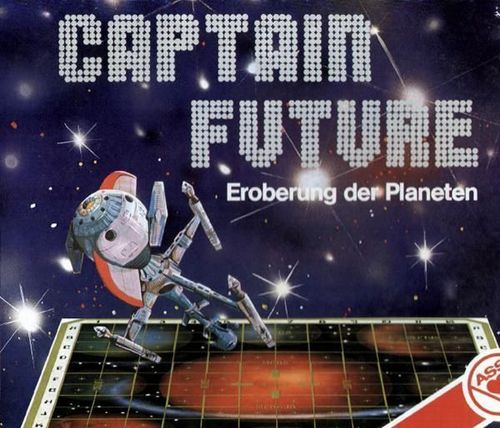
Captain Future
Captain Future Rulebook
Table of Contents
Table of Contents
Object
Occupy as many spaces on the planets as possible.
Bits
1 board, 66 space cards (space and event cards); 170 spaceships, 1 secret stone, rules.
Setup
Place the secret stone on any space of a planet. The 66 space cards are shuffled. Each player takes a color and 10 space cards and the spaceships of that color:
With 2 players, use blue and yellow. Each player gets 50 ships. With 3 players, add red, and give each player 40 ships. With 4 players, add green, and each player gets 30 ships.
It is possible to shorten the game by giving players less ships, though all players must receive the same number.
The rest of the cards form a stack near the board.
Space cards
The 56 trajectory cards refer to a space on the game board.
A letter or number: The spaceship is placed on any space in that row or column. Planet: A spaceship is placed on any space on this planet. Joker: The spaceship lands on any space on a planet or moon (mons).
Game course
The youngest player starts. He plays two trajectory cards to place two spaceships on the chosen spaces.
This is 'landing' and is playing onto an empty space only. It costs just one card to do.
Example: A player plays "B" and "3". The play could land a spaceship on row B and one on column 3. He could use those spaces to cover two spaces on Uranus.
Why place two spaceships on one planet? Because it is important to have the majority on a planet as you will see.
The player then draws two new cards to replace his cards with two from the stack. Then it is the next player's turn.
If all spaces on a planet are occupied, the planet is conquered. 'Attacks' can only occur on a conquered planet, not on any which still have free spaces.
[Note: the source spells this word "conquererd"; corrected here to "conquered".]
Whoever has the majority on a planet can play 1 card to kick a foreign ship off the planet. A player without the majority, but at least one spaceship on the planet can attack a spaceship on the planet with two cards.
A player without a spaceship on the planet can attack with 3 cards. If no players have a definite majority, then all attacks require two or three cards.
Example: Space A-11 can be attacked by A, 11, Neptune or a joker. Any two or three of those cards can be used for an attack.
Enemy ships on attacked spaces are removed from the game (and so cannot be reused), and a spaceship of the attacking player replaces it. Players may make 1 or 2 attacks per turn. They draw replacement cards to bring their hand back to 10 cards.
If a player acquires the majority with a double attack as his first action of a turn, then if his second attack is on the same planet he can attack with just one card as he now has the majority.
Exchanging cards: Instead of an attack one card may be discarded and a new one drawn. This can be combined with a landing or an attack, and may be done twice in a turn if no other attacks / landings are performed.
Event Cards: 1 event card may be played before or after he plays trajectory cards or exchanges cards.
The secret stone: This blocks actions on the board. If on a row or column, it blocks attacks on that row or column. Placed on a planet, it keeps ships from landing or attacking that planet.
End
The game ends when a player plays his last ship. Each other player may play one more time before the game ends. However, no three card attacks may be made.
Each player gets as many points as he has spaceships on planets. Whoever completely controls a planet gets 5 for a big planet, 4 for an average planet, and 3 for a moon. For other planets a player with a majority receives one extra point.
Event Cards
There are only four different events. One for each of the henchmen, and the remove a ship card.
Simon Wright orders: The secret stone may be moved to a different row, column or another planet.
Each player takes one of his ships off of a planet and returns it to the space before him. It may be replaced at any time later in the game.
Otto the Android helps: The player may transfer one of his ships to a new space. If the new space is occupied, the two ships trade places.
GRAG helps out. The player may take any space on the board with one of his ships. An opponent's ship on the space is returned to its owner and may be reused.