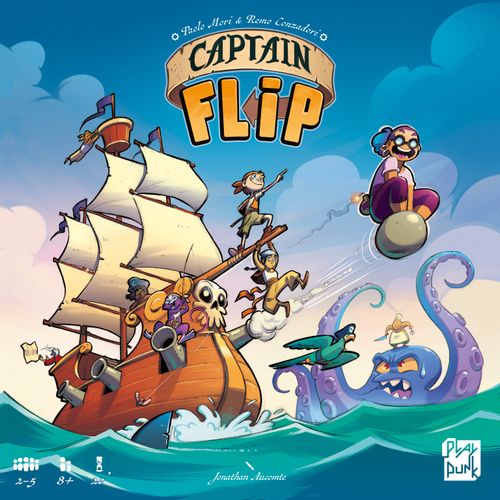
Captain Flip
27 questions players ask about Captain Flip, answered in plain words and graded by where the answer comes from. See also the full rulebook.
Updated 2026-10-30.
27 questions players ask about Captain Flip, answered in plain words and graded by where the answer comes from. See also the full rulebook.
Updated 2026-10-30.
No — each Adventure board exists in only five copies, so a sixth player has no board, and the tile supply could not support a sixth player.
Yes — there are nine characters and each appears on 16 of the tile faces. There are 36 different character pairings, each present on two tiles (72 tiles in all), and no tile shows the same character on both sides.
The rulebook's Setup section says this.
Yes — all boards of the same letter are identical, except one that has a pirate flag in the upper-left corner. Its holder starts the game.
The designer confirmed this, and it matches the rulebook's turn steps.
Yes — you choose the column, but within it the tile goes on the lowest empty space. Some columns start higher than the bottom row, which is what the Board Anatomy note means; it does not let you pick any starting space.
The publisher confirmed all effects are mandatory.
Yes — all effects are mandatory. The one exception is a Monkey with no adjacent tile: then there is simply nothing to flip.
The rulebook's FAQ says the flip is simply skipped when the Monkey has no neighbor.
Yes — you still take the Monkey's 1 coin; you just skip the flip because no tile is adjacent.
The designer confirmed this reading.
Yes — a flipped tile's effect applies as if it had just been placed, so a Gunner pays 5 coins and a revealed Monkey activates and flips in turn. Chains work the same way.
Two players agree, but there is no official ruling on chains.
Yes — a Monkey can flip back an earlier Monkey if it is adjacent, and that ends the chain there. A Monkey only ever flips tiles adjacent to itself.
Step 4 of the rulebook's Gameplay Overview states this order.
The tile's immediate effect comes first, then the column bonus applies if the tile sits on the column's highest space.
The rulebook ties the bonus to a tile being on the highest space when placed, and players agree.
No — the bonus is collected only when a tile is placed on the highest space of that column. Nothing later re-triggers it.
The player aid text says so and players confirmed it.
Every turn — if you hold the Treasure Map at the end of your turn you take 1 coin, so it repeats for as long as you keep it.
The rulebook says the coin comes at the end of your turn.
Once, at the end of your whole turn after all tiles are placed, not after the Parrot alone.
One player reports this from the game state; the rulebook is silent.
No — nothing in the rules lets you check the back of a placed tile, even one you flipped before placing it.
The Board Anatomy section defines adjacency.
Orthogonal — up, down, left and right all count. Diagonal spaces and spaces separated by a gap do not.
The Board Anatomy and Cook text together settle this.
Yes — rows may have empty spaces, and the Cook counts every tile in its row, itself included.
The designer said the loss happens at the end of the game, matching the rulebook.
It is checked at the end of the game. The 5 coins come immediately, but the loss applies only if you still have three or more Gunners at the end, so flipping one away beforehand avoids it.
Everyone loses; nobody wins on points, so the Treasure Map tiebreaker does not apply.
The publisher said to play the Parrot effect first.
Yes — resolve the Parrot's effect first, then the round is finished as usual, so the remaining players still take their turns.
The designer answered yes to all three parts.
Yes to both — the Parrot's immediate effect applies, the newly drawn tile can be kept or flipped as normal, and a second Parrot triggers its own draw.
Several players agree and it fits the rulebook's yellow-box rule; no official ruling.
A Cook scores only when it is placed or revealed by a flip (which counts as newly placed), one coin per tile in its row at that moment. Adding tiles later does not rescore it, and a tile's back side never scores.
The designer gave an example and the rulebook says the Cook counts itself.
One coin per tile in its row at placement, counting the Cook itself. A Cook placed in a row that already holds three tiles scores 4 coins.
The Swabby card text states this.
Swabbies score by number of columns containing at least one Swabby, not by Swabby count: 1/4/9/16/25 coins for 1 to 5 columns. Extra Swabbies in a column already counted add nothing.
Two players agree; no official ruling.
No — only Cartographer tiles carry the icons that count; Navigator tiles do not.
The designer confirmed this.
Yes — the bonus belongs to the covered space at the column's top, so the column must be filled up to it.
The designer confirmed it.
Only from the space it is attached to; covering the diagonal spaces does not trigger it.
Yes — three bomb symbols at game end cause a loss even without any Gunner.
Yes, according to players — the solo rules from the Captain Flip: In the Jaws of the Kraken expansion have been used with Isla Bomba maps. Column and row bonuses that depend on being first need a house ruling, since the solo rules do not cover them.