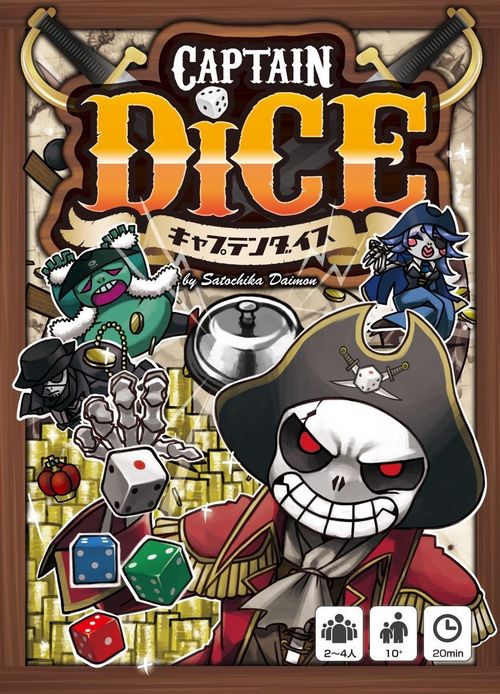
Captain Dice
Captain Dice Rulebook
Table of Contents
Table of Contents
To Put the Game in a Nutshell
Secure territories pre-emptively by placing a pair of dice on the treasure cards as fast as possible, then take time to think about how to protect the territories with attack cards, so that other players cannot foil your plans. If you are successful in holding your territory on the treasure cards, then SUCCESS! The treasure cards are rewarded to you and the process is repeated again. In the end, the player with the most treasure cards wins.
Components
- Bell: 1 item.
- Dice: 24 pieces (6 pieces x 4 colors: red, blue, green, white).
- Treasure cards: 42 cards (2 x 21 kinds).
- Attack cards: 36 cards (9 cards with 6 kinds x 4 colors).
How to Read Attack Cards
- The number on the card indicates the order of attack card effects during the BATTLE PHASE. The order of priority is as follows: 0 → 1 → 2 → 3 → 4 → 5.
- The name of the attack card is printed on the card.
- The effect range of the attack cards is as described in the text.
- The illustration depicts the area of effect of the attack card. The attack cards of your opponents that lie within the colored areas will be discarded.
Attack Cards: 6 Kinds
| No. | Name | Quantity |
|---|---|---|
| 0 | Vile Hostage Strategy | 1 card per color (4 total) |
| 1 | Squadron Battle on Board | 1 card per color (4 total) |
| 2 | Side Cannon | 1 card per color (4 total) |
| 3 | Main Cannon | 1 card per color (4 total) |
| 4 | Wrath of the Great Squid King | 1 card per color (4 total) |
| 5 | Spy Ship | 4 cards per color (16 total) |
Game Preparation
- Each player chooses a color (red, blue, white or green) as they like, and then takes all 9 attack cards and dice in the same color. The players should hold all of the attack cards in hand.
- Turn the treasure cards face down, shuffle them well, and then place them into a deck.
- Take 16 treasure cards from the top of the deck, turn them face up, and line up 4 of the cards vertically and 4 of them horizontally. Place the bell in t[he center] (the printed text is cut off at the edge of the page here; the placement is shown in the set-up diagram).
- Determine the first player with rock-paper-scissors or any other convenient method.
2 Players
- After each player receives their respective 9 attack cards, remove both of the (5) Spy Ship cards and put them back in the box. These cards will not be used for 2 players. Hold all 7 remaining cards in hand.
- Turn the treasure cards face down, shuffle them thoroughly, and then place them into a deck. Take 10 cards from the deck in random order, and put them back in the box. These cards will not be used.
- Take 9 treasure cards from the top of the deck, turn them face up, and line up 3 of the cards vertically and 3 horizontally. Place the bell to set up the game board.
Basic Game Flow
- DICE PHASE: Roll the dice on hand, and secure the treasure cards on the field pre-emptively as one's own territory.
- SET UP PHASE: Put the attack cards face down on the treasure cards that have been secured pre-emptively as occupied territory.
- BATTLE PHASE: Turn the attack cards on the field face up, then interfere with each other by activating the effects in order of attack speed.
- TREASURE PHASE: The treasure cards on surviving territories are rewarded, then the field is restocked with new cards from the deck.
Confirm the requirements for ending the game.
The sequence from 1-4 counts as 1 round, which repeats itself until there are only 8 or fewer treasure cards left at the end of the turn. This marks the end of the game. The player with the most treasure cards at the end wins.
Basic Rule "Action Mode"
1. Dice Phase
During this phase, the players can roll the dice on hand, and secure the treasure cards on the field pre-emptively as their territory. After having advanced past the SET UP PHASE and BATTLE PHASE, the players are rewarded with the treasure cards on their surviving territories during the TREASURE PHASE. The players can score points with these cards.
Diagram captions: (1) The first player can ring the bell at any given time. (2) When the bell is rung, every player has to cast their dice on hand at once! (3) In order to secure the land of treasure, place a pair of dice on the treasure cards with the same numbers as the outcome of the dice. It is not possible to place a pair of dice on treasure cards that are already occupied.
There are no turns during the DICE PHASE; instead, everyone is to take actions simultaneously.
- The first player has the power to ring the bell at any given time. When the bell is rung, every player has to cast their 6 dice on hand all at once.
- The player checks the outcome of their thrown dice, and in order to secure the land of treasure, places two dice simultaneously on the treasure cards that show the same numbers as the outcome of their dice. It is not possible to place any dice on treasure cards that are already occupied by other players.
- During the DICE PHASE, the players are free to re-roll the dice on hand as many times as they like.
- The players should cast the remaining dice on hand, which have not been placed on treasure cards, all at the same time.
End of the Dice Phase
If the following conditions are fulfilled, then any player may ring the bell to end the DICE PHASE at any time.
- 3-4 players: Any of the players can end the phase when more than 3 treasure cards are occupied within any of the vertical, horizontal or diagonal rows of cards.
- Requirements met (diagram): dice have been placed on more than 3 places in a line. The requirements are met, so any player can ring the bell and end the phase.
- Requirements not met (diagram): none of the vertical, horizontal or diagonal rows have more than 3 occupied treasure cards, so no one can ring the end bell.
- 2 players: Any of the players can end when more than 3 treasure cards are occupied.
Whoever rings the bell to announce the end of the DICE PHASE gets to go first in the next round, until the end of that round's DICE PHASE.
ATTENTION: In case someone rings the bell by mistake, without meeting the proper requirements for ending the DICE PHASE, they will suffer a penalty, and they are not allowed to cast or place their dice, nor ring the bell until the proper conclusion of the DICE PHASE. They have to stand by until one of the other players rings the bell.
TIPS & NOTES (DICE PHASE):
- The first player may ring the bell and start the game at any given time, therefore, it is important to memorize the dice numbers printed on the treasure cards to some extent. It is also possible to play the game by making small talk, and then ring the bell when the other players are distracted.
- The player can place the dice on more than 2 positions, even if they only have 1 attack card left on hand. The reason behind this will be explained in the following section "SET UP PHASE".
Treasure cards with dice of one's own color on top in the DICE PHASE, and treasure cards with attack cards of one's own color on top after the SET UP PHASE, are referred to as "territories (occupied territories)".
2. Set Up Phase
During this phase, the players can secure their territories on the treasure cards (with the dice of their color on top) by placing the attack cards face down.
Each attack card has different effects, such as nullifying the placement of the opponents' attack cards or interfering with territories.
The area of effect of the attack cards is depicted on the bottom right of each card. The area of effect has an impact on every attack card of opponents within range. However, it does not affect one's own attack cards.
The effects of the attack cards activate during the upcoming BATTLE PHASE, starting with the smallest number (0 → 1 → 2 → 3 → 4 → 5). Get the hang of using the attack cards to attack treasure cards on the territories of other players, and do not allow anyone to take away one's own treasure cards.
Diagram captions: (1) Starting with the first player who rang the end bell, each player takes turns clockwise. (2) Place the attack card on the treasure card occupied by one's own dice, and take back the dice. (3) If there are no more dice with the player's color occupying treasure cards on the field, skip a turn.
- Starting from the first player, each player takes turns clockwise. The first player is the person who rang the bell determining the end of the previous DICE PHASE.
- On the player's turn, choose 1 attack card from hand, and place it face down on 1 of the treasure cards that are occupied with their dice. Recollect the 2 dice placed on top of the treasure card when dealing the attack card.
ATTENTION:
- If there are no more treasure cards occupied by one's own dice left on the field, then the player has to skip a turn.
- If there are treasure cards taken up by one's own dice on the field, then the player has to place an attack card on their turn.
- If the player uses up all of their attack cards on their turn, during which they are required to place an attack card, they can take all of their discarded attack cards back on hand.
TIPS & NOTES (SET UP PHASE):
- Hold all of the 9 attack cards in hand at the beginning of the game.
- Have a go at discussing or negotiating with other players in order to make a successful attack on players with high scores, as well as keep the damage to a minimum.
The SET UP PHASE ends when all of the players have put down their attack cards on their occupied treasure cards face down, and all of the dice have been removed from the field.
3. Battle Phase
In this phase, the players will turn everyone's attack cards on the field face up, and interfere with each other's territories by activating the attack card effects in order of attack speed.
Flip every attack card that has been placed face down to face up all at once. Then activate the effect of each attack card in the order printed on the upper left of the attack cards (1 → 2 → 3 → 4 → 5).
The cards of the opponents that lie within the area of effect of the player's attack card are discarded and sent back to the pile of each respective owner. Each affected player should place the cards face down on their own pile. (They are to remain secret.)
If attack cards with the same attack speed are placed, e.g., 2 "Squadron Battle on Board [1]" cards in the same turn, the priority of card effect will be in clockwise order starting with the first player.
The BATTLE PHASE ends when the effects of every attack card have been activated.
Example
The first player is marked red. The players take turns clockwise in the order of red → blue → green. Priority: RED → BLUE → GREEN.
ORDER ①: "Squadron Battle on Board [1]" (Blue), "Squadron Battle on Board [1]" (Green)
- "Vile Hostage Strategy [0]" (green) will not be affected.
- 2 players played the "Squadron Battle on Board [1]" card. In this case, the effects activate in clockwise order starting with the first player (blue). The blue player gets priority in this example. Furthermore, "Main Cannon [3]" (red) and "Squadron Battle on Board [1]" (green) become invalid.
- The effect of the "Squadron Battle on Board [1]" card sends opponents' cards of its immediate surrounding back to their owner's discarded pile.
ORDER ②: "Side Cannon [2]" (Red)
- The next card which has higher attack speed is "Side Cannon [2]" (red). It sends opponents' attack cards within a horizontal line back to their owner's discarded pile.
- The effect of "Side Cannon [2]" (red) discards "Squadron Battle on Board [1]" (blue). Similarly, depending on the positioning, it is possible to discard a "Side Cannon [2]" (red) with a "Squadron Battle on Board [1]" card.
TIPS & NOTES (BATTLE PHASE):
- The different effects of the attack cards target every attack card of opponents within range. E.g., when 3 opponents' attack cards are within the area of effect of the player's "[2] Side Cannon" card, then all 3 of them will be sent back to their owners' deck.
- The effect of each attack card does not affect attack cards of the same color.
4. Treasure Phase
During this phase, the players receive the treasure cards on their surviving territories as reward, and restock the field with new treasure cards from the main deck.
The players are rewarded with the treasure cards on which their own attack cards remain placed. In addition, they can also obtain every treasure card sandwiched between their attack cards in a vertical, horizontal or diagonal line. But none of that counts if there are cards of another player placed in between their row of cards.
Example
The blue player's attack cards, "Wrath of the Great Squid King [4]" and "Spy Ship [5]", surround 4 treasure cards horizontally, so they obtain all 4 cards.
- After the players obtain the treasure cards, the used attack cards are gathered in a pile, and put face down on the table close to themselves.
- 1 treasure card in possession is worth 1 point, and the player with the most treasure cards wins.
- After obtaining the treasure cards, restock the empty card spots with new cards from the main deck.
- Restore the field to its original 4 × 4 placement with treasure cards from the main deck. This is done by the first player.
- If there are no more cards remaining in the deck, and the 4 × 4 field with 16 cards cannot be maintained anymore, then re-arrange the available treasure cards to form a rectangular formation. This is also done by the first player.
TIPS & NOTES (TREASURE PHASE): It is possible to gain a large score if the players can obtain the treasure cards lying in between their attack cards in a vertical, horizontal or diagonal line. Trying to squeeze as many treasure cards in between during the DICE PHASE, or selecting the right attack cards to protect sandwiched territories during the BATTLE PHASE, are all important choices to make.
End of the Game & How to Win
The game ends when there are no more treasure cards left in the deck and less than 8 treasure cards left on the field after the TREASURE PHASE (when the 3 × 3 formation is not possible anymore).
Note: the basic game flow above states the round repeats "until there are only 8 or fewer treasure cards left at the end of the turn"; the end-of-game section here says "less than 8". Both are transcribed as printed.
At the end of the game, the player with the most treasure cards wins.
- If there are multiple players who end up with the same number of treasure cards, then the player with the most treasure cards containing matching dice numbers (11, 33, etc.) comes off victorious.
- In the extremely rare case of players obtaining the same number of matching dice as well, all of you should communicate with each other, and "the player who was the most delighted bell ringer" shall emerge as winner.
Start the next round (1. DICE PHASE) if there are more than 8 treasure cards on the field.
The first player can ring the bell to begin the DICE PHASE for the next round at any time. The same player who rang the bell to end the DICE PHASE of the previous round becomes the new first player.
Additional Notes
Basis: If there is a conflict with overlapping timing between players while playing Captain Dice, priority is always clockwise from the first player.
Whoever rings the bell to end the DICE PHASE is the new first player until the end of the next DICE PHASE. The first player has 3 special advantages:
- If the order of attack speed (the number on the upper left of the attack cards) overlaps, conflict is resolved in clockwise order from the first player. (In other words, the card effect of the first player gets priority first, making it very easy to gain the upper hand during the BATTLE PHASE.)
- The first player can ring the start bell for the DICE PHASE at any given time. They can do so when everyone is distracted during a conversation or after memorizing the dice numbers on the open treasure cards.
- If more than 1 player were to secure a row of treasure cards with their attack cards, then the priority to get the sandwiched cards during the TREASURE PHASE is clockwise from the first player.
Example (First Player: Red)
As shown in the example below, the player in red is able to obtain "Card B".
As shown in the example below, the player in red is not able to obtain "Card A".
- During the DICE PHASE, it is possible to place the dice on 2 different cards, even with only 1 remaining attack card on hand. When it is the player's turn to place a card, but they are empty-handed during the SET UP PHASE, they can redraw all of their discarded attack cards from the waste pile.
- If the priority of attack speed (the number on the upper left of the attack cards) overlaps during the BATTLE PHASE, play order is clockwise beginning with the first player.
- When restocking the treasure cards on the field during the TREASURE PHASE, the players can continue the game even if there are not enough cards for a 4 × 4 formation. Re-arrange a rectangle formation with the cards available. This task should be conducted by the first player.
- If there are cards of other players placed in between the player's sandwiched treasure cards, then it does not count as "sandwiched".
2 Players (Changes)
Game Preparation (Changes)
- They will not be used in the game for 2 players. They will not be used in the game for 2 players. Hold the remaining 7 cards in hand. (The sentence is printed twice in the source.)
- Turn the treasure cards face down, shuffle them well, and place them in a deck. Remove 10 cards from the deck in random order, and put them back in the box. They will not be used.
- Take 9 treasure cards from the top of the deck, turn them face up, and line up 3 of the cards vertically and 3 of them horizontally. Place the bell to set up the game board.
Dice Phase (Changes)
The requirement to ring the bell and end the DICE PHASE is met when more than 3 treasure cards on the field are occupied with dice, regardless of players.
TIPS & NOTES: The rest of the game, rules, and winning condition, etc., are the same as the basic rules for 3-4 players. The requirements for ending the game are the same as well. The game ends when there are no more treasure cards left in the deck and less than 8 treasure cards on the field (= when you cannot establish a 3 × 3 formation).
NOTES FOR 2 PLAYERS:
- Due to the small size of the game field, it is very important to know which cards remain in the opponent's hand, and place the dice at places out of attack range during the DICE PHASE.
- The attack priority for ringing the bell first will prove to be powerful, so do not forget to consult with the cards on hand, place the dice strategically while watching the opponent's movement, and do not forget to ring the bell!
How to Have More Fun
Captain Dice is a game which offers a high degree of freedom. Different play styles can be experienced by slightly adjusting the rules. Here are some examples showing different ways to play Captain Dice.
- Reverse the priority of attack speed: Try switching the priority order of attack effects to 0 → 5 → 4 → 3 → 2 → 1 for the BATTLE PHASE. The gameplay will feel distinctive with a different strategic direction.
- Remove the Spy Ship cards: Try removing the Spy Ships (all 4 cards) that do not have any attack effect, and play with only 5 attack cards. Filled with intense attacks, it becomes even more fun to play this game at parties.
- Change the way to end the DICE PHASE: Try to change the rules for ending the DICE PHASE, so you can only ring the bell after every player has placed down all of their dice.
The basic and strategic rules explained in this rulebook have been test played more than a hundred times. The game balance has been improved, so the rules are easy to follow for players of all kinds. However, there were voices that preferred slightly modified rules which differed from the ones described before. After all, the greatness of analogue board games comes in the form of a high degree of freedom in terms of gameplay, local rules depending on the circle of players, and also big changes during test plays.
Roll the dice. Seize and place them quickly. Sometimes accidentally bump hands with opponents. Ring the bell. Do not miss out on Captain Dice, a game packed with experience that can only be gained in analogue games!
New Rule "Strategic Mode"
Removing the action elements from the basic rule of Captain Dice, the strategic rule focuses on taking time to come up with strategies. Players who have trouble casting the dice quickly can enjoy this game in a different way.
The game preparation, basic game flow, end of game and winning conditions are the same as the basic rule "Action Mode". The only thing that changes is the way to play the DICE PHASE.
Dice Phase (Strategic Mode)
At the beginning of the DICE PHASE, all of the players roll the dice at the same time. Afterwards, the players take turns clockwise following the first player. Each player can choose one of the following actions during their turn.
- Action 1: Reroll any of the dice at hand. The player can choose any dice that have not been placed on treasure cards and are still in their hand, and reroll them once. They can choose to reroll multiple dice. They are allowed to reroll all at once or only one die.
- Action 2: Place the dice. Utilize the dice number of cast dice at hand and place a pair of them on the treasure cards with the same dice number, in order to secure their territory of treasure. The player cannot place a dice on treasure cards that are already occupied by any other player. The DICE PHASE comes to an end when the treasure cards are occupied with dice forming a vertical, diagonal or horizontal line.
Caption: In the case of "Action 2", if the dice are placed in any of the following places, then the treasure cards are occupied in a row. The DICE PHASE will end and the SET UP PHASE will begin.
After the DICE PHASE has ended, the players move on to the SET UP PHASE. The player who put an end to the DICE PHASE becomes the first player until the end of the DICE PHASE in the next round. The gameplay follows the same rules as the basic rules of "Action Mode" after the DICE PHASE is over.
NOTES (STRATEGIC MODE):
- Just like with the basic rules, the first player is at a great advantage.
- It is easy to see the dice numbers of the enemies in this mode, so choose actions wisely. Try not to let other players place any cards at an advantageous position or let them meet the requirements to end turns.
- Consult with the cards at hand while thinking about where to place the dice.
- Make sure to team up with other players and foil the plans of players with a high score.
Attack Card List
| Card | Name | Ability | Effect |
|---|---|---|---|
| 0 | Vile Hostage Strategy | Invincibility | The effect of the attack card prevents this card from being discarded. |
| 1 | Squadron Battle on Board | Adjacent attack | Discards all attack cards of other players placed on an adjacent square. |
| 2 | Side Cannon | Side attack | Discards all attack cards of other players on the same horizontal line. |
| 3 | Main Cannon | Front/back attack | Discards all attack cards of other players on the same vertical line. |
| 4 | Wrath of the Great Squid King | Diagonal attack | Discards all attack cards of other players on the same diagonal lines. |
| 5 | Spy Ship |