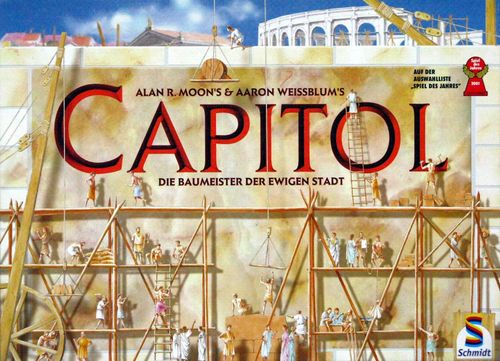
Capitol
Capitol Rulebook
Table of Contents
Table of Contents
Contents
- 1 game board with 9 prefectures (the 7 hills, the Field of Mars, and Tiber Island)
- 90 building blocks
- 40 roofs (10 each in 4 colors, 5 round and 5 pointed per color)
- 12 neutral structures (tiles): 8 fountains, 2 amphitheaters, 2 temples
- 62 action cards:
- 14 roof cards (the values 1-7, twice each)
- 24 building-block cards (the values 1-8, three times each)
- 24 building permits (the values 1-8 once each, in the three prefecture colors)
- 4 senator cards (STOP cards) in the players' colors
- 1 consul (starting-player marker)
- 4 scoring columns (in the players' colors)
- 1 column base
- Instructions
Setup
Place the game board in the middle of the table. It shows 9 prefectures: 3 light blue, 3 purple, and 3 pink. Along the right-hand edge you will find the 12 auction spaces for the neutral structures that are auctioned off during play.
Sort the cards by roof cards, building-block cards, and building permits, and shuffle each pile separately. Then deal the following cards face down to each player:
- 2 roof cards
- 2 building-block cards
- 4 building permits
Then place the three remaining card piles face up as draw piles next to the game board. Each player also receives one senator card (STOP card) in their color, which always stays with that player.
Players hold their cards face down in hand.
Each player takes all the roofs of one color plus 6 building blocks, which they arrange in front of themselves next to the game board as follows:
- 1 house with 1 building block and a round roof,
- 1 house with 2 building blocks and a round roof,
- 1 house with 1 building block and a pointed roof,
- 1 house with 2 building blocks and a pointed roof.
The remaining building blocks are placed next to the game board. The roofs remain with the respective players.
Place the fountains, amphitheaters, and temples according to the symbols on the auction spaces at the edge of the game board. There they wait, ready to be auctioned off one after another and then placed into the prefectures.
The column base is used to display the score and to hold the columns together. Fold both outer ends of the base 180 degrees down along the scored lines, and glue them (or use double-sided tape) to the underside of the base.
The 4 columns are placed side by side under the base, so that the two outer columns (red and blue) rest against the folded and glued edges of the base. Push the columns into the base far enough that they do not yet show any points, i.e. do not protrude from the base.
At the 4 scorings of the game, push the columns out from under the base (pressing down lightly on top of the base as you do) by an amount corresponding to the number of points reached.
Scoring example: Blue 26 points, Green 32 points, Yellow 37 points, Red 28 points
The oldest player receives the consul and is thereby the starting player in the first round.
The Goal
The players build houses and try to achieve the majority of building blocks as often as possible in the 9 prefectures. To do this they use cards, which they also need as bids in the auctions each round. Whoever has scored the most points overall after the last scoring wins the game.
Course of Play
The game runs over 4 rounds. Each round has a Building phase, an Auction phase, a Scoring phase, and a Card-drawing phase.
A. Building Phase
Beginning with the starting player, the players in clockwise order each have one of the following options in turn:
a. Play a building-block card The player takes 2 building blocks from the general supply and uses them to raise their houses already under construction or to begin the construction of one or more new houses.
b. Play a roof card The player takes one of their unbuilt roofs and places it on one of their houses under construction. The house is thereby completed.
c. Play a building permit The player may place one of their completed houses onto the game board, into a prefecture of the color of the building permit.
d. Pass The player forgoes any further actions for the rest of the Building phase.
a. / b. Building Rules
When a player plays a building-block card, they must decide immediately and finally how they wish to use the two building blocks with their houses. This decision cannot be changed later.
A house without a roof is not complete and cannot be built onto the game board. Building blocks may continue to be added to such a house. Removing building blocks is not allowed.
If the building blocks run out before the end of the game, players can no longer take any building blocks from the supply when they play a building-block card.
If a player plays a roof card and places a roof onto one of their houses, that house is thereby completed and can no longer be changed.
c. Building Permit
Houses and fountains are built on the small, colored-bordered squares (building-block spaces). Amphitheaters and temples are built on the large, colored-bordered squares (building spaces).
After playing a building permit, the player may place one of their houses onto the game board according to the following rules:
- The color of the building permit determines which prefecture the player may build their house in.
- The house must be placed on a free building-block space (a small, bordered space).
- Houses may not be built on a large, bordered space, and not on a fountain.
- If a house is built in a prefecture where no house yet stands, it may have either a round or a pointed roof. However, all houses in one prefecture must have the same roof shape. Furthermore, not all three prefectures of one color may have the same roof shape built in them. For example, if the two light-blue prefectures already have houses with a pointed roof, then a house with a round roof must be built in the third light-blue prefecture.
- The first house built in a prefecture must be exactly one building block tall. Every further house in that prefecture must be exactly as tall as, or one building block taller than, the currently tallest house in that prefecture. Example: two houses stand in one prefecture, one with one story and one with two stories. A new house in this prefecture must therefore be two or three stories tall.
d. Pass
Even once all the other players have passed, a player may continue playing as long as they hold cards. Once a player has passed, they may not re-enter the current Building phase.
The numbers on the cards play no role during the Building phase. They only come into play during the Auction phase.
It is permitted to play a card without carrying out an action (this is sometimes necessary in order to remain active during the Building phase).
The Building phase ends once all players have passed.
Rules for the cards
Played cards are placed face down next to the draw pile of the respective card type, forming a discard pile.
The cards are never shuffled. Once a draw pile is used up, the corresponding discard pile is simply turned over and placed as the new draw pile in its designated spot next to the game board.
B. Auction Phase
Of the structures lying on the game board, 3 are auctioned off individually, one after another, each round. From top to bottom, these are:
- Round 1: Fountain / Fountain / Amphitheater
- Round 2: Fountain / Fountain / Amphitheater
- Round 3: Fountain / Fountain / Temple
- Round 4: Fountain / Fountain / Temple
Fountain
At scoring, each fountain is worth 1 extra point, both for the player with the most building blocks in that prefecture and for the player with the second-most building blocks in that prefecture. Three prefectures already have fountains as part of their basic setup. On the Capitoline Hill there are even two. These count in the same way as fountains that were auctioned and placed. Each prefecture may contain any number of fountains.
Amphitheater
Amphitheaters allow certain players to draw more cards during the Card-drawing phase. The player with the most building blocks in an Amphitheater prefecture may draw 2 extra cards; the player with the second-most building blocks in that prefecture may draw 1 extra card. In case of a tie, the same rules apply as for ties in the Scoring phase (see page VII). Example: If, after a scoring, a player has the majority in 2 Amphitheater prefectures, they may draw a total of 6 + 2 + 2 = 10 cards in the Card-drawing phase.
Temple
If a temple is located in a prefecture, all scored points for that prefecture are doubled at each subsequent scoring.
The following rules apply to the auctions:
- Players may use all the cards they hold in hand.
- Only the numbers on the cards matter for the auction. The type of card (roof/building-block/permit) plays no role.
- All players arrange their remaining cards face down to set their bid. Then they place them all as a face-down stack in front of themselves on the table. Only the cards lying above their STOP card count toward the auction. Cards lying below the STOP card play no role for this auction.
Example: A player has cards with the values 4, 6, 7, and 8 in hand. They decide to bid 11 and place their 7 on top, below it their 4, below that the STOP card, and below that the 6 and the 8.
- After all players have set their stack, each player turns over their top card, then their second card, and so on, until they turn over their STOP card.
- If a player does not want to bid in an auction, they place the STOP card as the top card.
- The sum of the numbers a player has revealed before their STOP card counts as their bid for this auction. This also includes cards that would no longer be necessary to win, but that still lie above the STOP card.
- The player with the highest bid wins the auction. They place all the cards they revealed before their STOP card onto the corresponding discard piles. All other players take back the cards they bid.
- If two or more players have bid the same amount, the one whose score is lower on the columns wins. If the tied players have equal or no points at all, the contested object is removed from the game, and the tied players get their cards back.
- The player who won the object places it immediately into a prefecture of their choice (fountain: any free building-block space; amphitheater and temple: any free building space) and then the next auction, or the next round, begins.
C. Scoring Phase
A scoring takes place at the end of every round. What matters here is the number of building blocks per prefecture, not the number of houses.
In each of the 9 prefectures, the players with the most and second-most building blocks score points.
Tip: Scoring is simplest if you first score one player across all prefectures, then the next player, and so on.
Each of the 9 prefectures is settled individually according to the following rules:
- First place: The player with the most building blocks receives 2 points for this majority, plus 1 point per fountain in the prefecture, if any.
- Second place: The player with the second-most building blocks receives only 1 point per fountain in the prefecture, if any.
- If only one player has built in a prefecture, they receive only the points for first place.
- Tie for first place: If two or more players are tied with the same number of building blocks, the player with the tallest house receives the points for first place, and the other tied player(s) receive the points for second place. If there is still a tie even then, all tied players receive the points for first place. In this case, the points for second place are not awarded.
- If one player receives the points for first place and two or more players are tied for second place with the same number of building blocks, then all tied second-place players receive the points for second place.
- Temple: If a temple stands in a prefecture, all points for that prefecture are doubled at every scoring.
Examples of scoring:
- Blue: 2 points
- Blue: 2 points, Red: 0 points
- Red: 3 points, Blue: 1 point
- Blue: 8 points, Red: 8 points
- Green: 3 points, Red: 1 point, Blue: 1 point
The players push their columns forward under the base by the number of points scored. This way, all players can track the current score at any time.
D. Card-Drawing Phase
Beginning with the starting player, all players in clockwise order draw a total of 6 new cards from the three draw piles next to the game board. Each player takes all 6 of their cards one after another and may freely choose how many cards to take from which pile.
Whoever holds first place in an Amphitheater prefecture may draw 2 extra cards; the player in second place there may draw 1 extra card.
Cards are picked up one at a time. This way, the next card of a pile always becomes visible and can influence the decision of the player about which cards they still want to draw.
Once all players have drawn their cards, the consul moves to the next round's starting player, the player sitting directly to the left of the previous starting player.
End of Game
The game ends after the fourth scoring. The player with the most points wins.
Tactical Tips
- Try to allocate building blocks and roofs with foresight, so that you have as few finished or unfinished houses left over as possible at the end of the game. The less unbuilt material you have left, the more building blocks and houses you were able to build during the game to score points.
- Watch the other players' displays so that you can judge at any time who could build which houses how quickly. Sometimes it is enough to have a house of your own standing ready, letting the others believe that you could build with it. This "threat potential" can occasionally deter others from an "attack."
- Observe which cards the other players take into their hand. The more you know about these cards, the better you can estimate which prefecture a given player can still build in, and how high their bid in an auction could potentially be.