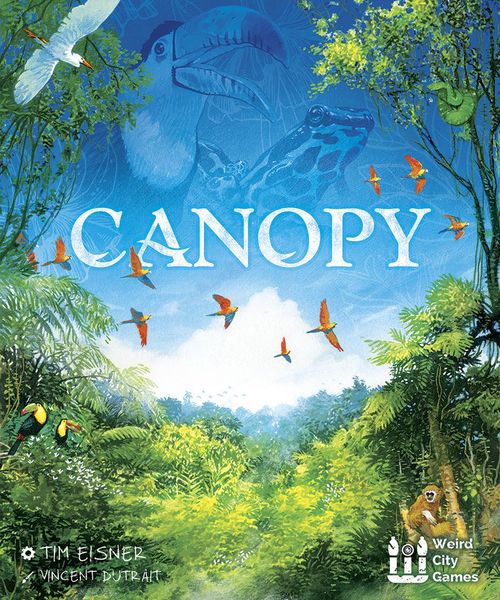
Canopy
Canopy Rulebook
Table of Contents
Table of Contents
Game Overview
Canopy is a game for two, where players compete to grow the most bountiful rainforest. The jungle ecosystem is full of symbiosis and players must grow tall trees, lush jungle plants, and attract the most diverse wildlife. By carefully selecting what grows in your forest you can create the ideal balance of flora and fauna and create a thriving rainforest.
Canopy is played over three Seasons (rounds). Each Season, players take turns selecting new cards for their forest from three New Growth piles.
Each time you look at a pile you may select it and add those cards to your rainforest tableau, or return the pile facedown, adding 1 additional card. As the piles grow you must search for the plants and animals that will benefit your forest the most. But choose carefully, as there are also threats in the form or fire, disease, and drought.
Winning the Game
At the end of each season you will score points for collecting sets of plants, completing trees, and growing the tallest tree. By growing a forest with a healthy balance of plants, trees and wildlife you will score higher points. At the end of the 3rd Season the player with the most trees in their forest will score a bonus, and the player with the most points will win.
Components
- 112 Rainforest Cards
- 21 Seed Cards
- 3 Game Board Cards
- 30 Point Tokens
- 3 Tallest Tree awards
- 1 Largest Forest award
- 2 Player aid cards
Set-up
- Place the Growth and Season cards in the center of the play area to form the game board.
- Place the point tokens and Tree Awards next to the play area.
- Shuffle the Seed cards together and place face down next to the game board.
- Shuffle all the Rainforest cards together. Remove 10 cards to the game box.
- Separate the remaining cards into 3 equal piles. Place one pile into each of these spaces: Current Season, Season 2, Season 3.
- From the Current Season deck deal cards facedown into the three New Growth spaces. Deal one one card into the New Growth 1 pile, two cards into the New Growth 2 space, and three cards into the New Growth 3 pile.
- The last player to water a plant is the first player.
Gameplay
-
Players take turns looking at and selecting New Growth cards.
-
Starting with the first New Growth pile (1), the current player will look at a pile, and decide whether to keep that pile, or pass on it.
-
If they pass on a pile, they add a card to it face-down from the top of the Current Season deck, and they proceed to the next pile. They may not choose a pile they have passed on.
-
When a player selects a pile of New Growth cards, they put all of the cards from that pile face-up into their Forest (tableau in front of them).
-
They then add one face-down card from the Season deck to fill the empty New Growth pile.
-
If a player passes on the New Growth 3 pile, they draw one card from the top of the deck and add it to their Forest.
Adding Cards to your Forest
The cards represent different plants, wildlife, and trees and have a variety of effects. Most cards count for points at the end of the Season, but some have in-Season effects (wildlife) and some have immediate effects that will be resolved as soon as they are added to your forest (Drought).
Wildlife: Animals with text have an ability that can be used once per Season. You may turn them sideways to mark you have used their ability.
Drought: When you add a Drought to your Forest you must immediately discard 1 other card from your Forest.
Turn Example
-
Maria goes first and looks at the card in the New Growth 1 pile. It is a Philodendron and she decides to put it back to see what is in the later piles.
-
She returns the Philodendron to New Growth 1, without revealing it to her opponent, and places the top card from the Current Season deck facedown on top of New Growth 1.
-
She then takes both cards from New Growth 2 and looks at them.
-
She returns the Frog and Rain card to New Growth 2, and places the top card from the Current Season deck facedown on top of New Growth 2.
-
She then looks at the three cards in New Growth 3. She decides to keep them and places all three cards face-up into her Forest tableau.
-
Maria then places the top card from the Current Season deck onto New Growth 3. Her turn is finished, and Otto, her opponent, will start his turn by looking at New Growth 1.
End of a Season
When the Current Season deck is empty, players continue selecting New Growth piles (without adding cards from the Season deck) until all piles have been taken. Once the Current Season deck is exhausted, players must select a New Growth pile on each of their turns.
Each player then follows these steps, gaining point tokens each time they score:
1. Seeds: If you have any Seed cards, draw 3 cards from the Seed Deck. Draw 1 additional Seed card for each Fire card in your Forest. You may then choose 1 card to add to your Forest for each Seed you have. Then discard the Seed card(s) and place the unchosen card(s) face-down on the bottom of the Seed deck.
If you have 2 Seed cards, you will still only draw 3 cards from the Seed pile. But you have the option to keep up to 2 of those cards instead of 1.
2. Fire and Disease: If you have 2 Fire at the end of the round, lose 2 Plant cards. If you have 3 or more Fire, it spreads, and both you and your opponent lose one Plant from your Forest. Disease functions in the same way but causes you to lose Wildlife instead of Plants.
3. Trees: Score points for each section of Trunk of each tree you have completed that round. Each Canopy awards a number of points between 0-2, based on the number of trunks in that tree. Place points from Trees onto that Tree to indicate that it has been scored.
The player with the tallest completed tree gains the Tallest Tree award for that Season (Season One/Two/Three = 3/4/5 Points). Place the award onto that Tree, it cannot win the Tallest Tree award in future Seasons. In case of a tie both players gain points equal to the Tallest Tree Award.
Completed Trees cannot be affected by cards in subsequent rounds (Drought), but can win the Tallest Tree award and will be used for the endgame Largest Forest bonus.
4. Plants and Weather: Score points for any Plant or Weather cards you have in your Forest.
5. Cleanup: After scoring, discard all cards except Trees and Wildlife. Wildlife is scored at the end of the game.
Tree Scoring Example
Maria has a complete Tree with two Trunks (worth 1 and 2 points) and a Canopy that awards 2 points per Trunk. She scores a total of 7 points (3 for the Trunks, 4 for the Canopy) placing the point tokens onto the tree to indicate that it has been scored.
Incomplete Trees award no points and remain in your Forest until completed or the game ends.
A New Season
If it is the end of Season 1 or 2 you will now setup for the next Season. Take the next Season deck in numerical order and place it in the Current Season area. From the new Current Season deck, deal one card to New Growth 1, two cards to New growth 2, and three cards to New Growth 3.
The player who did not win the Tallest Tree award in the previous round goes first.
End of Game
At the end of the 3rd Season, after regular scoring, each player will score their Wildlife. (See card overview for scoring details).
Then the Largest Forest bonus is awarded to the player with the most completed Trees. If both players are tied for the Largest Forest, the player with most incomplete Tree sections gains the bonus.
The player with the most points wins! In case of a tie the player with the most Wildlife wins!
Card Overview
Root/Trunk: (18) Each Root/Trunk card has a point value of 0, 1, or 2. These points are awarded at the end of the Season if the Tree is complete.
The Root/Trunk card can be used to start a new tree or added to an existing incomplete Tree to make it taller. You must decide when the card is added to your Forest whether it will be a Root or a Trunk.
Canopy: (10) Canopies must be played on top of a Root/Trunk card. If you do not have any open Root/Trunk cards the Canopy is discarded. Canopies have a Point multiplier of 0, 1, or 2. They award that number of points for each Trunk below them at the end of the Season.
Plants
Philodendron: (12) Each set of 3 Philodendron's scores 8 points. If you have less than 3 Philodendron's you do not score any points.
Bromelia: (11) If you get 3 or more Bromelia they count as negative 3 points total.
Ferns: (13) If you have an odd number of Ferns they award 2 points each. If you have an even number of Ferns they award 0 points. Five Ferns would be worth 10 points, and six Ferns would be worth 0.
Seeds: (5) At the end of the Season, before scoring, draw 3 cards from the Seed pile. Add 1 to your Forest for each Seed. Draw 1 additional Seed card for each Fire card in your Forest.
Weather
Rain and Sun: (8 of each) Your rainforest is healthiest when you have a proper balance of rain and sun. Each matched pair of Rain and Sun is worth 5 points.
Threats
Fire: (3) If you have 2 Fire cards at the end of the round, lose 2 Plant cards. If you have 3 or more Fire cards, the fire spreads, and both you and your opponent lose one Plant card from your Forest. If you have 1 Fire card it has no effect, but will still grant you a Seed bonus.
Drought: (3) If you add a Drought to your Forest you must immediately discard 1 card. This is usually a negative but can sometimes be helpful, such as when you discard a Disease or a Fire. After taking effect the Drought card is discarded.
Disease: (8) Disease cards are added to your own Forest and present a growing threat which you will check at the end of round. One Disease card has no effect, but two or more Disease cards will impact your Wildlife. If you have two Disease cards at the end of the round, lose two Wildlife. If you have three or more Disease cards the disease spreads and both players lose one Wildlife from their Forests.
Wildlife (6 Pairs)
There are two types of Wildlife in Canopy: Active Wildlife and Mating Pairs. Each animal has one card of each type. Active Wildlife give you a powerful ability you can use once per Season, and some points. Mating Pairs give you a higher point award and even greater points if you have the matching Wildlife.
Wildlife stay in play for the entire game (unless removed with Disease or Drought) and award points at the end of the game.
Mating Pairs
These Wildlife award the lower point value if unmatched and the higher point value if you have the matching pair. If you have a pair of matching Wildlife they will both score points.
Active Animals
Emerald Boa: Once per Season you may take one card from a pile that you pass.
Kinkajou: Keep 1 extra card when you draw from the Seed pile.
Leafcutter Ants: Once per Season, you may discard 1 card from your forest.
Poison Frog: Once per Season you may add 1 card to each Growth pile before your turn.
Sloth: Once per Season draw 1 extra card if you pass all Growth piles.
Toucan: Once per Season you may peek at one pile before your turn.
Clarifications
-
When you select a pile you must take all of the cards.
-
Cards from a pile may be added to your Forest in any order. You could for example play a Disease and then a Drought from the same pile to discard the Disease.
Shifting Seasons Variant
To play with this advanced variant, shuffle the Shifting Seasons cards at the start of the game. At the start of each Season reveal one Shifting Season card. That card's effect will take place for that entire Season. At the end of the Season discard that card and reveal a new one.