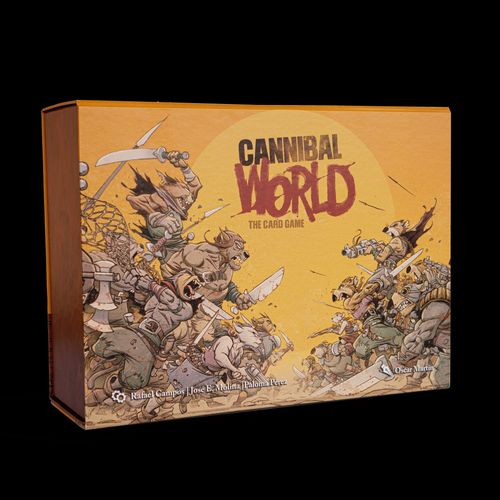
Cannibal World
Cannibal World Rulebook
Table of Contents
Table of Contents
Components
- 4 Preconstructed decks (Rats, Dogs, Cats, Rejects) of 21 cards each
- 4 Habitat cards (Rats, Dogs, Cats, Rejects)
- 30 extra cards for each faction (120 cards)
- Abilities Quick Guide
- 50 circular counters (Meat/Damage)
Creature Cards and Action Cards
Creature Cards: These have an icon showing the combat strength and the total life points of the creature. Additionally, creatures may have ability symbols at the bottom center and/or right of the card.
Action Cards: They only have ability symbols at the bottom center and/or right of the card. Action cards may show one or two ability symbols.
Card anatomy (as labelled in the rulebook): faction icon, card value, rank icon, ability symbols, combat strength and life (not present on Action Cards), illustrator and card ID.
Setup
This is the space you will need to play in a 1v1 game (diagram on page 2 of the rulebook: for each player, Main Deck, Discard Pile, Reinforcements Deck, Action Counters, Habitat Zone, Cover Zone and Hunting Zone, with the Counter Reserve shared between the players).
- Select factions: Each player chooses a faction and gets the preconstructed deck from that faction and the corresponding Habitat card.
- Create the Reinforcements Deck: Each player selects 1 card from their Main Deck and places it face down to create their "Reinforcements Deck". (See "Recommendations for New Players", page 4.)
- Separate and shuffle decks: Each player separates their Habitat card and shuffles their Main Deck. Decide the starting player randomly.
- Place counters:
- Set up a common reserve of meat/damage counters.
- Each player places 3 meat counters on their Habitat card. Every time their opponent is able to "Ransack" it, they will remove one of these counters (as if the Habitat had 3 "lives"). (See "Ransack the Opponent's Habitat", page 8.)
- The starting player gets 2 meat counters, while the other player receives 4. These meat counters represent the number of actions available on their first turn.
- Player zones:
- Habitat Zone: Place your Habitat card in front of you and put three meat counters on it.
- Cover Zone: Adjacent to the Habitat Zone. This is where you will place creatures that are not directly exposed to enemies during the game.
- Hunting Zone: Adjacent to the Cover Zone, farthest from you. You will place creatures ready for combat during the game.
How to Play
Recommendations for New Players
- We recommend playing the first games with the preconstructed decks to learn before customizing them.
- All the preconstructed decks have a Leader card. They are better than the rest of the cards and can be played for free. (See "Play a Creature Card", page 7.)
- Play Cats and Rejects first to learn the ropes. Rats are the most challenging.
- What to put in the Reinforcements Deck: Rats: use RA/02. Rest: use the Ability Card with "Backup 2" (RE/13, DO/13, CA/13).
Victory Conditions
You only have to meet one of them:
Destroy the Habitat
- If you "Ransack" your opponent's Habitat 3 times, you immediately win the game. (See "Ransack the Opponent's Habitat", page 8.)
Eliminate All Creatures
- You win the game if you remove all your opponent's creatures from play, hand, and decks. As long as your opponent has cards to draw from their Main Deck or Reinforcements Deck, it is considered that they still may have creatures.
- If the opponent cannot draw more cards and has no creature cards left neither in play or in hand, they are considered defeated. At this point, the player must reveal their hand to confirm there are no creature cards, and they cannot play any Action cards from their hand.
Pyrrhic Victory: If the winning player's remaining creatures (in play and in hand) have a combined strength less than the opponent's remaining Habitat life (meat counters), the game is considered a draw.
"Sometimes, annihilation is just a bad outcome for everybody, leaving no true winners in this savage struggle for survival…"
Gameplay
Players alternate turns until the game ends. Each turn has three phases.
- Draw phase: Draw one card. If you have fewer than 3 cards, continue drawing until you have 3 cards. You can draw from your Main Deck or the Reinforcements Deck.
- Main phase: Perform actions by spending your available meat counters. Actions include putting cards into play, executing abilities, moving creatures, initiating combat, etc. (See "Actions on Your Turn", page 7.)
- Final phase: Reset or replenish your meat counters up to 4. These are your actions for your next turn, or you can spend them during the opponent's turn (e.g. to dodge or use tactical abilities), but then you'll have fewer left for your turn.
For Card Game Veterans
- Abilities do not reset at the start of your turn. Once an ability is used, it stays in its spent state until a game effect (like a Reload) resets it, meaning most abilities are effectively single-use, so choose wisely.
- Likewise, creatures don't rotate 90° when attacking and can strike repeatedly. If a creature is rotated due to a game effect, it won't automatically return to its upright position at the start of your turn.
Drawing Cards and Reinforcements Deck
Whenever you draw a card (during the Draw Phase or from card effects), you may choose to draw from your Reinforcements Deck or your Main Deck. If you draw from your Reinforcements Deck, you may look at and select any card from there. If you draw from your Reinforcements Deck and it becomes empty, immediately place the top card of your Main Deck in the Reinforcements Deck before continuing to draw. You can check the cards in your Reinforcements Deck at any point.
Exhausted Faction
When a player attempts to draw a card and there are no cards left to draw (neither in their Main Deck nor Reinforcements Deck), that faction is considered "Exhausted". From that moment and for the rest of the game:
- The player cannot add cards to their Reinforcements Deck.
- All their actions must be spent playing cards, advancing, attacking, etc. unless they ransack the opponent's Habitat (specific actions taken are always at the player's discretion, as long as all actions are spent). Once the opponent's Habitat is ransacked, they may pass the turn or they can continue to use their actions if they wish.
"An exhausted faction is going to try and make every turn an all-out attack in a desperate attempt to win."
Types of Damage
In Cannibal World there are two types of damage: Combat and Direct Damage. Abilities specify which kind of damage they deal or prevent. (See abilities detailed description, pages 12-15.)
- Combat Damage: Inflicted through melee attacks, in combat.
- Direct Damage: Inflicted from distance, usually through some type of projectile.
Damage is permanent and is represented with damage counters from the reserve. If a creature accumulates counters equal to or greater than its life icon, it dies (it goes to the discard pile).
Stunned Creatures
Creatures can be stunned. When a creature is stunned, rotate it 90º. Stunned creatures cannot dodge, initiate combat, or use abilities. They also cannot be the target of abilities from their owner. However, they remain valid targets for the opponent.
- When in combat, stunned creatures do not deal Combat Damage but can receive any damage.
- Stunned creatures do not count as enemy creatures in their zone, enabling the opponent to attack the Cover Zone, or even Ransack the Habitat.
"If you manage to stun some of your opponent's biggest creatures, it can give you a significant advantage in battle."
Actions
- You can take any action in any order and repeat them (except Ransack, which can only be done once per turn) as long as you can pay with meat counters.
- A creature can enter combat multiple times in the same turn, provided you pay for each combat. Damage is permanent and represented by damage counters.
- You spend counters by returning them to the reserve or by marking an ability with it, signaling that it is spent and cannot be activated again.
- All actions are optional. You do not need to spend every action but note that meat counters do not accumulate.
- You CANNOT spend meat counters for actions that cannot be performed (such as drawing when no cards remain).
Actions on Your Turn
- Play a creature card: Spend 1 meat counter to put a creature from your hand into play, either in the Cover Zone or in the Hunting Zone. If the creature is a Leader card (identified by its rank icon), you can play it for free without spending a meat counter.
- Play an action card: Action cards may have 1 or 2 abilities. Spend 1 meat counter to activate one of the abilities on the card, or spend 2 counters to activate both abilities. Don't pay counters if they are Triggered Abilities. (See page 11.) Some abilities will specify a "target creature" or "this creature", which must be chosen when the ability is activated. If the ability has a range, you may choose the zone from which it is activated, provided it is valid for that ability. Discard the Action Card.
- Execute an ability: Place 1 meat counter on an ability from a Creature Card you control to activate it. The counter remains on the ability to indicate it has been used. If it's a Triggered Ability, do not spend one of your counters; instead, place a counter from the reserve to mark it as used.
- ABILITIES CAN BE USED ONLY ONCE. After activation, an ability remains covered with a meat counter for the rest of the game unless reset by another effect (such as the Reload ability).
- Move a creature: Spend 1 meat counter to move a creature you control from your Cover Zone to your Hunting Zone. You cannot move a creature back to the Cover Zone.
- Initiate combat: Spend 1 meat counter to declare a combat with a creature from your Hunting Zone. Choose an enemy creature in the opponent's Hunting Zone as the target. If there are no enemy creatures in the Hunting Zone, or if they are all stunned, you can target creatures in the Cover Zone. (See Combat Resolution, page 9.)
"Seizing the initiative in combat means shaping the fight on your terms, forcing the enemy to react and decreasing their future actions."
- Ransack the opponent's Habitat: Spend 1 meat counter to ransack the opponent's Habitat if neither their Hunting Zone nor their Cover Zone contains any creatures, or if all remaining creatures are stunned.
- You MUST have at least one non-stunned creature in the Hunting Zone.
- You can only take this action ONCE per turn (you need 3 turns to eliminate a player).
- Mark each Ransack by removing a meat counter from the Habitat and returning it to the reserve. Those counters are not replenished.
- The first player CANNOT Ransack on the first turn.
- Draw an additional card: Spend 1 meat counter to draw an additional card from your Main Deck or your Reinforcements Deck. (See "Drawing Cards and Reinforcements Deck", page 5.)
- Recover a stunned creature: Spend 1 meat counter to recover (straighten) a stunned creature you control.
Actions on Opponent's Turn
- Dodge a combat: Spend 2 meat counters to avoid a combat declared by the opponent. Combat does not occur. That means you cannot use Tactical Abilities for that combat.
- Dodge an Assault Ability: Spend 2 meat counters to avoid the effect of an Assault Ability used by the opponent. This does NOT make you dodge the combat that may result, if this is from a creature. (See "Assault Abilities" rules, page 11.)
- Activate a Tactical Ability: Spend 1 meat counter to use a Tactical Ability from a Creature Card in play or from an Action Card in your hand during a combat initiated by the opponent. (See "Combat Resolution", page 9.) You cannot activate Tactical Abilities outside combat in the opponent's turn.
- Triggered Abilities: Your Triggered Abilities can be activated if their trigger condition is met, and you must mark them as spent with a meat counter from the reserve. (See "Triggered Abilities" detailed description, page 15.)
Combat Resolution
Combat is the main action in Cannibal World. If you want to defeat your opponent, you'll need to send your creatures to kill theirs, as well as defend against their attacks at the same time.
Keep in mind your strategy for using your creatures' abilities when deploying them on the battlefield. Always try to maximize your actions, as well as the number of times you can attack with each of your creatures. For example: a strength 4 creature could take out two of your opponent's strength 3 creatures.
- Declare combat:
- Choose a creature from your Hunting Zone to initiate combat with an enemy creature in the opponent's Hunting Zone as the target.
- If there are no enemy creatures in the Hunting Zone, or if they are stunned, you can target creatures in the Cover Zone instead.
- You can target stunned creatures too, and they will not be able to deal damage to your creature, nor activate any of their abilities.
- Dodge:
- The defender can spend 2 meat counters to avoid the combat.
- If dodged, the combat does not occur.
- A stunned creature cannot dodge.
- Activate tactical abilities:
- You can only activate tactical abilities if the combat is not dodged.
- The initiator of the combat starts by activating a tactical ability (or passing).
- Players alternate activating tactical abilities until both pass.
- Abilities resolve immediately, but all damage is resolved simultaneously at the end of the combat.
- Combat resolution:
- Each creature inflicts damage equal to its strength.
- Apply and prevent damage simultaneously. Use damage counters to indicate damage. Damage counters do not affect strength.
- When the total damage equals or exceeds a creature's life, that creature is killed and goes to the discard pile.
Combat Example
The rulebook illustrates a combat with the following sequence (attacker and defender):
- Initiate combat: Attacker spends a meat counter to initiate combat.
- Dodge: Defender decides not to dodge the combat.
- Activate tactical abilities: Attacker passes initially on tactical abilities.
- 3a. Defender activates "Feint", spending one meat counter and putting it on the card's ability.
- 3b. Attacker activates "Shield 2" to prevent 2 combat damage points.
- 3c. Defender activates "Scattered Shots 2" to deal 2 direct damage points to a Strength 2 attacker's creature. That creature is situated in the Cover Zone and is not involved in the combat, but it's in range and a valid target for "Scattered Shots".
- Resolve damage: The attacker's creature receives 1 combat damage point (3 minus 2). The defender's creature doesn't receive combat damage (because of the "Feint"). The attacker's creature in the Cover Zone gets 2 direct damage points and is killed.
Abilities
Ability icons have a color that indicates the type of ability, related to when and from where you can use them, what triggers them, if they can be dodged, etc. They also have a symbol that represents the effect of the ability (damage, etc.).
Some abilities have a Range: the distance of zones they can reach, starting to count from where they have been launched, and counting both player's zones.
Cover Abilities
These represent strategic actions from the back.
- Activate only during your turn and from the Cover Zone (or the hand).
- They cannot be used in the middle of a combat.
Assault Abilities
These represent special attacks that provide advantage before combat.
- They cannot be used in the middle of a combat (they are used to initiate it).
- Can be used during your turn from the Hunting Zone (or the hand).
- Select an enemy creature in the opponent's Hunting Zone as the target. If there are no enemy creatures in the Hunting Zone, or if they are stunned, you can target creatures in the Cover Zone (you can target stunned creatures).
- Assault Abilities can be dodged (see "Actions on Opponent's Turn", page 8).
- When activated from a creature, this triggers a combat immediately after fully resolving the Assault Ability with the target creature.
- If the target creature is killed from the Assault Ability there is no combat.
Assault Abilities can trigger Triggered Abilities. Resolve the Triggered Ability fully before combat.
Tactical Abilities
These represent fast action abilities and can be used in close combat.
- Can be used anytime during your turn from any zone.
- Can be used during combat on the opponent's turn.
Triggered Abilities
These represent automatic reactions. They are the only abilities that can modify effects of the game (actions, abilities...) before resolution.
- Can be activated anytime when the trigger condition is met. Each ability has a different trigger condition.
- Triggered abilities do NOT cost meat counters but must be marked as spent using a meat counter from the reserve.
- If it's from an Action Card, just show the Action Card, resolve it and discard it.
Native Abilities
These represent innate characteristics that the creatures may have.
- These abilities have a permanent effect as long as they remain uncovered.
- If by an effect of the game that ability is lost, you must cover them with a counter from the reserve.
Ability Tables
Cover Abilities
Header: only on your turn from the Cover Zone (or hand); cannot be used in the middle of a combat.
| Name | Description |
|---|---|
| Single Shot 1 | Deal one Direct Damage to target creature. Range 2 |
| Scattered Shots X | Distribute X Direct Damage among the opponent's creatures, where X is the number of icons. Can be assigned to one target or split among multiple targets. Range 2 |
| Single Shot X | Deal X Direct Damage to target creature. Range 2 |
| Backup X | Draw X number of cards and gain the same number of meat counters from the reserve. |
| Rat Proliferation | Put a rat creature card with a value of 6 or less from the discard pile into your Reinforcements Deck. |
| Reload | Remove the meat counter from another used ability, allowing it to be used again. |
| Net | Stun (rotate 90º) target creature. Range 2 (see "Stunned Creatures", page 6). |
| Cat Pounce | Move this creature from the Cover to the Hunting Zone and immediately initiate combat with an opponent's valid target creature, without paying another meat counter. This combat cannot be dodged, and the target creature cannot use tactical or trigger abilities for this combat. |
| Summon Alpha |
Assault Abilities
Header: only on your turn from the Hunting Zone (or hand); must be a valid combat target; can be dodged; initiates combat afterwards.
| Name | Description |
|---|---|
| Single Shot X | Deal X Direct Damage to target creature before entering combat unless this ability is dodged. Afterwards both creatures initiate combat. |
| Stab X | Deal X Combat Damage to target creature before entering combat unless this ability is dodged. Afterwards both creatures initiate combat. |
| Shield X | Unless dodged, the attacking creature becomes "Shielded" for the resulting combat. Afterwards both creatures initiate combat. If Shielded, the creature will have an X Combat Damage prevention during the combat damage resolution. |
| Net | Stun (rotate 90º) target creature before entering combat unless this ability is dodged. Afterwards both creatures initiate combat. |
| Dog Charge | Unless dodged, the attacking creature becomes "Charged" for the resulting combat. A Charged combat cannot be dodged. Afterwards both creatures initiate combat. If Charged, the opponent must distribute all Combat Damage exceeding the life of the attacked creature among other creatures in the same zone in damage resolution. However, no creature can take more damage than its current Life amount. |
| Immolate | Unless dodged, deal 1 Combat Damage to all enemy creatures in the same Zone as the target creature before entering combat. If this ability is from a creature, deal 1 damage to this creature too. Afterwards both creatures initiate combat. |
| Feint | Unless dodged, the attacking creature gains "Feinting" for this combat. A Feinting attack cannot be dodged. Afterwards both creatures initiate combat. If the attacker is Feinting, prevent all combat damage dealt to this creature. This creature still deals combat damage as normal. |
Tactical Abilities
Header: from any zone (or hand); on your turn, or in combat.
| Name | Description |
|---|---|
| Single Shot 1 | Deal one Direct Damage to target creature. Range 2 |
| Scattered Shots X | Distribute X Direct Damage among the opponent's creatures, where X is the number of icons. Can be assigned to one target or split among multiple targets. Range 2 |
| Single Shot X | Deal X Direct Damage to target creature. Range 2 |
| Additional Damage X | During combat: If activated by a creature, that creature deals X additional Combat Damage in the damage resolution phase. If activated by an Action Card, choose a target creature involved in the combat to deal X additional Combat Damage. |
| Shield X | During combat: If activated by a creature, that creature prevents X Combat Damage in the damage resolution phase. If activated by an Action Card, choose a target creature involved in the combat to prevent X Combat Damage. |
| Feint | During combat: prevent all Combat Damage done to this creature, but this creature still deals Combat Damage. |
| Loyalty | During combat: Choose a target creature involved in the combat. Redirect all Combat Damage that would be dealt to the chosen creature to this creature instead. |
Native Abilities
Header: permanent effect; lost if covered.
| Name | Description |
|---|---|
| Stalker | Cannot be targeted by attacks or opponent abilities. Does not count as a creature in its zone (allows attacks on the Cover Zone or Ransack). Loses "Stalker" (cover the ability) if it enters combat or uses any ability, unless that ability explicitly says otherwise. Can attack or assault from the Hunting Zone to the Cover Zone, ignoring Hunting Zone creatures. On your turn (never in combat), you may choose to lose "Stalker" by covering the ability (counter from the reserve). |
Triggered Abilities
Header: can be activated anytime when trigger condition is met; can modify actions and abilities that trigger them; you do not need meat counters to pay them; you can choose to trigger them or not.
| Name | Trigger and Effect |
|---|---|
| Bullseye | Trigger: When the opponent activates an ability that deals Direct Damage. Redirect all the damage from that ability to this creature (ignore range). |
| Armor X | Trigger: If the creature receives any type of damage. Prevent X amount of damage to this creature. |
| Reload | Trigger: Whenever you use a Creature's ability (Cover, Tactical or Assault). Remove the meat counter from the ability you just used and return it to the reserve. That ability can now be used again. |
| Rat Proliferation | Trigger: When this creature enters the Cover Zone. Put a rat creature card with a value of 6 or less from the discard pile into your Reinforcements Deck. |
| Cat Pounce | Trigger: When this creature enters the Hunting Zone (from the hand or the Cover Zone). Initiate a combat without paying a meat counter. |
| Reject's Tactics | Trigger: When entering the game (any Zone). Choose a card from your Main Deck and place it in your Reinforcements Deck. Reshuffle your Main Deck. |
| Backup X | Trigger: When entering the game (any Zone). Draw the indicated number of cards and gain the same number of meat counters. |
| Swap | Trigger condition: When a creature is the target of an Assault Ability or a combat and they are not dodged. Choose another of your creatures in play. The combat proceeds with this new creature (deals and receives all the combat damage). If that creature is not in the attacked zone, move it there (don't move the original). |
Customization
Preconstructed Decks
Each faction comes with a preconstructed deck that includes 21 game cards totaling 160 value points. These preconstructed decks are balanced and ready to play, making them ideal for new players to get started.
Cards in each preconstructed deck (card ID and number of copies):
| Rats | Copies | Cats | Copies | Dogs | Copies | Rejects | Copies |
|---|---|---|---|---|---|---|---|
| RA/01 | 1 | CA/01 | 1 | DO/01 | 1 | RE/01 | 1 |
| RA/02 | 1 | CA/02 | 1 | DO/02 | 1 | RE/02 | 1 |
| RA/03 | 1 | CA/03 | 2 | DO/03 | 1 | RE/03 | 1 |
Customized Decks
A customized deck in Cannibal World consists of no less than 15 and no more than 25 cards from the same faction, chosen by the player, with the following restrictions:
- Value restriction: Each card has a value cost (see "Anatomy of a Card", page 1). The total sum of the value of the cards in a customized deck cannot exceed 160 points.
- Typology restriction:
- LEADER: Each deck must include one leader card. The leader of the faction can be played for free WITHOUT paying a meat counter.
- RESTRICTED: Only one copy can be included in a deck. However, you can have multiple different restricted cards.
- COMMON: The rest of the cards, of which you can include up to 3 copies of each in the deck.
Customization Guidelines
- Choose cards from your faction's pool:
- A. Minimum of 15 cards and a maximum of 25 cards total in the deck.
- B. Maximum of 160 points (can be fewer).
- C. Up to 3 copies of common cards and 1 copy of restricted cards.
- D. Maximum of 3 restricted cards.
- Leader: You must include one Leader Card (it counts towards the 15-25 total cards).
- Add Habitat Card: Include your faction's Habitat card (it doesn't count towards the 15-25 total cards).
"Experiment with different combinations of cards to find the strategies that work best for you!"
2 vs 2 Game Mode
Basics
Most of the rules for this mode are the same as in the 1 vs 1 mode. This section will focus only on the rules that differ from the basic rules. If a point is not mentioned otherwise, the basic rules apply.
Game Setup
- Both groups of 2 players are now considered a single side (they can use the same or different faction decks).
- Players of each side sit next to each other on one side of the table, facing the players of the opposing side.
- Within each side, players share the same Hunting Zone, Cover Zone, and Habitat Zone. They will choose and share a single Habitat card, but each player will have their own Main Deck, Reinforcements Deck, and Discard Pile.
- Randomly choose a side to start the game, and the player seated on the left on that side will start. First player gets 2 meat counters, the rest of the players get 4 counters.
- The turn sequence is not circular. Instead, sides alternate turns, and within each side, players also alternate. The turn sequence follows an "N" pattern.
"In the chaos of battle, a lone warrior may fight bravely, but an alliance turns courage into strategy, strength into victory, and survival into triumph."
Objective
The objective remains to hunt (eliminate) the entire opponent's population. In this case, it means eliminating all creatures of the opposing side. Players continue to play until all creatures of both players on the opposing side are eliminated. Alternatively, you can also win by destroying the opposing side's single Habitat, which can be achieved after ransacking it 3 times.
How to Play
Players who share a side can discuss general game tactics and strategies but cannot share information about their hands or Reinforcements Deck.
Actions available on your turn: In addition to the usual actions, you can:
- Give one of your action counters (only one per turn) to your teammate.
- Use abilities of all your side's creatures in play as if they were yours.
- Move a creature from your side from the Cover Zone to the Hunting Zone as if it were yours.
- Declare combats with all your side's creatures in play as if they were yours.
- Recover (straighten) stunned creatures from your side as if they were yours.
- Activate triggered abilities. As long as the trigger condition is met, you can activate triggered abilities of your side's creatures in play as if they were yours.
Actions available on other players' turn:
- You cannot dodge combat or Assault Abilities targeting your teammate's creatures, only yours.
- You can use and pay for Tactical Abilities of all your side's creatures in play as if they were yours.
- You can activate triggered abilities. As long as the trigger condition is met, both of you can activate triggered abilities of your side's creatures in play as if they were yours.
Exhausted Player
When a player attempts to draw a card (whether during their draw phase or due to a card effect) and cannot because there are no cards left to draw (neither in their Main Deck nor in their Reinforcements Deck), that player is "Exhausted." The exhausted player will apply all the usual rules for exhausted players, but this does not affect their entire side. Each player can become exhausted separately.
Tournament Rules
- Match format: Tournament matches are played as best-of-3 games. The first player to win 2 games wins the match.
- Victory condition: In each game, the last player standing wins. No Pyrrhic Victory.
- Fixed decklists: Players must use the same main deck and sideboard throughout the tournament. No changes are allowed between matches.
- Sideboard: Each player may bring a sideboard of up to 55 points. Between games in a match, players may exchange cards between their main deck and sideboard, ensuring that the resulting deck remains valid under the customization guidelines.
- Deck restoration: After each match, players must restore their main deck to its original configuration before starting the next match.
FAQ
General
Q: Can I activate an ability if I can't execute an effect, for example drawing a card? A: Yes, just ignore the effects you cannot execute. But you cannot pay for an action you can't do, like paying for initiating combat without creatures, or paying to draw a card without cards.
Q: My faction is exhausted, am I forced to play abilities with all my actions? A: No, you are not forced to use abilities with all your actions. However, you are required to spend your actions on playing creatures, moving forward, and attacking unless you ransack the opponent's Habitat or until you have no more actions left. You can use abilities to spend actions strategically, which may result in fewer or no forced actions.
Q: If I trigger Armor 2 to prevent 1 damage, can I still prevent another damage? A: No, once the ability is spent, you mark it as spent and it cannot trigger again unless you use an effect to clear it (for example Reload).
Combat and Assault
Q: If I don't dodge an Assault Ability, can I still dodge the combat? A: Yes, unless the effect of the Assault Ability prevents you from it (for example, stunning your creature).
Q: Can I both dodge the Assault Ability and the combat? A: Yes, paying 2 meat counters each time, but you may end up without actions for your turn.
Q: Can I prevent damage from an Assault Ability? A: Only with Triggered Abilities. Assault Abilities have to be resolved fully before entering combat and being able to use Tactical Abilities.
Q: Can I use a Triggered Ability on a dodged Assault Ability? A: If the trigger condition depends on the effect happening, then no. For example, if you dodge an Assault Direct Damage ability, you cannot then apply the "Armor X" Ability since you did not receive any combat damage. But you can trigger Bullseye (but then it would be pointless to dodge).
Q: Can I kill a creature in combat with Direct Damage before it deals Combat Damage? A: No, all damage is assigned at the end, and the combat is not interrupted for excess damage.
Q: During combat, can I use Tactical Abilities from other creatures not involved? A: Yes, for example "Loyalty" is normally used on a creature outside of the combat.
Q: During combat, using Tactical Abilities, if I pass can the opponent still play abilities? A: Yes, until both of you pass sequentially. An example:
- You've declared combat and the opponent has not dodged. You're first to act, and decide to pass instead of playing a Tactical Ability.
- The opponent plays Additional Damage 1, which would kill your creature.
- You play Shield 1 to prevent this, and the opponent passes.
- You play Single Shot 1 to further damage the opponent's creature. Your opponent passes.
- You pass too. Since both players have passed, combat ends and all damage is resolved.
Q: Does an Assault Action Card (not creature) initiate combat? A: No, Assault Abilities only initiate combat from creatures, but Assault Action Cards can be dodged.
Q: If I trigger Bullseye to redirect Direct Damage from an Assault Ability does the combat still occur? A: Yes, you fully resolve the Assault and the Triggered Ability (in this case redirect the damage to the Bullseye creature) and then if both original creatures that should enter combat are still alive, they resolve combat.
Q: How is Feint resolved when used during a Dog's Charged Combat? A: When Feint is used, the creature that used it prevents all combat damage dealt to it. However, any excess damage beyond the creature's total Life points must be distributed among other creatures in the same Zone (no creature can take more damage than its current Life amount).
Faction's Characteristics
Rats
Rats are small, numerous, agile, and clever. Very conscious of their place in this world: strongly persecuted by humans, they live in family groups or small villages, led by a respected chief. They are very skilled in combat, especially with knives and swords. Lethal in hand-to-hand combat, thanks to their speed, agility, and small size.
In Cannibal World this translates to:
- Feint: They are able to damage the opponent while avoiding taking damage.
- Rat Proliferation: They can return discarded cards to the game.
Cats
Cats are treacherous and fearsome. Moderately strong and not very intelligent. They hide in the shadows and attack by surprise whenever they can. They live in temporary settlements. Their leader is usually the least stupid and the most psychopathic. Very aggressive, to the point of being stupid or even insane.
In Cannibal World this translates to:
- Cat Pounce: They can attack from the Cover Zone.
- Swap: They are able to swap fighters in the middle of the combat.
Dogs
Dogs are strong, gregarious, and loyal. Brave, intelligent, noble, and loyal. They are big and strong both physically and mentally. They form organized clans and are very respectful of internal hierarchies. They appreciate a good weapon and consider the knife to be the most noble and more honorable to use than fighting at a distance.
In Cannibal World this translates to:
- Loyalty: They are willing to sacrifice themselves in combat.
- Dog Charge: They can rush to damage more than one enemy per attack.
Rejects
Rejects are dumb but they have some tricks. Dangerous criminals, unable to integrate into what remains of human society. They associate in gangs of opportunists where the leader is the least stupid. They are not very skilled, which they make up for with access to junk dealers and using some underhanded tricks learned from corrupted politicians.
In Cannibal World this translates to:
- Reject's Tactics: They can reorganise their decks to get what they need.
- Reload: The one thing they are skilled at is reusing their spent abilities.
Glossary
- Ability: Special powers or effects that a card can activate during the game. Abilities are categorized into types: Cover, Tactical, Assault, Triggered and Native, each with specific conditions and effects.
- Action: A game mechanic players can perform by spending meat counters. Actions include playing a creature, moving, initiating combat, and using abilities.
- Combat Damage: Damage dealt during melee combat. Unlike Direct Damage, usually it requires creatures to be in close proximity.
- Cover Zone: A player's zone where creatures are not directly exposed to enemy attacks. Cover Abilities can be used here.
- Direct Damage: Damage dealt from a distance, often through projectiles, that does not require physical proximity. It can be dealt outside melee combat.
- Draw Phase: The phase at the beginning of each player's turn where they draw cards, choosing from either the Main Deck or Reinforcements Deck.
- Exhausted Faction: A faction with no remaining cards in either the Main or Reinforcements Deck. Exhausted factions must spend all actions each turn, focusing on attacking the opponent's Habitat.
- Habitat Card: A card representing the home base of each faction. If a Habitat is ransacked three times, that faction loses the game.
- Hunting Zone: The front zone where creatures ready for combat are placed. Only creatures in the Hunting Zone can initiate attacks.
- Meat Counter: The main resource in the game, used to perform actions such as playing creatures, activating abilities, and initiating combat.