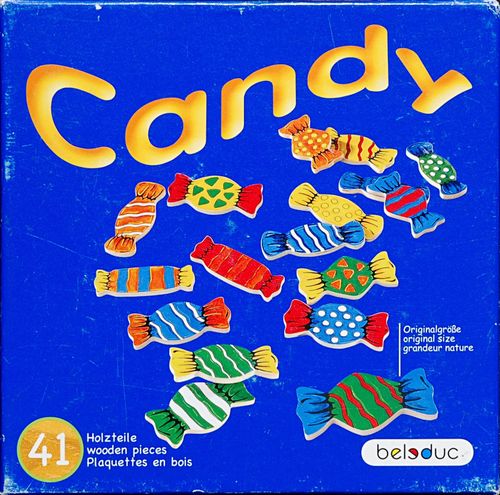
Candy
Candy Rulebook
Table of Contents
Table of Contents
Educational Areas
The game develops:
- Arts Education: Recognising and naming colours, combining colours, distinguishing primary and secondary colours
- Health Education: Action-reaction, fine motor skills when picking up sweets
- Social Education: Playing together, social behaviour
Supporting children in their development: arts, somatic, social, maths, language and science.
Game Info
- Age: 4+
- Players: 1-8
- Playing time: 15 min
Game idea: Tobi and his sister Lisa helped their mum in the garden and have been rewarded with a big bag of coloured sweets. On the way to their playroom, each of them wants to carry the bag and because both of them pull at it, the bag tears suddenly and the sweets fall out. What a mess! All the coloured sweets are lying scattered on the carpet. The sweets have to be picked up quickly! Who'll be the quickest to do that?
Game Preparation
All the sweets are mixed up and spread out on the play cloth with the coloured sides facing upwards. The 3 colour dice are laid out beside them. There are different ways of playing the game:
How to Play
Version 1
In this version the number of sweets to be collected in order to win must be decided before the game starts, e.g. the first one to get 5 sweets wins the game. The sweets have different colour combinations of up to three colours. The youngest child begins and throws all three dice together. The aim now is to find the sweet that matches the colour combination on the dice. All players look at the same time, and the one to find the right sweet shows it to the other players and then takes it for himself. Everyone throws the dice in turn.
Version 2
As above, except that the sweets may not be taken, but instead when the player finds the right sweet, (s)he points to it and another player or adult keeps a list of points scored. A player is awarded one point for each sweet (s)he identifies. If the player fails, the round is continued until the right sweet is found. In this version, the length of the game can be agreed on beforehand, e.g. 10 minutes. The winner is the player who has scored the most points by then.
Version 3
The sweets are distributed among all players so that each one has an equal number. The players lay the sweets out openly in front of them. Any sweets that are left over are set aside. The dice are now thrown, and whoever has a sweet in front of him or her with the colour combination shown on the three dice can place it in the centre of the play cloth in the middle of the table. The first to get rid of his sweets wins the game.
Here, too, a time or a number of sweets can be decided on before the game begins, so that it doesn't go on for too long. The winner is the player with the fewest sweets left in front of him after the agreed time, or the first to be down to the agreed number.
Tips for Parents
Depending on your child's age, you can use some or all of the sweets in the game. Initially, to learn and name the colours only use the sweets with one colour. Then gradually increase the number of "sweets" you use, first adding the sweets with two colours, and finally all the sweets. You don't always have to play for speed. Allow your child as much time as he or she needs to look for the right sweet, although you may already have found it yourself. The game can be enjoyed by the whole family. Take it with you when you go to visit grannie and grandpa – they will have lots of fun, too.
Tips for Kindergarten Teachers
Descriptions (Age: 4+)
In this version of the game, no dice are needed. One player is chosen to start the game and he or she secretly picks one sweet among the ones on the table and then describes it to the other players. The description has to include the shape, the pattern and the colours on the sweet. The player who first spots the right sweet is allowed to take it.
Learning the Primary and Secondary Colours (Age: 4+)
Let the children paint pictures of their favourite – or an imaginary – sweet. First, only give them the primary colours red, yellow and blue, plus white and black to darken or lighten them. Let the children experiment themselves and mix their own lovely colours. Afterwards, you can show the group what colours are mixed together to produce the secondary colours.
Healthy Eating (Age: 4+)
Sweets taste yummy, but you shouldn't eat them too often. Together with the children, approach the topic of "healthy eating" and make a wall newspaper on the Food Pyramid, showing healthy and not-so-healthy foods. This helps the children to see which foods are especially important, and which ones it is better to only eat occasionally.