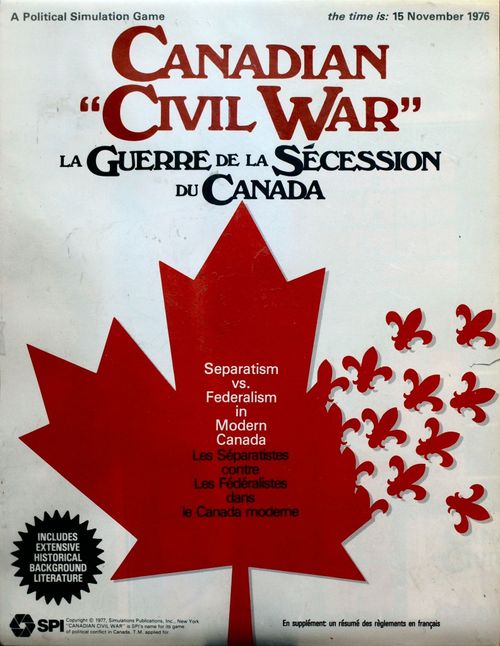
Canadian Civil War: La Guerre de la Sécession du Canada
Canadian Civil War: La Guerre de la Sécession du Canada Rulebook
Table of Contents
Table of Contents
- Historical Background
- How To Read This Rules Booklet
- 1.0 Introduction
- 2.0 Game Components
- 3.0 Setting Up the Game
- 4.0 Sequence of Play
- 5.0 Political Opportunity
- 7.0 Contesting
- 8.0 Elections
- 9.0 Sample Game-Turn
- 10.0 National Emergency
- 10.1 Creating a National Emergency
- 10.2 Loyalty Determination
- 10.3 Initial Deployment
- 10.4 National Emergency Cycle Sequence of Play
- 10.5 Movement Effects During the National Emergency
- 10.6 Effects on Stacking During the National Emergency
- 10.7 Combat During the National Emergency
- 10.8 National Emergency Chart and Tables
- 11.0 Victory Conditions
- 12.0 Scenarios
- Player's Notes
- Designer's Notes
- Color Shift Matrices
- Scenario Charts and Deployments
- National Emergency Cycle Charts
- Transcription Notes
Historical Background
In March of 1867 the British Parliament passed the British North America Act, which essentially set up Canada as an independent country — the Dominion of Canada. The Canadians initially wanted to call the country the Kingdom of Canada, since Queen Victoria was still the head of state, but it was decided that the United States would not look kindly upon a kingdom on its northern borders (perhaps the first case of United States interference in Canadian affairs). Almost immediately, the Province of Nova Scotia wanted to secede from the confederation and join the United States. This did not happen, of course, but the pattern of intense regionalism within a very centralized federal governmental system had been set.
Canada was created as a very large country with such a diversity of life-styles and historical outlooks that even the "Melting Pot" to the south seemed homogeneous in comparison. This situation was exacerbated by the fact that Canada was and is a country of two languages and two cultures, the French and the English. This situation has been the focal point of the most recent separatist movement.
The Quebec Separatist movement is a child of the fifties. Its father, ironically, was Maurice Duplessis, le Chef. In the 1920's, Quebec's financial and industrial structure was controlled by the English-speaking (Anglophone) minority of the province, and — what was more galling to the Francophone (French-speaking) minority — by Anglophones from Ontario. During the prosperity of the 20's, this imbalance was not particularly noticeable; everyone was too busy fighting for his piece of the pie. But, like many inequities, the depression of the 30's brought this situation into sharp focus. For a while, this issue was the main focus of Quebec-Ontario relations, and in 1936 the Union Nationale and M. Duplessis won an overwhelming majority in the Quebec National Assembly on a platform of autonomy and social reform.
The program of social reform soon gave way to what has been called "Clerical Fascism" because of the party's exploitation of the religious differences between the Catholic Francophones and the rest of Canada. The platform's autonomy plank, however, was not overlooked since M. Duplessis would no more tolerate interference from the federal government than he would from his own people. M. Duplessis ruled Quebec with an iron hand for two decades, intractable to both social reform and Canadian Federalization. Then, in 1959, he died, and the "quiet revolution" began.
The quiet revolution was essentially the dismantling of the Duplessis machine and the liberalizing of Quebec society. During the 60's, there were two Liberal Party and two Union Nationale governments in Quebec. Also in the 60's, there was Trudeaumania, and for a time it looked as though the two societies would come together.
Then the rumblings of separatism in the west began — primarily in Alberta. While this influence was never as strong or as organized as the Quebec movements, it could not help but encourage les Québécois. In the late 60's, the Parti Québécois was started by a group of disillusioned Liberals, and General de Gaulle shouted, "Vive le Québec libre." While Canada snickered at the troubles in the United States, the FLQ (Front pour la Libération du Québec) was blowing up mail boxes and kidnapping officials. In October of 1970, Pierre Trudeau, the Prime Minister, invoked the War Measures Act and put down the FLQ. It was only the beginning.
On November 15, 1976 René Lévesque was elected Premier of Quebec in an election that stunned the Liberal Party as much as the election of Menachem Begin in Israel stunned the Israeli Labour Party in 1977. While M. Lévesque campaigned primarily against the inefficiencies of the administration of the incumbent Robert Bourassa, the separatist program of the Parti Québécois underlay the entire campaign.
How To Read This Rules Booklet
The Canadian Civil War Rules are divided into Major Sections, each of which is numbered with a whole number (1.0, 2.0, etc.). Each Major Section has a General Rule, a Procedure (if applicable), and Cases.
The General Rule is a description of how the rule operates in game terms. It contains none of the qualifications or subtleties of the rule, but explains essentially what the rule is about.
The Procedure explains in a step-by-step manner how the game equipment is manipulated in order to perform the mechanics of the General Rule.
The Cases are an arrangement of the qualifications and subtleties of the rule. These Cases are numbered decimally to reflect the Major Section to which they apply. For example, Major Section 6.0, Movement, is divided into Cases 6.1, 6.2, and so forth. In some instances, the Cases themselves are divided into Secondary Cases by going to a second decimal place (e.g., 6.21 and 6.22). When a cross-reference is made in the rules, this numbering system is used. The number reflects where the rule is in the organization of the rules.
Section 1.0 is the Introduction. This section describes what the game is all about and something of how the game is played. Also included in Section 1.0 is the Introduction to the Game Terms. This section is particularly important, since many of the concepts and terms have not appeared in previous games. It also contains some terms which are peculiar to the situation we are simulating, which may be unfamiliar to many non-Canadians.
Section 2.0 is a description of the Game Components and a brief description of how they accommodate the game mechanics.
Section 3.0 is Setting Up the Game. This section describes in a step-by-step manner how to go about preparing to play a game.
Section 4.0 is the Sequence of Play. This section provides a general description of how the game operates, and then gives a more detailed description of each step. This is the most important section for understanding the rules, since it is this section that puts the whole of the rest of the rules into a logical sequence. For the Player's convenience, a summary of the Sequence of Play is printed on each Chart/Deployment Sheet.
Sections 5.0 through 11.0 are detailed descriptions of the various game mechanics.
Section 12.0 contains the Scenarios. Each Scenario is divided into four parts. The first part deals with the distribution of Pieces at the beginning of the game. The second part is the number of Political Opportunity Cards a Player receives at the beginning of the game. The third part includes any special rules for that particular scenario. The last part contains the victory conditions for that scenario.
Note: Players are designated in Canadian Civil War by the color of the pieces each uses throughout the political game.
On page 2 is an outline of the Major Sections and the Primary Cases associated with them. Players may wish to use this outline as a quick reference as to where a given piece of information may be found.
1.0 Introduction
1.1 General Description of the Game
Canadian Civil War is a three or four Player simulation of Canadian politics in the past, present, and future. Each Player represents a general political outlook or school of thought. The object of the game is for a Player to attain political ascendency for his particular element. In game terms, the Players must gain control of "Issues" to win. Each Issue in the game represents a concern that is more or less basic to Canadian politics today.
At first glance, the rules to Canadian Civil War may seem exceptionally long and complex. Once the basic mechanics of the game are mastered, however, Players will see that the game is actually quite simple and enjoyable. Various sections of the rules — such as this Introduction, Game Components, Setting Up the Game, and the Sequence of Play — provide brief, easily mastered overviews of essential game concepts. The best way to learn the game is to read the rules once with the game components laid out in view. After reading each section, follow the examples provided and perform the functions just described. Once the rules have been gone through completely, Players should play the game once or twice, referring to the rules as often as necessary. It will take only a few trial playthroughs to master the mechanics of the game, and then Players can concentrate on the strategy, political maneuvering, and negotiations that make Canadian Civil War the endlessly entertaining and unpredictable contest that it is meant to be.
1.2 Game Terms
This introduction to Game Terms is an integral part of the rules. Because of the game's unique subject matter and the fact that it involves many new game concepts, Players should read this section before reading the rules.
1.21 The Players
There are either three or four Players in a game of Canadian Civil War. Each Player is represented by one color on the display and by one complete set of Political Pieces of the same color.
The Federalist Player (Red) represents the school of thought that the North American Confederation should be restructured to emphasize the Federal Government over the provincial governments.
The Provincial Moderate Player (Orange) represents the status quo — the people who have it made in the present system and who want no drastic realignments of power forces.
The Provincial Autonomist Player (Green) represents the people who think that the Federal Government sticks its nose into too many places it has no business sticking it.
The Separatist Player (Blue) represents the people who think that the cultural, linguistic, and political differences are too great to support a federal government and therefore that the entire confederation should be replaced by an economic community rather like the European Economic Community.
Note: The Players are referred to throughout the rules either by their color designations or by their full names. The terms are interchangeable.
Once the game starts, players will be either a Phasing Player or a Non-Phasing Player.
The Phasing Player is a Player whose turn is in progress and a Non-Phasing Player is a Player whose turn is not in progress.
Once a National Emergency is created, the Players divide themselves into two Sides; each of these sides can comprise either one Player or a coalition of Players (see Case 10.1).
The Government Side or Player is the side or Player controlling the Prime Minister piece. The Rebel Side or Player is the Player or Players opposed to the Government Side.
1.22 The Pieces
There are two varieties of Pieces: Political Pieces and Military Units.
The Political Pieces represent the Political forces and Issues extant in Canada today. There are two varieties of Political Pieces: Passive Pieces and Active Pieces.
The only Passive Pieces are the Issues. The Issues are Pieces which represent causes for concern in the minds of the Canadian People. The object of this game is to control these Issues. Issues are called "passive" because they cannot be moved without being stacked with a specific type of Active Piece.
There are five varieties of Active Piece: Constituencies; Interest Groups; Civil Servants; Premiers; and the Prime Minister. Each of these Pieces can move and contest independently of any other Piece on the display.
Constituencies represent blocks of voters. They are used to control Issues.
Interest Groups represent organized pressure groups, business groups, voting blocks, and various other organizations.
Civil Servants represent the Governmental departments, the cabinet posts and the bureaucracies behind them.
Premiers represent the Provincial Governments, both executive and legislative branches.
The Prime Minister represents the Head of Government in Canada.
There are two types of Military Units: Militia Units and Federal Military Units. These Units are used only during a National Emergency.
Federal Military Units are the units of the Regular Canadian Armed Forces.
Militia Units are the Reserves of the Canadian Armed Forces.
Some of the Military Units are marked "F". These are Francophone Units, which means that French is the official language of the Unit.
1.23 The Display
The Game Display is divided into four Home Areas and the Crisis Zone.
The Home Areas are used to protect Political Pieces from the effects of Contesting, and Elections. Each of these areas is divided into 3 sections, which represent the degrees of protection the Home Area exerts. These sections are the Administrative Section, the Legislative Section, and the Grassroots Section.
The Crisis Zone is used to call Issues and Active Pieces into an unprotected state. It exerts negative effects relative to the Home Areas during Contesting and Elections. It is also where Issues become Uncontrolled for First Player Determination.
For movement purposes, the Display is divided into squares. There are two types of squares: Regular Squares and Control Point Squares.
Regular Squares are used for movement purposes only. They are the Home Area for the Pieces whose color corresponds to theirs. Control Points are used to control Issues without their being stacked with a Constituency.
Adjacent squares between which Pieces are eligible to move are connected by Paths. These Paths run only from the side of a square to the side of another square — never from corner to corner.
1.24 The Cards
The Political Opportunity Cards (POC) represent the random events in the political situation. There are three types of POC: Crisis Cards, Event Cards, and Election Cards.
Crisis Cards are used to call Issues into the Crisis Zone. They represent the capacity to unsettle a particular Issue.
Event Cards represent the miscellaneous events which change the political alignments from time to time.
Election Cards are used to bring about elections. They can represent anything from a vote of no-confidence to a legislature's term running out to just the political malaise that causes a government to dissolve itself before too many votes are lost.
1.25 The Functions
First Player Determination is the way in which the First Player for any given Game-Turn is determined.
Control comes in two varieties. When an Active Piece is being controlled, it refers to the allegiance of that unit — its color. It is controlled by the Player whose Home Area matches that of the Piece. When a Passive Piece is being controlled, it refers to either stacked with a Constituency or placed on a Control Point. Control of an Issue Piece is changed by physically placing it beneath a Constituency Piece.
Active Pieces change their allegiance by Shifting or Turning toward a different color. This is accomplished by physically exchanging a Piece of one color for its companion Piece of another color.
Calling an Issue into the Crisis Zone (or just Calling the Issue) is accomplished by physically placing the Issue and every Piece stacked with the Issue into the Crisis Zone.
A Block is an attempt to keep an Issue from being called into the Crisis Zone by using the National Debate rules.
National Debate is conducted through a series of Votes. This entails polling each Player on where he stands on various propositions that arise during the game (primarily attempts to block or call an Issue), then weighing each Player's vote with the number of Constituencies he controls.
Movement is physically moving a piece through the squares. Movement is quantified with a Movement Allowance which is expressed in Movement Points. One Movement Point is the capacity of a Piece to enter one square. Therefore, the Movement Allowance is the number of squares a Piece can enter during its controlling Player's Movement Phase.
Contesting is a matter of bringing political pressure to gain control of Issues and to convert Active Pieces to your own allegiance.
Strength is the numerical quantification of a Piece's ability to influence the action of the game. There are two kinds of strengths in this game. On the front of the Political Pieces is the Contesting Strength. The Contesting Strength represents the political influence of each Piece. On the back of the Political Pieces and on both sides of the Military Units is the Combat Strength. This represents a Piece's capacity to Cause a riot, avoid arrest, or fight. A Parenthesized Strength — e.g., (1) — means that the strength can be used only for defensive purposes.
National Emergency is a special six-Turn Cycle which is fought as a military action. Refer to the complete rules, Section 10.0, for further information.
1.26 General Information
A Riding is the Canadian equivalent of a Congressional District.
A Francophone is a French speaking Canadian. An Anglophone is an English speaking Canadian.
Forming a Government is the way a parliamentary system chooses its head of Government, either the Premier of a Province or the Prime Minister of the Country.
2.0 Game Components
Commentary: This section identifies each component of the game and the various symbols on them. A Player should take out the Game Display, the Counter Sheet, and the Political Opportunity Cards and examine each as it is being described.
2.1 The Game Display
The Game Display is an abstract, non-geographical representation of Canada that is divided into five areas: the Crisis Zone and four Home Areas — one for each Political Viewpoint. The Crisis Zone is where Issues become Undecided or Uncontrolled. The four Home Areas are areas Friendly to the Player having the same colored pieces as that area.
Each Home Area is further divided into three Sections: the Administrative Section, the Legislative Section, and the Grassroots Section. These sections represent the degrees of Control a Player has over a given Issue, and the degree of safety a Player's Pieces have during an Election. Each Home Area is also divided into squares. These squares determine Movement. They represent areas friendly to the Player, and they can be as large as a "riding" or as small as an "auditorium." There are two types of squares: Regular Squares and Control Points. Squares are connected by Paths which are utilized in movement. Regular Squares are blank, but Control Points contain the following symbol (a solid black disc with a "C" cut into it): [Control Point symbol]
On the edge of the Display, each Player has two tracks — one to keep track of the number of Issues a Player controls and one to keep track of the number of Constituencies a Player controls. These are merely play aids to speed up the adjudication of Elections, First Player Determination, and National Debate. Their use is purely optional.
2.2 The Playing Pieces
Examine the sheet of die-cut counters (do not punch them out until you have examined the rules). These counters are Political Pieces and Military Units, and they represent the men and organizations involved in Canadian politics today.
There are five types of Political Pieces. Four of these types are referred to as Active Pieces, and one type is referred to as Passive Pieces. Issues are the Passive Pieces. They are printed on both sides — on one side in English and on the other side in French. Either side of an Issue may be used.
Active Political Pieces include Constituencies, Premiers and the Prime Minister, Civil Servants, and Interest Groups. These Pieces are also printed on both sides. However, only the "front" side is used in the Political Game.
Sample Constituencies (front): The Constituency counter shows a Contest Strength (top left), a Movement Allowance (below it), and the Province it represents (for example, Ont, Nbr, Mnt, Alb, Qbc, PEI, Sas, Bcb, Nfl, NvS), printed with a provincial emblem.
Province Abbreviations: Ont = Ontario; Nbr = New Brunswick; Mnt = Manitoba; Alb = Alberta; Qbc = Quebec; PEI = Prince Edward Island; Sas = Saskatchewan; Bcb = British Columbia; Nfl = Newfoundland; Nvs = Nova Scotia.
Sample Premier and Prime Minister (front): The Premier counter shows its Province (for example, Nbr), the word PREM, a Contest Strength and a Movement Allowance (sample 2-4). The Prime Minister counter shows the Canadian flag and a Contest Strength and Movement Allowance (sample 3-3).
Sample Civil Servants (front): Each shows a department name with a Contest Strength and a Movement Allowance. Civil Servant departments include Commerce, Labor, Finance, Agriculture, Hlth-Wlf, and Justice. Abbreviation: Hlth-Wlf = National Health & Welfare.
Sample Interest Groups (front): Each shows a group name with a Contest Strength and a Movement Allowance. Interest Groups include Wood, Auto, Chemical, Intellctl, Francphn, Clergy, Co-ops, Farmers, Transport, Petro, Unions, and Hydro. Abbreviations: Intellctl = Intellectuals; Francphn = Francophone; Transport = Transportation; Petro = Petroleum; Hydro = Hydro-Electric Power.
Sample Issues (front): Issue counters include Language, Tax, Media, Tariff, Industry, Territory, Transport, Finance & Banking, Education, and Foreign Affairs.
Each Player also has two Markers, used to keep track of how many Issues and Constituencies he controls on the Game Display tracks.
Sample Markers: Issues; Constituencies.
During the special National Emergency Cycle Turns (see Section 10.0), Players will use what in essence is a different set of counters. Once a National Emergency is created, all Issues are permanently removed from the Display, and all Active Pieces on the Display are inverted to show the new values on their "backs."
Note: Parenthesized () Combat Strengths signify that the unit may defend only — it may not attack.
Sample Active Pieces (back): Each shows a Combat Strength, a Movement Allowance, and a type name (for example, Commerce, Wood).
Also during a National Emergency (only), Players will receive Military Units. There are two basic types of military unit: Federal Military Units and Militia Units. Both of these types are printed on both sides with the same symbols and values, but in different colors. The use of these Units is completely explained in Section 10.0.
Sample Federal Military Unit: Shows a Unit Designation, the marking "Fed", a Combat Strength (sample 3-5), and a Movement Allowance.
Sample Militia Unit: Shows a Unit Designation (sample: Camerons), the marking "Mnt", a Combat Strength (sample 2-5), and a Movement Allowance.
Some Federal Military Units and Militia Units are designated as Francophone Units. Sample Francophone Federal Military Unit (Fed, Combat Strength 3F5) and Sample Francophone Militia Unit (Qbc, Combat Strength 2F5) each show a Francophone Designation in addition to the Unit Designation, Combat Strength and Movement Allowance.
2.3 The Cards
Examine the Political Opportunity Cards. There are three types of these cards, each labeled at the top.
Event Cards describe miscellaneous events and their effect on the Game. Sample (Political Opportunity Card nr. 04): "EVENT: Poll Shows New Confidence in Government. EFFECT: Contest Strengths of all Civil Servant pieces are doubled for current Player-Turn."
Election Cards describe which province there is an Election to be adjudicated in. There is also an Election Card for National Elections. Sample (Political Opportunity Card nr. 19): "ELECTIONS CALLED IN British Columbia."
Crisis Cards call for a Crisis and then name an Issue. Sample (Political Opportunity Card nr. 36): "CRISIS — Tax."
2.4 Inventory of Game Components
A complete game of Canadian Civil War includes:
- One Game Display
- One die-cut Counter sheet (400 pieces)
- One Rules booklet
- Four Chart/Deployment sheets (identical)
- One deck Political Opportunity Cards (56)
- One Plastic Die
- One Box/Coversheet assembly
If any parts are missing or damaged, please write to Simulations Publications, Inc., 44 East 23rd Street, New York, N.Y. 10010.
Questions regarding the rules of the game will be answered if accompanied by a stamped, self-addressed envelope and phrased to be answered by a simple one word answer. Send rules questions to the above address marked: "Rules Question: Canadian Civil War."
3.0 Setting Up the Game
There are two "versions" of Canadian Civil War called scenarios. One of these scenarios is designed for three Players, and the other involves four Players. The three-Player scenario is also more limited in scope, as it involves only one Province. Players should turn to Section 12.0 for information on such things as Initial Deployment, Special Rules, and Victory Conditions for the particular scenario being played.
-
Once the scenario to be played is determined, Players must decide who will represent each Political View. Players can be randomly assigned to Political Views by the simple method of "drawing lots" (i.e., one counter of each of the Political View's colors can be placed in a cup and drawn blindly one at a time by each Player).
-
After seating themselves around the Game Display, with each Player near his own Home Area, the Players should turn to Section 12.0 to the proper scenario. The Issues that are to be used in that scenario are distributed randomly, again by blind draw from a cup. In the three-Player scenario, each Player receives 3 Issues; and in the four-Player scenario, each Player draws 6 Issues. Whichever scenario is being played, there will be one Issue left over. This Piece is placed face-up in the Crisis Zone. Players are free to examine what Issues they themselves have selected, and it is up to each individual Player whether he will disclose his Issues to the other Players or keep them secret.
-
Each Player next takes the Pieces assigned to him by the scenario and arranges them front face-up however he sees fit in his Home Area. Note that the maximum number of Pieces that can be placed in a single square is 2 Active Pieces and 1 Issue. Further, no more than 1 Issue may ever be in a single square. If a square contains no Issue, the maximum number of Active Pieces that can be placed in that square is still 2.
-
Finally, each Player is allotted a specific number of Political Opportunity Cards. These Cards are shuffled and dealt to each Player in the quantities dictated by scenario. The cards remaining after distribution are left in the "deck" and laid face-down within easy reach. The Players may look at their own Cards, but they will certainly want to keep secret from the other Players what they have been dealt.
Canadian Civil War is now ready to begin. A first Player for the first Game-Turn must be selected (see Case 4.2), and then play proceeds.
4.0 Sequence of Play
Commentary: Once the Players have acquainted themselves with the major aspects of the game and have examined the various game components, they should set up the game according to Section 3.0. Now they are ready to play. This Section outlines the general course and specific sequence of activity in Canadian Civil War.
4.1 General Course of Play
Canadian Civil War is played in Game-Turns, interspersed with First Player Determination Inter-Phases (which is simply the process by which one Player is assigned to go first). Each Game-Turn is divided into three or four Player-Turns, depending on the scenario that is being played. Once the game is set up and the order of play established, the first Player-Turn ensues. Each Player-Turn comprises four Phases during which various activities take place, and play proceeds through all four Phases for each Player until everyone has had a Player-Turn. Play then reverts to the First Player Determination Inter-Phase, and a new Game-Turn commences.
4.2 First Player Determination Inter-Phase
Before the first Game-Turn, the Players must determine who is the first Player. Each Player should roll the die once, and the Player rolling the highest number is designated as the first Player for that Game-Turn. (In case of a tie, roll again.) Once the first Player is determined, the order of play is established by proceeding clockwise around the Game Display.
Immediately before each Game-Turn subsequent to the first, the first Player is determined on the basis of Issues controlled. Whoever controls the greatest number of Issues is the first Player for the ensuing Game-Turn. (In case of a tie, roll a die.)
4.3 Game-Turn
Each Game-Turn comprises three or four Player-Turns, depending on the scenario being played. The Player whose Player-Turn is in progress is referred to as the Phasing Player, and all other Players are referred to as Non-Phasing Players. Each Player-Turn is divided into four separate Phases. These Phases occur in the following sequence:
-
Political Opportunity Phase. During this Phase, the Phasing Player draws 2 Political Opportunity Cards, which he adds to those already in his possession. He may now play any Crisis and/or Event Card(s) he holds. Any Card(s) played take effect immediately. Also during this Phase, any Non-Phasing Player may attempt to prevent a Crisis Card from taking effect. The Phasing Player may attempt to call an Issue into the Crisis Zone without playing a Crisis Card. See Section 5.0, Political Opportunity, for details.
-
Movement Phase. The Phasing Player may now move any or all of his Pieces that are capable of Movement up to the full extent of their Movement Allowances, within the restrictions of the rules for Movement. See Section 6.0, Movement, for details.
-
Contest Phase. The Phasing Player may attempt to Contest Control of any Issue(s) and opposing Piece(s), within the restrictions of the rules for Contesting. See Section 7.0, Contesting, for details.
-
Election Phase. The Phasing Player may now reveal his Election Card(s), calling for National or Provincial Elections. See Section 8.0, Elections, for details.
Once the first Player's Turn is completed through all four Phases, play proceeds to each Player in clockwise sequence. When all Players have had their Player-Turn, play reverts to the next First Player Determination Inter-Phase, and a new Game-Turn commences.
Note: This sequence of play may be interrupted and terminated at any time by an attempt to create a National Emergency.
4.4 National Emergency Cycle
At any point during the game, some Player may attempt to declare a National Emergency. A National Emergency in Canadian Civil War has an effect similar to that of an actual political catastrophe of some sort occurring within a nation. The orderly sequence of normal events is severely disrupted. In the game, a call for National Emergency terminates normal play immediately — right in the middle of whatever is happening. The Players then determine whether a National Emergency does in fact occur. If it does not, the game is over; if it does, play reverts to the special National Emergency Cycle for a specified number of Turns. Either way, a call for a National Emergency is a very drastic measure. See Section 10.0, National Emergency, for details.
4.5 Game Length
Barring the special circumstance of National Emergency, the game continues until any one Player meets his Victory Conditions as specified in the scenario being played. Victory Conditions are based on the Control of various Issues. See Section 12.0, Scenarios, for details.
4.6 Settling Disputes
Canadian Civil War simulates a vast and intricate political situation; and, although the rules are written to cover as many contingencies as possible, there are bound to be certain areas in which disputes will arise — just as in real government. When such a dispute over rules does arise, each Player should be allowed to present his opinion. Players should then ally themselves with whomever shares their own opinion. Each ad hoc alliance then counts the Constituencies under its Control, and the stronger side wins.
This method — and any variations that may become necessary to account for three-way splits, etc. — will solve problems in a manner that at least somewhat reflects the machinations of politics, which is what the game is all about. Players must refrain, however, from ganging up on and trying to outvote the game system itself. Players may not vote to stack the deck, for instance.
5.0 Political Opportunity
General Rule: The first Phase of the Player Turn is the Political Opportunity Phase. At the beginning of this Phase the Phasing Player draws two Political Opportunity Cards from the stack. The player may then play any or all Crisis and/or Event Cards in his hand.
Procedure: At the beginning of the Political Opportunity Phase, the Phasing Player draws two POCs and adds them to his hand. He may then play either a Crisis Card or an Event Card. He does this by announcing which card he is playing and placing the card in the discard pile. He then requests any information the card demands. For example, if a Player wishes to play a Crisis Card he announces that he is calling a Crisis in Industry and asks who has an Industry Issue. Each Player then reveals whether he has an Industry Issue and what is stacked with it. Once the Industry Issues are revealed, then the Player who played the Crisis Card takes one and every Piece stacked with it and places them in the Crisis Zone. If an Event Card had been played, the Player announces which Card it is and what effect it has (reading the information on the Card). All POCs take effect immediately upon being played, and their effects last throughout the Player-Turn. Once the Political Opportunity Card deck is completely depleted, the discard pile is reshuffled and turned face-down to become the new deck.
5.1 Active and Passive Pieces
There are two types of Pieces used in the game (aside from the Military Units which are used only in the National Emergency Cycle). The Active Pieces are Constituencies, Interest Groups, Civil Servants, Premiers and Prime Minister. The Passive Pieces are the Issue Pieces. Each of these types of Pieces is controlled in a different manner, and each passes from the control of one Player to another in a different manner.
5.11 Active Pieces
Each Player has a complete set of Active Pieces which match the color of his Home Area. A Player controls Active Pieces of his own color. During the course of the game, Active Pieces change their allegiance among the Players; that is, they may be replaced by an identical Piece of a different color. This happens when an Event Card calls for a "shift," when an Election result is a number, or when a "C" or "D" result is received during a Contest.
Example: An Active Piece controlled by the Federalist Player (Red) could come under the control of either the Provincial Moderate Player (Orange) or under the control of the Provincial Autonomist Player (Green) simply by exchanging the Red Counter for that Piece with an Orange or Green counter.
5.12 How Active Pieces Change Color
An Active Piece always changes color in the direction of another color.
Example: A Red Piece that is required to change color toward or shift toward Blue would be exchanged for either an Orange or Green Piece, depending on whether it was required to shift one or two colors. (Note that the terms "change in the direction of" and "shift" do not refer to a change in location on the Game Display; the terms refer only to a change in Political Viewpoint.)
An Active Piece may never change directly from Blue to Red or vice versa. It must always pass through Orange and/or Green. If a Player receives a result on the Contest Table that calls for a color shift, control of the Active Piece being shifted never passes beyond the color of the successful Contester.
Example: If the Orange Player receives a C-2 result against the Green Player, the Green Active Pieces being contested will shift only one color — to Orange — rather than the two colors called for.
Summary of Color Shifts
- When a Blue Piece shifts one toward Red, it becomes Green. Toward Orange, it becomes Green. Toward Green, it becomes Green.
- When a Blue Piece shifts two toward Red, it becomes Orange. Toward Orange, it becomes Orange. Toward Green, it becomes Green.
- When a Green Piece shifts one toward Red, it becomes Orange. Toward Orange, it becomes Orange. Toward Blue, it becomes Blue.
- When a Green Piece shifts two toward Red, it becomes Red. Toward Orange, it becomes Orange. Toward Blue, it becomes Blue.
- When an Orange Piece shifts one toward Red, it becomes Red. Toward Green, it becomes Green. Toward Blue, it becomes Green.
- When an Orange Piece shifts two toward Red, it becomes Red. Toward Green, it becomes Orange. Toward Blue, it becomes Blue.
- When a Red Piece shifts one toward Orange, it becomes Orange. Toward Green, it becomes Green. Toward Blue, it becomes Orange.
- When a Red Piece shifts two toward Orange, it becomes Orange. Toward Green, it becomes Green. Toward Blue, it becomes Green.
5.13 Controlling Passive Pieces
The object of Canadian Civil War is to control Issues. Issues are the only Passive Pieces in the game. They perform no function unless they are controlled by either a Constituency or are placed on a Control Point in the Controlling Player's Home Area.
An Issue can be controlled in two ways:
A. An Issue is controlled by placing a Constituency Piece on top of it. Only the Constituency directly above the Issue is said to be controlling that particular Issue Piece. If the control of a Constituency Piece that in turn controls an Issue changes from one Player to another (see Case 5.11) then control of the Issue passes with control of the Constituency.
B. Issues may also be controlled by placing them on a Control Point. These are certain designated squares where an Issue is controlled without being stacked with a Constituency. These squares control the Issue for every purpose except movement. In all other respects, Control Points are just like Regular Squares. Issues controlled by a Control Point can move off the Control Point only by either transferring Control for that Issue to a Constituency or through play of a Crisis Card.
5.2 Political Opportunity Cards
5.21 Crisis Cards
Crisis Cards are used to call Issues into the Crisis Zone. They are played during the Political Opportunity Phase. When a Crisis Card is played, the Phasing Player asks which Players control the Issue referred to by the Crisis Card. He then chooses one of these Issues and moves it — together with any Pieces stacked with it — into the Crisis Zone. If all the Issues referred to by the Crisis Card are already in the Crisis Zone, the Crisis Card has no effect.
Note: The effects of a Crisis Card being played may be nullified by National Debate (see Case 5.4).
5.22 Event Cards
Event Cards refer to miscellaneous events that affect the control or placement of Active Pieces. They are played during the Political Opportunity Phase and take effect immediately. Each card explains its effect individually. All Event Cards calling for a shift refer to an Active Piece changing its allegiance, as described in Case 5.12. If certain pieces are required to go to a specific section or area, then they are physically moved to that area or section. All Constituencies carry the Issues they are controlling with them, and Pieces may ignore stacking limitations if necessary. If Active Pieces are halved or doubled, that means that their Contesting Strength is either halved or doubled for that Player-Turn.
5.23 Election Cards
Election Cards are stacked with the Crisis and Event Cards but are not played until the Election Phase (see Section 8.0).
5.24 Playing POCs Out of Turn
Any Player may, at the option of the Phasing Player, play any Political Opportunity Cards in his hand during either the Phasing Player's Political Opportunity Phase or Election Phase.
5.3 The Crisis Zone
The Crisis Zone is in the center of the Game Display. It is considered to be one large square for Contesting purposes, and all squares adjacent to it, except those off its corners, are connected to it by Paths.
5.31 All Issues in the Crisis Zone that are stacked with a Constituency count as controlled for movement purposes only (never for purposes of First Player Determination or Elections).
5.32 If an Issue is called into the Crisis Zone without being controlled by a Constituency, the Issues and all the Pieces stacked with it must be contested in order to return them to the control of any Player.
Example: The Federalist Player (Red) controls the Taxation Issue on a Control Point. The Issue is stacked with the National Health and Welfare Piece (NH&W), which is a Civil Servant Piece and cannot control the Issue on its own. The Orange Player (Provincial Moderates) plays a Crisis in Taxation Card, and the Taxation Issue is called into the Crisis Zone. The Issue is not under the control of any Player and therefore cannot move out of the Crisis Zone. The NH&W piece cannot unstack from the Issue Piece (see Case 5.34) and therefore cannot move out of the Crisis Zone. The only way that any Player — including the Red Player — can get all the Issue and the NH&W Piece out of the Crisis Zone is to Contest Control of it.
7.0 Contesting
General Rule: A Contest occurs between Pieces occupying adjacent squares connected by Paths. A Contest is an attempt to gain control of either an Issue, an Active Piece, or both. The Phasing Player is called the Contester and the non-Phasing Player whose Piece is being contested is called the Defender.
Procedure: The Contester announces which of his Active Pieces are contesting against which stack or Piece owned by the Defender. The Contesting Strengths of the Contester and the Defender are compared and expressed as a simplified ratio of Contester's Strength to Defender's Strength.
Example: A Red Interest Group and Constituency are contesting control of an Orange Constituency and Taxation Issue. The Contester's strength is 3 (2 + 1) and the Defender's Strength is 2 (1 + 1). The Simplified ratio would be 1-1 since fractions are always rounded off in favor of the Defender.
Find the ratio column on the Contest Table which corresponds to the simplified ratio that has just been calculated and roll the die. Now add one of the appropriate numbers to the die roll if the Contesting Pieces are not in their Home Area (see Contest Table). Cross reference the modified die roll with the Odds Column on the Contest Table to get the result of the Contest. Apply the results immediately.
7.1 Which Pieces May Contest
[7.11] Active Pieces are the only Pieces which can Contest control of either an Issue or another Active Piece. Issues can only defend against a Contest, with a Contesting Strength of 1.
[7.12] An Active Piece, or group of Active Pieces, can only Contest against a Defending stack which contains an Issue if there is a Constituency Piece among the Friendly pieces which can take control of that Issue.
[7.13] A Constituency Piece which is controlling an Issue cannot participate in a Contest as the Contester, only as the Defender.
[7.14] Premiers and the Prime Minister may never be Converted (i.e., change color) except by the play of an Election Card. Neither the Prime Minister nor any Premier may be the Contester unless the control of an Issue is at stake.
7.2 Restrictions and Prohibitions
[7.21] A Contest can only take place between Pieces that occupy adjacent squares connected by Paths, including those adjacent to the Crisis Zone.
[7.22] Units stacked together always Contest or defend as a homogenous unit. A single Piece within a Stack may not be Contested without Contesting the entire Stack. Similarly, a single Piece within a Stack may not Contest without the entire Stack Contesting (Exception: see Case 7.26).
[7.23] One Piece or Stack may defend against any number of Pieces or Stacks, but a single Piece or Stack may not Contest more than one Piece or Stack in a single Contest.
[7.24] Each Piece or Stack may Contest or defend only once per Player-Turn.
[7.25] Premiers and the Prime Minister may be converted only through Elections — never through Contesting. The Control of any other Active Piece may be Contested whether or not it is Stacked with an Issue.
[7.26] Premiers and the Prime Minister may Contest only if Control of an Issue is at stake.
[7.27] Except as stated in Case 6.5, Control of an Issue must always be Contested, whether or not the Issue is under Control of any given Player.
[7.28] If an uncontrolled Issue is contested other than in the Crisis Zone, and the result calls for the Contester to shift color, the Contester shifts toward the color of the Home Area in which the Issue is located. If an uncontrolled Issue is contested in the Crisis Zone, and the result calls for the Contester to shift color, the Contester shifts toward the color of the Home Area from which the Issue was called into the Crisis Zone. (Players should place uncontrolled Issues in the corner of the Crisis Zone nearest the Home Area from which they are called.)
7.3 Contest Table
(see Chart/Deployment sheet)
8.0 Elections
General Rule: During the Election Phase of the Player-Turn, the Phasing Player may play any or all of the Election Cards in his hand. The procedure for this is the same as the play of the other two types of Political Opportunity Cards. There are two types of Elections: Provincial Elections and National Elections. Provincial Elections are resolved on the Election Table. National Elections allow the Player with the most Constituencies to attempt to form a government.
8.1 Provincial Elections
Whenever a Provincial Election Card is played (it will read "Elections in" and name the Province) each Player who has a Constituency in the specified Province counts the number of Issues he controls — all the Issues under his control anywhere on the Game Display except those in the Crisis Zone are counted. The Player finds the appropriate column for the number of Issues he controls on the Election Table and rolls the die. The die roll is then modified for the section of the Player's Home Area or the Crisis Zone — whichever the Constituency occupies. The Player then takes the modified die roll and crossreferences it with the Issues column on the Election Table to obtain the result. This procedure is repeated for each Constituency from the named Province.
[8.11] If the result is "–" then no further action is taken.
[8.12] If the result is a "1" or a "2" then the die is rolled again and the Piece shifts allegiance either toward Blue (Even) or towards Red (Odd) using the rules for Active Pieces.
[8.13] After all the Constituencies have been rolled for, the Premier is exchanged for a Piece the color of the Player with the most Constituencies from that Province. In the event that two Players have an equal number of Constituencies — and that number is greater than the number of Constituencies held by the other Players — the color of the Premier is determined by a die-roll, with one Player winning the Premier on an odd number result and the other winning on an even number.
8.2 National Elections
The Canadian people do not elect their head of government — the Prime Minister — directly, as the United States elects its president. Instead, the party which has the most Members of Parliament is asked to form a government. The head of this party becomes Prime Minister, and, if the party controls a majority of the seats in Parliament, he then chooses members of his party for Cabinet Posts and runs the government until the next election. However, if his party does not control a majority of the Parliament, then this potential Prime Minister must form a coalition of parties to construct his government. A government cannot be formed until one party exhibits the capacity to control a majority of the votes in Parliament.
Whenever the National Elections card is played, the game stops, and all Civil Servants and the Prime Minister are removed from the Display. The Player with the most Constituencies then takes control of the Prime Minister and forms a government.
[8.21] In order to form a government, the Player with the most Constituencies must get Players who collectively control at least 20 Constituencies to vote to restart the game (see National Debate, Case 5.4).
[8.22] The Player controlling the Prime Minister can make any deal he deems necessary to obtain these votes. Since control of the Prime Minister means that this Player also controls the Civil Servants (which have already been removed from the Display), giving control of these Pieces to other Players for their votes is the most common way of getting votes.
[8.23] If the Player with the greatest number of Constituencies cannot get a vote of 20 Constituencies to restart the game, he must pass control of the Prime Minister and the Civil Servants to the Player with the second greatest number of Constituencies who must, in turn, try to form a government.
[8.24] If no Player can form a government, the game ends and everyone loses.
8.3 Election Table
(see Chart/Deployment sheet)
9.0 Sample Game-Turn
This sample Game-Turn has been included in order to give the Player an idea of how each Player-Turn works. It is suggested that the Players set up the situation given and perform a mock turn once before trying to play the game.
The Situation. It is the Separatist's Player-Turn. He needs a Territory and a Transport Issue to win.
9.1 Political Opportunity Phase
The Separatist Player picks two Political Opportunity Cards from the Stack and adds them to his hand. He now has five cards in his hand. One "Crisis Territory", one "Event: Government Support for Separatism, Double Francophone Interest Group this Player Turn", one "National Elections" and two Election cards. He plays the "Crisis Territory" card and announces which Issue he is trying to call into the Crisis Zone. The Federalist Player controls a Territory Issue and the Provincial-Moderate Player another. The Separatist Player calls the Provincial-Moderate Issue. The Provincial-Moderate Player tries to block calling the Issue into the Crisis Zone. The Separatist Player reminds the Provincial-Autonomist Player that if the Contest is successful, he will get the Constituency stacked with it. The Separatist Player and the Provincial-Autonomist player vote to call the Issue into the Crisis Zone, and the Federalist and Provincial-Moderate Players vote to block the Issue from being called into the Crisis Zone. The Separatist and Provincial-Autonomist Players control 20 Constituencies and the other two Players control 19 Constituencies. The Territory Issue is moved into the Crisis Zone along with the Manitoban Constituency stacked with it.
The Separatist Player now plays his Event Card, and everyone notes that the Francophone Interest Group is doubled for that Player-Turn. The Separatist Player announces that he is trying to call the Provincial-Moderate controlled Transport Issue into the Crisis Zone without playing a Crisis Card. He tries to enlist the Provincial-Autonomist Player again, but the Provincial-Autonomist Player has been counting Issues and realizes that this is the only Issue the Separatist Player needs to win. Everyone votes against the call, and it is blocked.
9.2 Movement Phase
The Separatist Player moves the Francophone Interest Group and a Quebecois Constituency adjacent to and connected by a Path with the Crisis Zone. He could move an Albertan Constituency and the Premier of Quebec into Federalist Territory to try for the Transport Issue and its controlling Ontario Constituency, but he decides that the move is too risky.
9.3 The Contest Phase
The Separatist Player announces that he is contesting control of the Territory Issue. The Francophone Interest Group has a Contesting Strength of four (two doubled) and the Constituency has a Contesting strength of one, for a total of five. The Provincial-Moderate Player has an Issue, with a Contesting Strength of one and a Constituency with a Contesting Strength of one, for a total of two. This is a 2-1 ratio on the Contest Table. The Separatist Player rolls the die and gets a three. Since the Contesting pieces are in a friendly Home Area, there are no die roll modifications. Control of the Territory is transferred to the Separatist Player by removing the Issue from under the Manitoban Constituency and placing it beneath the Quebecois Constituency. The Orange Manitoban Constituency is then removed from the Display and replaced with a Green Manitoban Constituency since the Constituency was shifted toward the Separatist Player as a result of the Contest result.
9.4 The Election Phase
The Separatist Player now plays his "Election in Ontario" Card. This forces all the Ontario Constituencies to roll for an Election. The Provincial-Moderate Player controls five Issues. He rolls for the Ontario Constituency which controls the Transport Issue, and gets a six, which means that the Constituency has shifted two colors. He then rolls the die again and gets a two — an Even number. This means that the Constituency shifts toward Blue — the Separatists. A shift two colors toward Blue makes the Ontario Constituency Blue; that is, it comes under Separatist Control, along with the Issue stacked with it. The Separatist Player has won the game.
10.0 National Emergency
General Rule: At any time during the game the Player controlling the fewest number of Issues may attempt to create a National Emergency. The moment he announces this intention, normal play is terminated, and the attempt to create the National Emergency is adjudicated. If the Player fails to create a National Emergency then the game stops, and he has lost. If the Player succeeds, then play immediately reverts to the National Emergency Cycle, which lasts for six Game-Turns, after which the victor is determined.
10.1 Creating a National Emergency
At any time during the game, the Player with the fewest Issues under his control, and controlling no more than 3 Issues, may attempt to create a National Emergency. He does this by simply announcing his intention to create a National Emergency and then finding out how many other Players wish to join him. The Players divide themselves into two Sides — those who wish to have a National Emergency and those who don't. (These Sides remain throughout the National Emergency Cycle, the Side controlling the Prime Minister becoming the Government Side and the other side becoming the Rebel Side.) The ratio of Pro-National Emergency Players to Anti-National Emergency Players is then referred to on the National Emergency Table, and crossreferenced with a die-roll by the Player trying to create the National Emergency to find whether or not a National Emergency has been created.
[10.11] If no one opposes the attempt to create the National Emergency, the Player attempting to create it wins the game.
[10.12] If the attempt to create a National Emergency fails, the game ends, and the Player attempting to create the National Emergency loses the game. No one wins.
[10.13] If the Player successfully creates a National Emergency, play proceeds according to the National Emergency Cycle.
[10.14] A Player may always remain neutral during an attempt to create a National Emergency. If a National Emergency is created and a Player remains neutral, that Player takes no further part in the game.
[10.15] After the Players have divided themselves into two Sides over the creation of a National Emergency, these two Sides last throughout the National Emergency. The Side which controls the Prime Minister is called the Government Side. The other side is the Rebel Side.
10.2 Loyalty Determination
After a National Emergency has been created, each Player must determine what Military Units they will receive.
[10.21] Each Rebel Player counts all the Issues he controls and all the Constituencies he controls. He cross-references these two numbers on the Loyalty Number Table to obtain his Loyalty Number. The Player finds the column headed by this number on the Loyalty Table, and rolls the die for each Province in which he controls Constituencies. The die-roll is then cross-referenced with the Loyalty Number Column to determine whether or not the Province remains Loyal to the Rebel Side. If the Province is Loyal to the Rebel Side, the Rebel Side receives the Militia Units for each Constituency according to the Militia Deployment Schedule. If the Province is Disloyal to the Rebel Side, he receives no Militia Units from the Constituencies he controls in that Province.
[10.22] The Government side receives all Federal Military Units. (Exception: see Case 10.25)
[10.23] If the Government Side wishes to call up any Militia Units from the Constituencies it controls, it rolls on the Loyalty Table using the column headed with the "3" Loyalty Number. If the Constituency is Loyal to the Government Side, the Government receives the Militia Units from it according to the Militia Deployment Schedule. If it is Disloyal to the Government Player, the Rebel Player automatically receives the Militia Units.
[10.24] If the Separatist Player is on the Rebel Side, he automatically receives all Quebec Francophone Militia Units, and the Government Side receives all other Quebec Militia Units.
[10.25] If the Separatist Player is on the Rebel Side, the Government Side must roll with a "3" Loyalty Number on the Loyalty Table for each Francophone Federal Military Unit. If the Francophone Unit is Disloyal, it goes to the Rebel Side.
[10.26] If the Separatist Player is on the Government Side then Quebec is treated as any other Province, and Cases 10.24 and 10.25 are ignored.
[10.27] Notice that all Military Units are printed with one color on one side and a different color on the reverse. All the Rebel Units should be of one color and all Government Units should be of the other color. Command and Control problems on Sides which are coalitions should be decided by the Player's constituting those Sides.
10.3 Initial Deployment
In order to deploy for the National Emergency, remove all Issues from the Display, and turn all the Active Pieces to their reverse sides, revealing their new Movement Allowances and Combat Strengths. The Rebel Militia is deployed with the Constituencies that generated them. The Militia Units need not obey stacking limitations until after their first Movement Phase. Any Government Militia is deployed in the same manner. If either side receives any Bonus Militia Units for controlling all the Constituencies in a Province, these are deployed anywhere in the sides Home Area(s). The Federal Military Units of both sides are deployed anywhere on the Game Display, Rebels first.
10.4 National Emergency Cycle Sequence of Play
The National Emergency Cycle is played in special Game-Turns which are divided up into Side's Turns, and each Side's Turn into two Phases.
A. The Government Side's Turn
-
Movement Phase. The Government Side may move all its Units and Pieces capable of movement up to the full extent of their Movement Allowances, subject to the restrictions of the Movement Effects During the National Emergency (see Case 10.5) and Stacking Effects During the National Emergency (see Case 10.6).
-
Combat Phase. During the National Emergency, people stop debating and start fighting; hence contesting becomes Combat. The Government Side may attack any Rebel Unit (or Piece) subject of the restrictions of Case 10.7, Combat During the National Emergency. The same procedures used during the Contest Phase of the Political Game are used in the Combat Phase of the National Emergency, except that different tables are used.
B. The Rebel Side's Turn
(same as the Government Side's Turn)
10.5 Movement Effects During the National Emergency
Movement is exactly the same during the National Emergency as during the Political Game, except that hostile Pieces cannot move through each other. The presence of Enemy Units blocks movement through the square they occupy.
Note: There are also new Movement Allowances on the back of the Political Pieces.
10.6 Effects on Stacking During the National Emergency
The maximum number of Units allowed in a square is one Military Unit and two of any other kind of Piece. No Military Unit may stack with any other Military Unit. These effects apply only at the end of the Movement Phase.
10.7 Combat During the National Emergency
Combat during the National Emergency is identical to Contesting in the Political Game except that different Tables are used to obtain results and the effects of Combat are different.
[10.71] If a defending stack contains any Military Units, Combat is decided on the Combat Results Table. If the Defending Stack contains any Constituency Pieces then, Combat is resolved on the Riot Table. If the only Pieces in the defending square are Civil Servants, Interest Groups, Premiers, or the Prime Minister, Combat is resolved on the Arrest Table. Only Military Units may attack (contest).
[10.72] If both a Military Unit and a Constituency are stacked in the same square, the Military Unit must be attacked first on the Combat Results Table. The results of this attack have no effect on the Constituency.
[10.73] If there are no adverse effects on the Military Unit then no further attacks may be made on the Stack. If, however, the Military does receive an adverse effect and leaves the Stack then the Constituency may be attacked during the same Player-Turn by different Enemy Military Units. This attack is resolved on the Riot Table and effects all Pieces in the square.
Example: The Rebel Player has a Stack which contains "Les Voltigeurs du Quebec," (a Military Unit), a Quebec Constituency, and the Francophone Interest Group. The stack has a Combat Strength of 4. It is being attacked by four Federal Military Units, which are surrounding it. These units have a Combat Strength of 12. The attacker allots three Federal Military Units to attack "Les Voltiguers" at 2-1 on the Combat Results Table, and rolls a four, which is a "Defender Retreat." Since the defender is surrounded, it is eliminated instead. Now the Attacker attacks the Constituency and the Interest Group with the remaining Federal Military Unit. The defending stack's Combat Strength is three. It is a 1-1 Attack on the Riot Table. The Attacker rolls a 5. The result is an "Exchange." The Federal Military Unit, the Constituency, and the Interest Group are all removed from the Display.
10.8 National Emergency Chart and Tables
(see Chart/Deployment sheet)
- 10.81 National Emergency Table
- 10.82 Loyalty Number Schedule
- 10.83 Loyalty Table
- 10.84 Militia Deployment Schedule
- 10.85 Combat Results Table
- 10.86 Riot Table
- 10.87 Arrest Table
11.0 Victory Conditions
General Rule: Once a winner or loser has been determined the game is over.
11.1 Winning the Political Game
[11.1] The only way to win the Political Game is to collect the required Issues for that scenario. A Player is never eliminated by losing all his Pieces or Issues, since Pieces can shift to his color during the normal course of the game, and he will again be able to play. Also, the Player — even if he has lost all his pieces — can still play his Political Opportunity Cards.
11.2 Losing the National Emergency Game Cycle
[11.21] Once a loser has been determined, the game is over.
[11.22] A Player loses the game if he attempts to create a National Emergency and fails.
[11.23] The Government Side loses the game if it cannot eliminate all Rebel Constituencies during the six-turn National Emergency.
[11.24] The Rebel Side loses the game if all the Rebel Constituencies are eliminated during the six-turn National Emergency.
11.3 Unanimity
[11.31] If a Player gets everyone to join him in creating a National Emergency then he has won the game.
[18.32] If, in the course of a National Emergency, a Side finds that everyone has joined that Side in the National Emergency, that Side has won the game.
(Printed as "18.32" in the source; the case number appears to be 11.32 in the Victory Conditions section.)
12.0 Scenarios
Commentary: There are two "versions" of Canadian Civil War. One, The Quiet Revolution, involves three Players (Red, Orange, and Green) and only one Province (Quebec). This scenario is the simpler of the two and, as such, it is particularly suited to Players who are just being introduced to the game. Of course, the Quiet Revolution is also suited to experienced Players, since it is largely the Players themselves who determine how complex the interplay is to become.
The second scenario, The Referendum, involves all four Political Viewpoints and all the Provinces. It is in this scenario, with four Players vying for control, that all of the game's subtleties emerge.
Each scenario is divided into four parts:
- Initial Deployment lists the Active Pieces assigned to each Player at the beginning of the game.
- Political Opportunity Cards at Start lists the number of Political Opportunity Cards each Player receives at the beginning of the game.
- Special Rules provide any information applicable exclusively to that scenario.
- The Victory Conditions inform each Player what Issues he must control in order to win the game.
Note: Each Player in the scenarios is referred to by the color of his home area.
[12.1] The Quiet Revolution (1950s) (see separate Chart/Deployment Sheet)
[12.2] The Referendum (1970s) (see separate Chart/Deployment Sheet)
[12.3] Making Your Own Scenarios
The Players may play Canadian Civil War using their own alignments to create their own view of the Canadian Political scene.
[12.31] Divide all Constituencies according to how strongly you think a particular Province feels about a particular Political Viewpoint (color). Do the same for the Interest Groups. Then assign the Premiers to the Political Viewpoint with the greatest number of Constituencies and assign it the Prime Minister. Assign Civil Servants to the Viewpoint with the most Constituencies and — unless this Viewpoint has 20 Constituencies — to the Viewpoint most likely to form a coalition with the most Constituency-rich Viewpoint.
[12.32] The Political Opportunity cards are assigned in inverse proportion to the number of total Strength Points each Viewpoint possesses. Five should be the maximum number of cards assigned to any given Viewpoint.
[12.33] Divide the Victory Conditions according to what you feel each Political Viewpoint is most concerned about. Just be sure that each Viewpoint needs something that another Player also needs. Ten is the maximum number of Issues a full four Player game can support for Victory Conditions.
[12.34] A two Player game is not really feasible (you're welcome to try). However, a three Player scenario, using the special rules in Case 12.1 is feasible. Divide everything as described above, just making sure that each Player controls enough Constituencies to Control the number of Issues it needs for the Victory Conditions.
Design credits block omitted (attribution only).
Player's Notes
Canadian Civil War is a game of practical politics, and thus it is more concerned with random events and talk than with movement and contesting. The Players will probably find, once play has begun, that they will not be able to leave the table, since they must be present during every phase of another player's turn in order to deal with the various negotiations, votes, and elections that occur at virtually any time. The players will also find that they are not discussing the Canadian political situation, but rather they are engineering practical compromises. Lastly, the players will notice that some of the alliances that form may seem rather odd — but then the history of politics is fraught with strange bedfellows.
Choosing a Side
The two main elements used to balance this game are the number of Pieces that a player receives at the beginning of the game versus the number of Political Opportunity Cards that a person receives. This inverse proportion is intended to take into account the fact that the incumbent side tends to be a better target to those out of power. Aggressive players will probably find that they do better with the out-of-power political viewpoints — the Separatists and Provincial-Autonomists. On the other hand, those players who like to sit back and lay traps will probably find the more established schools of thought to their taste.
The Political Opportunity Phase
This is the most important phase in any player's turn. It is during this phase that a player attempts to use his Political Opportunity Cards to strengthen the position and number of his Pieces and place his opponents Pieces in dangerous positions — the Crisis Zone for instance. This is also the phase in which a player's political action comes into closest play. A player must be able to prod, cajole, or force other players to support him when he wishes to protect himself from being placed in dangerous positions by the play of Political Opportunity Cards. This means that he has to make it advantageous for a player to protect a potential opponent, which is not as difficult as it sounds, since he may need support sometimes, and he will need you then as much as you need him now.
Also, the players will find that there are certain cards that work very well in sequence, particularly if you find that a player has most of the Issues you need to fulfill your victory conditions and win. If you hold the cards that change the allegiance of most of his Pieces, then it can be very difficult for him to hold on to those Issues that you need. I suspect that anyone who is good at poker will excel at this game.
Movement Phase
Movement in Canadian Civil War is defensive rather than aggressive. The players will find that the only safe place for any of the Pieces that he controls is in his own Home Area. However, once the game begins, a player will find that in order to take advantage of the Pieces which switch to him during Elections and the play of Political Opportunity Cards, he will be frantically moving Pieces around the Display to get them back to his Home Area.
Another predominant movement will be away from the Crisis Zone, and squares adjacent to the Crisis Zone, and to the Control Points within the Home Area. The fact that only Constituencies control Issues, and that a Constituency must be used when control of an Issue is contested, means that there may not be enough Constituencies to go around; hence, a Constituency will pick up an Issue and move it to a Control Point then go back to the squares adjacent to the Crisis Zone and pick up another Issue.
Contesting Phase
Contesting is not fighting, physically, but it is debating. As a result of contesting, the loser of the debate sometimes changes his allegiance. Contesting is the only way to gain control of an Issue, so in order to win, it is most important to risk losing control of some of your Pieces. That is the only thing a player needs to know about Contesting.
Election Phase
The Election Phase is at the end of the Sequence of Play to simulate the fact that an Official who is embroiled in a crisis is more likely to have a hard time at the polls than an official who has lain low during his term. The play of Crisis Cards, and then Election Cards, is particularly potent.
Politicians, Winners, and Losers
The player who wins this game will not necessarily be the best game player. Winning or losing this game does not lean upon absolute mastery of the game mechanics — they are very simple — but rather upon the manipulation of the other players. The only way a player can protect himself from unwanted crisis is by gathering votes from other players (I dare any player to go after Constituencies in preference to Issues). The best way to do this is to make it look as though you are everybody's friend, until you all of a sudden realize that you have all the Issues you need to win.
National Emergency
Trying to create a National Emergency is a very dangerous proposition. The player trying to create the National Emergency has no more than a 5/6th chance to create it, and then he has to get every player but one to agree with him to get violent. Even if a person does create a National Emergency, that does not mean that he will get all the troops he expects to get, which could spell disaster once the Cycle begins.
Rules as Law
As you have probably noticed, the rules for Canadian Civil War contain many loopholes. This is intentional. In order to understand the intent, one must realize that the situation which the game attempts to simulate is not mechanical, physical or particularly well defined. For example, when a 'Crisis Industry' or some such occurs, what does that represent? Well, it could be any one of an almost endless variety of things. The party of the player who is playing the card stirs up a political stink, or a journalist writes an article using heretofore classified information...
Once the players come to realize and accept that the game is attempting to simulate, through its mechanics, a very fluid and multivariate situation, it is a lot easier to live with the uncertainty generated by the lack of precise definition in the rules. This is not to say that anything that seems unclear should be ignored, rather a great deal of attention should be paid to anything that could, through invocation of the Settling Disputes Rule, turn an Issue or a Piece. Dispute settlement is not encouraged in the rules as a joke. It is perhaps the most serious rule in the game. Its use allows players to, quite literally, push their line or interpretation of the rules, which is, after all what politics is all about.
Perhaps one of the most unrealistic rules in Canadian Civil War is the National Emergency rule — not that a National Emergency would not proceed as outlined, but rather in that the individuals in power in Canada today would probably never countenance such a thing. They respect the order of things far too much. However, four players sitting around a table attempting to (as it were) cut each others throats are not going to be quite as queasy about making that last, desperate bid for victory, even if it means the destruction of the long established hierarchy.
After playing Canadian Civil War a few times, it will become apparent that, through proper manipulation of the rules, it is a player's ability to act with grace, not brute force, that will enable him to come out the victor.
Players should avoid setting down standard interpretations of the less concrete rules sections. They should allow the ebb and flow of political power in each game determine just how each situation should be handled. Above all, players of Canadian Civil War should become shrewd masters of diplomacy and tact, whether they are bidding to institute their own interpretation of a rule, or planning to unveil the crisis that will finally crush the opposition.
Designer's Notes
The title for this game was obtained from a column in a Canadian newspaper (The Ottawa Citizen) in which reference was made to a uniquely Canadian "civil war" currently raging over the Quebec separatist issue. A "civil war" in which no blood would be shed because Canadians have developed a political system which allows for a relatively bloodless method to resolve "civil war." This game attempts to simulate that process. The game is not concerned solely with the issue of Quebec separatism, but rather with the fundamental issues implicit in the Canadian Confederation and its political way of life. The game takes a little getting used to, but then so does Canadian politics (even for most Canadians). Being a multiplayer game, much of the game's dynamics will come from the interaction between players. The following notes attempt to explain the connections between reality in Canadian politics and reality as it appears in this game.
Political Power and Constituencies
The game clearly shows that political power is not just the "will of the people." The voters in the ridings (voting districts) are represented by the playing pieces from the provinces. These represent not only the Members of Parliament, but also the political organizations back in their ridings. This is how we can justify the constituency playing pieces "changing their colors." This does not represent so much the member of parliament changing political allegiance (a rare event). The voters, however, have been known to change their preferences — oftimes rapidly and unexpectedly. Therefore, the game reflects this. The game also shows that much of the available power is held by others than the electorate. The special interests usually attempt to play down their political power, but the power still exists. Primarily coming from large organizations and/or highly organized voting blocks, many are, at least indirectly, American controlled. Considerably more conservative than the voters, the special interests have a strong inclination toward maintaining the status quo. Another status quo group are the federal bureaucrats. Although not as "federalized" as most other democracies (which is one of the causes of the current political problems), Canada still has a rather strong federal organization. The elected and/or appointed bureaucrats are in key positions to influence voter attitudes and lawmaking. Naturally enough, the federal bureaucrats tend to be rather (but not exclusively) federalist in attitude. Since the federal appointments are made partially on the basis of paying political debts while forming a coalition government, you will get some markedly non-federal minded people in office.
The Opposition, a prominent part of Canadian politics, is abstracted in the game. Its function, to serve as another government (complete set of bureaucrats, government ministers, etc) should the present one get thrown out (legally, that is), is represented by the multi-player nature of the game. Keep in mind that one of the main design elements of the game is that the electorate does not hold all (or even most) of the political power. Between the rules representing the multiple directions Canadian politics is going in, the power of the bureaucrats and the special interests, and the ability of the media to magnify (or diminish) all of the above, it's a wonder anyone's in control at all. The game attempts to show how control (such as it is) is achieved. And how one can simulate the process for one's edification.
Therefore, political power in the game — the ability to get one's way — is a combination of provincial power bases represented by the constituencies and premiers, the special interests (both economic and otherwise), and the federal bureaucrats (including the prime minister). The main objective of these "powers" is to obtain more power. It is the Canadian way, without brute force, but rather with persuasion, reason, horse trading, veiled threats and other interesting techniques common to Canadian politics.
There are no political parties, as such, in the game. While party labels often change, the overall objectives of their members do not. Thus we have, in effect, created four parties. These are represented on the game board as Separatists, Provincial Autonomists, Provincial Moderates, and Federalists. These four groups cover the range of options open to the Canadian people, from a "common market" approach to the federation with each province an independent country all the way to a strongly federalized nation (much like the United States).
Contesting and Crises
In the game, the chief means of resolving political conflict is by means of "contesting" control of an "issue." Now all of this is somewhat artificial, but the basic idea is sound in that political power comes from convincing people that your way is best. This conviction is not arrived at solely through the exercise of sweet reason. A certain amount of political muscle is usually exercised. The undertaking can often be rather loud and definitely not for the thin of skin. Thus we have an issue being exposed to "attack" by other groups when said issue is forced into a "crisis" situation. The issues are self-explanatory. They represent various aspects of Canadian life. The player that controls these issues can be considered to control how laws and practices affecting that issue are created and administered. The contesting procedure is one political group going up against another in the "arena of public (and not so public) opinion." At that point, it is a question of brute (political) force determining who shall prevail.
It's In The Cards
The deck of cards represents the many unpredictable and uncontrollable events which make politics the imprecise "science" that it is. For the most part, the cards represent unexpected opportunities, either for being able to create a crisis for a particular issue or for calling an election. The crisis is "created" by some particular event occuring (or having it in your power to cause it to occur). A dip in the economy, for example, could make some economic issue(s) vulnerable to being made into a crisis. And once this issue is in a crisis state, some other political group can jump in and take control away from whoever currently has it. A bit simplistic, but at the same time realistic and not overly complicated. The opportunities for calling elections operate in much the same way. Although elections are, in theory, to be held every so many years, the Canadian political system allows for a political crisis (a "loss of confidence" in the party in power) to trigger new elections immediately, often with disastrous effects on the party in power. The cards, then, make you aware of the uncertainty of political life. The cards provide for all the events which the game does not deal with in detail (social, economic, etc). These factors are still important, but to treat them all in equal detail with the elements already covered would make the game much more complex and much less playable.
The Areas of the Political Map
The "playing surface" (for want of a more accurate word) does not represent any geographical area. It is a "political" map. And the political map must deal with what Canada is, as well as what different groups of Canadians would like Canada to be. Each of the four "parties" we have created for the game (Separatist, Federalist, etc.) represent "pure" political parties. By pure we mean that there are no factions within the party which have only their party label in common with the rest of their party. Party labels change, political leanings do not. Within each of the party areas there are three other areas denoting the position of party power with reference to how exposed (but capable of "contesting" other political powers) they are. In the grassroots area you are taking care of things at the grassroots level. You are fairly safe from attack from other national political powers but, at the same time, are far away from the crisis area where issues are contested and change hands. The other areas take one further into the active areas of national politics — up through the legislative and lobbying process until one is in a position to be fully exposed in the arena of national (political) conflict. In other words, your mutterings are repeated in the national, rather than the local, media.
The National Emergency
The main purpose of these rules was to show the desperate, and ultimately futile, result of resort to armed force. This activity could be initiated by either a provincial or federal leader that ended up on the losing end of the political battle. The chances of force reversing such a situation are shown to be slight.
What Winning the Game Means
If you control enough issues, you are able to fundamentally change the structure of the Canadian political system. In other words, your "party's" legislative program can be considered to have been passed and implemented on a sufficiently large scale to signify victory for your party's idea of what Canada should be. This, of course, implies not just control of a certain mix of issues, but also a sufficiently large number of constituencies, special interests, and federal bureaucrats.
Color Shift Matrices
These matrices are provided for easy computation of color "shifts" as they occur in Canadian Civil War. They may be referred to whenever a Piece is obligated to shift toward any Political Viewpoint. To use the matrices, use the following procedure:
- Determine if the Piece is required to shift one color or two colors, and locate the pertinent matrix.
- Cross-index the current color of the Piece (one of the line headings running down the left-hand side of the matrix) with the color to which the Piece is shifting (one of the column headings running across the top of the matrix).
- Trace down the proper column and across the proper line and read the new color of the Piece. Replace the original Piece with a Piece of the new color instantly.
Shifts One Color toward... (original color in rows; target color in columns: Red, Orange, Green, Blue)
| Original Color | Red | Orange | Green | Blue |
|---|---|---|---|---|
| Red | – | Orange | Orange | Orange |
| Orange | Red | – | Green | Green |
| Green | Orange | Orange | – | Blue |
| Blue | Green | Green | Green | – |
Shifts Two Colors toward... (original color in rows; target color in columns: Red, Orange, Green, Blue)
| Original Color | Red | Orange | Green | Blue |
|---|---|---|---|---|
| Red | – | Orange | Green | Green |
| Orange | Red | – | Green | Blue |
| Green | Red | Orange | – | Blue |
| Blue | Orange | Orange | Green | – |
Scenario Charts and Deployments
Transcribed from the "Political Game Charts/Deployments" sheet. "(P)" means the piece is a Constituency or Interest Group marked to receive a plus Premier, as printed ("P = plus Premier").
12.1 The Quiet Revolution
Initial Deployment (Red / Orange / Green)
- Constituencies: Qbc 3 / 3 / 4(P)
- Civil Servants: Hlth-Wlf 1 / – / –; Labor 1 / – / –; Justice 1 / – / –; Finance – / 1 / –; Commerce – / 1 / –; Agriculture – / 1 / –; Prime Minister 1 / – / –
- Interest Groups: Hydro 1 / – / –; Chemical 1 / – / –; Wood 1 / – / –; Farmers – / 1 / –; Clergy – / – / 1; Transport – / 1 / –; Auto – / 1 / –; Unions – / 1 / –; Intellctl 1 / – / –; Francphn – / – / 1
Political Opportunity Cards at Start: Red 2; Orange 3; Green 4.
Special Rules:
- The Blue (Separatist) area is ignored for all purposes, and nothing can shift to Blue — only toward it. If a National Emergency is created, use only Quebec Militia Units and Federal Military Units.
- Do not use Political Opportunity Cards numbered: 5, 8, 9, 18, 19, 22-31, 36-38, 42, 45-47, 53, 54.
- Use only the following Issues: Language (2), Transport (2), Tariff (2), Territory (2), Media (1), and Education (1).
Victory Conditions: Players must control indicated Issues.
- Red: Tariff (2), Territory (2), Media (1), Transport (1)
- Orange: Language (1), Transport (1), Media (1), Territory (1), Education (1)
- Green: Language (2), Territory (2), Education (1), Transport (1)
12.2 The Referendum
Initial Deployment (Red / Orange / Green / Blue)
- Constituencies: Ont 7(P) / 3 / 2 / 2; Qbc 3 / – / – / 7(P); Alb – / 1 / 1(P) / 1; Sas – / 1 / 1(P) / –; Bcb – / 1 / 3(P) / –; PEI – / 1(P) / – / –; NvS – / 1(P) / – / –; Nbr – / 1(P) / – / –; Mnt 1 / 1(P) / – / –; Nfl 1(P) / – / – / –
- Civil Servants: Labor 1 / – / – / –; Finance 1 / – / – / –; Agriculture 1 / – / – / –; Hlth-Wlf 1 / – / – / –; Justice 1 / – / – / –; Commerce – / 1 / – / –; Prime Minister 1 / – / – / –
- Interest Groups: Petro 1 / – / – / –; Unions – / – / 1 / –; Clergy – / – / 1 / –; Hydro – / 1 / – / –; Auto – / 1 / – / –; Farmers – / – / 1 / –; Transport 1 / – / – / –; Wood 1 / – / – / –; Chemical – / – / 1 / –; Co-ops – / – / – / 1; Intellctl – / – / – / 1; Francphn – / – / – / 1
Political Opportunity Cards at Start: Red 2; Orange 3; Green 4; Blue 5.
Special Rules: None.
Victory Conditions: Players must control indicated Issues.
- Red: Territory (2), Language (2), Finance & Banking (1), Media (2), Industry (1), Tariff (2)
- Orange: Foreign Affairs (1), Language (1), Finance & Banking (1), Tax (2), Industry (2), Tariff (1), Education (1), Territory (1)
- Green: Foreign Affairs (1), Language (1), Finance & Banking (1), Tax (2), Industry (2), Transport (2), Education (1)
- Blue: Territory (2), Language (2), Finance & Banking (1), Media (2), Industry (1), Transport (1), Education (1)
7.3 Contest Table
Ratio of Contester Strength to Defender Strength (columns 1-1, 2-1, 3-1), by die roll:
| Die | 1-1 | 2-1 | 3-1 |
|---|---|---|---|
| 1 | C-1 | C-2 | C-2 |
| 2 | C-1 | C-1 | C-2 |
| 3 | C-1 | C-1 | C-1 |
| 4 | – | C-1 | C-1 |
| 5 | D-1 | – | C-1 |
| 6 | D-1 | D-1 | – |
| 7 | D-2 | D-1 |
Key:
- C-1 (C-2) = Defending Piece(s) converted one (two) colors toward the Contester's color and Issue passes to Control of the Contester.
- D-1 (D-2) = Contesting Piece(s) converted one (two) colors toward the Defender's color.
- – = No effect.
Die Roll Modifications:
- +1 if Contester in unfriendly Administrative Section.
- +2 if Contester in unfriendly Legislative Section.
- +3 if Contester in unfriendly Grassroots Section.
Notes: Contests at a ratio of less than 1-1 are prohibited. Contests at a ratio of greater than 3-1 are treated as 3-1.
8.3 Election Table
Number of Issues Controlled by Player (columns 0, 1-5, 6-10, 11+), by die roll:
| Die | 0 | 1-5 | 6-10 | 11+ |
|---|---|---|---|---|
| -2 | – | – | – | – |
| -1 | – | – | – | – |
| 0 | 1 | – | – | – |
| 1 | 1 | – | – | – |
| 2 | 1 | 1 | 1 | – |
| 3 |
Key: 1 (2) = Constituency converted one (two) color(s). Roll the die again: an even number result and the Constituency converts toward Blue; an odd number result and the Constituency turns toward Red. – = No effect.
Die Roll Modifications:
- −1 if Constituency in friendly Administrative Section.
- −2 if Constituency in friendly Legislative Section.
- −3 if Constituency in friendly Grassroots Section.
- +1 if Constituency is in the Crisis Zone.
Sequence of Play Summary
The Game-Turn:
- First Player Determination
- First Player-Turn: a. Political Opportunity Phase; b. Movement Phase; c. Contest Phase; d. Election Phase
- Second Player-Turn (Second Player repeats a through d)
- Third Player-Turn (Third Player repeats a through d)
- Fourth Player-Turn (Fourth Player repeats a through d)
After the Fourth Player-Turn, a new Game-Turn begins, repeating the sequence 1 through 5.
National Emergency Cycle Charts
Transcribed from the "National Emergency Cycle Charts" sheet.
10.81 National Emergency Table
Ratio of Players For and Against National Emergency (columns 1:3, 1:2, 1:1, 2:2, 2:1, 3:1), by die roll:
| Die | 1:3 | 1:2 | 1:1 | 2:2 | 2:1 | 3:1 |
|---|---|---|---|---|---|---|
| 1 | N | N | N | N | N | N |
| 2 | – | N | N | N | N | N |
| 3 | – | – | N | N | N | N |
| 4 | – | – | – |
Key: N = National Emergency created. Political Game-Turn Sequence terminates; proceed to National Emergency Cycle. – = Attempt to create National Emergency fails. Game ends.
10.82 Loyalty Number Schedule
Controlled by Rebel Player (rows: Constituencies; columns: Issues):
| Constituencies | 1 Issue | 2 Issues | 3+ Issues |
|---|---|---|---|
| 0-2 | 4 | 3 | 3 |
| 3-5 | 3 | 3 | 2 |
| 6-7 | 3 | 2 | 1 |
| 8-9 | 2 | 2 | 1 |
| 10+ | 2 | 1 | 1 |
Key: # = Loyalty Number (see Loyalty Table, 10.83).
10.83 Loyalty Table
Loyalty Number (columns 1-4), by die roll:
| Die | 1 | 2 | 3 | 4 |
|---|---|---|---|---|
| 1 | L | L | L | L |
| 2 | L | L | L | D |
| 3 | L | L | L | D |
| 4 | L | L | D | D |
| 5 | L | D | D | D |
| 6 |
Key: L = Province remains Loyal to Rebel side. D = Province Disloyal to Rebel side.
10.84 Militia Deployment Schedule
Militia Units per Constituency (+ Bonus):
| Province | Militia Units per Constituency (+ Bonus) |
|---|---|
| Ont | 2 (+1) |
| Qbc | 1 (+6) |
| Alb | 1 (+1) |
| Sas | 1 (+1) |
| Bcb | 1 (+2) |
| PEI | 1 |
| NvS | 4 |
| Nbr | 3 |
| Mnt | 2 |
| Nfl | 2 |
Bonus Militia Units are deployed only if a Player or Side controls all Constituencies in the Province.
10.85 Combat Results Table
Ratio of Attacker Strength to Defender Strength (columns 1-1, 2-1, 3-1, 4-1), by die roll:
| Die | 1-1 | 2-1 | 3-1 | 4-1 |
|---|---|---|---|---|
| 1 | Ae | Ar | Ar | Ar |
| 2 | Ar | Ar | Ar | Ar |
| 3 | Ar | Ar | Dr | Dr |
| 4 | Dr | Dr | Dr | De |
| 5 | Dr | De | De | De |
| 6 |
Key: Ae (De) = Attacker (Defender) eliminated. Ar (Dr) = Attacker (Defender) retreat.
Notes: Attacks at a ratio of less than 1-1 are prohibited. Attacks at a ratio of greater than 4-1 are treated as 4-1.
10.86 Riot Table
Ratio of Attacker Strength to Defender Strength (columns 1-1, 2-1, 3-1, 4-1, 5-1, 6-1), by die roll:
| Die | 1-1 | 2-1 | 3-1 | 4-1 | 5-1 | 6-1 |
|---|---|---|---|---|---|---|
| 1 | Ar | Ar | Ar | Ar | Be | Be |
| 2 | Ar | Ar | Ar | Be | Be | Be |
| 3 | Ar | Be | Be | Be | Be | Be |
| 4 | Be | Be | Be |
Key: Ar = Attacker retreat. De = Defender eliminated. Be = Both Attacker and Defender eliminated.
Notes: Attacks at a ratio of less than 1-1 are prohibited. Attacks at a ratio of greater than 6-1 are treated as 6-1.
10.87 Arrest Table
Ratio of Attacker Strength to Defender Strength (columns 1-1, 2-1, 3-1, 4-1, 5-1, 6-1), by die roll:
| Die | 1-1 | 2-1 | 3-1 | 4-1 | 5-1 | 6-1 |
|---|---|---|---|---|---|---|
| 1 | Ar | – | – | – | – | – |
| 2 | – | – | – | Dr | Dr | Dr |
| 3 | – | – | Dr | Dr | Dr | Da |
| 4 | – | Dr | Dr |
Key: Ar (Dr) = Attacker (Defender) retreat. Da = Defender arrested. – = No effect.
Notes: Attacks at a ratio of less than 1-1 are prohibited. Attacks at a ratio of greater than 6-1 are treated as 6-1.
National Emergency Cycle Sequence of Play Summary
- Government Side's Turn: a. Movement Phase; b. Combat Phase
- Rebel Side's Turn: a. Movement Phase; b. Combat Phase
After the Rebel Side's Turn, a new National Emergency Cycle begins, repeating the sequence. Note: Once a National Emergency is declared, there are only six National Emergency Game-Turns to be played.
Transcription Notes
- The scanned booklet's French "Résumé des Règlements" (printed p.14, with the French summary's continuation on the following scan page) is a translation aid and is not transcribed.
- The historical essay printed on the scanned pages following the rules (a Steve Goldberg essay on Quebec separatism and Canadian history) is background reading, not rules, and is not transcribed.
- The Political Opportunity Card deck list, the counter sheet and the printed map are component sheets and are not transcribed. Card numbers referenced in the scenarios are as printed.
- Case numbers are reproduced as printed. Case 5.4 cites "Case 4.5" for rules disputes, and the Settling Disputes rule is printed as Case 4.6. Case 11.3 prints its second case as "[18.32]".
- Some pen annotations and underlining on the scan are not part of the printed text and are not transcribed.