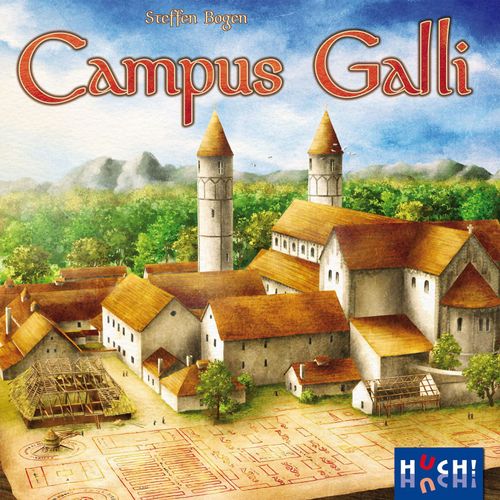
Campus Galli
Campus Galli Rulebook
Table of Contents
Table of Contents
Level I: Ora et Labora (Pray and Work)
Game Components
- 1 monastery plan
- 11 monastery buildings (parchment side on one face, construction side with wooden buildings on the other)
- 40 building sections, 10 in each of the 4 colors
- 52 action cards: 48 cards marked with an I and 4 angels
- 1 bag
- 36 task cards marked with an I
- 1 task board
- 4 planning boards (front is for level I, reverse is for levels II and III)
- 60 "monk" pieces, 15 in each of the 4 player colors
Game Setup
Lay out the monastery plan. Then place the monastery buildings in their positions on the monastery plan with the parchment side facing up. Only place the church (A), the cloister (B) and the bakery, brewery, almshouse, and guesthouse (C) with the construction side facing up.
Lay out the task board. Shuffle the task cards and place them next to it in a face-down pile.
Put the 20 building sections with the black symbol into the bag. Put the 5 building sections with white symbols back into the box. You don't need them until level II.
Lay out the remaining 20 building sections as a supply. This is what we call the "builders' hut".
Each player takes a planning board and the 15 pieces in the color of your choice. Use the front of the planning board for level I.
Draw 1 angel face down and a number of action cards (see The Action Cards on page 4) according to the number of players:
| Players | Angel | Action cards |
|---|---|---|
| 1 player | 1 angel | 31 action cards |
| 2 players | 1 angel | 15 action cards each |
| 3 players | 1 angel | 11 action cards each |
| 4 players | 1 angel | 7 action cards each |
You can also find an overview of the card distribution on the parchment side of the church.
Shuffle your hand of cards and lay them face down in a pile on your planning board on the "this year" space.
Goal of the Game
Use the monastery plan to create a finished monastery by first erecting temporary wooden structures and then gradually finalizing each one in stone. You score points for constructing building sections with matching colors and for fulfilling the day's tasks.
The Action Cards
Each action card allows you to select 1 building section and to build it in the monastery.
- Cards with a red background allow you to take a matching building section from the builders' hut. You may choose the shape yourself.
- Some of these cards give you a choice between 2 different colors.
- The grand master builder even has access to any color and shape from the builders' hut.
- Cards with a blue background and a shape allow you to draw from the black bag, or "prayer pouch". You are then allowed to feel for the matching shape in the prayer pouch. This means, of course, that you can't recognize the color. So all that's left is to "pray" that it's a color you can make good use of.
- Some of these cards give you a choice between 2 different shapes.
- There are also cards with double-colored backgrounds. They give you a choice between selecting a particular shape, which you can see, from the builders' hut or feeling for one in the bag. You only need to make this decision once all of your cards have been revealed (see below).
- The grand seer allows you to take any shape from the prayer pouch.
- The angel even allows you to take any building section from the builders' hut or the prayer pouch. You can still only search the prayer pouch by touch, however.
The blue or red symbol at the bottom of the card is not relevant to this level.
How to Play
1. Fill Up the Task Board
Before every round, fill up the task board:
| Players | Task cards |
|---|---|
| 1 player | 3 cards |
| 2 players | 4 cards |
| 3 players | 5 cards |
| 4 players | 6 cards |
Some of these cards give you a choice between 2 different colors.
Check the tasks: If they concern particular monastery buildings (marked with letters), then those buildings must have their construction side face up. If they are still showing the parchment side, flip them over now. If you uncover a task that you can no longer fulfill because the building is already complete, put the card to the side and replace it with a new task card.
2. Draw and Select Action Cards
Draw the top 2 action cards from your pile. If your pile is empty, shuffle the cards from the "next year" space on your board and form a new pile with them.
Select 1 of your 2 drawn action cards for this round at the same time. Place your selected card face down on the space with the sundial. Place the other card on the "next year" space. Once you have played through all the cards in your current action pile, form a new action pile from the cards on the "next year" space.
3. Flip Action Card and Perform Action
All players flip their selected action card over at the same time. Now take your turns in order. The numbers in the bottom right corner of your selected cards determine the turn order. The lowest number begins, followed by the next highest, and then the next highest, and so on.
If you play an action card with a double-colored background, you can decide whether to feel for the shape in the prayer pouch or select from the builders' hut with full knowledge of the other players' cards. This affects the turn order: if you choose the bag, then the smaller number applies, and if you choose the builders' hut, the larger number applies.
Perform the following steps in this order on your turn:
a) Lay building section
Take a building section from the bag or from the builders' hut according to the card you played and lay it on the monastery plan. As well as the specifications on the action card, the following building rules apply:
- You can only lay a building section if it replaces at least 1 space of a wooden building.
- You can lay building sections so that they connect wooden buildings together across the building borders on the monastery plan.
- You can build over grass, but not over trees.
- You cannot lay building sections on the parchment side of a monastery building.
- You cannot lay building sections on other building sections.
b) Place master builder
If you manage to lay the building section so that
- it covers at least 1 symbol of the building section's color (red, yellow, green, or blue), not necessarily with the symbols exactly aligned, AND
- none of the building section is on a grass space,
you can place 1 of your monks on the building section as a master builder. Master builders score you 1 point each at the end. If you only fulfill 1 or none of these 2 conditions, you cannot place a monk on the building section (see example on page 6).
c) Fulfill tasks
Pay attention to the task board when laying your building sections. If you fulfill a task by laying your building section, take that task card and place it on the matching space on your board.
- You can fulfill the "building progress" task by laying any building section on the monastery building shown. You must cover at least 1 space of the building and not just grass spaces.
- You can fulfill the "construction tasks" with color or shape combinations by laying a building section of the color or shape shown. It must also border a building section of the second color or shape shown. The building sections must be touching on at least 1 edge, but not necessarily exactly as shown on the card.
- You can fulfill "construction tasks" with a cardinal direction by laying a building section of the color shown on the relevant area of the monastery plan (on any of the indicated monastery buildings).
- You can fulfill "construction tasks" with a letter by laying a building section of the shape shown on the monastery building indicated.
Each golden seal scores you 1 point at the end. Only refill the task board at the beginning of the next round.
d) Monastery building complete?
If you cover the last free space of a monastery building with your building section, you can flip 1 other monastery building from its parchment side to its construction side. Place 1 of your monks as a master builder on the grass next to this building. This master builder scores you 1 point at the end. If you complete a monastery building and all the buildings are already on their construction sides, you cannot place a master builder.
e) Lazy monk?
Try to lay your building sections without leaving empty spaces. If you lay a building section and leave an empty space (3 or fewer wooden building spaces), lay down 1 of your monks in the gap. He counts as a lazy monk (placed on a yellow roof space of the wooden building, not on a building section or on grass like the master builders). You can remove a lazy monk and return him to your supply if someone completely closes the empty space when they lay a building section, or increases the empty space beyond 3 wooden building spaces by flipping a parchment to create a neighboring wooden building.
Example: You place this green building section over 2 green symbols. You have followed all the building rules, so you place 1 monk as a master builder on this section. You also, however, have to lay down a lazy monk on the left side of wooden building C. (Lazy monk and master builder are marked in the example illustration.)
Tidy Up
Once everyone has taken their turn, lay your used action card on the red and blue space on your board (in the top right). Then prepare for the next round, starting back at 1.
Game End (Level I)
The game ends the second time that you run out of cards on your "this year" space. Then you score the game.
Scoring (Level I)
Lazy monks count for -1 point and master builders for +1 point. For every lazy monk, you can remove it from the monastery plan with a master builder because the points cancel each other out. Count up your fulfilled task cards. Each seal on the task card scores you another point. Whoever scores the most points has won this game.
Cooperative Game (Level I)
Instead of playing against each other, you can also play cooperatively. It is then your goal to reach a particular score together (see table below).
The game's rules are the same. You can discuss your moves, but you cannot discuss the values or effects of your cards. You also cannot show your cards. There is a small change to the scoring: Any empty spaces that are too large to lay a lazy monk down in score you -3 points at the end of the game. Any monastery buildings still on their parchment side (that you haven't started building) score you -6 points.
Use the following table to work out your score and see if you have qualified for the next level.
| Score | Pigment | Result |
|---|---|---|
| under 40 | Iron gall | try again |
| 40-41 | Ochre | success |
| 42-43 | Red lead | success |
| 44-45 | Azurite | success |
| 46-47 | Tyrian purple | success |
| 48-49 | Gold | success |
| over 50 | Lapis lazuli | qualified for level II |
These are the names of different pigments that were being used in the 9th century. Blue lapis lazuli had to be imported from what is now Afghanistan and was more expensive than gold, whereas iron gall ink could be produced and used in large amounts.
Level II: Libri et Hospites (Books and Guests)
Level II Setup
Set up the components as in level I, but with the following changes:
48 tiles. Lay out the tiles next to the monastery plan. You receive 1 tile of each color and then draw 1 random fifth tile at the start.
5 building sections with black and white symbols. Add them to the bag. They count as jokers. That means you can use these building sections to gain tiles in any of the 4 colors.
Planning boards. Use the reverse of your planning board for levels II and III.
Level II action cards. Use all the level II action cards with books and people (with a number II at the bottom and green or yellow borders) and the level I action cards in this game. Start by separating the level II cards from the red and blue action cards, then shuffle each pile and deal the cards as follows:
| Players | Cards dealt |
|---|---|
| 1 player | 1 angel, 31 level I action cards, and 22 level II action cards (54 cards total in your action pile) |
| 2 players | 1 angel, 15 level I action cards, and 11 level II action cards each (27 cards total in your action pile) |
| 3 players | 1 angel, 10 level I action cards, and 7 level II action cards each (18 cards total in your action pile) |
| 4 players | 1 angel, 7 level I action cards, and 7 level II action cards each (15 cards total in your action pile) |
Shuffle your own action cards and lay them in a face-down action pile on the "this year" space on your planning board.
Level II task cards. Shuffle the 32 level II task cards together with the 36 level I task cards and lay them next to the task board in a face-down pile.
Monastery buildings. Lay out the monastery plan. Begin level II by flipping only the church (a) and the cloister & enclosure (b) onto their construction sides. All other buildings start on their parchment side.
Level II Goal of the Game
In addition to constructing the monastery, you have new tasks: Construct your own library in your scriptorium and try to accommodate guests in the monastery. These actions also score points to add to your shared or individual score at the end. Before you begin the game, decide if you want to play a cooperative or competitive game.
Level II How to Play
1. Reveal task cards and lay them on the task board
Before every round, fill up the task board:
| Players | Task cards |
|---|---|
| 1 player | 3 cards |
| 2 players | 5 cards |
| 3 players | 6 cards |
| 4 players | 7 cards |
The rules from level I apply (flip monastery buildings required by the tasks to their construction side and immediately replace tasks that can no longer be fulfilled).
Task cards with brown borders take effect immediately once revealed. Stop filling the task board and resolve the card's effect immediately, then flip that task card over and continue filling the task board. Discard flipped task cards at the end of the round.
- Dues: If you have more than 7 tiles, you must discard all of them to the general supply. You then receive 1 tile of each type.
- Feast day: Each player can score up to 2 of their guests.
- Study day: Each player can score up to 2 of their books.
2. Draw 3 action cards and select 1
At the start of every round in level II, draw the top 3 action cards face down from your "this year" pile (not just 2 like in level I). If your pile is empty, shuffle the cards from the "next year" space on your board and form a new pile with them.
In level II, actions cost tiles. However, you can also earn new tiles by performing any action, whether writing books, building, or bringing guests into the monastery.
You have to have the tile shown in the bottom left of a card to be able to use it:
-
For cards with a red background, you must spend a red "work" tile. As in level I, they allow you to take building sections from the builders' hut (the visible supply).
-
For the grand master builder, who allows you to take any color or shape from the builders' hut, you must spend 2 tiles: 1 red and 1 other tile of any color.
-
For cards with a blue background, you must spend a blue "prayer" tile.
-
For the grand seer, who allows you to take any color or shape from the prayer pouch, you must spend 2 tiles: 1 blue and 1 other tile of any color.
-
Cards with a double-colored background allow you to choose: You can spend a red tile to select the shape shown from the builders' hut or you can spend a blue tile to select the shape from the prayer pouch. You only need to make this decision once all of your cards have been revealed (see below).
-
Angels will give you their aid for free.
-
Guest cards with yellow backgrounds require a yellow "handshake" tile to play: They let you bring a guest into the monastery to strengthen the monastic community (see page 10).
-
Book cards with green backgrounds require a green "writing" tile to play: They let you produce a book to add to your library (see a) Produce a book).
All players select 1 action card for their next action at the same time. Lay your selected card face down in the middle of your planning board on the "ORA & LABORA" space. Lay the 2 unselected cards on the "next year" space. Cards laid here form the discard pile, which becomes the new draw pile in the second year of construction.
If you don't have the tiles for any of the action cards, select 1 anyway and lay it on the "ORA & LABORA" space.
3. Flip action card and perform action
The next step is to flip over your selected action cards together and to perform their indicated actions. The turn order is decided by the numbers on the cards, as in level I. The smallest number goes first, followed by the next highest. The numbers are ordered so that PRODUCE A BOOK goes first (green tile), then PRAYER (blue tile), then BUILD (red tile), and then BRING A GUEST TO THE MONASTERY (yellow tile). The last actions played are those that cost no tiles (angel) or begging, which you do when you don't have the necessary tiles.
a) Produce a book
Spend a green tile to perform this action. Add the newly finished book to your library (top left corner of your planning board). In return, you receive 1 tile of the color shown on the top of the card. This reward will increase as you grow your library. You can then also score up to 2 of your other books again. This means that you can receive a maximum of 3 tiles for every new book. Each book will also score you half a point at the end, apart from the monastery plan itself, which scores you 1 whole point.
b) Lay building section
The same rules from level I apply. You must, however, spend the required tiles before you can lay a building section.
c) Receive tiles
In level II, you do not directly score points in the form of master builders by installing building sections, but you can earn new tiles. The color of the building section determines the color of tile you can earn.
- If you lay the building section perfectly on the wooden building (meaning not on any grass spaces), you always receive 1 tile in the color shown on the building section. If you lay any part of your building section on grass, you do not receive the tile.
- You receive 1 additional tile in the building section's color for every same-colored symbol that you cover (even if you build on the grass).
- You do NOT receive tiles for covering symbols of other colors!
- White building sections from the prayer pouch count as jokers. They reward you with tiles for all of the colored symbols that you cover (but no extra tiles for building only on the wooden building).
d) Lazy monk?
The same rules from level I apply: Anyone who causes an empty space in a building of 3 spaces or fewer must still lay down a lazy monk in the gap.
e) Bring a guest to the monastery
First spend 1 yellow tile and lay the guest card on the yellow space on your planning board. Guests that you play are visiting your monastery. In return, you receive the tile shown in the top left of the card.
Some guests don't bring anything with them. Some have 2 tiles to choose from. You can select 1 of these. If you have already played other guest cards, you can score a second guest card from your planning board again and receive that card's reward.
Every guest is assigned to a building. If that monastery building has already been erected in wood, the guest doesn't just visit. They move into the monastery permanently. Place 1 of your monks on the grass next to the relevant monastery building. If the building has already been completed in stone, the guest even brings a second person with them. In this case, you can place 2 monks. Each of them scores you 1 point at the end.
f) Beg
If you have played an action card and you cannot or don't want to spend the required tiles, you have to beg. Place your action card on the red and blue space on your planning board and take any 2 tiles. You perform no other action this round.
g) Daily tasks fulfilled?
Pay attention to the task board when choosing your actions. As soon as you fulfill a task at the end of your turn, you receive that task card and lay it on the space for fulfilled tasks on your planning board. The following task types have been added in level II:
- Long hours of prayer: If you have 0 of the tile shown on the card at the end of your turn, you receive 1 of that tile and can also take this task card. This card scores you half a point (from the half seal) at the end of the game.
- Alms: If you only have 2 tiles or fewer at the end of your turn, you can take any 2 tiles, and you also receive this card.
- Complete: If you have completed a monastery building in this turn, you receive this card.
- New book: If you have produced a new book in this turn, you receive this card.
- New person in the west/east: You can either fulfill this task with a guest card if the guest moves into the monastery, or by flipping a parchment to erect the wooden building on the other side and placing a master builder beside it (see Expand the monastery).
Note: Completing a monastery building does NOT allow you to flip another building from parchment to construction like in level I. There is now a special action for this called "expand the monastery" (see page 11).
- All together: If you have received both of the tiles shown in this turn, you receive this card. This is possible through the actions "produce a book", "bring a guest to the monastery", "beg", or by laying a joker building section. It is also possible with the task card "alms".
Tile exchange: At any point during your turn, you can swap any 3 tiles for 1 tile of any type.
The manual's box also explains the "?" symbol (a tile icon with a question mark): it indicates that you can take or must spend any 1 tile.
5. Game End (Level II)
The game ends after 2 years of construction, once you run out of cards on your "this year" space for the second time.
In a 4-player game, draw 4 action cards in the last round and choose 1 to be your action.
Scoring (Level II)
Lazy monks count for -1 point and master builders for +1 point. For every lazy monk, you can remove it from the monastery plan with a master builder because the points cancel each other out. Count up your fulfilled task cards. Every whole seal scores you 1 point. Every 2 half seals also score you 1 point. Every 2 half seals (for example, from books) also score you 1 point. Each set of 3 tiles of the same color scores you 1 point. Each set of tiles with 1 tile of each of the 4 colors also scores you 1 point.
Whoever scores the most points has won this game.
Cooperative Game (Level II)
Instead of playing against each other, you can also play cooperatively. It is then your goal to reach a particular score together (see table below).
The game's rules are the same. You can discuss your moves, but you cannot discuss the values or effects on your cards. You also cannot show your cards.
There is a small change to the scoring: Any empty spaces that are too large to lay a lazy monk in score you -3 points at the end of the game. Any monastery buildings still on their parchment side (that you haven't started building) score you -6 points.
Use the following table to work out your score and see if you have qualified for the next level.
| Score | Pigment | Result |
|---|---|---|
| under 40 | Iron gall | try again |
| 40-41 | Ochre | success |
| 42-43 | Red lead | success |
| 44-45 | Azurite | success |
| 46-47 | Tyrian purple | qualified for level III |
| 48-49 | Gold | qualified for level III |
| over 50 | Lapis lazuli | qualified for level III |
Level III: Eventus et Periculi (Events & Dangers)
Level III Setup
Add the following to the setup and game components from levels I and II:
Action cards. Add construction task action cards to the action cards in the game. Separate the cards by level (I, II, or III), then shuffle each pile and deal the cards as follows:
| Players | Cards dealt |
|---|---|
| 1 player | 1 angel, 31 level I action cards, 22 level II action cards, and 18 level III action cards (72 cards total in your action pile) |
| 2 players | 1 angel, 15 level I action cards, 11 level II action cards, and 8 level III action cards each (35 cards total in your action pile) |
| 3 players | 1 angel, 10 level I action cards, 7 level II action cards, and 6 level III action cards each (24 cards total in your action pile) |
| 4 players | 1 angel, 7 level I action cards, 7 level II action cards, and 3 level III action cards each (18 cards total in your action pile) |
Shuffle your own action cards and lay them in a face-down action pile on the "this year" space on your planning board.
"Unfinished tasks" board. Do not return the leftover level I and II action cards to the box. Lay them instead on the appropriate space on the "unfinished tasks from the previous year" board. Sort the cards by color (sort double-colored cards to the blue or red pile, keeping the piles equal in size). Shuffle each of these new piles separately and lay them back face down on the board. Turn over the top card of each pile.
Level III task cards (32). Shuffle the 32 level III task cards together with those from levels I and II and lay them all in a face-down pile next to the task board.
Good cooperation cards. Lay out the additional "good cooperation" cards in a separate pile.
Monastery buildings. Lay out the monastery plan. In level III, only flip the church (a) over. All other buildings start on their parchment side.
Components. Lay out the 3 colored dice and the cordon.
Level III Goal of the Game
In level III, you must work to extend the monastery, fill your library with books, and grow the monastic community. You also have to repel dangers, such as accidents, epidemics, and fires. You can score points for this as well. Level III is particularly suited to cooperative play.
Level III How to Play
All the rules from level II apply, with the following changes:
1. Reveal task cards and lay them on the task board
Before every round, fill up the task board:
| Players | Task cards |
|---|---|
| 1 player | 4 cards |
| 2 players | 6 cards |
| 3 players | 7 cards |
| 4 players | 8 cards |
The rules from level II apply: flip monastery buildings required by the tasks to their construction side and immediately replace tasks that can no longer be fulfilled. Resolve events immediately, but only replace them with new tasks at the beginning of the next round.
There are additional event cards. For some you need to roll to see which tiles they require. If you roll white, then no tile is required. If you roll black, then any 1 tile is required.
Fire hazard. When this card is revealed, everyone who has a book has to fight a fire in their library. Each player with at least 1 book rolls 1 colored die to see which tile they have to spend to extinguish the fire. If you cannot or do not want to spend the tile, you have to return 1 of your books to the box. You can choose which book to lose. If you spend the tile and extinguish the fire, you either receive this task card or 1 of the additional "good cooperation" cards as a point.
If no one has a book, ignore the event, lay the card on the discard pile, and immediately replace it with the next task card.
Risk of epidemic. The parts of the monastery shown on the card are affected. Everyone who has at least 1 guest monk in an affected area must deal with the epidemic. Each of these players rolls 2 colored dice to see which 2 tiles they must spend to repel the danger. If you cannot or do not want to spend the tiles, you have to return 1 of your guest monks from the affected part of the monastery to your supply. If you successfully deal with the epidemic, you receive 1 point (either as the epidemic task card or an additional "good cooperation" card). If there are no guests in the affected part of the monastery, ignore the event, lay the card on the discard pile, and immediately replace it with the next task card.
Risk of collapse. The first column on the "risk of collapse" card shows which building section is affected. Read this column from top to bottom until you reach a shape that has been built on the monastery plan. If there is more than 1 building section with this shape already built, the second column shows which color is affected. The building section indicated collapses. If there is a matching building section already built from both the builders' hut and the prayer pouch, the one from the builders' hut collapses. If none of the building sections shown are on the monastery plan, or if fewer than 3 building sections are in play, ignore the event, lay the card on the discard pile, and immediately replace it with the next task card.
Roll 3 colored dice to see which 3 tiles you must spend to prevent the collapse. If you are playing competitively, any of you can prevent the collapse by spending the required tiles. In return, you receive 2 points in the form of this task card or 2 additional "good cooperation" cards. If you are playing cooperatively, only 1 player can prevent the collapse by spending the required tiles on their own.
If no one can or wants to prevent the collapse, remove the affected building section. Return it, as appropriate, to the builders' hut or prayer pouch. You can lay it again later. When playing cooperatively, the collapse counts for -1 point at the end. Lay the task card face up next to the task board as a reminder.
Storm on the north tower. If the church's north tower is already built, it collapses in a storm. Return the affected building section, as appropriate, to the builders' hut or prayer pouch. You can lay it again later. You cannot prevent this event.
Construction halt. Lay the cordon on top of the affected monastery building. You cannot lay building sections in this area. You can still flip the building to its construction side to erect a wooden building. This task card can only be removed using a special action. This means the construction halt remains in effect for at least 1 round. You can remove the card by spending tiles. Once spent, remove the cordon immediately. You can then lay building sections again as normal.
Expansion and connection. To fulfill "expansion" or "connection" tasks, lay a building section on at least 1 of the indicated grass spaces so that the monastery building is expanded or so that the 2 monastery buildings are connected.
Reconstruction. Use this card to move an already built building section of the same shape to another position. Just as with the special action "lay building section" you earn no tiles in return, but you can get rid of lazy monks or fulfill other tasks.
New arrivals. Anyone with a guest or a master builder in the indicated area of the monastery can benefit from new arrivals there. If you spend the required tiles, you can place another monk there.
Level III Action Phase
2. Action phase: draw 3 action cards and select 1
The action phase follows the level II rules. The number on your action card determines the turn order. There is 1 new action card:
Unfinished tasks from the previous year. If you select this card, you have access to the "unfinished tasks from the previous year" board. Spend any 1 tile to take 1 of the action cards and perform its action. You only need to spend 1 tile, even for action cards that normally cost 2 tiles (master builder and seer). Lay the card on the appropriate space on your planning board once its action is finished.
Reveal the top card from the appropriately colored pile to refill the "unfinished tasks from the previous year" board. This new card is immediately available through use of an unfinished tasks card.
Level III Game End
The game ends after 2 years of construction, once you run out of cards on your "this year" space for the second time.
In a 4-player game, draw 4 action cards in the last round and choose 1 to be your action.
Level III Scoring
Lazy monks count for -1 point and master builders for +1 point. For every lazy monk, you can remove it from the monastery plan with a master builder because the points cancel each other out. Count up your fulfilled task cards. Every whole seal and every 2 half seals score you 1 point. Every 2 books that you have finished score another 1 point. Each set of 3 tiles of the same color scores you 1 point. Each set of tiles with 1 tile of each of the 4 colors also scores you 1 point.
Whoever scores the most points has won this game.
Cooperative Game (Level III)
Instead of playing against each other, you can also play cooperatively. It is then your goal to reach a particular score together (see table below).
The game's rules are the same. You can discuss your moves, but you cannot discuss the values or effects on your cards. You also cannot show your cards.
There is a small change to the scoring: Any empty spaces that are too large to lay a lazy monk down in score you -3 points at the end of the game. Any monastery buildings still on their parchment side (that you haven't started building) score you -6 points.
Use the following table to work out your score and see if you have beaten the game. If you complete the monastery, leaving no empty spaces, you score +5 points in level III.
| Score | Pigment | Result |
|---|---|---|
| under 70 | Iron gall | try again |
| 70, 71 | Ochre | success |
| 72, 73, 74 | Red lead | success |
| 75, 76, 77 | Azurite | success |
| 78, 79, 80 | Tyrian purple | one for the annals! |
| 81, 82, 83 | Gold | one for the annals! |
| over 84 | Lapis lazuli | one for the annals! |
4. Special Actions
After all players have completed their actions, you can also perform a special action each. Take your special actions in the same turn order, as determined by the numbers on your action cards for this round. You can perform a special action if you have the required tiles and want to spend them. Otherwise, you pass and perform no more actions in this round. If you do take a special action then, after the other players have had their turn, you will have another chance to perform a special action. This phase only ends once all players have passed.
The following special actions are possible:
-
Church bell, imperial visit, feeding the poor, ivory panel:
Note on this list: the printed heading says "ivory panel", but the fourth card shown is labelled "Church Treasure" (level III). The four cards are shown as "Church Bell", "Imperial Visit", "Feeding the Poor" and "Church Treasure". Their tile costs are shown only as icons on the cards: Church Bell shows a red tile and a "?" tile; Imperial Visit shows a yellow tile and a "?" tile; Feeding the Poor shows a blue tile and a "?" tile; Church Treasure (level III) shows two "? = ?" pairs.
There are some daily task cards that require you to spend tiles. These can only be fulfilled through special actions.
-
Expand the monastery: You must spend 3 tiles to bring a monastery building into the game by flipping it from the parchment side to the construction side. The required tiles are shown on the parchment side. As in level I, you can place a monk as a master builder on the grass next to the wooden building after flipping it. This master builder scores you 1 point at the end.
NOTE: Unlike in level I, you can no longer flip parchments to erect wooden buildings when you complete a monastery building.
-
Lay building sections from the builders' hut or draw them from the bag: You can purchase a building section from the builders' hut with tiles and install it. A building section costs 3 tiles of the same color (so a red building section costs 3 red tiles) plus another 2 tiles of any color.
You can purchase any building section from the prayer pouch for 1 tile of each color plus another 1 tile of any color. You draw the section from the bag without looking inside.
Place this building section according to the normal rules, but you do not receive any tiles for this special action. You can, however, use this action to fulfill construction tasks that are still on the task board.