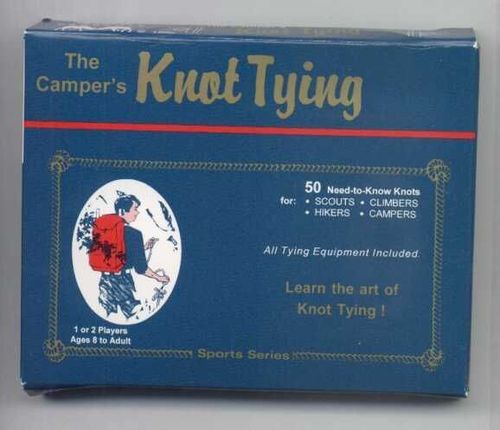
The Camper's Knot Tying Game
The Camper's Knot Tying Game Rulebook
Table of Contents
Table of Contents
How to Play
Any number can play by adding ropes and bars.
For tying knots requiring two ropes, use both ends of your rope.
- HOW TO PLAY: Each player selects one length of tying rope and one tying bar.
- One player shuffles the cards and places them face down in the center of the players.
- One card is turned face up, and all players race to be the first to tie the knot.
- The first player to correctly tie the knot throws the knot to the center of the players. He is given the knot tying card which shows the point value.
- In case of two players tying the knot at the same time, the card is returned to the center of the card stack and used again [illegible word] later in the game.
- Another card is turned face up and the players race to [unclear: "be" or "tie"] the knot. Continue turning up the cards until all cards are used.
- Players then count the point value on each of their cards and the highest score wins.
Cut rope into two equal parts.
About Ropes
Working End: The end of the rope being used at the time to tie the knot. Also called the "Bitter End."
Standing Part: The part of the rope not being used at the moment.
Bight: A curve or bend in the rope. This is usually a loop through which the working end is passed.
There are thousands of knots used for special purposes, but the ones in this game are the most basic, and should suffice for most jobs. Practice with your ropes and bars until you have mastered the knots. Someday you may find them essential.
Breaking Strength
When you tie a knot, the breaking strength of your line is reduced. The remaining strength is shown here.
(Beginning strength of line = 100%)
The card lists these knots: Overhand Knot, Timber Hitch, Reef Knot, Fisherman's Bend, Clove Hitch, Sheet Bend, Bowline, Two Half Hitches, Blood Knot.
The remaining-strength values printed on the card, in printed order, are: 40%, 70%, 45%, 75%, 75%, 55%, 60%, 70%, 80%.
Transcription note: in the photograph the values column is skewed and its first value sits on the header line with no knot name beside it. The pairing of each value with its knot could not be read reliably, so the values are not assigned to knots here. Check against a clearer copy of the card before relying on any individual percentage.