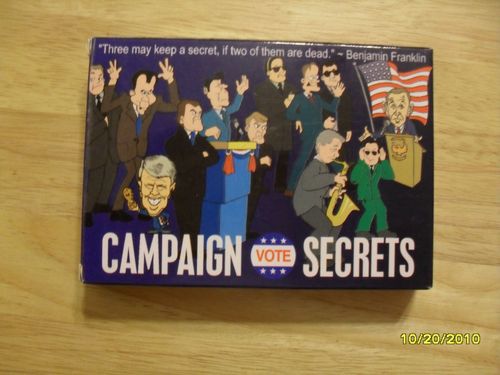
Campaign Secrets
Campaign Secrets Rulebook
Table of Contents
Table of Contents
- Articles
- Amendments (Clarifications)
- Amendment I - Any Card Anywhere
- Amendment II - Special Play Cards
- Amendment III - Defense Against Secrets
- Amendment IV - Tie Breaker
- Amendment V - Poll Results
- Amendment VI - Payments and Losses
- Amendment VII - Secrets Have No Cost After Election Day
- Amendment VIII - No Limits Per Player
- Amendment IX - No Losers Until Election Day
- Amendment X - Multi-party Nominations
- Amendment XI - One Running Mate
- Executive Privilege
Articles
Article I - Setting Up The Game
Section 1 - Give each player 10% (or 10 chips). Place the remainder of the chips, hereafter known as "the undecided vote," in the center of the table.
Section 2 - Sort through the deck and pull out the card labeled "Election Day." Place it aside; it will be used later.
Section 3 - Shuffle the deck, then deal each player five cards. This five card limit is called the "hand size", and may be altered up or down throughout the game by various cards.
Section 4 - Place the Election Day card at the bottom of the deck.
NOTE: Some players like to place the Election Day card at a random location in the deck so no one knows exactly when the game will end.
Section 5 - Place the remainder of the deck, hereafter known as "the draw pile," in the center of the table.
Section 6 - Leave a space at the center of the table for "the discard pile."
Section 7 - Determine who will start first. If this is the first game, we recommend choosing the person who most recently had their birthday. After you've played a game, you can have the winner start first each time.
Article II - Defining Play
Section 1 - Blue campaign cards directly affect play. When a player chooses to play a campaign card, s/he will read it aloud, select a player for it to affect, and then place it in the discard pile.
Section 2 - Red secret cards come in two parts: cost and benefit. Cost is the percentage of the vote paid by a player that has his/her secret revealed. Benefit is the amount of the vote that a player may gain at the end of the game if s/he can keep the secret from being revealed. When a player chooses to play a secret, s/he will place it face down in front of the player s/he wishes it to affect. If a secret becomes revealed, the holder of that secret must pay it's cost and then discard the secret.
NOTE: The holder of a secret should not know what his/her secrets are until they are revealed.
Article III - The First Round of Play
Section 1 - The first player will choose a card from his/her hand and play it.
NOTE: Any card may be played to affect any player.
Section 2 - Play then continues to the next player (clockwise), until all players have played their first card.
Article IV - Continuing Play
Section 1 - At the beginning of each player's turn s/he should draw from the draw pile until s/he has reached her/his hand size (usually five cards). Each player then plays their turn just like they did in the first round.
Section 2 - When a player plays a party nomination card, they should play it face up in front of them, and leave it there. There are two nomination cards of each type. The next player to play the same type of nomination card as you, becomes your running mate. At the end of the game running mates add their percentage of the vote together to score a victory.
Section 3 - Play until the "Election Day" card is revealed.
Section 3.1 - Each player should discard his/her hand, but not the secrets already played in front of him/her.
Section 3.2 - Starting with the player who drew "Election Day", reveal a secret. The holder of the secret collects the Benefit from the undecided vote. Go around the table clockwise revealing secrets and collecting benefits until all secrets have been revealed.
Section 4 - The winner of the game is the player with the greatest percent of the vote at the end of the game.
Amendments (Clarifications)
Amendment I - Any Card Anywhere
Although we already stated this earlier in the rules, many people forget that you may play any card on any player (including yourself).
Amendment II - Special Play Cards
Some cards have a bold statement between the artwork and the description. This statement describes when that card may be played.
Amendment III - Defense Against Secrets
You may play any number of Special Play Cards outside of your turn to prevent a secret from being revealed.
Amendment IV - Tie Breaker
In the event that two or more players are tied at the end of the game, the winner may be determined in the following manner. The players not involved in the tie, may choose to cede their votes to the player of their choosing. After all players have ceded their votes, do a recount.
Amendment V - Poll Results
Each player's percent of the vote is considered public knowledge as it could be obtained by conducting a poll.
Amendment VI - Payments and Losses
When a player pays the cost of a secret, or is forced to lose a percent from a campaign card, that percent goes back to the undecided vote.
Amendment VII - Secrets Have No Cost After Election Day
The costs of secrets only apply during the game. When the "Election Day" card is drawn, only the benefits of secrets matter. Disregard the costs completely.
Amendment VIII - No Limits Per Player
If a card doesn't explicitly specify the maximum amount of percentage points you can take from any given player, then assume you can take the full amount from any player.
Amendment IX - No Losers Until Election Day
It doesn't matter if you lose all of your percentage points. You can continue playing until the "Election Day" card is played. No percent of the vote doesn't mean you're out, it simply means you aren't popular.
Amendment X - Multi-party Nominations
You may be nominated by more than one party. In fact, this has happened many times throughout history, a smaller party may nominate a member of another party that shares its views when it has no one to nominate itself.
Amendment XI - One Running Mate
Once you have a running mate, as determined by a matching party nomination, discard all but the matching party nominations. You and your running mate are now linked for the rest of the game, and are no longer eligible to become the running mate of any other player. You may still play additional nominations, but you should play them directly to the discard pile, rather than leaving them in front of you.
Amendment XII - Sole Victory
It is certainly possible to win the game without a running mate. You do not have to have a running mate by the end of the game. However, you cannot refuse to be someone's running mate if they are also nominated by the same party as you.
Note: the printed rulebook labels two amendments "Amendment XII". Both are transcribed as printed; the second one follows.
Amendment XII - Choose Your Running Mate
Per Amendment I you may play any card on any player. Should you happen to get matching party nomination cards you may play the second card on a player of your choosing to make them your running mate. Likewise you may play a card that matches someone else on another player to force them to become running mates.
Executive Privilege
The following rules may spice up the game a bit more if you're looking for a more complex game from Campaign Secrets. They may be used individually or in conjunction with each other.
Super Secrets
Playing Super Secrets will speed up game-play and cause a little more excitement around secrets. To play with this rule simply allow everyone to play as many secrets as possible per round. Therefore if a player has three secrets in his/her hand, s/he may play all of them when it comes to his/her turn. In addition to playing as many secrets as you want, you can play one campaign card per round.
Betting Rules
Here are some simple rules to allow a friendly wager on the game.
Use pennies, nickels, dimes, quarters, or dollars instead of the chips. Everyone brings a set amount to the table, whether that is $2, $20, $200 or some other random number. In poker this would be called the "Buy In". This money is in effect your percentage of the vote.
There is no "undecided" vote in the beginning. This will change rather quickly as secrets are revealed and so on.
Start playing as normal.
When a card says "Take 5% from any combination of players," take 5 dollars, 5 nickels, etc. When a secret is revealed the money from the cost goes to the "Undecided Vote" just like normal.
When the Election Day card comes up, the person in the lead after counting secret benefits gets all of the "Undecided Votes". Reshuffle the deck and continue playing. When you run out of money, you're done. Just like in poker. The last person with money wins.
My Own Private Secrets
Whenever you get a card that allows you to reveal a secret you can use it on yourself to take the benefit of the secret instead of paying the cost. Now when you get those cards you have to decide whether you want to get rid of your own secrets for a benefit or spoil another candidate's day.
Campaign Blitz
Play up, or discard and redraw, up to three cards per turn instead of just playing one.
Drinkin' Rules
If you're over 21 and want to turn Campaign Secrets into a drinking game, here are some ideas how to do that.
Everytime you get a secret, take a drink.
Everytime you reveal a secret, everyone else drinks.
If you ever run out of percentage points, take a drink. It means you're unpopular and drowning your sorrows in booze!