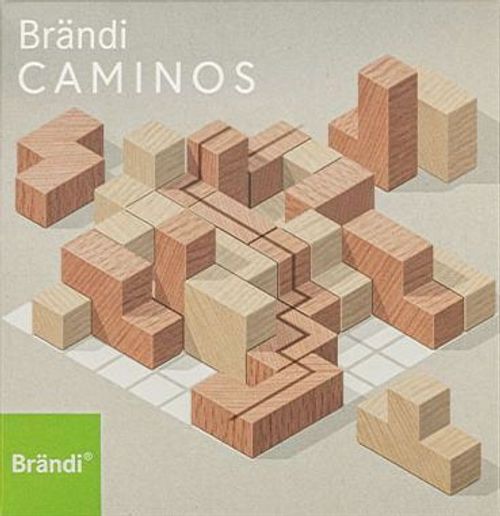
Caminos
Caminos Rulebook
Table of Contents
Table of Contents
Object of the Game
Caminos is a three-dimensional strategy game for two or four players. The aim is to be the first to connect two opposite sides of the playing field with your own stones. Different playing fields are available with different numbers of sides and jagged or smooth edges.
Components
- 2 double-sided playing boards with 4 playing fields
- 28 playing pieces in 2 colours and 4 shapes
- 2 neutral playing pieces in blue (for variant rules)
Base Game
Preparation
With 2 players, each player receives all the pieces in one colour. With four players, the players form a team with the player opposite, and share the pieces of one colour with an equal number of each shape for each. A playing field is selected and placed in the centre of the table. For the first game, the square field is recommended.
Gameplay
The players take turns to place a piece on the playing field. They must follow the following rules.
- No gaps or holes may be created under a placed piece.
- Stones may be free-standing or placed on top of other stones, but one face must always be touching the playing field. The maximum height is thus 3 cubes.
The players attempt to create a path between any two opposite sides, i.e. a path consisting of connected visible surfaces in their own colour. Corner spaces are considered to belong to both adjacent sides.
A connection exists if:
- Adjacent blocks touch with faces or along horizontal edges. Vertical edges and touching corners do not form a connection.
- A path is formed of same-coloured sides, not only as seen from above, but also from other directions. In the picture to the right, yellow's path is broken by the green vertical side, even though a continuous yellow path can be seen from above.
- At the edges of the playing field, the path must be visible from above. In the example to the right, yellow has won. It is not necessary for the path to touch the surface of the field at the edges.
Game End
Once a player has created a path from one side to the opposite side, he or his team have won. If neither side manages to create a path, the game ends in a draw after the last stone is played. If a player cannot place a piece, he is out of the game, even if he could later lay a piece. The other players continue to play while any player has a valid play.
Variants
Neutral Stones
The players or teams, in addition to their playing pieces, receive a neutral blue piece. In the first two turns of the game the two neutral pieces are placed somewhere on the playing field, then the real game begins with the normal rules. The neutral stones are obstacles but, like other stones, they can be built over.
Points
Here several games are played in a row and the players collect points to determine the overall winner.
If a connection was made in this game, the winner receives points equal to the length of the shortest connected path between the sides. In the example of yellow winning earlier, they would receive 13 points.
If no connection was made, players count the number of their pieces which lie at the edge of the playing field touching the ground. Of the pieces on the two visible sides to the right, the pieces with white dots count, while one green and one yellow piece indicated with crosses do not count because they do not touch the ground at the edge of the field. The player with the fewest pieces receives points equal to the number of pieces of the other player. In a tie, neither receives points.
Octagonal Playing Field
With the eight-sided playing fields (Octagon and Ring), connection to the opposite side includes the connection to the nearer side adjacent to the left or right of the target side (in the diagram, a connection from A to C). For this shorter connection, the normal number of points is awarded, while double points are awarded for a connection with the directly opposite side (A to B).