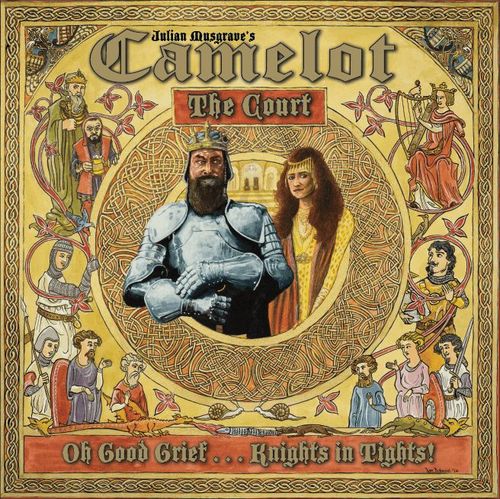
Camelot: The Court
Camelot: The Court Rulebook
Table of Contents
Table of Contents
Game Overview
Camelot – The Court is a game in which 2 to 5 players each control a faction of 8 Knights of the Round Table at the court of King Arthur & Queen Guinevere. Players use Action Cards to advance their Knights closer to the throne and increase their status while trying to weaken and demote Knights from other factions. Higher ranking Knights score more than lower ranking ones and the first player to reach the chosen points target wins the game.
The Game Pieces
The box contains: Game board, 40 double-sided Knight Tiles in 5 colour coded factions, 80 Action Cards, a six sided dice, 5 scoring counters and a rule book.
| Faction | Top Knight | Faction Colour |
|---|---|---|
| Cornwall | Sir Tristram | Red |
| Orkney | Sir Gawaine | Green |
| Gore | Sir Uwaine | Blue |
| Saracens | Sir Palomides | White |
| Ganis | Sir Lancelot | Yellow |
Set Up and Victory Conditions
Lay out the game board – the Great Hall at Camelot Castle.
At the top of the hall sit King Arthur and Queen Quinevere [sic]. In front of them are three spaces for their most senior Knights – the Senators. Below them, in the Lower Hall area, are spaces for nine middle-ranking Nobilitas and below them ten junior Equites. Spaces inside the Great Hall are joined by Movement Lines. Around the outside of the board is the Score Track.
Decide the points target for victory. A 50 points game takes about 20 minutes to play, 100 points 40 minutes and 200 points up to 90 minutes.
Players choose a faction and place their scoring counter on '0'. Shuffle the Action Cards and deal each player 6 cards. Before starting the game, each player places 2 Knights from his faction in the Equites row inside the Great Hall. Any player wearing mauve, pink or primrose coloured tights goes first, otherwise roll the dice. Play passes to the left. You are now ready to start.
Game Rules
1 Knights
Knights enter the Great Hall (using a Move card) into an Equites space, then may only be moved along the Movement Lines joining spaces while in the Great Hall. Knights may have up to two followers (Priests or Soldiers or one of each) stacked beneath him.
Let's meet Sir Lionel.
- The black number on the top left is his Power used in Challenge and Banish dice rolls.
- The red number on the top right is his Points value.
- The reverse shows him Scandalised! (using a Gossip card). He cannot score points and has a power of zero.
- On the far right Sir Lionel has been Scandalised! but still has a Soldier Follower so his Power is 2.
- Right: Sir Lionel with a +2 Priest as Follower. His power stays at 2, but his points value is now 4.
2 Action Cards
The game is played by players playing action cards onto Knights and then scoring points if they have a Score card and wish to use it. A player in his turn may play up to 6 Action Cards and at the end of his turn he draws new cards to make his hand back up to 6. Spent Action Cards go into a discard pile which is shuffled and re-used when needed.
At the end of his turn a player may discard unwanted Action Cards straight to the discard pile before drawing new cards.
3 Action Card Types
There are 8 different Action Cards in a pack of 80. The cards and their actions are:
-
Move (40 cards): Moves a Knight into the Great Hall and within the Great Hall up, down or across one position along the Movement Lines. Players may move other player's Knights as well as their own, and may move an Equites out of the Great Hall.
Challenging: If a move target space is occupied by a Knight from another faction there is a Challenge. Each player takes his Knight's power, rolls the dice and totals them. If the challenger's total is higher they exchange places. If not, the challenge has failed. Players may use a Knight not in the Great Hall to Challenge an Equites Knight in order to enter the Great Hall.
-
Gossip (7 cards): Play onto a Knight and he is Scandalised! His tile is turned over and he loses one follower (if he has any) chosen by the player playing the Gossip card, which then goes into the discard pile. Played onto a Scandalised! Knight and he returns to normal and is turned back face up.
-
Banish (5 cards): To banish a Knight from the Great Hall roll above his Power (including any follower soldiers). Banished Knights go back to the owning player and can return to the Great Hall in the player's own turn using a Move card.
-
Score (12 cards): All players score points for Knights they have in the Great Hall that are able to score. Senators score double their points value, Nobilitas score their points value, Equites score 1 point each + any Follower Priest value. The active player always scores first. Playing a Score card ends a player's turn and all Scandalised! Knights are turned face up.
-
Merlin (3 cards): Allows a Knight (and any followers) in the Great Hall to exchange places with any other Knight (and any followers) in the Great Hall.
-
Dwarf (3 cards): A Dwarf may be used as a Score, Move, Gossip or Banish action as described above.
Examples of Play
Here is a typical start position in a 4 player game. Cornwall (red) was discovered to be wearing mauve tights and is to start. He holds the following cards: A +2 Priest, a +1 Soldier, 3 Move cards and a Score. He places the Priest and Soldier behind Sir Tristram and then promotes him and Sir Constantine into the Nobilitas. This uses two Move cards. He brings Sir Loinstake into the Great Hall using his remaining Move card then plays his Score card. Cornwall scores 8 points (Sir Tristram 3+2, Constantine 2 and Sir Loinstake 1). All other players score 2 points each. Cornwall draws 6 more cards.
Note that Cornwall could have moved Tristram right up to Senator and scored 11 points, but opted to bring another knight into the Great Hall instead (see Strategy Guide later). The end position is shown below.
The next player is Saracens (white). He holds 4 Move cards, a +2 Priest and a Gossip. He adds the Priest to Sir Palomides and promotes him two levels using 2 of his Move cards. He promotes Sagramore one level and brings on Sir Safeashouses using the remaining two Move cards. Then he plays Gossip on Tristram who is turned over and his Priest deserts him (Saracens' choice as the card player). This is the end of his turn and Saracens draws 6 more cards. The position is now as below.
Note that despite being Scandalised!, with a soldier follower, Tristram has a power of 1 if he were challenged by Sir Safeashouses who has a movement line into Tristram's square and might chose to challenge him for position.
It is now Orkney (green) to play who has these cards: 3 Move, a Score, a Merlin and a Banish. He brings on Gaheris and promotes him to Nobilitas (yellow arrows) using two Move cards. Holding a Score card he wants to use at the end of his turn he must do something about Palomides. He could move him down a square using a Move card, but this does not effect Palomides' scoring. Instead he then promotes Palomides to Senator using a Move card. The other players gasp as, on first sight at least, this is a strangely generous thing to do, but this is where it gets devious. The position is now as below.
Orkney has a cunning plan and now 'Merlins' Sir Gawaine by exchanging places for Palomides (red arrow) – who ends the turn as a mere Equites while Gawaine is now a Senator. Now he could use his Banish card to banish Sir Tristram by rolling above 1, but instead opts to banish Sir Constantine, who scores more, by rolling a 5, which is comfortably above Constantine's Power of 3. The position is as below.
Orkney now plays his Score card and the scoring is as follows:
- Orkney – 10 points (Gawaine 3 doubled = 6, Gaheris 3. Gareth scores only 1, being a lowly Equites).
- Gore – 2 points (Uriens & Uwaine 1 point each as Equites).
- Cornwall – 1 point (Loinstake 1. Tristram, being Scandalised!, scores a big fat 0, but will go back to normal at the end of the turn).
- Saracens – 6 points (Sagramore 2. Palomides and Safeashouses 1 point each, plus Palomides gets the +2 score from his priest).
This is good play by Orkney as at the start of his turn he was pretty weedy with only two Equites at court, but by imaginative card play (and a bit of luck) he has turned it around with a perfectly splendid Coup de Spiel*.
Coup de Spiel – A play of all six cards ending in a Score card that leaves the opposition stunned and with their eyes rolling in horrified, if awe-struck, disbelief. Only experienced Camelot – The Court players aspire to such giddy heights.
Players whose bedtime reading includes Caesar's 'Gallic Wars' in the original latin will remember the line 'Tunc Vercingetorix magnum coup de spiel envinceat. Magnificat meum.' which roughly translates as 'Then I defeated Vercingetorix with a magnificent manoeuvre. What a fine chap I am.' Modest fellow, that Julius Caesar; as he was in the habit of telling anyone who couldn't get out of the way fast enough. Pity he didn't have a 'No Stabbing Your Mates' rule in the Senate…..
Strategy and Tactics in Camelot – The Court
At first play Camelot – The Court may seem to be fun but somewhat frustrating. How can I build a position and then exploit it? One asks oneself, as yet another Senator is reduced to dust before he even gets to score. More experienced players always seem to have the drop on you, gracefully playing coup-de-spiel after coup-de-spiel with their scores humming along very nicely thank you. But that tells you something important – that there are indeed deeper strategies in the game. That they are not obvious or easy to exploit gives the game its unique flavour. Players who 'get' the game will almost always beat those who treat it as a crap shoot. So, in a game where your position appears to be all but destroyed the second after your turn is over, where is the strategy? Here's what playtesting has taught us:
A key skill is grading and sorting your action cards so that you create a playing order that maximises your advantage during your turn. See your cards not as individual actions, but as a campaign, complete and perfect in its own space and time. The term 'coup-de-spiel', coined humorously maybe, encapsulates the satisfaction a player experiences when such a view is taken through to its full expression – a play of six cards ending in a score that markedly improves your position in the game.
Before your turn, decide if your hand is a scoring hand or a preparation/strategy hand. Your actions will flow easily from that most basic decision.
If you hold a Score card then your objective will be markedly different from if you do not hold a Score card. If you can score then every card should be directed towards advancing your Knights and destroying the scoring opportunities of your enemies. Use Move cards to elbow them aside and push your chaps forward. Use Gossip to unscandalise your knight so he can score and so on.
If you cannot score in a turn then your objective should be directed towards creating or consolidating a position that does not leave you a target for other player's actions. A strategy to always bear in mind is to bring more knights onto the board and thus keep your pipeline flowing, promoting them up to Senator when cards permit. Crowding the hall also means you always score something whoever plays the Score card, so hopefully keeping you in the running.
Picking up the cards you want means clearing your hand of unwanted cards so keep the action flowing even if you are not going to score this turn. Remember you can discard at the end of the turn and refresh your hand. Keeping cards is probably only worth it with Score, Merlin or Dwarf cards.
Packing a powerful knight with followers and making him a Senator certainly works if you are scoring, but that makes him a target too and he is unlikely to last long – almost certainly not until your next turn. So hold on that tactic if you cannot score from him immediately. Modest scoring spread over more knights is usually a better way to do it. Try to keep them in the Nobilitas ready to move into the Senators when your cards allow.
For most of the game scoring more points than other players is reason enough to play the Score card. But there are a number of tactical factors to consider:
- If you score more points than the leading player it probably is worth scoring.
- If you are leading and it gets you significantly closer to the finish line it might be worth scoring, even if you don't score the most points.
- Remember that scoring unscandalises all Scandalised! Knights, and that may give another player the edge if they are close to the finish line.
The endgame can become a whole battlefield on its own where the leading player comes under relentless attack. Watch out for the quiet player who wins from behind. It is, after all, the classic courtier's strategy!