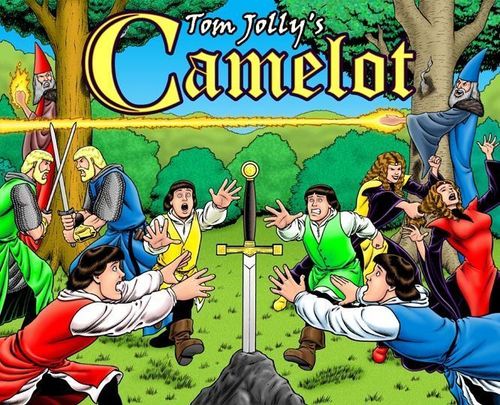
Camelot (Tom Jolly)
Camelot (Tom Jolly) Rulebook
Table of Contents
Table of Contents
Camelot: Basic Game
Object
Claim Excalibur and return it to your Entry Hex. To claim Excalibur you need only move one of your Arthur-pieces onto it. Once you've done this, you can move that piece on your next Turn and may carry Excalibur along with it; however, an Arthur who is carrying the Sword may only move 1 space per Turn. If you get Excalibur back to your Entry hex, you win.
Setup
Place the playing board in the middle of the table. Place Excalibur in the hex marked with a blue diamond. Select a color and take that set of pieces, setting up your 15 adventurer pieces close at hand, face up, along with your color's 3 Spell Tokens. Separate them out so that you know where everything is: Speed is of the essence in this game. Roll a die to see who goes first. The two highest rollers each get a TURN token to indicate that it is their Turn, and they will start the game simultaneously.
Players now take Turns placing their Entry hexes, anywhere along the edge of the board, starting with the highest roller, then the next highest roller, and so on. A player may not choose a location within 5 edge-spaces of any other player (but this may be reduced to 4 if the last players find that there IS no edge space more than 5 spaces from all other players). Note that while it is a slight disadvantage to be squeezed between two other players, it is also a slight advantage — because both opponents will be moving Excalibur nearer to that player's exit in the process of claiming it for themselves.
Characters may not move onto another player's Entry hex, nor may two characters occupy a single space, nor may any unit move through any other unit's space. Thus, it is rather easy to accidentally block your own pieces from moving onto the board.
Simultaneous Movement
Player Turns are regulated by the two "Turn Tokens." At any given time, 2 players will be taking their Turns while other players wait. When one player finishes his Turn, he passes his Turn Token clockwise around the table to the first player who does not already have a Turn Token. When a player receives a Turn Token, they may begin their own Turn immediately. Thus, if one person takes a very long time to finish a Turn, the other players might take many Turns around him — an opportunity to move their forces into action while he wastes time thinking. This is not a game for slowpokes.
On your Turn (when you have a Turn Token), you may move up to 2 pieces: Placing and moving new units onto the board from your Entry hex, or moving units which were put on the board on prior Turns. Note that placing a playing piece on your Entry hex does not count as a space of movement for that piece — its movement follows its placement.
Enemy units may not disengage from one another once they are adjacent. They must remain adjacent, although they can move "around the perimeter" of each other. In some games, both players may decide it is in their best interest to disengage: One player, while they have a Turn Token, may ask the other player for permission to disengage; and if given permission, they may do so. Such permission will be rare.
Simultaneous Combat
If you intend to attack one or more pieces on your Turn, you must declare which pieces are to be attacked before you move your own pieces. This is done by physically touching the unit(s) you wish to attack and stating that you are attacking it (or them). Once you have declared an attack on a unit, that unit may not move or be used in an attack against another unit, effectively freezing it in place. If a player had already started moving a piece which you intended to attack, you must wait until his movement is complete before attacking it: Whoever touched it first has priority. All opponents to be attacked must be declared at the same time, and you must immediately move your attacking units into place and perform the attack once declared. Once you've attacked, you lose any unused movement and your Turn is over.
You may declare any number of attacks before your movement, as long as you can actually perform the attack. For example, if one of your Knights is already in a position to attack an opponent's Arthur and you can additionally move two of your own units up to attack and kill two more tokens, then you could declare that you are attacking all 3 units during your Turn.
Each token has 3 markings on it: Attack (represented by Swords for melee, a Bow & Arrow for missiles, a Skull for Morgan's Curse, and a Star for Merlin's Zot), Defense (represented by Shields) and Movement (represented by Triangles at the base of the counter). The Triangles tell you how many spaces you can move that unit on your Turn. The Shields tells you how big an attack has to be to kill the unit (one more than the number of Shields shown). Thus, an attack with a value of "1" cannot kill a piece with 1 Shield. Swords tell you how many points of damage that unit does.
Galahad's Bow has a range of 3 spaces; so it does not have to be adjacent to another unit to attack. Galahad cannot shoot over trees or rocks because they block line-of-sight, but Galahad can shoot over water or other characters. Thus, you can have Lancelot attacking someone with Galahad behind him supporting the attack, even though it appears that Lancelot is in the way of the attack. Morgan's Curse and Merlin's Zot are also ranged attacks (2 and 3 spaces, respectively).
Resolving Combat
If the attack value is greater than the number of shields on the defending unit, the unit dies. Units that are killed are immediately removed from the playing board by the attacker.
If an attack's value is less than or equal to the number of shields, nothing at all happens to the defender; the unit "successfully defends." However, if you declare an attack and do not have the strength to finish the unit off, you must discard one of your own units that is closest to the attacked piece. This is to prevent players from declaring attacks merely to "freeze" another unit for the Turn, with no intent to kill it. (If all players agree, you may play without this rule since it may slow the game down.)
Attack values can be combined. Any or all units within range can be added to the total attack on one unit.
Keep in mind that each unit may only attack once per Turn. If any unit is in a position where it can attack two different targets, it must choose only one to attack. The only exception to this is Lancelot's "sweeping attack."
There is no "cumulative damage" in this game. Either you have enough attack strength to kill a unit in one attack, or you don't. Damage does not carry over from Turn to Turn.
Unlike other pieces, which are discarded from the game once killed, Arthurs are returned to the owning player's token pile to be brought back into the game again and again at that player's Entry hex. Each player has five Arthurs, which can all be on the board at the same time.
Carrying Items
In the Optional Play which includes the use of Gold and Items, each character can carry only one Item or Gold Token at a time, and it cannot move more than 1 space per Turn while carrying an it. A unit carrying an Item can still attack and defend, however.
Only an Arthur can carry Excalibur! An Arthur may also carry an Item or Gold instead, if it desires, in the optional versions of play.
If you drop an Item or the Sword before you move the token that was carrying that Item, then you may move full movement on that Turn. The Item remains where you dropped it.
Teamwork
The opportunity for teamwork may arise if two of your opponents are adjacent, and you could provide the support needed for either player to kill the other one off. When this happens, you may ask either player if they will support you in your attack (and point to the piece to be attacked as you ask this). Then, once you move your unit up into attack position, you and your momentary ally add your attack values together to bring down the third player's unit. Assisted attacks can occur even if it is not the assisting player's Turn.
Board Space Effects
Ranged attacks can only occur if you have line-of-sight. This means being able to draw a continuous line from the center of the attacker's hex to the center of the defender's hex without passing through any tree or rock hex. (Note: Grass hexes with a slight overlap don't count.) The line may skirt the edge of a tree or rock hex, if the edge lies exactly along the line-of-sight.
Trees and rocks block line-of-sight; but water does not block line-of-sight, nor do other characters. The space that has Excalibur (or the Gold or special Items from the optional versions of play) does not block line-of-sight and may be moved through freely.
Loss of Players
Players can never lose all of their playing pieces, since the Arthurs just keep coming back, so no one is ever out of the game until someone wins. It would be wise to toss the dead pieces and used Spell tokens into the game box, so there will be no confusion about which pieces are still available for play.
Playing Pieces
Each player has five types of units: Arthurs, Galahads, Lancelots, Merlin and Morgan Le Fey. Arthurs can move the fastest, but are the weakest.
ARTHURS: Move 2, Attack 1, Range 1 (adjacent), Defense 1. (Qty. 5) Due to their abundance in local villages, Arthurs are immediately returned to the owning player's token pile when killed. Thus, Arthurs are in unlimited supply, although you may never have more than 5 Arthurs on the board at a time.
GALAHADS (Archers): Move 1, Attack 1, Range 3, Defense 1. (Qty. 4) Galahads are excellent for supporting other units' attacks from a distance.
LANCELOTS (Knights): Move 1, Attack 2, Range 1 (adjacent), Defense 2. (Qty. 4) The Knight also has the unique ability to use a "sweeping blow," causing 1 point of damage each to all adjacent units in one attack. Naturally, this won't kill any of them unless the attack is supported by other pieces.
MERLIN: Move 1 (or Teleport), Attack 1, Range 3, Defense 1. (Qty. 1) Merlin may only use his Teleport spell once per game, allowing him to move anywhere on the board as a substitution for his normal movement. Discard the Teleport token when used. The Teleport spell may be used the same Turn that Merlin is placed on the Entry hex. Merlin has a reusable minor attack spell (the "Zot") which has an attack value of 1 and a range of 3. Merlin may also use a Fireball spell once per game, which causes 2 points of damage to one opponent within his range of 3, but has no effect on other Merlins. Discard the Fireball token once used. Merlins may never carry anything in any version of the game (Gold, Items, Excalibur).
MORGAN: Move 1, Attack 1, Range 2, Defense 2. (Qty. 1) Morgan has a magical Curse attack which has an attack value of 1 and a range of 2. She may also use the Death Touch spell if adjacent to another piece, causing 3 points of damage; but she can only do this once per game, and the token is discarded once it is used. Morgan also has the ability to bring any character back to life, IF she observes that character's death (she must have line-of-sight). That character is removed from the board and returned to the owning player's token pile, and it may be brought back onto the board on a subsequent Turn. She may reuse this ability as often as opportunity allows. If Merlin is brought back to life, he does not get a new batch of spells — he only gets what was left over from his previous life.
Timeouts
In some circumstances, a line-of-sight question or a rules question may come up during the game. In this case, a player may call "timeout" to resolve the line-of-sight or rules question, all players pausing until the question is resolved.
Camelot: Variation Rules
Accoutrements of Kingship
Instead of playing to capture Excalibur, you can play to capture the Accoutrements of Kingship (hereafter referred to as "Items") from the rest of the castle, returning the collected loot to your Entry. If you can claim any 2 of the 4 Items (the Crown, the Scepter, the Robe, the Throne) from the ruins, then you can just get the Kingship without all that hassle about claiming the Sword. Any playing piece (except Merlin) may carry one of the Items. Whenever one of your playing pieces reaches your Entry hex, remove the Item from it and put the Item in front of you.
To play this version of the game, take the 4 "Item" tokens and place them on the spaces marked with red diamonds.
If each player succeeds in grabbing exactly 1 Item, then the game is a draw.
If 5 or 6 people are playing this version, add Excalibur to the board, and it becomes merely another Accoutrement of Kingship.
Buying the Kingship
In this version of the game, you are to gather up gold until you have enough to buy the Kingship. There are various denominations of gold coins on the tokens. Take the number of players and multiply by TEN to see how much gold will be scattered around the playing board (thus, for 4 players, select 40 Gold worth of tokens in any denominations). Randomly place the Gold tokens face-up on the board, prior to selecting who goes first. Gold tokens should not be placed within 2 spaces of the board edge or each other.
Players make their initial starting placements as before, but now the object is to gather up 15 points worth of Gold tokens. As before, each character may only carry one Gold token at a time, at a movement rate of 1 space per Turn. The first player to return 15 Gold to their Entry hex is the winner. If all the Gold is gathered without any player having 15, whoever has the most wins the game (and there can be ties).
The Guardians of the Sword
In this version, put aside one of the 6 sets of tokens (or make 2 new tokens for this purpose). Take two of the Knights (Lancelots) from that set and place them within 2 spaces of Excalibur before the game starts. During the game, any player may move and attack with one or both of these Knights, or use one of these "Guardians" to supplement their own attack. Using one of these Knights counts as one of their movements for their Turn. Note that it is possible for one of these knights to move and attack 5 times during each round of Turns in a 5-player game!
Multiple Variations
Feel free to add one or more game options together for a more intense gaming experience (if you can stand it).
Turn-Based Variation
You can, of course, play this game just taking Turns, but it will not be nearly as much fun.
Winning Conditions
Basic Game:
- The first player to take Excalibur back to their Entry hex wins.
Variation Rules:
- The first player to take 2 Items back to their Entry hex wins.
- If Items and Excalibur are both used, then the first player to take 2 Items OR Excalibur to their Entry hex wins.
- The first player to carry 15 Gold back to their Entry hex wins.
- If playing until all the Gold is gone, the player with the most gold wins.