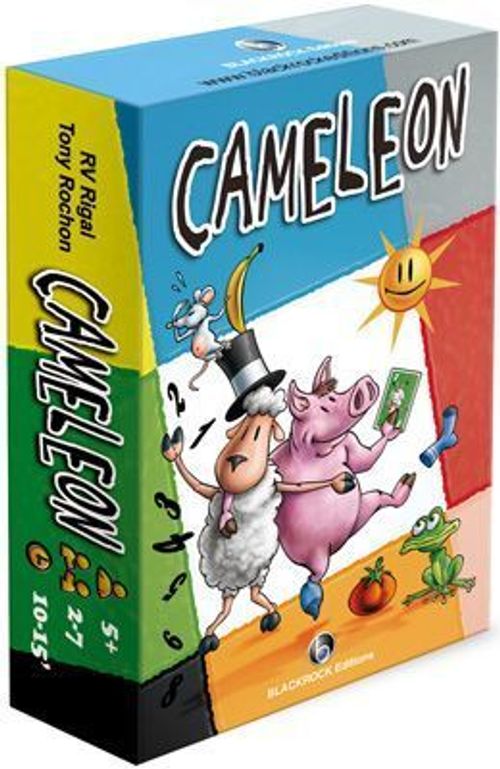
Caméléon
Caméléon Rulebook
Table of Contents
Table of Contents
Components
The game consists of 55 cards: 54 "combination" cards and 1 "Caméléon" card.
Each "combination" card is made up of three elements: a number (1 to 9), a picture (9 different pictures), and a background colour (9 different colours).
- All cards have, on their face, a combination that is different from every other card.
- Each element appears 6 times in the game.
Goal
To win a round, you must be the first to collect 3 cards that reconstruct the combination (number; picture; colour) of the card drawn at the start of the round.
Example: a player has drawn the card "8 - TOMATO - BLUE". To win, he must collect a card "8", a card "TOMATO" and a card with the background "BLUE".
(The rulebook illustrates this with the blue tomato card showing 8, and three cards: a yellow card with an 8 and a frog, a black card with a 6 and a tomato, and a blue card with a 9 and a mouse. The captions read: "8 blue tomatoes", "8", "tomato", "blue".)
The winner of a game is the first player to win 2 rounds.
Setup
Each player draws one card at random and places it in front of him, face up. The player who drew the card with the highest number becomes the dealer for the first turn. He gathers the remaining cards. The game can begin.
If more than 2 players have drawn the same element (number, picture or colour), 2 of them keep their card, and the other player(s) draw again.
If a player draws the "Caméléon" card, he puts it back in the deck and draws a new one.
Playing a Turn
The dealer takes the remaining deck, face down, and turns the cards over one by one, face up, quickly (about one per second), into the centre of the table, in a single pile.
The dealer may never try to win a card.
If a turned card shows one of the elements a player is looking for, that player must place his hand on it before that card is covered.
If several players place their hand on the same card, only the fastest may try to win it.
To do so, without looking at the card under his hand, he must announce the combination of that card. He must announce, in order, the number, the picture and the background colour.
Example: "eight yellow frogs".
The player wins the card if he announces the whole combination clearly and without error. In that case, he designates the dealer for the next turn.
Warning! A player cannot be dealer two turns in a row.
The player does not win the card if:
- he removes his hand before announcing the combination;
- he looks at the card;
- the covered card does not show any element of his combination.
In that case, he becomes the dealer.
The dealer is not obliged to take back all the cards already turned over, and may continue with the rest of the deck.
When the "Caméléon" card is turned over, the first player who covers it while announcing "Caméléon" wins it. This card allows him to replace any element of his combination (number, picture or background colour). With the "Caméléon" card, he only needs to obtain 2 of the 3 elements of his combination to win the round.
End of a Round
The player who first obtains the 3 elements of his combination wins the round.
End of the Game
The player who wins 2 rounds wins the game.
Young Players
It is preferable for an adult to act as dealer for the whole game.
Advanced Rules
- The players taking part in the turn each place one hand on their forehead. It is this hand that must cover the card.
- When a player covers the "Caméléon" card, he must announce, clearly and without error, the whole combination he has to make (without looking at his card).
2-Player Variant
The same card is drawn for the 2 players, who place it face up. Each player must therefore collect the same 3 elements.
The rest of the cards is divided into 2 piles. Each player takes one and places it in front of him, face down. In turn, each player turns one card from his pile over with one hand, into the centre of the table, in a single pile. If a sought-after element appears, the fastest player to cover the turned card with his other hand may then announce the combination of that card.
A player may take back one of the elements he already has, not to complete his own combination but to prevent his opponent from completing theirs.
If there is an error, there is no special rule.