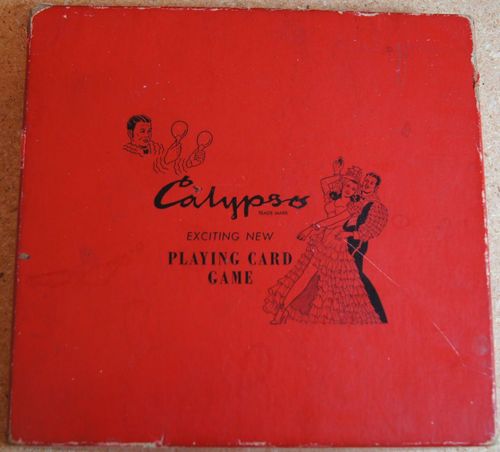
Calypso
Calypso Rulebook
Table of Contents
Table of Contents
Players
Calypso is played by four in fixed partnerships. See the Non-Partnership Calypso section below for the non-partnership version for three or four players.
Cards
Use four 52-card packs, preferably of identical back design and colour, and necessarily all the same size, weight, and finish. Shuffle them together very thoroughly before play.
Cards rank Ace, King, Queen, Jack, 10, 9, 8, 7, 6, 5, 4, 3, 2.
Partners and Seats
The players cutting the two highest cards are partners against the two lowest, and sit opposite each other. Whoever cut highest has first choice of seats and personal trump suit. That player's partner will sit opposite and have as personal trump the partnering suit of the first player, such that one partnership's suits are spades and hearts and the other's clubs and diamonds.
(The illustrated association of specific suits with specific seats is customary — only a serving suggestion, not legally binding.)
Deal
A game consists of four deals, one by each player. Whoever cut the highest card deals first and the turn to deal subsequently passes to the left. Deal 13 cards each face down in ones, and stack the remainder face down to one side. These will gradually be used up in subsequent deals.
Object
To win tricks and make calypsos from the cards they contain. A calypso is a complete run of 13 cards of the same suit from Ace down to Two. Specifically, your aims are:
- to build calypsos in your personal trump suit,
- to help your partner build calypsos in his or her own suit, and
- to hinder your opponents from building calypsos in theirs.
The cards they are built from come only from cards won in tricks, not directly from your hand. The catch is that calypsos must be completed one at a time. That is, you may not start a second calypso until you have completed your first. If you win any cards in a trick that duplicate those already in the calypso you are currently constructing, you can't (with one slight exception) hold them back for future calypsos. It is therefore virtually impossible for anyone to complete all four possible calypsos, and even three is something of a triumph.
Trick-Play
The player at dealer's left leads to the first trick, and the winner of each trick leads to the next. You must follow suit if you can, but may otherwise play any card. The rules of trick-taking are:
- If you lead a card of your personal trump suit, and everyone follows suit, you win the trick regardless of rank. However, if anyone can't follow suit and instead plays a card of their own personal trump, then the trick is taken by the highest-ranking personal trump played.
- If you lead from any other suit, then the trick is taken by the highest card of the suit led, or (if different) by the highest personal trump if any are played.
- If the trick is being taken by two identical cards, or by personal trumps of different suits but equal rank, then the first such card wins.
Note. If somebody else leads your personal trump suit, you cannot "trump" it. You can only follow suit, and hope to win by playing the highest card.
Building Calypsos
When you win a trick, you extract from it any cards you need towards building your current calypso, and pass to your partner any cards needed for theirs. You then stack any unused cards face down on a pile of won cards belonging to your partnership. Unused cards will be both those of your opponents' suits, and those of your own side's suits that duplicate cards already contained in calypsos under construction.
Each player's calypso under construction sits in front of them. To the side of a player's current calypso is the face-down stack of unused cards won by that player in tricks, and beside that a pile of completed calypsos, face up.
Completing Calypsos
When you complete a calypso you bunch all its cards together and stack them face up on the table at your right-hand corner like a won trick. You may then start building a new one, and for this purpose are allowed to use any valid cards in the trick you just won. (This is the exception to the rule about not being able to use duplicates won in the same trick.)
Ending and Scoring
When thirteen tricks have been played, the next 13 cards are dealt by the player to the left of the previous dealer. Play continues in the same way until four deals have been completed. Each side then scores as follows:
| Item | Score |
|---|---|
| For each partner's first calypso | 500 |
| For each partner's second calypso | 750 |
| For each subsequent calypso | 1000 |
| For each card in an unfinished calypso | 20 |
| For each unmelded card won in tricks | 10 |
Revokes
A revoke occurs when a player fails to follow suit although able to do so. The penalty for a revoke is the addition of 260 points to the score of the non-offending side.
(It is set high because a revoke could lead to the loss of a complete calypso to the offended side. In trick-taking games like Bridge where all the cards are dealt out it is usually obvious when a revoke is committed, but in Calypso, where there are four times as many cards and not more than a quarter of them are in play at any given time, it helps to provide some way of marking who has failed to follow suit in case they do play from that suit to a later trick in the same deal and nobody notices. Konstam recommends that each player be equipped with four indicator cards, one per suit. These are kept face down till their owner fails to follow suit, when the card showing the suit renounced is turned face up for the rest of the deal.)
Notes on Play
In most trick-taking games you lead to a trick from either the trump suit or a plain suit. In Calypso, however, you are always leading from a trump suit — not necessarily your own — and you have in fact three choices. Whether to lead your own trump, your partner's trump, or either of the adverse trumps, calls for a radically different approach from what you may be used to.
Probably the most important piece of advice is to avoid leading from your own suit just for the sake and novelty of winning an easy trick. The danger of doing so is that if an opponent follows with a duplicate of the card you lead, or any other card played to the trick, or any rank already represented in the calypso you are currently constructing, you will thereby be deprived of a whole calypso, as the duplicated card can only be added to your pile of won cards.
This doesn't mean to say that you should studiously avoid leading from your own trump. It can be a good opening gambit at the start of a deal if you hold between three and six of your own suit and have no particularly short suit elsewhere. It may also be helpful if you have only low-ranking personal trumps and are unlikely to be able to take tricks with them later when opponents get the lead.
It is rarely a good idea to lead your partner's trump, especially early in the deal, as there is no guarantee that your partner holds high enough cards of that suit to be able to win the trick. But it may be worth doing so if you have certain trick-winners in that suit, or if you are void or have only one of it, so that you may be able to trump when the suit is led again.
As for leading adverse trumps, it is generally best to lead high rather than low.
Non-Partnership Calypso
Calypso for four with everyone playing for themselves, although apparently the original game, is pretty pointless; for if there is no requirement to give anyone else cards for their own calypsos it will be quite surprising for anyone to complete more than one.
Rather more promising is Calypso for three. In the official version, you simply omit one of the suits (conventionally spades) and play for yourself. In both non-partnership games, players who cannot help themselves should endeavour to give help (however grudging) to the player who is farthest in arrears.
Another workable option is to play the official three-player version described above, but in "split partnership" format. This simply means that, at the end of the game, you each score for everything made by yourself and the player on your right.