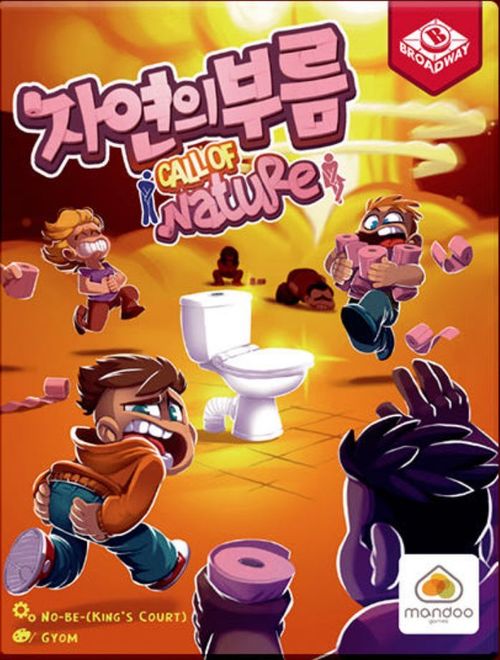
Call of Nature
Call of Nature Rulebook
Table of Contents
Table of Contents
Goal of the Game
In CHIPATSU, raise the Pressure while avoiding the critical thresholds that will make you lose Mastery. The first player who loses control will perhaps drag the others along with them, too eager to finish... Among those who have saved their dignity, the one who shows the most Mastery wins the game!
Components
- 76 Pressure cards. They serve to raise or lower the common Pressure for all players, that is, the irresistible urge to release one's sphincters. Some cards have a special power printed on them.
- 24 Mastery cards (double-sided). They represent the Mastery of your body. The 7 represents total Mastery of your internal flows. The lower the number, the more control you lose. When it reaches 0... it is the explosion!
- 2 Threshold cards (double-sided). The first is used to evaluate the consequence of the Pressure Thresholds on players' Mastery. The second is used to evaluate the state of the toilets at the end of the game (yes, you read that right).
- 2 dice
Setup
- Give each player 1 set of 4 Mastery cards numbered 0 to 7 (double-sided). Stack them in ascending order (1 at the bottom, then 3, 5 and 7 on top). This is your individual Mastery counter.
- Each player receives 4 Pressure cards in hand (they may look at them but must hide them from the other players). The remainder becomes the common draw pile, face down. Beside it, players will place one card per turn, face up, to form the common Pressure pile.
- The player who went to the toilet last starts the game.
Playing the Game
A game is played over several rounds. Each round is made up of player turns. Pressure starts at 0 and rises progressively thanks to the Pressure cards played by the players. Aim for the thresholds 50 and 80. Avoid the critical thresholds 31, 61 and 91.
1. Play a Card
On your turn, play a Pressure card from your hand, face up, onto the common pile (next to the draw pile), to change the Pressure.
- If it is a card with a toilet bowl, add or subtract the card's value to or from the common Pressure. Announce the new Pressure value out loud (you may also keep track on a sheet of paper). For example, if the previous player announced 20 and you play a card of value +3, you must announce 23 on your turn.
- If it is a special card, announce the Pressure, then apply its effect.
- If the Pressure reaches or exceeds a threshold (31, 50, 61, 80 or 91), your Mastery changes.
2. Reach or Exceed a Critical Threshold: 31, 61 and 91
- When you play a card other than +0 and the Pressure reaches or exceeds 31, 61 or 91, lose respectively 1, 2 or 3 levels of Mastery on your individual counter. Your Mastery thus decreases progressively from 7 to 0. Make sure you are not the first to reach 0!
When you change your Mastery card, you may read its ambience text out loud...
END OF ROUND: If you reach or exceed the critical threshold of 91, you trigger the end of the round. If nobody has exploded (a Mastery counter falls to 0), start a new round: shuffle all the Pressure cards, deal 4 to each player and form the common draw pile face down as during setup. THE MASTERY COUNTERS DO NOT MOVE! The player who triggered the critical threshold 91 starts the next round. Pressure restarts at 0.
3. Respite Thresholds: 50 and 80
When you play a card other than +0 and the Pressure reaches exactly 50 or 80, you have a Respite to try to regain control of your sphincters. Roll a die:
- If the result is higher than your current Mastery level, you recover 1 level of Mastery. Adjust your Mastery counter. For example, to go from 4 to 5, turn the card 4 over to show face 5.
- If the result is lower than or equal to your Mastery level, nothing happens. Perseverance is not necessarily the key to control...
Question: The Pressure reaches 50 and the player who reached this threshold therefore benefits from a Respite. If another player plays a +0 card to keep the Pressure at 50, do they also benefit from a Respite? NO. A Respite can only be gained when playing a card that changes the Pressure (whether it raises or lowers it) to reach exactly the 50 and 80 thresholds.
4. Draw Up to 4 Pressure Cards
After playing your turn, draw one (or several) card(s) so that you have 4 cards in hand. If the draw pile is empty, shuffle the cards of the Pressure pile to form a new draw pile. Continue counting the Pressure from where it was before shuffling (do not restart from 0).
5. Next Player
Play continues in the same direction (clockwise or counter-clockwise, depending on the U-TURN! cards played). The next player takes their turn by adding a card from their hand to the common Pressure, and so on.
End of the Game
- Chain rounds until a player sees their Mastery level fall to 0. That player is then eliminated and triggers the end of the game. Someone has just lost all dignity; they could not hold it in...
- The other players can finally go to the toilet. But be careful not to relax your concentration: it can be dangerous to let go too quickly after moments like these!
To finish the game, the players who have not been eliminated take turns rolling the 2 dice, add up the result, and adjust their Mastery according to the result on the End of Game card:
| Sum of the two dice | Result |
|---|---|
| 2 | It's a disaster! You lose 7 levels of Mastery. |
| 3 | Bad luck! You lose 3 levels of Mastery. |
| 4 | Too bad! You lose 2 levels of Mastery. |
| 5 | Ohhh... You lose 1 level of Mastery. |
| 6-12 | Bravo, you have saved your dignity! |
The player with the highest level of Mastery wins the game. In case of a tie, the players share the victory.
Variants
-
Removing the powerful cards: Certain cards in the game, such as "Un petit tour dans les buissons ?" (A Little Trip in the Bushes?) and "Mais si, on est pareils !" (But Yes, We Are All the Same!), can radically change the game. You may remove them if you think they bring too much chaos. You may also ignore the roll of the 2 dice on the End of Game card, which adds randomness.
-
New function of the CRITICAL THRESHOLD card: You may agree together that the CRITICAL THRESHOLD! card remains dangerous as long as it is held in hand. For each CRITICAL THRESHOLD! card in your hand at the end of the game (after a player has been eliminated), subtract 2 from your dice roll total (minimum 2) when calculating the End of Game. It would be good form to get rid of it before the disaster...
-
Speeding up the game: If you play with many beginners, to simplify the game (even though this reduces tactical options), you may remove the cards "Mais si, on est pareils !", "Un petit tour dans les buissons ?", "Suspens !", "On serre les sphincters !", "Pousse-toi de là !", "PERSÉVÉRANCE !" and "On est potes, HEIN ?".
Question: I lose 1 level of Mastery because I reached the critical threshold of 31. Another player plays a -10 card and drops the Pressure to 21. If another player then raises it back above 30, do they also lose 1 level of Mastery? YES. If the Pressure drops back below 31 or 61, the next critical threshold becomes 31 or 61 respectively (the 91 threshold is not concerned, because it ends the current round). A player who passes through a critical threshold again loses Mastery according to that threshold (1 for 31, 2 for 61).