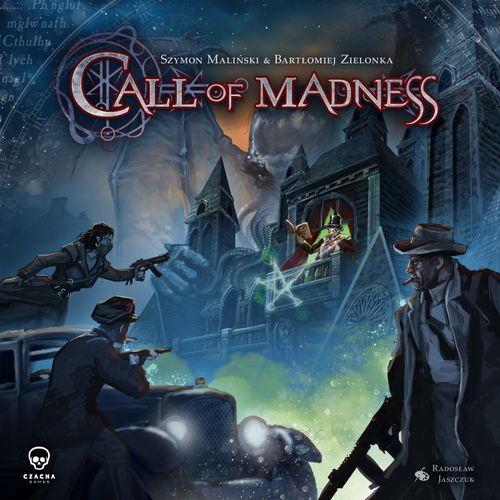
Call of Madness
Call of Madness Rulebook
Table of Contents
Table of Contents
Goal of the game
In Call of Madness players take on the role of priests of Cthulhu cults. They try to defend their headquarters from investigators, who believe that defeating one of the priests will stop the summoning of The Great Old One. As priests we will sacrifice cultists to gain the powers of the ancients. Thanks to them, we will fight the investigators attacking our headquarters, as well as support their actions against our opponents. The player who protects their headquarters and gathers the most summoning points from accomplished goals and remaining followers will be the winner.
Game components
- 24 outposts tiles
- 1 bag
- 75 madness markers (25 in each of 3 colors: blue, green and red)
- 40 investigator tiles
- 16 basic cards (4 for each player), 5 power cards, 30 god cards
- 4 character miniatures
- 4 player boards
- 1 day/night time token
- 4 double sided player aids
- 4 setup cards
- 34 goal cards (22 immediate goals and 12 endgame goals)
- 62 cultist tokens (12 x 10, 12 x 5, 20 x 3, 18 x 1)
- 20 fire tokens
Cards and tokens
Basic cards
- Name of the player / god
- Cost of the card
- Set of actions
- Action set cost
- Special action
- Additional effect
God cards
(Same numbered elements as basic cards: 1 name of the god, 2 cost of the card, 3 set of actions, 4 action set cost, 5 special action, 6 additional effect.)
Power cards
- Name of the god
- Special action
- Power card description
Goal cards
- Goal type
- Goal requirements
- Summoning points value
Setup cards
Cards indicate where each player should place investigators on their player boards at the start of the game.
Investigator tile
- a - Health level
- b - Strength level
- c - Madness marker symbol
Elements on the player board (headquarters, off the board)
Goal cards, pool of fire, madness pool, cultist tokens, discard pile, player's deck.
Game setup
(The rulebook shows an example setup for 3 players.)
Player boards
- Each player takes one player board and player aid and puts them in front of them.
- Each player takes cultist tokens with a total value of 50 – 3 tokens with value 10, 2 with 5, 3 with 3 and 1 with 1. Put the tokens face down on your player board.
- Each player randomly chooses one setup card. Then each player takes investigator tokens depicted on the card and places them on their boards indicated on the card. Remember! Tokens should be placed with black heart at the bottom.
- Shuffle the rest of investigator tokens and form the draw pile. Place the pile within easy reach, face down on the table.
- Put all madness markers inside the bag. Each player puts one random madness marker on each investigator on his board and one additional marker in their madness pool.
Gods and goals cards
- Take all power cards and randomly choose 4 of them. Put them face up in the middle of the table. Take all matching god cards. Shuffle them separately for each god and put them in a face up pile below matching power card. Put all unused power cards as well as god cards back to the box, you will not need them for this game.
In a 3-4 player game:
- Shuffle the immediate goal cards and place them face down in a draw pile within easy reach of all players. Put top 3 goal cards face up on the table so everyone can see them. Deal each player 3 endgame goal cards. Each player chooses 2 and puts in on their player board face down. Discard the remaining cards to the box.
In a 1-2 player game:
- Put all goal cards to the box. They won't be needed for this game.
Priests cards
- The last person to make a sacrifice becomes starting player. That player takes time token and puts it in front of them with day side up.
- Each player takes 4 basic cards and a matching character miniature, and puts them beside their board.
- Starting with last player, counterclockwise, each player chooses one of four visible god cards and pays its cost (shown in the upper right corner of the card) by discarding cultist tokens with a total value equal to the cost of the card.
- Each player shuffles all 5 cards they have and puts them face down on their board to form their deck. Then each player draws 3 cards.
Other components
- Put all remaining cultist tokens, fire tokens, and outpost tiles within easy reach of all players.
Gameplay
Game is played in rounds. There are 3 phases each round.
1. Preparation Phase (in the first round of the game, this phase is skipped)
a. Time of day update
The player with the time token flips it over.
b. Fire tokens resolve
Players that have fire tokens in their headquarters lose 1 cultist per 1 token during day and 2 cultists per 1 token during night. Do not discard fire tokens. They can be removed during the game with the appropriate action described later.
c. Card draw, character miniatures activation
Each player draws one card. Put all the character miniatures upright if they were knocked over. If they were on the power card, they stay on that card.
d. Adding new investigators
Each player draws 3 investigator tokens and adds them to the top 3 spaces on their player boards (furthest to their headquarters). Tokens should be placed with black heart at the bottom. For each investigator draw 1 (during day) or 2 (during night) madness markers from the bag and put them on their tiles. When there are no more investigator tiles, shuffle all discarded ones and prepare a new stack of tiles.
Next, all players sum up health level of newly added investigators. Player with the highest result draws one madness marker from the bag and adds it to their madness pool. In case of the tie, all tied players draw a marker.
2. Headquarters Defence Phase
Starting with the player with the time token and going clockwise, each player takes their turn, during which they can play a card or pass. During their turn, they can take any number of Additional Actions. These Additional Actions can be taken before and/or after playing a card or passing.
Remember! Player has to do actions one by one.
Play a card
Player chooses one card from the hand and plays it. Next they choose one set of actions from that card and resolve them in any order they want. Each action from the set has to be taken on different targets (i.e. you can not attack and then move the same investigator in one turn). If a card has text at the bottom, the player has to take all the actions from the top first. Taking all the actions from the set and text at the bottom (if the card has one) is mandatory unless the player cannot take them. After resolving all the effects, put the card on top of the discard pile. Discard pile is always face up. Players can always look through their own discard piles.
Some of the sets and actions at the bottom of the card have an additional cost. If a player wants to choose that set or action, they need to discard corresponding madness marker/s from their pool to the bag. In the case of the set indicated, cost covers all actions included in it.
Remember! If on any set, there is an icon (night/moon), it means that this set can be chosen only during the night round.
Example 1: Adam plays a card with 3 sets of actions. He chooses the top one that allows him to attack one investigator with power of 1. Instead he could choose the set from the middle. To do so, he should discard one madness marker from his madness pool. Than he could attack one investigator with power 1 and move other investigator 1 space. If the Time token is on the night side, Adam can choose the third set of actions instead.
Example 2: Adam plays a card that allows him to attack any investigator with 1 power as well as strengthen another one giving him 1 health. He must also move his figure to the Shudde M'ell's power card. Additionally, he could also spend 1 madness token to place it upright.
Remember! All actions can be taken on any player board, unless stated otherwise.
Actions
ATTACK – Deal damage to chosen investigator. The power of the attack is set by the value next to the symbol. While reducing investigator's health level, player needs to rotate their tile so actual health level is always at the bottom.
If investigator's health level is decreased to zero, they are defeated. The player whose board the investigator is on, takes all the madness markers from the investigator token and adds them to their madness pool. When madness marker symbol is marked on the investigator, it means that after defeating him, player receives one additional random madness marker from the bag. Put defeated investigator token to the box.
DESTROY – The investigator selected as the target is immediately defeated. Resolve all effects as described above as though the investigator's health was reduced to 0.
STRENGTHEN – Add as many health to any investigator as indicated on the value next to the symbol. While increasing investigator's health level, player needs to rotate their tile so actual health level is always on the bottom.
Maximum health level is 6. Player can't increase that level above 6. If any action of other effect would allow you to raise life beyond the maximum, just ignore the excess life and do not add it.
MOVE – Move chosen investigator horizontally or vertically in any direction. Diagonal movement is forbidden. The value next to the symbol indicate show many spaces they can be moved. Moves can be made to free spaces only – without any other investigators or outposts. If investigator was to be moved on a space with the outpost, they skip that space (or spaces if there are more outposts along the way) and move to the next free one. On each space there can be only 1 investigator. The investigator cannot be moved off the board, except at the bottom edge, which leads to the player's headquarter. In this case resolve headquarter's entrance effect (described later in section 3. Investigator's Phase).
ADD OUTPOST – Place one outpost on a free space on player's board but not on one of the 3 top ones. An investigator may never be placed over an outpost, or vice versa. You cannot add two outposts one on top of the other. Outposts have no other purpose than accelerating investigators as described above when explaining MOVE action. If there is no free space for additional outposts or, in very rare case, that there are no more outposts in the general supply the player discards cultist tokens with a total value of 2 for every outpost he cannot place.
Example: In this situation, player cannot place an outpost at the investigator's locations as well as at the other outposts. Also, he cannot put an outpost on a space in the upper left corner, since it is the top line. He only has two empty spaces marked in green.
DISCARD OUTPOST – Remove one outpost from the player's board to the general supply. The outpost token shows additional costs for its removal – this is only used when you remove an outpost as an additional action described in the Additional Actions section.
RITUAL – Take the top god card from any god pile and pay its cost shown in the upper right corner of the card by discarding cultist tokens with a total value equal to the cost of the card. If a player does not have enough cultists to purchase a card, he cannot do so. The new card goes to your hand. After getting a card, move your character miniature to the power card belonging to the god you bought a card from. Set the miniature active (upright). If a player bought a card from a god whose power card already has his character miniature on it, he places it active (upright). There can be more than one figure on a power card. With an active miniature on a power card, you will be able to perform an Additional Action (described later) to use a god's power.
PLAYER CULTISTS / OTHER PLAYER CULTISTS – Take cultist token/tokens with the total value indicated next to the symbol and place them face down on your board. If there is a minus sign next to the value, target player discards the indicated cultists value. Green symbol means yours, red symbol means any other player's.
ADD FIRE TOKENS – Add a Fire token to target player's fire pool on his/her board. Fire tokens do not have an immediate effect. They are resolved at the start of a new round as described in the Preparation Phase.
DRAW A CARD – After a card with this effect was played and resolved, you can draw a card from your deck. Each time player is instructed to draw a card and he has no cards in their deck, they do not draw a card. Don't shuffle your discard pile. The new deck will be prepared at the end of the round in phase 3.
ACTION – After a card with this effect was played and resolved, discard it to the discard pile and immediately play another card from your hand or pass your round.
Other icons on cards
HEALTH – Actual level of health (red) and starting (black) level of health.
MADNESS MARKERS – Cost of playing an action or a set of actions in case on the cards.
Additional Actions
As long as it is your turn, you can choose to perform one or more Additional Actions before or after you played a card or passed. You cannot play additional actions in the following turns after you pass.
a. Outpost removal
Players can remove outposts from their player boards by discarding two madness markers from the madness pool to the bag or by discarding cultist tokens with a total value of 2. As a reminder, it is shown on the outpost token.
b. Use of God's Power
If player's character miniature is on a power card and is active (upright), they can knock it over and use the effect of the Power card it is on. Effects differ depending on the time of the day.
c. Spending madness markers
During their turn, a player can discard a madness marker from their madness pool to the bag. Color of discarded markers is insignificant. Discarding one marker allows the player to:
A. Draw a card. Remember: Each time player is instructed to draw a card and they have no cards in their deck, they do not draw a card.
B. Put the top card from your discard pile on the bottom of your deck. If you have no cards in your deck, create a new one from the card you just took from the discard pile.
C. Put the top card on each god's deck on the bottom of the pile.
d. Achieving the immediate goal (once per turn)
Player can achieve any face up goal cards. To do so they must fulfill its demand. Player takes that goal and puts it on their player board. New goal is drawn from the pile and put face up on the display. If the goal draw pile is exhausted, it cannot be refilled.
Pass
Whenever player cannot or does not want to play a card, they have to pass. The player's round is over, but they may still take any Additional Actions on the turn they has passed. First player to pass takes the Time token (do not change the side). Other players can play one more turn in that round for free. If they want to continue playing their turns, they need to discard one madness marker from madness pool for each played turn. If all players have passed, the phase is over.
Example: In a 3 player game, Adam has passed. Peter and John play their turn. Than Peter takes another turn so he discards 1 madness marker. John does not want to continue and passes as well. Peter can take another turn by paying with another madness marker, but he decides to pass. This phase is over.
3. Investigator's Phase
a. Move
First player to pass, moves all the investigators on their board 1 space towards their headquarter. Headquarter of every player is located below the bottom edge of their board. Investigator movement should start from the spaces closest to the headquarters. Investigators skip the spaces with outposts.
After moving all investigators, check to see if any of them entered the headquarter (passed the bottom edge of the board). When investigator or investigators entered the headquarters, player discards cultist tokens with a total value equal to the strength of these investigators. Next they resolve effects of madness markers that were on investigator tiles (see table). These investigators are considered defeated. Player takes any madness markers they just resolved into their madness pool and discards investigator tokens to the box.
Then the next player resolves movement of the investigators.
This phase can be played simultaneously by all the players to speed up the gameplay. But remember that game ends whenever any player loses their last cultist, so closer to the end of the game we suggest resolving it one at a time.
| Color | Effect |
|---|---|
| Green | Put 1 outpost onto your player board according to the rules of adding outposts described in the Action section. |
| Blue | Investigator gains +3 Strength. This means that after entering the headquarter, the player will have to discard additional cultist tokens with a total value of 3. |
| Red | Add 1 Fire token to your Fire pool. |
b. Adding Outposts
After investigator's move and all the following effects are resolved, the players check the level of intensity of their cult. For each 3 cards in player's discard pile (rounded up) player adds one outpost to their board. It should be placed on a free space but not 3 top ones. If there is no free space for additional outposts, the player discards cultist tokens with a total value of 2 for every outpost he cannot place.
After adding the outposts, each player shuffle their discard piles and puts them underneath their decks. Do not shuffle the rest of the deck. When a player has no deck, they create it from shuffled cards.
End of the game
Game ends immedietely when one player has no more cultist tokens in their headquarters. Note that the Investigators Phase is resolved in player order, starting with the player with the Time Token. If during this phase the first player loses all the Cultists tokens, the game ends immediately, and other players do not resolve this phase.
All players reveal their all remaining cultist tokens and count the points.
In a 3-4 player game players check if they have achieved their end game goals. If so, they receive the points indicated on them in the lower right corner of the card. Additionally, the points for the Immediate Goal cards collected during the game are also added up.
Add the number of cultists left to the points achieved from the goal cards. The player with the most points is declared a winner of the game.
In case of a tie, the player with the most madness markers in their madness pool wins. If this number is also tied, all tied players share the victory.
Longer game variant
During the game, when achieving the immediate goal, the player acts in the same way as in "Achieving the immediate goal" action, however after taking the completed goal card, they draw Cultist tokens with a total value indicated on the goal card, and add them to their Headquarters. After taking the completed goal, player draws cultist tokens with a total value indicated on the goal card to their headquarters. At the end of the game, points from the immediate goal cards are not added to the final score. End goals are scored unchanged.