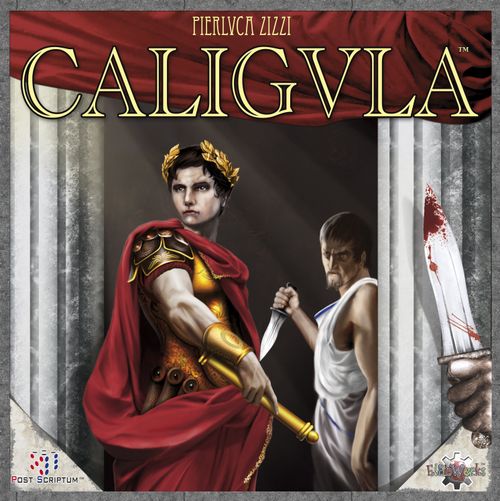
Caligula
Caligula Rulebook
Table of Contents
Table of Contents
Components
- 55 Civitas cards, including:
- 11 Legionarii cards
- 11 Tribuni cards
- 11 Prætoriani cards
- 11 Plebs cards
- 11 Nobiles cards
- 6 Sequentia cards
- 10 Augustus cards
- 5 Ordo cards
- 20 Coniura cards (10 with only the coniura symbol, 10 with both coniura and pugio symbol)
- 14 Pugio cards (7 with only the pugio symbol, 7 with both coniura and pugio symbol)
- 6 Conspiracy points
- 47 Victory points: 31 "I" worth 1 point, 16 "V" worth 5 points
- 1 Primus Inter Pares token
- 1 Sequentia token
- 40 SPQR tokens (8 per color, from -1 to 6)
- 5 Favor tokens (1 per color)
- 1 Pugio Tile
- 1 Coniura Tile
Goal of the Game
Influence the central figures of Roman life to gain advantages. Conspire to kill the emperor and put your favorite candidate on the throne. Form alliances with other players, but be ready to betray them without pity if it will help you acquire VICTORY POINTS!
Set Up
Each player takes the 8 SPQR tokens and the Favor token of his color. The tokens showing "5" and "6" must be set aside at the beginning of the game. You may gain these tokens later. Give one dual-purpose card from the coniura deck to each player. Shuffle each deck of cards separately, and place them on the table as shown in Figure 1.
IMPORTANT: ALL THE FACE UP CARDS SHOWN IN THE FIGURE ARE EXAMPLES. THE CARDS MUST BE PLACED RANDOMLY (INCLUDING THE ORDER OF THE SEQUENTIA CARDS), EXCEPT FOR CALIGULA, WHO IS ALWAYS THE FIRST EMPEROR AT THE BEGINNING OF THE GAME.
Prepare the Augustus deck. There are always six cards in this deck: in 2 or 3 player games, remove Claudius, Commodus, and Nero. With 4 or 5 players, remove Domitianus, Vitellius, and Elagabalo. Shuffle these cards and turn over the top two candidates.
Remove the ordo cards with values greater than the number of players (i.e., in a 3 player game, remove the "IV" and "V" cards). Deal the rest randomly, one to each player.
Figure 1 (set up layout): Shuffle the civitas decks separately and place the first two cards from each deck face up on the table, in positions 1 and 2. Pugio deck: shuffled and marked with the Pugio tile. Coniura deck: shuffled and marked with the Coniura tile. Current emperor: at the beginning of the game Caligula is always the emperor. Candidate emperors: placed beside the current emperor. Sequentia cards: must be resolved from left to right. The effects of each card follow the arrow.
Play of the Game
Each round is divided into the following phases:
- Bid SPQR tokens
- Resolution
- 2A. Sequentia cards
- 2B. Civitas cards
- 2C. Conspiracies
- End of the round
1. Bid SPQR Tokens
Players take turns in the order given by their ordo cards. On their turn, players must place one of their SPQR tokens face down (with the value hidden) on any empty space on any of the ten face-up civitas cards.
The spaces on each card must always be filled in order from left to right. Spaces with numbers can only be used if there are at least that many players in the game. When the last player (according to the ordo cards) has placed his first token, the first player then places his second one, and so on, until all players have placed all of their tokens on the cards, or until there are no more empty spaces remaining. Once a token is placed, no one can check its value until the resolution phase, including its owner!
SPQR tokens allow you to gain advantages from the cards, as explained in the "Civitas Cards" section and in the Legenda. Remember that cards in position 1 will be resolved before the cards in position 2.
Token placement is mandatory! You cannot pass without placing.
Figure 2 (card examples): Each civitas card shows its card type, its effect, and its minimum winning bid. The spaces marked for four or five players can only be used in games with at least that many players.
- Collective card (example, minimum winning bid 1): ALL PLAYERS WHO PLACED TOKENS WORTH A TOTAL OF AT LEAST 1 ON THIS CARD MAY PLACE A SPQR TOKEN THEY HAVE AVAILABLE ON ANY EMPTY SPACE.
- Individual card (example, minimum winning bid 2): THE SINGLE PLAYER WHO PLACED THE HIGHEST BID (OF AT LEAST 2 TOTAL) MAY DISCARD (WITHOUT EFFECT) ANY FACE UP PLEBS CARD, OR DRAW A CARD FROM THE PUGIO DECK.
- Penalty card (example, minimum winning bid 1): THIS IS A PENALTY CARD: ALL PLAYERS WHO DIDN'T PLACE A BID OF AT LEAST 1 LOSE ONE VICTORY POINT, INCLUDING ANY PLAYER WHO DID NOT PLACE ANY TOKENS HERE AT ALL. IF A PLAYER HAS NO VICTORY POINTS, HE LOSES NOTHING.
2. Resolution Phase
2A. Sequentia Cards
Once the bidding phase is over, it is time for the sequentia cards. These cards must be resolved in order from left to right (see Figure 1). All steps of a card must be completed before proceeding to the next card.
After each sequentia card is complete, there may be a CONSPIRACY (see "2C. Conspiracies").
Effects of the sequentia cards:
- Each player, in turn order, takes a coniura card.
- Each player gives his ordo card to the player on his left. The new turn order applies immediately.
The civitas cards shown are resolved in the order of the arrow. Use the sequentia token to mark the current card until it is completely resolved.
Example: This sequentia card indicates that you must resolve the Tribuni card (green) first, then the Prætoriani card (blue), and then the Nobiles card (yellow). In all three cases, the card in Position 1 is resolved.
Place the sequentia token on the card symbol to remember which civitas card you are resolving. When it's done, move the sequentia token to the next civitas symbol. If there are no more symbols, the sequentia card is complete.
After the Nobiles card is finished, players may form a conspiracy. After any potential conspiracy is complete, the next sequentia card must be resolved.
IMPORTANT: Sequentia cards remain where they are after they have been resolved.
2B. Civitas Cards
When the sequentia token is moved onto a civitas symbol, the matching card in Position 1 is resolved. Reveal all the SPQR tokens placed on the card (see above), and apply the card effects. The revealed tokens are returned to their owners.
There are three kinds of civitas cards: COLLECTIVE, INDIVIDUAL, and PENALTY cards. Each civitas card has a number in the bottom right corner. Any bid which totals less than this number cannot receive the benefits of the card.
After the card has been resolved, discard the card from the game. Move the card in Position 2 up to Position 1, turn over the top card of the matching deck, and place it in position 2 (see Figure 1).
- If the card is an INDIVIDUAL CARD (black statue in the bottom left corner), only the player who placed the SPQR tokens with the highest total value will gain the advantage given by the card (the total value must also be at least equal to the number on the card). In case of a tie, the tied player who placed his SPQR token first gains the advantage (remember to place the tokens in order, left to right, so you can remember who played first).
- If the card is a COLLECTIVE CARD (light blue statue in the bottom left corner), all players who placed SPQR tokens with a total value at least equal to the number on the card gain the advantage given by the card. Start with the player who placed the highest bid, or, in case of a tie, the tied player who placed first.
- If the card is a PENALTY CARD (red statue in the bottom left corner), all players who did not place SPQR tokens worth at least the number on the card suffer the penalty. If the penalty applies to something that the player doesn't have, nothing happens (i.e., a player cannot lose victory points if he has none).
Important:
- Penalty cards affect both those players who placed SPQR tokens worth less than the number on the card and any players who didn't place any tokens there at all.
- Civitas cards are discarded from the game when resolved even if there are no tokens on them (of course, if it's a penalty card, all players suffer the effects).
- If a player places more than one token on a card, the values are added (example: 4 and -1 = 3). A player never gains the advantage of a card more than once.
- If the card is INDIVIDUAL or COLLECTIVE, the player can decide whether to use the effect or not. If it is a PENALTY, the effect always applies.
- If a PENALTY card has two possible effects, and the player cannot pay one of the penalties, he must choose the one he can pay.
Coniura and Pugio Cards
Some civitas cards allow players to draw cards from the coniura or the pugio deck. Both types of cards are used during conspiracies.
Both decks have the same card backs. Some cards have only one effect, while others are dual-purpose. The single-effect cards show only the coniura or the pugio symbol, while the dual-purpose cards show both symbols. Dual-purpose cards can be used as a coniura or a pugio. Either way, they can only be used once before they are discarded, applying only the chosen effect.
The number of cards each player has in hand (but not the type) is public and cannot be kept secret.
In these rules, when we write about coniura or pugio symbols, we mean a card that has the corresponding symbol. It does not matter if it is a single or a dual-purpose card, or which deck the card came from. When a card is played, it is returned to the bottom of its original deck.
2C. Conspiracies
The conspiracy phase happens after the resolution of each sequentia card, and before the next one begins. Each conspiracy allows the players to try to kill the emperor.
A conspiracy is divided into three steps: PLOT, FAVOR, and ASSASSINATION.
Plot
This is a type of auction to decide who will join the conspiracy, and who will be its leader.
In order of the ordo cards, the first player can declare if he wants to start a conspiracy. If he doesn't, the second player can decide, and so on. If no one wants to conspire, this phase ends and the round continues with the resolution of the next sequentia card.
When a player starts a conspiracy, he must place at least one coniura symbol in front of him. He becomes the conspiracy leader. The other players, in turn order and including any players who already spoke, (i.e. if the leader is the player with ordo card "III," play continues with "IV," "V," "I," and "II"), can chose to:
- PASS: the player doesn't play any coniura symbols, and he cannot later join this conspiracy;
- ACCEPT: the player plays exactly the same number of coniura symbols as the leader; or
- RAISE: the player plays more coniura symbols than the leader, and becomes the new leader.
If someone RAISES, all players who didn't pass can decide, in turn order, to pass, accept, or raise.
IMPORTANT: to ACCEPT a raise, the players must play a total number of coniura symbols exactly equal to the leader. For example, if a player starts the plot with one card, and another player raises to two cards, the first player will need to play one more card to accept. If he plays two more, he raises. That's why it's important to play all the coniura cards in front of you, and return them to the deck only when the plot is over.
If everybody has accepted or passed, it is no longer possible to raise.
Once the PLOT step is complete, all the cards played return in their original decks. It does not matter if the player who played them has joined the conspiracy or not.
Example of a conspiracy in a 4 player game, plot step:
- Player 1 decides not to start a conspiracy, so he plays no cards.
- Player 2 starts the conspiracy with 1 card: at this point she is the leader.
- Player 3 passes and plays no cards.
- Player 4 accepts, and plays 1 card.
- Player 1 raises, and plays 2 cards. He becomes the new leader.
- Player 2 accepts and plays 1 more card.
- Player 3 has already passed, so he can't do anything.
- Player 4 accepts and plays 1 more card.
- Player 1 is still the leader, and he cannot raise again.
- Player 2 and Player 4 are also conspirators.
- Player 3 can defend the emperor.
- All the cards played are discarded and returned to their original decks.
Favor
Once the plot is over:
- The leader must chose one of the two possible candidates (the two face up Augustus cards on the table). If the conspiracy is successful, this candidate will be the new emperor.
- The leader places his favor token on the chosen candidate or the current emperor card. If he already has his token on the current emperor, he can decide to leave it there, or to move it onto the chosen candidate's card.
- After the leader has placed his favor token, all the other conspirators (i.e., the players who accepted during the plot step), following the turn order (i.e., if the leader is the player with the ordo card "III," the turn continues with the "IV," "V," "I," and "II"), can place their FAVOR token on the current emperor, or on the candidate chosen by the leader. They can't choose the other candidate, even if the leader placed his favor token on the current emperor.
Players can only place a FAVOR token if there is at least one empty space on one of the two Augustus cards (the current emperor or the candidate). Caligula has no spaces, so no one can place his favor token on this card. It is possible that later conspirators (in turn order) won't have a free space, and won't be able to place their favor token.
Example of the favor step: During the favor step, the leader (Player 1) chose a candidate and placed his favor token on him. Player 2 also placed her favor on the candidate. Player 4 has her favor token on the current emperor, and decides to leave it there.
Assassination
- First, each player who did not join the conspiracy, in turn order, may choose to play one pugio (but not more than one) symbol to defend the emperor. Each pugio played will raise the life value of the current emperor by one point.
- Then, starting with the leader, and following the turn order as explained above, all players who joined the conspiracy can play one or more pugio symbols. After the last conspirator has decided to play or not, the emperor's life is checked (see "Life or Death" below). Once the last player has made a decision, no one may play any more pugio symbols!
Example of the assassination step: Player 3, who did not join the conspiracy, can defend the emperor. He decides to do so, and plays one pugio symbol. Each defender can play only one pugio, so he keeps the rest of his cards. The life value of the emperor is increased by one point, for a total of two. The conspirators, in turn order starting with the leader, can play pugio symbols to kill the emperor. Player 1 plays two pugio symbols, equal to the life value of the emperor. Player 2 has no pugio symbols to play. Last turn, Player 4 placed her favor token on the emperor. But, since the emperor is going to die any way, she decides to play a pugio symbol to gain the victory point. The emperor died, so the conspirators gain victory points. Player 1 gains 1 conspiracy point because he is the leader. Player 1 and Player 4 each earn one victory point, because they played at least one pugio in the attack. The candidate becomes emperor. Player 1 and Player 2 leave their favor token on the new emperor's card. A new candidate is drawn. No more conspiracies can be made for the rest of this round, because an emperor has already been killed. At the end of the round, both Player 1 and Player 2 will gain the victory points indicated on the emperor's card.
Life or Death:
Each emperor has a life value on his card. This value can be increased by the pugio symbols played by the players who are not in the conspiracy.
If the pugio symbols played by the conspirators are at least equal to this value (increased by pugio played in his defense), the emperor is slain. Any favor tokens on his card are returned to the players who own them, and the chosen candidate becomes the new emperor.
Otherwise, the emperor survives, and the favor tokens on the candidate's card are returned to the players who own them.
If there is a new emperor, a new candidate is drawn from the Augustus deck, and placed near the one already on the table.
IMPORTANT: it could happen that, after the emperor's death, there are no FAVOR tokens on the candidate's card. The new Emperor will still be the candidate chosen by the leader at the beginning of the favor phase.
Victory Points for the Conspirators
If the emperor dies (and only if he dies), the leader receives one conspiracy point.
Then, all the conspirators (including the leader) who played at least one pugio against the emperor, each gain one victory point. It doesn't matter if someone played more than one pugio, only one victory point per conspirator is awarded. If the emperor survives, no one gets any points for this conspiracy.
Conspiracy points have the same value as the other victory point, but they could be used as tie-breakers at the end of the game.
IMPORTANT: IF A CONSPIRACY ENDS WITH THE EMPEROR'S DEATH, THERE CAN BE NO MORE CONSPIRACIES FOR THE REST OF THE ROUND.
After checking the emperor's survival, continue with the resolution of the remaining sequentia cards.
3. End of Turn
After the last sequentia card is finished:
- Any SPQR and favor tokens already on the cards remain where they are.
- The emperor gives victory point to all players who have a favor token on him, equal to the value shown on his card.
- If there are ten face up civitas cards, a new round begins. If not, it's time for The Fall of the Empire.
The Fall of the Empire
Chaos has erupted in the Empire, and the emperor trusts no one. Remove all favor tokens from the emperor card. Now, the players can make one final conspiracy with the cards they have in hand, using the same rules as other conspiracies except for the favor step, which is not played. In fact, if the assassination is successful, no new emperor will take power!
If the last emperor is killed, the leader gains 1 conspiracy point as normal, and all the conspirators who played at least one pugio (including the leader) each gain 1 victory point.
If the emperor survives, no one gains any points for this final conspiracy.
In either case, the game ends.
The Game Winner
The player with the most victory points after The Fall of the Empire is the winner!
Remember that the CONSPIRACY points are also VICTORY POINTS!
If there is a tie, among all the tied players, the winner is (in order of priority):
- the player who holds the primus inter pares token;
- the player who has the most CONSPIRACY points;
- the player who has the most cards still in hand.
If there is a total tie, the tied players share in their victory!
Strategy Hints for New Players
You should try to get as many pugio and coniura cards as possible, in order to start and lead a successful conspiracy.
It also might be a good idea to get your hands on your additional SPQR tokens (number 5 and 6), so you will have more influence in the fight for the civitas cards. Of course, after some experience you may find subtler strategies!
It is possible to conspire even if the leader doesn't want to kill the emperor. A player could conspire without having any pugio symbols in hand, just to be the leader, and then let the emperor survive.
If the leader, or any other conspirator, already has his favor token on the current emperor, and he moves it to the candidate's card, he would free up a space on the emperor's card. Later conspirators might decide to place their favor token there, and then refuse to help the leader kill the emperor.
If there are empty spaces on the emperor's card, a player could decide to conspire just to put his favor token on it, and try to gain points at the end of the round.
In any phase of the game, you can talk to the other players, making deals, intrigues, and promises. But, you are not obliged to keep your word!
Legenda
Or: The player may apply only one effect of this card, his choice.
- Discard a face up civitas card of the indicated color. Any SPQR tokens on it return to their owners.
- Draw a card from the Coniura deck.
- Draw a card from the Pugio deck.
- Take a new SPQR token for the rest of the game (the 5 first, and then the 6).
- Take the primus inter pares token.
- Immediately place a SPQR token you have in hand on any empty space (you may also choose to use a token you had on this card).
- Swap two SPQR tokens that are already placed on the civitas cards, without looking at their values. They can be of two different colors.
- Remove a SPQR token that is already placed on the civitas cards, without looking at its value. It returns to its owner.
- Swap any two ordo cards.
- Swap a civitas card in position 1 with the card of the same deck in position 2.
- Swap two sequentia cards that do not have the sequentia token on them (this can result in a sequentia card revolving twice this turn).
- PENALTY: remove one of your SPQR tokens from a civitas card of your choice. It returns to your hand.
- PENALTY: lose a victory point (or a conspiracy point). The primus inter pares token is not a victory point.
- PENALTY: discard a pugio card from your hand, and return it to the bottom of the pugio deck. If you don't have any pugio cards, you must prove it by showing all your cards.
- PENALTY: discard a coniura card from your hand, and return it to the bottom of the coniura deck. If you don't have any coniura cards, you must prove it by showing all your cards.
Conspiracy Summary
Starting a conspiracy: You may attempt a conspiracy after each sequentia card.
Plot:
- In turn order, any player may choose to begin a conspiracy.
- This player (the leader) must bid at least one coniura card.
- Other players may:
- PASS (= non-conspirator);
- ACCEPT by bidding the same number of coniura cards (= conspirator); or
- RAISE by bidding a higher number of coniura cards (becoming the new leader).
- If all players have accepted or passed, no further raises are allowed.
Favor:
- The leader selects a new candidate.
- All conspirators (starting with the leader) place their favor tokens on either the candidate or the old emperor.
Assassination:
- Non-conspirators may each play one pugio card to raise the old emperor's life value by 1 point per pugio.
- Conspirators (one by one, in turn order) may play any number of pugio symbols.
- If the total is equal to or higher than the emperor's total life value, the candidate becomes the new emperor. Favor tokens on the old emperor go back to the players.
- If the total is lower than the emperor's life value, the favor tokens on the candidate go back to the players.
Victory points:
- If the emperor dies, the leader gains 1 conspiracy point.
- Each conspirator who played at least 1 pugio gains 1 victory point.
- If the emperor survives, no one gains any points.