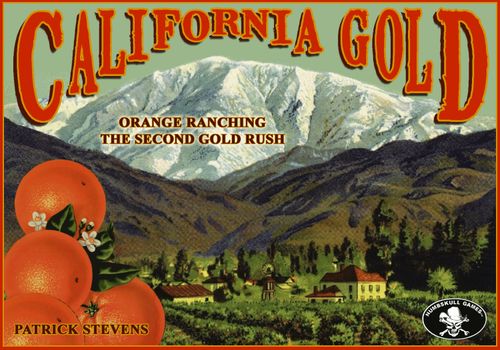
California Gold
California Gold Rulebook
Table of Contents
Table of Contents
Overview
California Gold is a historic simulation of orange grove production in the early to middle 1900's where each player represents a Co-Op furnishing help for orange ranchers to receive support and best prices for their crops. Play hinges around adding members to your Co-Op by collecting Grove Cards that represent local orange ranches. A growing Co-Op creates support structures including Packing Houses and Nurseries to assist the local ranches. The combined size also provides leverage in Advertising and Railroad Contracts to help increase profits. Political, climatic, and agricultural considerations will also have an impact on production.
The object of the game is to have the most members (Grove Cards) in your Co-Op by end game. Acquiring new members is constrained by Packing House location and capacity. Working conditions will deteriorate each round and must be supported financially or the risk and severity of worker strikes is increased.
Components
- Chips, Workers and Trains of a specific color will be used by each player to mark each of their buildings and box positions on the board.
- Money for business transactions.
- Buildings: Packing House (orange), Nursery (green), Agency (tan).
The Board
The map section of the board is separated into counties which are color designated to match the corresponding counties of the Grove Cards.
(Board diagram labels: the # represents the price for a Nursery and how many Grove Cards are in the deck for the county; railroad(s) running through county; type of oranges grown in county; county name; Grove Card Array area; Agency box; Political box; Production box; Advertising box; Railroad Contract box; Working Conditions box.)
- The counties are where each Packing House and Nursery will be placed.
- The Agency Box is where players will place Agency Buildings.
- The Political Box is where players' chips will be placed to track Political Lobbying.
- The Production Box is where players' chips will track Production Amenities.
- The Advertising Box is where players' chips will track Advertising Campaigns.
- The Railroad Contract Box is where players will place trains to track their Railroad Contracts. The numbers show how many of each railroad company there are in the Grove Card Deck.
- The Working Conditions Box is where workers are arranged to determine effects of worker strikes.
- The Array is an area where six Grove Cards will be displayed so that players may Add Members to their Co-Op by acquiring the cards to place them in their tableau.
The Cards
There are two kinds of cards, Farm Report Cards and Grove Cards. Each are shuffled into their own decks. Each deck will develop its own discard pile which shall be maintained face up to distinguish it from the deck. If either deck becomes exhausted, shuffle and use its discard pile.
Grove Cards
Each Grove Card represents orange ranches or groves from a municipal area in a specific county which is color coordinated with the color of the county on the board. Each card sports a period orange crate label from the area depicted. The upper left circle displays a Railroad Logo showing what railroad runs through that area. The upper right circle displays a logo representing the kind of oranges produced in the area ie. (W) Washington Navel (hereafter called Navel) which is an easily peelable or eating orange, or the (V) Valencia which is often sliced or used for making orange juice.
(Grove card front: railroad, city (no bearing on play), type of oranges — Navels worth $2, Valencias worth $1 — and county. Farm Report card front: name, event card front, effect.)
Farm Report Cards
One Farm Report Card played each round will have a detrimental or beneficial affect on the Political, Climatic, or Agricultural conditions of the industry. From a hand of six, players will take turns selecting the card to be active during a round. Unprepared players may suffer as a result. Farm Report Cards are explained fully under Farm Report Cards below.
Set up
- Each player starts with $20, 1 Packing House, a play aid, a stack of chips of his chosen color, and a worker.
- Each player places his worker in the Optimal section of the Working Conditions Box.
- Deal each player 6 Farm Report Cards.
- Deal out the top 6 Grove Cards to be displayed face up on the board in the Array.
Determine a start player. Proceed counterclockwise starting with the start player, with each player placing a Packing House on top of one of their chips on the board in the county of their choice (more than one players' Packing House may occupy a county).
Play Sequence
The last player to place a Packing House on the board during set up now becomes the first player and obtains the First Player Token. Play proceeds clockwise with the first player performing one action after placing his initial Packing House.
Each player will proceed with his turn until all players have played, which constitutes a full round. Each round is followed by an administrative phase.
Managing Your Tableau
The object of the game is to have the most members (Grove Cards) in your Co-Op by game end. As Grove Cards are acquired they are maintained face-up in a Tableau in front of the player where they are visible to all. Arranging the cards in sets of three by county will help to quickly ascertain Packing House capacity.
Grove Card membership in multiples of three can boost the income received by the Collect Dues action in two different ways:
a) Each Advertising Contract the player establishes is worth $1 per set of any three Grove cards in the player's Tableau (fewer than 3 do not count as a set). The Tableau does not need to be rearranged for this benefit. Cards can simply be counted to determine how many sets qualify.
b) Each Railroad Contract the player establishes is worth at least $2. To obtain this benefit the player may arrange his Tableau so that Grove Cards related to a specific Railroad company are assembled in matching sets of three (fewer than 3 do not count as a set).
It does not matter if the sets are a mix of Orange types (Valencia and Navel). Since Navel groves do not produce during a Crop Freeze event, though, players may wish to reorganize sets to facilitate calculating income. Rearranging sets in a player's Tableau may be done at any time.
Actions
Each player may perform one of the following as a Standard Action on a turn, and may perform more as Supplemental Actions if he has an Agency, a Nursery, or when certain Farm Report Cards are played. Any of these actions must be performed in the following order.
Action Order
Multiple actions performed during a turn must be done in this order:
- Standard Action
- Supplemental Action(s).
- Action associated with a Farm Report Card.
1. Buy and place Building
A player may purchase one Building; a Packing House, a Nursery, or an Agency, and place it on a chip of his color in any county (Agency goes in the Agency Box) as described in the Buildings section. Each Building provides specific benefits to expand Co-Op activities.
2. Add a Member
A player may recruit one new member to his Co-Op by selecting any Grove Card displayed in the Array and placing it in his Tableau. The Array is immediately replenished from the Grove Card draw deck.
- This action may only be executed if the player has a Packing House with unused capacity located in the same county as the Grove Card selected. A Packing House reaches its capacity when it is supporting three Groves from its county.
- A Nursery may allow recruiting an additional Grove Card within a turn, but a player's Co-Op may never grow by more than two members on a single turn.
3. Collect Dues
Player collects payment from the bank representing dues from Co-Op members, volume discount payments from Advertising, and from Railroad Contracts. Rate of income can decrease with freezing weather conditions and other Farm Report Card effects, or may increase from some Farm Report Card effects. When calculating income, add up all cards held in player Tableau and adjust according to these variables:
- Each Valencia Card in the player's tableau is worth $1.
- Each Navel Card in the player's tableau is worth $2.
- Each of the player's Chips in the Advertising box is worth $1 per set of any three Grove cards in the player's tableau (fewer than 3 do not count as a set).
- Each of the player's Trains in the Railroad Contracts box is worth $2.
- Each Railroad company where the player has placed a majority of Trains is worth $2. No bonus is paid for ties.
During a Crop Freeze Farm Report:
- Each Valencia Card in the player's tableau remains worth $1.
- Each Navel Card in the player's tableau is worthless and cannot be counted for income.
- No Navel Cards are used in assigning sets of three for Advertising payments.
- Any Railroad Train based sets of three that include a Navel Card provide no payment.
- Any Railroad Trains based on sets of three that include a Navel Card do not count in calculating Railroad Company majority (other players' Trains are counted without consulting Freeze impact to compare who has a majority).
Collect Dues Examples
The blue player has 11 cards in his Tableau, 1 chip in Regional Advertising and 3 trains in the Railroad Contracts Box. He chooses a Collect Dues Action receiving $14 for his card holdings (8 Valencia cards @ $1 and 3 Navel cards @ $2), $3 for his Advertising Contracts (3 sets of 3 cards), and $8 for his Railroad Contracts ($2 for each train = $6 plus $2 for the majority holding in Southern Pacific = $8), for a total of $25 for his Collect Dues Action.
Supposing a "Freeze" Farm Report Card was played this round: He will receive no pay for the 3 Navel cards, the Advertising can only cover the 8 Valencia cards which means 2 sets of 3 = $2, and he has lost 1 of his Railroad Contracts (Southern Pacific) losing his bonus for the majority in Southern Pacific. So his Pay will be $8 for his Valencia cards, $2 for his Advertising, and $4 for his Railroad Contracts, for a total of $14.
4. Canvass New Growers
A player may sweep all six Grove Cards from the Array and place them face-up onto the discard pile. The Array is replenished with fresh cards from the Grove Card draw deck. This action represents sending out agents to approach new growers to join the Co-Op.
This action may reveal a card from a county that the player has a Packing House and Nursery in, making the card available for him immediately as a Supplemental Action. A game courtesy is that the discard pile may not be examined.
NOTE: The following 4 Actions (5 through 8) are all referred to as Agency Actions since they can also be performed as a Supplemental Action whenever the player has an Agency Building (besides still being available as a Standard Action). When used as a Supplemental Action, this must be done after the Standard Action.
5. Place Train
A player may place one Train in the Railroad Contracts Box. The players' Tableau must contain a set of 3 Grove Cards, all with a Railroad logo matching the company selected (Southern Pacific, Union Pacific, Atchison Topeka and Santa Fe), in order to place the Train. Trains placed here benefit the player during Collect Dues Action. This benefit does not begin until the turn after the Train is placed. All players may place multiple Trains for each Railroad company.
Placing a Train is not automatic with assembly of a Railroad set. Any number of sets in players Tableaus may remain unrepresented in the Railroad Contracts Box until players take this action. This action represents the benefits of large consignments consolidated with one railroad company.
6. Advertise
A player pays $5 or $10 as shown on the board for the advertising level selected (Regional or National) to place one chip of his color in the Advertising Contracts Box. Payments here benefit the player during Collect Dues Action. This benefit does not begin until the turn after the Advertising Contract is purchased. All players may place one chip in each level of the Advertising Contract Box. These chips will be removed whenever an Advertising Farm Report Card is played. This action represents the benefits of greater sales due to advertising.
7. Political Lobbying
A player pays $5 or $10 as shown on the board for the government level selected (County or State) to place one chip of his color in the Political Lobby Box. Contributions here may protect or benefit the player when some Farm Report Cards, such as an Election Card, are played. All players may place one chip in each level of the Political Lobby Box. These chips will be removed whenever an Election Farm Report Card is played. This action represents the benefits of large contributions to promote agendas through political parties.
8. Production Amenities
A player pays $5 to place one chip of his color in the selected category (Irrigation, Fumigation, or Fertilization) of the Production Amenities Box. A payment here will protect or benefit a player when an Irrigation, a Fumigation, or a Fertilization Farm Report Card is played. All players may place one chip in each category of the Production Amenities Box. These chips will be removed when certain Farm report Cards are played. This action represents the benefits of advanced agricultural techniques.
9. Move Packing House
A player pays $1 to move one unused Packing House (i.e. no associated Grove Cards are held in player Tableau) to another county.
When a Packing House is moved to another county, it is not available for an Add New Member Action until the following turn. An unused Packing House may also be abandoned as an Action for no cost. This may benefit a player if the upkeep fees are too high.
10. Pass
A player may pass if he determines there is no other desirable action.
Buildings
Each Building type provides a specific function. The Packing House is a necessary building to obtain Grove Cards. The Nursery and Agency, while not necessary, offer special benefits to Co-Op owners.
| Building Prices | |
|---|---|
| Packing House (orange) | $5 |
| Nursery (green) | # on each county on the board |
| Agency (tan) | $10 |
Packing House – A player pays $5 to the bank to place one Packing House on a chip of his color in any county. Each Packing House permits the player to recruit a maximum of three Grove Card members from the county where the Packing House is located. This ability does not begin until the turn after the Packing House is purchased. Any player may place any number of Packing Houses in any county. A player may take one Action and pay $1 to move an unused Packing House (i.e. no associated Grove Cards are present in Tableau) to another county (see Action 9).
A Packing House, therefore, is a prerequisite to obtain Grove Cards. Without a Packing House with sufficient capacity in a specific county, a player may not obtain any Grove Cards from that county.
Nursery – A player pays to the bank the amount shown on the board for the county where it is to be located and places one Nursery on a chip of his color in that county. Each Nursery permits the player to Add a Member by obtaining a Grove Card from the county where the Nursery is located as a Supplemental Action (Packing House capacity applies, see Action 2). This action may be repeated each turn as a Supplemental Action. This ability does not begin until the turn after the Nursery is purchased. This ability may be executed only once per player turn even when the player owns multiple Nurseries. Each player may place only one Nursery in each county. A Nursery may never be moved to another county.
The benefit of a Nursery is that it can be invoked to perform an Add a Member Action in addition to the Standard Action (still subject to Packing House capacity). Nursery Add a Member Action is always performed after the Standard Action.
Agency - A player pays $10 to the bank to place an Agency Building on a chip of his color in the Agency Offices Box. A player may have only one Agency Office at any time. Owning an Agency permits the player to perform one Agency Action (See Actions 5 though 8) as a Supplemental Action on each following turn.
The Supplemental Action effects of both the Nursery and Agency may be exercised during a player turn. Thus a player with the necessary buildings and sufficient opportunity may: 1) Perform his Standard Action 2) use a Nursery to Add a Member by obtaining an available Grove Card; and 3) use an Agency to Advertise, Lobby, or to Place a Train - all on a single turn.
Administrative Phase
The end of each round is followed by an Administrative Phase including four parts:
- The First Player Token is passed clockwise to the next player.
- All workers are moved down one slot in the Working Conditions Box.
- Each player may pay to improve Working Conditions in turn order beginning with the new First Player.
- The new First Player plays a Farm Report Card from his hand to be effective in the following round and then draws a replacement from the deck.
Working Conditions
The Working Conditions Box tracks each player's efforts to maintain worker satisfaction regarding job factors such as pay and living quarters. Satisfaction naturally declines over time if the environment is stagnant, so players are offered an opportunity each round to provide improvements.
A good employer knows that workplace morale can affect productivity. For game purposes the impact is only measured when a Strike Card is played. An attentive player can avoid Strike consequences with a preventive investment.
The cost for improving Working Conditions is based upon the total count of Packing Houses that the player owns. A player pays $1 times the number of Packing Houses to the bank in order to advance each slot in the Working Conditions box.
Example: Assuming each player has 4 Packing Houses and wants to achieve Optimal Working Conditions, the cost for each player would be: Yellow - $4; Green - $8; White - $12; Red - $16; Blue - $20.
Working Conditions box slots: Optimal - No Effect; Good - Collect No Dues; Standard - Acquire No Grove; Substandard - Lose Grove; Bad - Lose Your Next Turn; Vile - Lose Grove and Turn.
Working Conditions Consequences
When a Strike Card is played each player follows the instructions for the respective slot of the Working Conditions box.
- Optimal – Player is not affected by the Strike Card.
- Good – Player may not perform any Collect Dues Action next round.
- Standard – Player may not Add a Member by obtaining a Grove Card next round.
- Substandard – Player discards one Grove Card. This may also require removal of a Train from the Railroad Contracts Box if a supporting set of cards can no longer be arranged.
- Bad – Player loses his turn the next round.
- Vile - Player discards one Grove Card and loses his turn the next round. Losing a Grove Card may also require removal of a Train from the Railroad Contracts Box if a supporting set of cards can no longer be arranged.
Farm Report Cards
Farm Report Cards provide a variety of business circumstances that can be encountered throughout the game, such as crop Freeze, state and county Elections, Advertising opportunities, labor Strikes, and others. One card is played each round during the Administrative Phase and applies to all players during the round that follows.
Beginning with the end of the 2nd round, as the fourth step of the Administrative Phase, the new First Player plays a Farm Report Card. This card will be in effect for the entire ensuing round of play. All subsequent rounds will include Farm Report Card play. Effects and procedures are generalized as follows:
- When a Freeze Card (9 in deck) is played, no dues can be collected from Grove Cards producing Navel oranges this round. Any Advertising or Railroad Contracts depending on Navel Cards are not counted for pay during a Collect Dues Action. (Other players' trains are treated as if they are not subjected to a Freeze for sake of determining majority holder.)
- When a Regional (4) or National (2) Advertising Card is played, all player chips in that advertising slot are removed and returned to players.
- When a Strike Card (9) is played, the Working Conditions Box is referenced and results for each player implemented for the ensuing round. If a player must lose a Grove Card, it is placed in the discard pile. If the loss of this Grove Card breaks a Railroad Contract, the Train is removed from the board.
- When an Election Card (8) is played, resolve effects according to each player's commitment on the Political Lobbying Box on the board. Additionally all player chips in the specified political slot are removed and returned to players.
- In each case when a Farm Report Card is played, it is left face up on a discard pile to be resolved or ignored if not applicable. If the deck becomes exhausted, shuffle and reuse the discard pile.
- Some Farm Report Cards will cause a player to lose a Grove Card. These cards are placed in the Grove Card discard pile. If the loss of this Grove Card breaks a Railroad Contract, the Train is removed from the board.
- When a Farm Report Card instructs players to "remove chips from slot", these should be placed to the side of the slot temporarily to denote that these players are exempt from penalties or receive the benefits of the Farm Report Card played.
- There are five "Repeat Action of Last Card Played" cards. These can exacerbate difficulties already encountered by prolonging them. Place this card in discard pile under the top card so players can see what card is in effect this round.
- There is one card, "Unions" which will have its effect following the next round rather than on next round of play. Thus that round will have two cards in play.
End Game
Game end is triggered when one player obtains enough Grove Cards (see table below). At this point the current round of play is completed.
- 3 players: 21 cards
- 4 players: 15 cards
- 5 players: 12 cards
The winner is the player with most Grove Cards. In case of a tie, player with the most money wins, further ties are ties indeed.
Courtesies
The amount of money and Grove Cards that players possess is common knowledge. There is no transference of money or either type of cards between players. Do not show other players your Farm Report Cards.
Though not supplied with this game, using chips instead of the paper money will speed up play a bit.