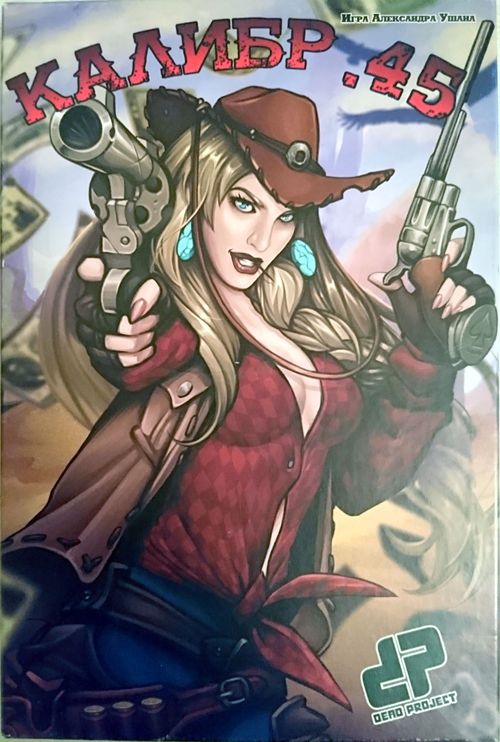
Калибр .45 (Caliber .45)
Калибр .45 (Caliber .45) Rulebook
Table of Contents
Table of Contents
Components
- Weapon deck: 62 cards
- Money deck: 34 cards
- Cowboy deck: 12 cards
- Bail tokens: 15 tokens
Setup
Split into 2 or 3 teams. It is highly desirable that players on the same team do not sit next to each other. Teams may have anywhere from one to three players. Determine the first player.
Shuffle each deck. Deal each player 6 cards from the weapon deck and 1 card from the cowboy deck. The cowboy card lies on the table in front of its owner, face down (it is turned face up when the player decides to go on a robbery). Place the remaining cards from these decks in the center of the table as two piles — as needed, other players will draw cards from them.
Place the cards of the money deck in the center of the table face down, but not in a stack — spread them out a little: players must have access not only to the top card but to any card of the deck.
If the cards in any of the decks run out, shuffle the discard pile and form a new deck.
Gameplay
Goal
Earn $1,000,000. To do this you must arm yourself well and carry out robberies, getting into shootouts.
Game Scenario
The game consists of 2 phases that alternate: "Arming" and "Robbery".
During the first phase, all players take turns drawing cards from the weapon deck until one of them decides to "go on the job." Then the players, in turn, either pass or also go robbing.
Only the players who agreed to go on the robbery may take part in the second phase. In this phase they may shoot at each other, arm themselves, or flee. The strength of a shot is limited by the number on the cowboy card; surplus bullets are not counted. The winner of the showdown takes the loot, and the game returns to the first phase.
Turn Structure
Arming
Turns pass clockwise from the first player. On his turn, a player may perform one of the following actions:
a) If the player has a cowboy and 5 or fewer cards in hand, he may take the top card of the weapon deck.
b) If the player has a cowboy and 6 cards in hand, he may discard 1 card from hand and take the top card of the weapon deck. "Coyote" may only be discarded together with any card that has bullets on it.
c) If the player has a cowboy, whether or not it has bail tokens on it, he may declare that he is going on a robbery. In that case, proceed to the next section of the rules, "Robbery."
d) If the player has no cowboy, he may take 1 random card from the cowboy deck and either discard it immediately or keep it. If he decides to keep it, he places it face down and puts 3 bail tokens ($150,000) on top of the card.
e) If the player has a cowboy with bail tokens, he may remove 1 bail token ($50,000) from it. After the last token is removed, the cowboy may go on a robbery without penalties from the next turn onward.
Robbery
Robbery is divided into four stages: "Challenge," "Attack," "Shootout," and "Dividing the Loot."
Challenge
If a player has a cowboy and confidence in his strength, he turns the cowboy card face up and declares that he is going to rob. The other players, in turn, declare whether they too take part in the robbery (their cowboy card is turned face up) or refuse. From then on, only the players who decided to take part (turned over their cowboy cards) take part in the robbery; the rest do not enter play until this phase is over.
If a player's cowboy has bail (it was placed in exchange for a dead cowboy and not all of its bail tokens have been removed), he may still go on the robbery despite the "debts." To do so, he must remove the bail tokens and pay for them from his personal cards received from the robbery. The bail must be paid off as soon as you or the discard pile have cards of a denomination suitable for making change from the money deck. The tokens must be backed by money in hand (you may not play on credit).
Attention! Bail may not be paid off for teammates!
Attack
The player who began the robbery takes one card from the money deck and shows it to the other players. If he is lucky, these will be the cards: "Stagecoach," "Mail Car," "Gold Train," or even "Fort Knox." If not, it will be "Sheriff," "Indians," or "Dynamite."
Money. Money cards show the number of guards that must be shot: one bullet per guard. The "Stagecoach" has no guards. To shoot the guards, the player must discard from hand one or more cards with bullets so that the total number of bullets on them equals or exceeds the number of guards.
If the player who began the robbery does not do this, his cowboy may be saved by a "Mustang" card; otherwise the guards kill his cowboy. The honor of dealing with the guards then passes to the next participating player clockwise.
If the next player also fails, the turn passes further. If no one deals with the guards, the card goes to no one and stays in the discard pile until the Sheriff appears. If someone manages to shoot the guards, proceed to the "Shootout" phase.
Sheriff. If you have drawn this card, it means he caught the cowboys in the act. Each player who volunteered for the robbery must pay $50,000 to the bank — bail for his cowboy. If the cowboy has no money, or the player does not wish to pay for him, the cowboy goes behind bars (the player loses the cowboy, just as in a shootout). A "Mustang" does not save you from the long arm of justice.
Attention! Do not pay for other players! If a player has large bills, he may receive change from the money deck discard pile.
Important! After dealing with the Sheriff, all cards of the money deck are shuffled together with the discard pile (the cards drawn earlier and the Sheriff) and laid out scattered again.
Indians. Indians are nothing but trouble and no profit. They must be dealt with, as with the guards: the player must shoot at least as many times as the number of attacking Indians shown on the card. If the player who began the robbery does not do this and does not escape (using a "Mustang" card), his cowboy is considered killed, and instead of the eliminated player the next player clockwise joins the fight with the Indians — until someone finally shoots the Indians, or they kill all the cowboys who went out on the robbery.
Dynamite. A trap! If this card is revealed, all the cowboys who went on the robbery die, and even a "Mustang" will not save them.
If the cowboys of all participating players were blown up by the dynamite, you may agree to give everyone new cowboys without bail and without the option to replace them.
Shootout
After the robbery, the cowboys face the difficult task of deciding who will own the money they have earned, and of course the Colts quickly join the negotiations. The shootout is started first by the player who dealt with the guards. If there were no guards, it is started by the first player who began the robbery.
During the shootout, on his turn a player may perform one of the following actions:
a) Shoot at any of the cowboys of the opposing team. The player discards one or more bullet cards, which are added together.
b) Arm himself, just as in the arming phase.
c) Flee: remove his cowboy from the shootout (turn the cowboy card over). A "Mustang" is not needed for this.
If the player whose turn it is draws a card, leaves the robbery, or has his cowboy killed, the turn passes to the next player clockwise. If the player shoots, the turn passes to the player who was shot; he must first defend himself and only then take his turn.
To defend, the player must discard cards with the same or a greater number of bullets than were fired at him. If a player cannot or does not want to defend, he may play a "Mustang" card and leave the robbery alive. If he does not do this, his cowboy is considered killed and goes to the discard pile.
Attention! Cards in the discard pile during the robbery phase are not returned to the deck. This limits endless rearming: if the deck runs out, it can be shuffled and used only after the robbery is over.
Dividing the Loot
When only the cowboys of one team remain in the shootout, the loot (the money card) goes to the one of them who performed the last action before all the opponents were killed or fled. From then on, this card lies face up next to the player, and everyone can see who has accumulated how much.
After the robbery is over, if the game has not ended, the arming phase begins. In it, the first to act is the player next clockwise after the one who performed the last action. The following actions count as such:
- receiving the loot;
- revealing the "Dynamite" or "Sheriff" card;
- successfully shooting Indians;
- the death (or escape on a mustang) of the last cowboy in a shootout with the Indians.
End of Game
The team that first accumulates a total of $1,000,000 between its players wins.
Card Details
Cowboy. Without a cowboy you cannot win: there is no one to rob, and you cannot take part in a shootout. The number on a cowboy card from the cowboy deck indicates the limit of bullets that can be used at the same time.
Attention! A cowboy cannot shoot or defend with more bullets than the number on his card.
Bullets. Bullets help a cowboy shoot during shootouts. With one shot you may present several bullet cards — they are added together. However, the strength of a shot is limited by the cowboy's weapon. For example, if the cowboy "Pat Garrett: 7-shot carbine" uses 12 bullets (2 cards of 6), his shot is still strength 7; the difference of 5 bullets is not counted anywhere, and those bullets are lost.
Mustang. Used only when a cowboy is being shot at and he cannot or does not want to defend (against guards, Indians, or other cowboys). The cowboy remains with the player. After use, the "Mustang" card goes to the discard pile. To leave a shootout on your own turn, a "Mustang" is not needed.
Cactus and Coyote. At first glance these cards are useless, but do not rush to conclusions: your opponent does not know your cards, and you can pretend to be armed "to the teeth." Unlike the cactus, you cannot get rid of the coyote so easily: to do so, you must discard it together with any one bullet card.