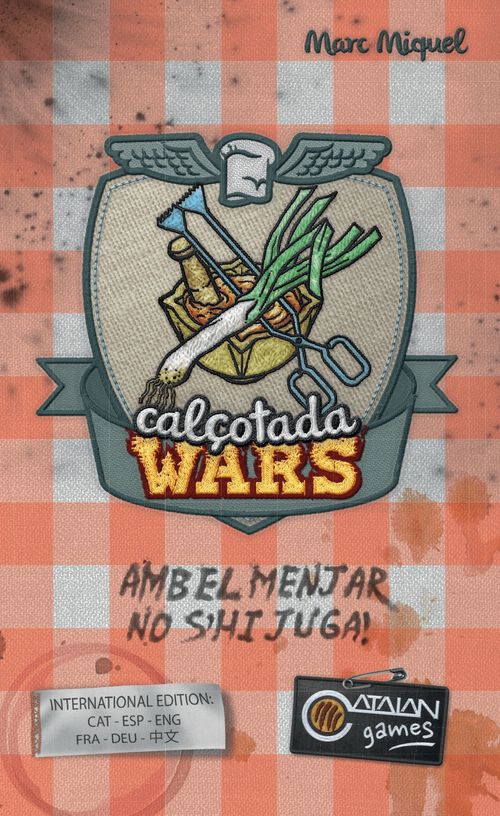
Calçotada Wars
Calçotada Wars Rulebook
Table of Contents
Table of Contents
Content
The game contains 110 cards.
Ingredient cards:
- 20 cards with value 17 (4 per ingredient)
- 15 cards with value 13 (3 per ingredient)
- 15 cards with value 11 (3 per ingredient)
- 20 cards with value 7 (4 per ingredient)
- 10 wildcards (2 per ingredient)
Types of ingredients: wood, fire, grid, calçots and sauce.
Action cards:
- 8 tweezers
- 6 wine jug¹
- 6 apron
- 6 bread with tomato²
- 2 cookbook
- 2 sausage³
¹ A kind of jug to drink wine typical in Catalonia called 'porró'.
² A Catalan specialty that consists of a slice of bread rubbed with half a tomato and seasoned with olive oil called 'pa amb tomàquet'.
³ Typical Catalan sausage called 'botifarra'.
Game's Goal
Eat as many calçots as possible until the end of the game. Calçots may be eaten when you complete a series with the following card order:
wood ≥ fire ≥ grid ≥ calçot ≥ sauce
The value of each card must be equal or less than the previous one so that it makes sense. The order in which cards are set on the table is not important (you can put the last card - sauce - first, then put the third - the grid - etc.).
For example:
One series could be: 17 → 17 → 17 → 13 → 13
Or: 13 → 13 → 11 → 11 → 7
But never: 11 → 11 → 7 → 11 → 7
This is a game in which everyone wants to cook and eat their calçots as fast as possible. The number of eaten calçots will be the sauce you put at the end of the series. Because the secret of good calçots is in the sauce! It is as important completing many series as eating big quantities.
Preparation
Shuffle the ingredient cards with action cards (all facing down) and deal each player 7. Build a deck with the remaining cards and put it on the table with the card values facing down. Players will draw from this pile during the game.
Players should hold their cards with the numbers facing them so their opponents will only see their back.
The Game
The player who ate calçots more recently starts the game. From then on turns are developed clockwise.
Player's Turn
A player's turn is compounded by two phases:
I) Draw 2 Cards: From two cards a player may obtain in his turn, the first one is compulsory from the pile. The second card can be either from the pile or from another player's hand. This player will show their cards' backs and the active player may take the one he prefers (the opponent can't oppose to it unless he shows a "bread with tomato" card). Then the active player must give one in exchange.
II) Play Cards: The active player can then play 1 ingredient card from the value he prefers to his series (dropping it on the table in front of him with the card face up) and/or additionally play as many action cards as he wants (playing cards is optional). To take into account:
- Each player has to build his own series and can only have one open at a time.
- If a player has two or more cards from the same value they can be played at once.
- Cards can be played in the series in any order, but always respecting their place in the series (sauce will always be the 5th card of the series and a grid the 3rd) and meeting the rule that states that the value of a card must be less or equal to the card on its left one.
- When a player completes a series, this is retired and the sauce card (or another with the same value if the sauce is a wildcard) is kept with the total points accumulated. Right after, without starting a new round or drawing any other card, this player has the opportunity to play the first card for the next series (it can be any value he prefers).
- If a player considers his series is not good enough, he can retire it from the table to start a new one. He cannot select which cards: all or none.
- Wildcards can be played as any value.
Action cards can be played whenever during a turn (including before obtaining 2 cards).
Action Cards
Among the action cards there are two kinds: attack (red) and defense (blue). The attack ones can be used whenever a turn. Defense cards are used to defend against an attack from other players. All action cards will be discarded once its effect it's past. The player who received them cannot use them against other players.
Attack cards:
- Tweezers: they allow you taking a card to your hand from your series or another player's.
- Wine jug: it blocks the turn to whomever you throw it.
- Cookbook: it requires all your opponents to show the cards they have in their hand during the turn in progress.
- Sausage: it lets you exchange your hand for another player's cards (you can exchange an empty hand!).
Defense cards:
- Bread with tomato: it protects you from another player trying to steal a card from your hand and also prevents a sausage card. When someone tries to get a card from your hand you can give it. The receiver loses the right to steal the card which was missing.
- Apron: it protects you from another player trying to get a card from your series on the table using the tweezers card.
End of the Game
The game end is foreseen to when the pile is finished at the end of a player's turn. Then each player counts his points and the one who got more wins the game.
Depending on the number of players, the game will finish earlier with the modality "the first who eats...".
| Players | Score |
|---|---|
| 2 | 29 points |
| 3 | 27 points |
| 4 | 25 points |
| 5 | 21 points |
Editor's note: the English end-of-game page gives this table under "Up to 5 players...". The English quick guide (page 3 of the booklet) also has a 6-player line that shows no point value and points to the "NO CARDS" icon. No 6-player score is printed in the English text, so none is given here.
Duel
In case of finishing the game with two or more people with the same number of points they will play a duel. The player with more cards on his uncomplete series will start the duel. If there is a tie at this point, the player with less cards in his hand will start. Players with action cards in their hand will be able to change them for cards from their unfinished series.
Right after all played cards are discarded and the duel starts. At this point, only values will matter and not their type.
The player who starts plays a card. Then the following one, in the clock-wise sense, will play one with an equal or higher value and so on. If a player cannot play a card, he is out of the duel.
The last one standing wins.