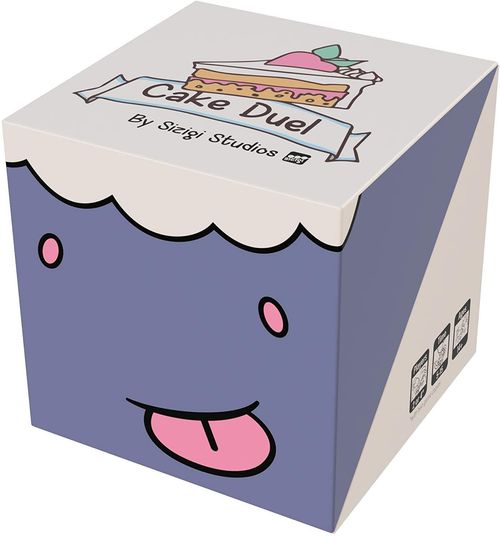
Cake Duel
Cake Duel Rulebook
Table of Contents
Table of Contents
Overview
- Take cakes from the opponent by bluffing Sheepie troop cards.
- The path to victory is simple: either take all of the opponent's cakes or catch them telling a lie.
Components
- 1 Rule Booklet
- 35 Cards
- 20 Core Cards
- 10 Special Cards
- 2 Core Reference Cards
- 3 Special Reference Cards
- 12 Tokens
- 7 Cake Tokens
- 5 Victory Tokens
- 1 Carrying Pouch
Sheepie Card Anatomy
- Type: What class this Sheepie troop is.
- Name: What to call this Sheepie troop.
- Description: What this Sheepie troop does when played.
- Flavor Text: This Sheepie troop has a deep soul.
Types of Sheepie:
- Weapon Attacker: Deals physical damage. Blocked by Defender.
- Magic Attacker: Deals magic damage. Blocked by Scientist.
- Special Attacker: Produces exotic special effects. Hard to block.
- Blocker: Nullifies attacker(s).
- Unclaimable: Its name must never be spoken.
Duel Set Up
- Shuffle the core deck of 20 cards and deal each player 4 cards. Each player should only look at their own hand.
- The player with the best sheep impression starts first as the attacking player. Give 3 cake tokens to that player (P1). Give 4 cakes to the other player (P2).
Note: Set aside the pink special cards for now. Do not put them in the deck (pg. 16).
Core Deck:
- 5 Soldiers
- 4 Archers
- 4 Defenders
- 3 Wizards
- 3 Scientists
- 1 Sir Wolfy
Tokens:
- 7 Cake Tokens
- 5 Victory (Trophy) Tokens
Play area (each player): Hand, Cakes, Trophies; shared Deck and Discard Pile.
Bout Overview
Duels are played as a set of individual bouts. The first player to win 3 bouts wins the duel!
During a bout, players take turns attacking with Sheepie troop cards to steal cakes. The goal of each bout is to either take all the opponent's cakes or catch them telling a lie.
- Each turn, the active player claims one or more attacker cards facedown to steal cakes (pg. 10).
- In response, the other player either claims cards facedown to block the cake theft (pg. 11) or challenges the attack (pg. 12).
- The stolen cakes are transferred. Both players resupply cards, and the bout continues! (pg. 13)
A bout consists of many turns. The order of actions for a single turn:
Turn Starts. The active player is the attacker.
- Attacker: Claim, Attack or Pass.
- Blocker: Claim Block, or Challenge Attack, or No Action.
- Attacker: No Action, or Challenge Block.
- Both: Resolve & Resupply.
Turn Ends. It is now the other player's turn to attack.
End the bout if one of these three conditions is met any time during a turn:
- Either player has no cakes
- Either player challenges
- Both players pass
Claims
In Cake Duel, all cards are played facedown. To make a play, put one or more cards facedown in the discard pile and claim what they are.
- Claiming is announcing the quantity and the name of the cards played. The claimed name can be a bluff.
There are 2 restrictions on claims:
- Do not lie about the quantity of cards played.
- Do not claim multiple troop names at once.
Note: Do not flip claimed cards faceup at the end of a turn.
Sample Claims:
- Two cards played facedown as "two Wizards" (Valid)
- One card played as "two Wizards" (Invalid. Claim unequal to # of played cards)
- One card played facedown as "Sir Wolfy" (Invalid. Cannot claim unclaimables)
- Two cards played as "one soldier and one archer" (Invalid. Claim uses multiple troop names)
Attacking and Blocking
During every turn, the active player will make an attacking claim. Then, their opponent will make a blocking claim.
Attacking Claim
The attacking player must claim weapon, magic or special attacker troops.
Passing
The attacking player may also pass. If both players pass their turns in succession, the bout ends.
Blocking Claim
The blocking player must claim blocker troops.
- The blocking player can only claim troops that are able to block the attack (e.g. Scientist is an invalid claim against Archer).
- Any quantity of blocker troops may be claimed. If insufficient blockers are claimed, the unblocked attackers still resolve (i.e. they steal cake).
Sample Turn:
- Alice plays 2 cards facedown and claims "Two Wizards."
- Bob plays 1 card facedown and claims "One Scientist."
- Alice accepts and takes 2 cakes (the effect of the unblocked Wizard).
Making a Challenge
After each claim, the other player has a chance to call a bluff. To do so, say "challenge" and flip the played cards.
Once cards are flipped, the bout ends!
- If the claim was a bluff, the challenging player wins.
- If the claim was truthful, the claiming player wins.
There is one restriction on challenges: A challenge can only happen immediately after the play is made. Drawing cards, making a play, or taking cakes forfeits the opportunity to challenge.
Example:
- Alice plays 2 cards facedown and claims "two Soldiers."
- Bob plays 2 cards facedown and claims "two Defenders."
- Alice challenges the play by flipping Bob's cards over.
- Alice wins the bout because Bob's cards are 1 Defender and 1 Soldier.
Resolving and Resupplying
At the end of the turn, resolve the claimed card effects. Then the attacker resupplies, followed by the blocker.
Resolving
Transfer any successfully stolen cakes. Remember to use the claimed effects, not the actual cards played. Do not flip any cards over.
Resupplying
The attacker redraws up back to hand size. Then, the blocker redraws back up to hand size. Unless modified, the hand size is 4 cards.
If the deck runs out during redraw:
- Players continue dueling with the remaining cards in their hands.
- If a player has no cards during their turn, it is an automatic pass.
- Players with no cards may still challenge claims.
Example:
- 2 cards remain. Alice claims 2 Archers and Bob blocks with 1 Defender.
- Alice takes 1 cake and draws out the last two cards in the deck.
- Bob cannot resupply and must start his turn with only 3 cards in hand.
Winning the Bout
There are three ways to win a bout.
- Take all of the opponent's Cakes.
- Win a challenge.
- Have more cakes when both players pass.
When the bout ends, give the winning player a trophy token, shuffle all the cards back into the deck, and start the next bout with the loser going first. The cakes are reset; the attacking player starts with 3 cakes, and the blocking player starts with 4. The first player to win 3 bouts wins the duel!
List of Core Set Cards
Use these cards to make the 20-card core deck.
- Soldier (5x) (Weapon Attacker): Steal one cake.
- Archer (4x) (Weapon Attacker): Steal one cake.
- Wizard (3x) (Magic Attacker): Steal two cakes.
- Defender (4x) (Blocker): Block one weapon attacker from stealing cake(s).
- Scientist (3x) (Blocker): Block one magic attacker from stealing cake(s).
- Sir Wolfy (1x) (Unclaimable): At the end of the turn, reveal face-up and taunt your opponent.
Note:
- Sir Wolfy is not a valid claim. You must bluff him as another card.
- Taunting has no gameplay effect and is optional in tournament-style play.
Special Set Card Overview
Congrats, Sheepie General! You have learned the core game. Now, add Special cards for the full Cake Duel experience.
Note: We recommend playing the core game several times before adding in the advanced set cards.
Prepare the Special Deck before each new Duel:
- Shuffle the 10 pink Special cards together to form the separate Specials Deck.
- Draw 2 cards from the Special Deck. Do not look at them. Add both to the Core Deck to form the 22-card Game Deck.
- Use the Game Deck to play a full duel. Players are allowed to claim any Special card, even if it's currently not in the deck.
Between bouts, do not reveal which specials are in the deck while reshuffling. Do not change the Special cards between bouts: use the same specials for the whole duel. For the first few rounds, we recommend looking at the added Special cards before shuffling them in, as there are many new card abilities to master!
The Special Set introduces many new Sheepie, each with their own unique abilities. Below is a brief overview of the new mechanics.
Special Attacker Type
Special attackers cannot be blocked by either Defender or Scientist.
Extra Effects
New weapon and magic attackers have extra effects. Defender and Scientist will only block cake theft, but not the extra effects. During resolution, resolve all blockers before resolving the effects of the attackers.
Example:
- Alice plays 1 card facedown and claims "one Scout"
- Bob plays 1 card facedown and claims "one Defender"
- Alice takes no cakes, but she still takes another turn.
New Blockers
Two new blockers, Priests and Angel, will block all types of attackers. They also block all extra effects of these attackers.
Transforming Unclaimables
New unclaimables change identities on challenge, allowing them to become valid cards when flipped.
List of Special Set Cards
- Assassin: Steal 5 cakes.
- Assassin is blocked by 1 defender.
- Scout: Steal 1 cake. Take another turn.
- Unless stated, the attacker still gets another turn if Scout is blocked.
- Both players still resupply before the extra attacking turn.
- Summoner: Name a card. Look at opponent's hand and steal two cakes per copy they have.
- Unless stated, the opponent's hand is still revealed if Summoner is blocked.
- Summoner must be challenged before a card is named.
- Unclaimable cards must be guessed by their unclaimable names.
- Quartermaster: Increase your hand size by one for the rest of the bout.
- Quartermaster can stack. Ex: playing two Quartermasters will increase handsize from 4 to 6.
- If Quartermaster increases hand size, draw up to the new, increased hand size when resupplying for every turn afterwards.
- Oracle: Look at opponent's hand. Take another turn.
- The attacker takes another turn after resupplying.
- Priest: Block one weapon, magic or special attacker, and put it into your hand. Cancel its effects.
Variant: Team Mode
Cake Duel can be expanded for 4 players! Players duel against each other in pairs. You will need two game sets to play.
Setup
- Players form teams of two. Teammates should sit next to each other and can look at each other's hands.
- Deal each player a hand of 4 cards. Give the team that goes first 4 cakes. Give the other team 5 cakes. Cakes are a shared team resource.
- Create the basic 39-card deck by combining two copies of the basic 20-card deck, and removing one Sir Wolfy.
- (Optional) Combine both copies of the Special deck and draw 3 cards randomly, adding them into the deck for the full 42-card deck.
End the bout if any of these conditions are met during a turn:
- Either team has no cakes
- Any player challenges
- All players pass
First team to win three bouts wins the duel!
Taking a Turn
Although mostly similar to 2-players, team mode uses a slightly different attack order and also adds a new teammate trading phase.
- Turn follows the diagram in the manual (Team 1: players A and B; Team 2: players C and D). Cycle back to player A after D's turn is done.
- The starting team may decide which teammate is player A after looking at their initial hands.
- At the start of the turn, choose a player to attack. That defending player can only block with cards from his/her own hand. Cakes, however, are taken from the shared team pools.
New Phase: Trading
- Immediately after resolving the attack, but before resupplying, the active attacking player may exchange one of the cards in hand for a teammate's card. The blocking team does not get to trade.
- If the deck has run out, the current attacking player may either swap a card, give a card, or receive a card from his/her teammate.
- After trading, resupplying happens as normal.
For more variants & tournament rules, see http://cakeduel.com/rules