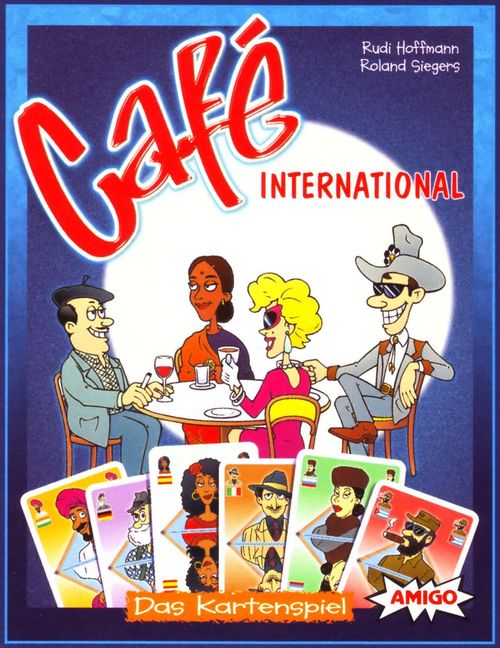
Café International: Das Kartenspiel
Café International: Das Kartenspiel Rulebook
Table of Contents
Table of Contents
Game Preparations
The guest cards and the table-cards are shuffled separately. Each player receives seven guest cards in his hand. The remaining guest cards are placed face down in the middle of the table to form the stock. Five of the table-cards are placed face up onto the middle of the table forming an 'X'-shape (the Café). The remaining table-cards are placed beside the guest card-pile to form another stock.
All players need a pencil and a score sheet to take down the points.
Designate a starting player. Then use a clockwise rotation for all other players.
Seating Arrangements in the 'Café International'
In the Café you will always find five table-cards. Around each table-card there are four free spaces marking the guest chairs. During the game, a guest card of a corresponding nationality may be put on a free space between the table-cards or on the edges of the Café.
A guest card corresponds with a table-card if the nationality of both the guest and the table are identical on at least one of the sides.
Apart from nationalities, 'Café International' also strictly observes a rule which requires the same number of ladies and gentlemen sitting at the tables whenever possible. The following are the only combinations of guests allowed for one table at any given time:
- one lady and one gentleman, or
- one lady and two gentlemen, or
- two ladies and one gentleman, or
- two ladies and two gentlemen.
Other seating arrangements are not permissible.
No one is allowed to be the only guest at any of the tables as long as he does not belong to another group of guests at a neighboring table.
How to Play the Game
If it is his or her turn, a player has to carry out one of the following actions:
- Place up to three guest cards from his hand at the table-cards, or
- draw one guest card from the stack, or
- lay down a guest card from his hand face up and in front of him.
(See the note under "Action: placing a guest card face down in front of oneself" below regarding this action's face-up/face-down wording.)
Action: Placing Guest Cards at the Tables
When it is a player's turn, he or she places one or up to three guest cards at appropriate tables. In doing so, players have to observe the seating arrangements as described above. Then the next player to the left takes his or her turn.
Scoring
Players must score whenever laying down a card. If a player places one card each at two different tables he has to score at both tables.
Exception: If a player allows a guest to be seated at an unoccupied table, he or she must lay down a corresponding guest at that table immediately if the first guest does not allow him or her to score. This also applies to the starting player putting the first guest card into the Café.
The more guests already sit at a table, the more points the player receives after having placed his or her card or cards on free spaces. A player may only score at those tables at which he or she has just placed one or more guest cards. In determining the score it is critical how many guests are sitting at a table and what their nationalities are.
Scoring examples as printed (table with identical-nationality guests):
- 1 gentleman + 1 lady of identical nationality = 4 points
- 1 gentleman + 1 lady + 1 guest of identical nationality = 6 points
- 2 gentlemen + 2 ladies of identical nationality = 8 points
Scoring examples as printed (guests of different nationalities at the Indian table):
- 1 gentleman + 1 lady = 2 points
- 1 gentleman + 1 lady + 1 guest = 3 points
- 2 gentlemen + 2 ladies = 4 points
A player may score at more than one table with only one guest card:
- 4 points at the German table + 2 points at the Italian table
- 3 points at the German table + 2 points at the Chinese table
If a player puts two or three guest cards down at one table, each card is counted separately:
- 1st guest = 4 points
- 2nd guest = 6 points
- 3rd guest = 8 points
- Total = 18 points
If the player puts two guest cards down at one table, each card is counted separately:
- 1st guest = 4 points
- 2nd guest = 3 points
- Total = 7 points
If a player places a guest card between two table-cards, both tables are counted separately:
- 4 points at the Great Britain table + 3 points at the Central African table = 7 points
The English guest is not allowed to be placed on the space indicated since an English gentleman is already sitting at the English table.
If the player places one guest card each at different tables, he may score at more than one table. Example as printed:
- 1st guest: 6 points at the Russian table, 2 points at the French table
- 2nd guest: 3 points at the French table, 2 points at the Spanish table
- 3rd guest: 4 points at the Italian table, 4 points at the French table, 2 points at the Great Britain table
- Total = 23 points
The points for each player are taken down on a score sheet.
How to Exchange Table Cards
If a player has fully occupied one or more tables after having placed a guest card, these tables have to be exchanged immediately. A fully occupied table is a table which is surrounded by exactly four guest cards. The table-cards and the surrounding guest cards are taken out of the game and will be put back into the box.
Then, the same number of new table-cards is drawn from the stock as has just been removed. The new table cards are placed on the space the old ones have been removed from.
Example as printed: when the French table and the Italian table are fully occupied, all four guests at the French table and at the Italian table are removed together with the tables. Two table-cards are drawn from the stock and put in the place of the previously used tables.
If one or more table cards have to be exchanged after a player has placed one or two guest cards only, that player may put a second or a third card into the Café. It is only after the player has placed his or her third guest card or does not want to play another guest card that the next player to the left is taking his or her turn.
Attention: It is possible for a guest to sit alone at a table or to sit at a "foreign" table after table-cards and guest cards have been removed. This is an exception and the game proceeds without reference to the general rule.
Action: Drawing a Guest Card
If a player does not want to place a guest card at a table-card or if he or she is unable to do so, that player must draw the top guest card from the proper stock. Then, the player to the left takes his or her turn.
Attention: A player may have a maximum of twelve guest cards on his hand.
Action: Placing a Guest Card Face Down in Front of Oneself
If it is a player's turn and that player has twelve cards in his or her hand, and if he or she does not want to place a guest card into the Café or is unable to do so, then that player has to place a guest card in front of him or her with the face of that card showing down. That card does remain there until the game is finished. Each hidden card will score 2 penalty points.
Source note: the "How to Play the Game" list says a guest card is laid down "face up and in front of him"; this section says the card is placed with its face showing down and stays hidden until the end. Both wordings are transcribed as printed; the hidden-card rule here is the operative one for the penalty.
End of the Game
The game ends when one of the following situations occurs:
- There are not enough table-cards in the proper stock to guarantee for five tables to be in the Café. In this case, the game does end immediately.
- The last available guest card is drawn from the proper stack.
- As soon as a player does not have any guest card on his or her hand, that player may declare the game to be over. If he decides against that opportunity the game proceeds without reference to this rule.
After the game has ended, each player adds up the cards on his or her hand and the cards face down in front of him or her. Each card is charged with two penalty points. These penalty points are subtracted from all of the points received and noted down on the score sheet. The player with the highest number of points is the winner. If there is a tie, the player with the smallest amount of penalty points is declared the winner.
Variation
Sometimes, women like to be amongst themselves while enjoying a cup of coffee and a good conversation. Men also like the company of other men to have a drink or two. To take this into account, the game may be played with the following variation:
There is an exception to the general rule: a player now may place up to four guest cards at a single table at one time if he or she can guarantee a complete ladies' table (four ladies at one table) or a complete gentlemen's table (four gentlemen at one table) when it is that player's turn.
A ladies' table or a men's table (with four ladies or four gentlemen) will be rewarded with 20 points. If such table is a one nation table it will score 40 points.
Examples as printed: a ladies' table or a men's table of different nations will score 20 points; a men's table (or a ladies' table) will score 40 points.