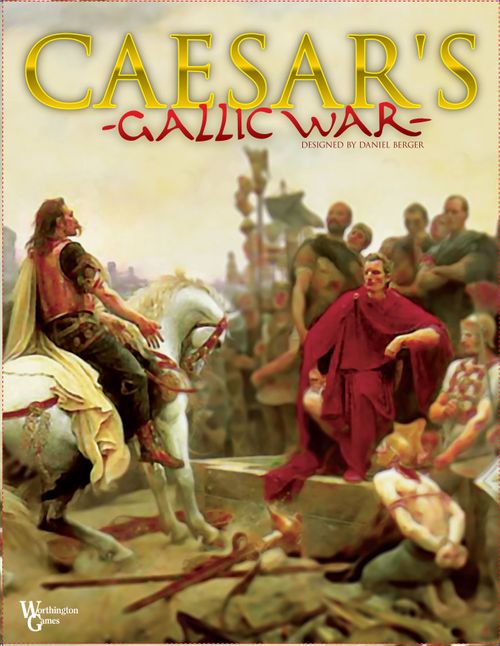
Caesar's Gallic War
Caesar's Gallic War Rulebook
Table of Contents
Table of Contents
- 1.0 Introduction
- 2.0 Components
- 3.0 Game Setup
- 4.0 Sequence of Play
- 5.0 Card Phase
- 6.0 End of Turn Phase
- 7.0 Leaders
- 8.0 Victory Conditions
- 9.0 Optional Rules
- 9.1 Tournament Play
- 9.2 Solitaire Play
- 9.3 Political Control Die Rolls When Opposing Units Are in the Area
- 9.4 German and Roman Cavalry
- 9.5 Scorched Earth (Barbarian Advantage)
- 9.6 Caesar Called Back Home (Barbarian Advantage)
- 9.7 The Politics of War (Barbarian Advantage)
- 9.8 Legio X (Roman Advantage)
- 9.9 Roman Historical Strength (Roman Advantage)
- 10.0 Comprehensive Example of Play
- Rules Changes for Version 2.0 Summary
- 11.0 Card Roster Section
1.0 Introduction
Caesar's Gallic War is a two player game based on Julius Caesar's conquest of Gaul. One player is the Roman and the other is the Barbarian. The game begins with Caesar's arrival in Gaul in 58 BC and lasts through 51 BC. During this time both players will attempt to bring Gallic tribal areas under their control, either through military or political means. Both players will eventually receive additional units; the Romans will receive four additional legions over the course of the game, while the Barbarian player will eventually receive Vercingetorix and other Gallic leaders that are allied to the Barbarian cause. The goal of the game is to score more victory points than your opponent, which is accomplished by controlling the tribe areas, as well as eliminating certain enemy units.
Historical Note: In the period and scale of this game, Caesar's success in making some German tribes allies is not conveyed.
2.0 Components
- One game map
- 60+ wooden blocks
- 31 Action cards
- Four dice
- This rulebook
2.1 The Game Map
The map has been divided into areas, with most areas home to a particular tribe. The name of the area is the name of the tribe that inhabits that area and is its home. The Roman player home area is Transalpine Gaul and they have a Roman Off Map Area and they are red. The Barbarian player home area is Germania and it is blue. Between the Barbarian player home area and the Roman player home area is Gaul (the Gallic tribal areas). The color groupings used in Gaul are to aid with setup and represent the historical regions of Gaul (green is Belgica, grey is Celtae, and dark green for Aquitaine). The map also contains a key that explains some of its features.
Some areas have a Fortified Town symbol (errata: the Sequani area should be fortified). These areas provide bonuses to the original defender, and supply points for the Romans. The name of each town is provided for historical flavor. The border between each area is either black or blue. The blue border denotes rivers or terrain that can limit movement. The Alps (in Helvetii) and Rhine River incur certain penalties or bonuses. Ocean is between Britannia and coastal areas, and contains a port symbol. Units that start their action in a port space can move amphibiously from their current area to another area that contains a port symbol.
The Turn Track keeps a record of what turn it is. There are eight turns, with each turn representing one year. In addition, it shows the die roll necessary to bring in additional Roman reinforcements. It can also be used to track whether or not Caesar or Ariovistus wintered for the turn. The Supply/Tribes Controlled/VP's Track keeps track of these factors in the game and there are marker blocks to use on the track. Each side has an area on the map to place cards that were used to activate a neutral tribe. This is useful in order to help players remember their respective limits.
2.2 The Units
Each unit is represented by a colored block with the appropriate label applied. To apply the labels, peel them from the label sheet and position in the center of the appropriate colored block for that label. Once positioned press the label down firmly. Only one label should be applied to each block. Apply the red (Roman) labels to the black blocks. Apply the blue (German) labels to the blue blocks. Apply the grey (Gallic Celtae) labels on the grey blocks, green (Gallic - Belgae) labels on the green blocks, and dark green (Gallic - Aquitaine) labels to the green blocks.
Each unit has a certain number of triangles on each side (pips) that represent its strength. The number of pips a unit has indicates the number of dice rolled in battle. As units take "hits" in battle they are reduced in strength by rotating the block counterclockwise. In the upper right corner of each unit is its initiative rating that determines the order in which a unit performs battle. There are three possible initiative ratings - A, B and C. A units would perform battle first, B units perform battle next, C units perform battle last. In the lower right corner of each unit is its battle rating which is the numeric value needed or less on a die roll to score a hit when performing battle. Each unit also contains its name. For Roman legions, a Roman numeral indicating the legion number. For Barbarian and Gallic tribe units, the name of the tribe is printed. For most leader units the name of the leader is printed on the block. Movement rate for all units is one area.
The black Roman blocks are controlled by the Roman player. The blue Barbarian blocks are controlled by the Barbarian player. The grey and green Gallic tribe blocks are in one of two states: neutral and controlled by neither player and placed face down on the board; or active and controlled by the Roman or Barbarian player. Active unit blocks are stood upright with the label facing the controlling player. Active Gallic tribe units controlled by the Roman player are Roman allies. Active Gallic tribe units controlled by the Barbarian player are Barbarian allies. Players may not look at their opponent's unit labels.
In the rules "Roman units" means Roman legion units and Gallic tribes that are allies to the Roman player. When the rules refer to "Roman legion" units it means only the black block Roman units. "Barbarian units" mean German units and Gallic tribes that are allies to the Barbarian player. When the rules refer to "German" units it means the blue block German units.
2.3 The Cards
Cards contain either the name of a Gallic Tribe with an image of its tribe area on the card or an event which summarizes the effect of the event. The Action Point value is printed on the card.
Sample Event Card (Major Revolt): Roman: Select 1 Barbarian controlled tribe to return home and become neutral. If occupied the tribe joins the other player, battle is resolved with units returning home the attacker. Barbarian: Select 1 tribe Roman controlled or neutral, in Celtae or Belgica to return home and become Barbarian allies. If Roman occupied resolve battle returning units the attacker. If no Roman units present, or battle a Barbarian victory, place minor leader in that area. Activate that area (only) for movement.
3.0 Game Setup
The Barbarian player starts with Ariovistus and the three German infantry units at full strength in Germania. The Barbarian player controls the three Helvetii tribe units at full strength in their home area. Stand these units upright facing the Barbarian player.
The Roman player starts legions VII, VIII, IX, X (Caesar), XI, and XII in Transalpine Gaul at full strength. The Roman player controls the Volcae tribe at full strength, and the Allobroges tribe at strength 1 each. The Volcae and Allobroges start in their home areas. Stand these units upright facing the Roman player. The Romans begin the game with 15 supply points.
All other tribes are placed in their home areas, face down. They begin the game neutral.
Note: Any units controlled by a player should be standing upright with the label facing the controlling player.
4.0 Sequence of Play
The game is divided into 8 turns with each turn representing one year. Each game turn is divided into a Card Phase, where cards are dealt and played, and an End of Turn phase that is conducted after all cards have been played. The sequence of play summary is:
- Card Phase
- A. Draw Cards and Play
- B. Card Action Phase Order
- i. Events
- ii. Supply Action
- iii. Neutral Tribe Activation
- iv. Political Action
- v. Movement
- End of Turn Phase
- A. Check Harvest
- B. Units Go Home in the Following Order
- i. Eliminated Gallic Tribe Units
- ii. Roman Legions
- iii. Gallic Tribes Allied to the Roman Player
- iv. Gallic Tribes Allied to the Barbarian Player
- v. German Units
- C. Tribe Area Control
- D. Supply and Attrition
- E. Replacements
- F. Roman Supply Point Production
- G. Roman Reinforcements
5.0 Card Phase
5.1 Draw Cards
Shuffle the card deck and deal five cards to each player. If the Romans control 13 or more tribes at the end of the previous turn, the Barbarian player has the option of putting the Massive Revolt card in his hand first if not already played. If using this option, only deal four cards to the Barbarian player. If not already played, at the start of 52 BC (only) the Barbarian player may select the Massive Revolt even if the Romans control less than 13 tribes, but it costs 1 VP and must be the first card played and must be played as an event.
5.2 Card Action Phase
Each player selects one card from his five card hand and places that card face down. Both players then simultaneously reveal which card they have selected. Each player then announces what action they are taking, Romans first. Actions are then resolved in card action order. There are five possible actions and they are resolved in the following order: Event, Supply Action, Neutral Tribe Activation, Political Action or Movement. If both players select the same action, the Romans resolve their action first.
Exception: If both players selected a Movement action, the player who played a card with the highest action value moves first. If both players played a card with the same action value, the Romans move first.
At the end of each card play (both players have played their selected card) if units of the Roman player and Barbarian player finish in the same area, a battle occurs.
This process is repeated until all five cards have been played and resolved. Played cards should be placed in the discard pile unless used for Neutral Tribe Activation in which case they are placed in the respective players Neutral Tribe Activation area on the map. Cards cannot be held between turns, i.e. a player may not pass in order to save a card for a future turn. Discard piles are not secret. They may be examined at any time by either player. All played cards and the un-dealt portion of the deck are shuffled together at the end of the turn for use at the start of the next turn.
5.2.1 Card Action Phase Order
A. Events
There are five event cards in the game. Each event card may be played as the event as described on the card, or may instead be played as a 1 for a Movement Action. Event cards may never be used for a Political Action, Neutral Tribe Activation or Supply Action. The cards explain the event and how it is applied to the game for each player. See the card roster section at the back of the rules for details.
B. Supply Action
The Roman player tracks his supply points on the Supply/Tribes Controlled/VP Track on the game board using the Roman Supply block. The Romans may add a number of supply points equal to the Action Point value of the card, plus one.
For example, if the Romans played a card with an Action Point value of 2 as a Supply Action, they would gain 3 supply points.
The Barbarian player may not use a card for a Supply Action until Vercingetorix is in play. The Barbarian player supply action is the play of a card to reduce the number of Roman supply points by the Action Point value of the card. The Barbarian player may perform a maximum of one Supply Action per turn (year) while Vercingetorix is in play.
C. Neutral Tribe Activation
Both players may activate neutral tribes and automatically bring them under their control as allies at full strength. The name of the tribe on the card must match the name of the neutral tribe the active player wishes to activate. Neither player can change control of a tribe that is already controlled by the opposing player with a Neutral Tribe Activation. The Barbarian player is limited to two neutral tribe activations per turn (year). The Roman player is limited to one neutral tribe activation per turn (year). When Neutral tribes are activated stand the units upright facing the player to which they are allied. Note: Neutral tribes may be activated by other cards or actions that do not count against this per turn limit.
Exception: The Romans may not use a Neutral Tribe Activation to activate Britannia.
D. Political Action
Either player may use a card to attempt to change the political allegiance of any tribe on the map, whether it's a neutral or controlled by the opposing player.
Roll a die. If the selected area of the Political Action matches the name of the tribe on the card, the active player receives a -1 bonus to the die roll in his favor. If the die roll result is less than or equal to the Action Point value on the card played, the Political Action is successful and control is switched to the active player. All units of that tribe immediately return to their home area (if not already home) at their current strength, and are now controlled by the active player. If there are enemy units present then a battle is immediately fought (see 5.2.2. Battles). The units returning home are considered the attacker.
If a Political Action is successful against the home area of a Minor Leader, that leader is immediately eliminated. If a Political Action is successful against the home area of Vercingetorix, the Barbarian player immediately designates a new home area. The home area must belong to a tribe that is currently controlled by the Barbarian player and is free of enemy units. If no such area exists, then Vercingetorix is eliminated. The Romans score victory points normally in this case.
The Roman player may only select Britannia as the target of a Political Action if there is at least one Roman legion in a port area. The Barbarian player may select Britannia as the target of a Political Action if there is any friendly active unit in a port area. The Roman player may not use a Political Action against Germania.
A neutral tribe activated by a Political Action does not count against the Neutral Tribe Activation limit.
Political Action Example: The Roman player plays the Santone card for a political action. He decides to target the Santones with his political action. By naming the Santones he receives a -1 die roll bonus since the target tribe matches the name of the card. He rolls a 3 which is reduced to a 2 due to the die roll bonus and the Santones are now Roman controlled.
E. Movement
The active player may activate for movement a number of groups up to the Action Point value of a card, or none at all if they choose. All units within an area are considered a group. Each group moving may move together to the same area or individual units within the group could move to separate areas. Unit movement rate is one area per card play (round). Retreat and regroup do not count as movement. All groups must be designated prior to actual movement.
Example: 4 Roman legions starting in Transalpine Gaul could as part of one group move have 2 units move into Allobroges and 2 units move into Helvetii, or all 4 into Allobroges, or any number of other moves within the restrictions of movement.
Exception: Each Roman legion unit in the off-map area is considered its own group, i.e. they must be moved onto the map one at a time, and only into Transalpine Gaul. Barbarian units may not enter the off-map area.
Roman Legion Force March: Roman legion units (only) have the option to expend one supply point per legion unit in order to conduct a forced march. This allows the legion unit to move up to two areas per card play instead of one.
Borders and Terrain: Borders and other terrain restrict movement and limit the number of units that may move from one area to another adjacent area. A maximum of six units may cross a black border from one area to another. A maximum of two units may cross a blue border from one area to another. All units crossing a blue border or moving using naval movement must stop immediately. This supersedes forced marches by Roman legions, i.e. a supply point may not be spent to force march a legion that has just crossed a blue border (though it could cross a blue border on its second move). Border limits are applied separately to each player. For example, both the Roman and Barbarian players could move two units across the same blue border in the same card play.
Units moving into an area containing enemy or neutral units are considered attacking that area. Units in an area into which the opposing player moves units are considered the defender. All units entering an area containing enemy or neutral units must stop immediately. Entering an area containing a neutral tribe causes that tribe to join the opposing player, though battle is not resolved until the end of the card play round. If both players move into the area of a neutral tribe, the tribe will join the player who moved into the area last.
Pinning: When moving into an area, all attacking units (including reserves) prevent an equal number of defending enemy units in an area from moving in that round. The defender chooses which units are pinned. Any unpinned units may move and attack normally, except that they may not cross any border used by the attacker to enter that area.
Naval Movement: The ocean may not be entered or crossed except from port area to port area using naval movement. Units that start in a port area may use naval movement. Up to two units may move from one port area to another per round as part of one group move. Barbarian units may not use naval movement to enter a port that contains enemy or neutral units. Conversely, Roman units may use naval movement to enter a port area that contains enemy or neutral units, though this affects battle by allowing the units defending the port area to be an "A" rated unit for the entire battle.
Movement Example: The Roman player used a '1' action point card for movement, he may activate one group. He activates the group in Transalpine Gaul (his six legions), and moves legions VII and VIII directly from Transalpine Gaul to Helvetii. Since it's a blue border he can move no more units across that border. He then uses two supply points to force march legion IX and X (Caesar) from Transalpine Gaul to Allobroges and from there into Helvetii. Roman supply is reduced from 15 to 13. The Romans then force march legions XI and XII from Transalpine Gaul to Sequani through Allobroges. Roman supply is now at 11. The Roman legions can force march through Allobroges because the Gallic units in Allobroges are Roman allies. If he had played a '2' action point card, he could have also moved the Roman allies grouped in Allobroges or any other group in an area.
5.2.2 Battles
Source note: the section heading is partly illegible in the source PDF; the title is taken from the in-text cross-references ("see 5.2.2. Battles").
Battles are fought as a result of Event, Political Action, and Movement card play. Each battle must be completed before fighting the next battle. Battles occurring as the result of Event and Political Action card play are resolved immediately with the order determined by the active player. The player who selected a movement action and moved first this round determines the order in which battles are fought as the result of a movement card play.
In any area in which there is a battle both players reveal their units by tipping the unit block forward so that they show their current strength. After each battle is completed, return any surviving units upright before proceeding to the next battle. After all units have taken one battle action, one battle round is considered to have passed. Repeat the sequence for a 2nd and 3rd round if necessary. Battles are fought for a maximum of 3 battle rounds. The attacker must retreat if the defender is not eliminated and does not retreat by the end of the 3rd round. This procedure is repeated until all battles are complete.
Each unit may fire, retreat or pass during each battle round. This is called a battle action. The order in which a unit resolves its battle action depends on its initiative. All defending units with an initiative of 'A' take their battle action first, followed by all attacking 'A' units. Then all defending 'B' units take their action, followed all attacking 'B' units. Finally, all defending 'C' units take their action, followed by all attacking 'C' units. Exception: If the Caesar unit is involved in a battle, it always rolls first, regardless of enemy initiative or circumstances.
Each unit may "fire" by rolling as many dice as its strength. A hit is scored for every roll less than or equal to its battle rating. Each hit reduces an enemy unit by one strength point. This is indicated by rotating the unit counter-clockwise for each hit. Enemy units may not be targeted individually. Each hit is applied to the strongest enemy unit. If two or more enemy units are the same strength, the owner decides on which unit to apply the hit except that, in mixed forces, Roman or German units must take a hit before Barbarian units. Units eliminated in battle are set aside until the End of Turn Phase.
A. Reserves
Multiple groups may attack or defend the same area, moving across the same or different borders. However, only one group is considered the main group. All other groups are considered reserves. In the case of defending units, the units that began the action in an area are considered the main group. Any units that moved to help defend the area are considered reserves. In the case of attacking units, the player attacking an area decides which group is the main group and which groups are reserves.
Reserve units may not perform a battle action or suffer hits, nor are they revealed, in the first round of battle. They are revealed and participate in the 2nd battle round, even if all other friendly units have been eliminated. If the attacking player eliminates all defending units before defending reserve units arrive, then the original attacker is now considered the defender, and the original defender is now considered the attacker. Battle is then resolved normally.
B. Battle Modifiers
Defending units that were attacked across the Rhine River (either into or out of Germania) or units defending in the Alps (Helvetii) area receive a +1 strength bonus in the first round of battle only.
Units defending in a fortified town area, or units defending a port area against a Roman naval move, are considered to have an initiative rating of 'A' for the entire battle. Units defending in a fortified town area also receive a +1 battle rating bonus in the first round of battle.
C. Retreat
Instead of firing, each unit may retreat to an adjacent friendly or empty area. Units may retreat to the same or different areas. Retreating units are returned to their face up position before retreating, potentially concealing which units are retreating to any particular area. Border limits apply to retreating units on a per-battle-round basis, e.g. up to six total units could retreat across a blue border, but no more than 2 per battle round.
Units may not retreat into an area through which enemy units entered the area. However, if both players moved units across the same border in the same round, only the player who crossed the border last may retreat across that border.
Units may not retreat into a contested area, i.e. an area where there is an unfought battle. Only German units may retreat into Germania.
D. Naval Retreat
Roman units conducting a naval move into an enemy port may retreat to any friendly port area. They may not retreat if there is no friendly port area. Any units defending in a port area may retreat up to two units (maximum, not per battle round) to another friendly port area.
E. Regroup
The winner of a battle is the player left controlling the area at the end of battle and he may regroup his units. Regroup allows all victorious units, including any in reserve, to move to any adjacent friendly or empty area. Unit cannot regroup into an unfought battle. Only German units may regroup into Germania. Border limits apply to regrouping units.
Battle Example of First Battle Round: Following the movement example above. Because the Roman player selected a movement action, he decides the order of the battles. He elects to resolve the battle in the Helvetii space first, declaring legions VII and VIII his "main" force and tip them down to reveal their values. The Barbarian player likewise tips their three units down to reveal their values. The other two legions are considered reserves and will not enter the battle until battle round 2. The Roman units are both "A" initiative units, and therefore fire first. The Roman player rolls 8 dice (one for each strength point) and needs a 1 or a 2 to hit since each legion has a battle rating of 2. He rolls a 1, 1, 2, 2, 3, 3, 5, 6. Four hits! Because damage must be distributed equally, the Barbarian player reduces the strength of each Helvetii unit by one, except for one unit that takes two hits. Since the Barbarian units have nowhere to retreat to (the Sequani space is an unresolved battle) they decide to fire instead. They would normally have a total of 5 dice, but because they're defending in the Alps, each unit receives a +1 strength bonus for the first round of battle. They therefore have a total strength of 8. The Barbarian player rolls 2, 2, 3, 5, 5, 5, 5, 5. Only two hits. The Roman player applies one hit to legions VII and VIII. Rounds 2 and 3 would follow and are shown in the Comprehensive Example of Play.
6.0 End of Turn Phase
After all cards have been played (Card Phase completed for the year), players must now deal with returning units to their home areas, supply and replacements. This reflects the end of the campaign year when armies returned home or went into winter quarters in effect "wintering". The End of Turn sequence below should be followed strictly.
6.1 Check Harvest
The harvest affects garrison limits for each area at the end of the year. Check the harvest by rolling a die. On a roll of 1, it's a poor harvest and the garrison limit for each area is 1. On a roll of 6, it's a bountiful harvest and the garrison limit for each area is 3. On a 2-5 the garrison limit for each area is 2. Gallic tribe units, including minor leaders, in their home area do not count against the area garrison limit.
6.2 Units Go Home
Units return to their home areas in the following order:
- Eliminated Gallic tribe units
- Roman legions
- Gallic tribe units controlled by the Roman player
- Gallic tribe units controlled by the Barbarian player
- German units
6.2.1 Eliminated Gallic Tribe Units Return Home
Gallic tribe units that were eliminated return to their home area. If the area is occupied by any units, the tribe is now controlled by the owner of the occupying units at strength 1. If the area is not occupied by any units, it returns to neutral status at full strength and the units are placed face down. In the case of a Gallic tribe with two units, but only one unit has been eliminated and neither player controls the area, the unit returns to its home area at strength 1 and remains controlled by the player who controls the other block. Note that it is therefore possible for each unit of a two unit tribe to be on different sides!
For example: The Barbarian player, with the Vercingetorix unit in Arverni controls the Arverni tribe, a 2-unit tribe. Later that turn one of the units is eliminated, and Vercingetorix is forced to retreat from the Arverni home area. At the end of the turn the Romans then winter a legion there, while the surviving unit winters with Vercingetorix. The Barbarian player would end up controlling one unit, while the Romans controlled the other, since it would switch to the Roman side once it returned home.
6.2.2 Roman Legions Return Home
All Roman legions returning home must return to Transalpine Gaul. If there are enemy units in Transalpine Gaul, then a battle is resolved immediately. All returning legions are considered a single group, and are considered the attackers. Barbarian units eliminated in battle return home as per 6.2.1 and 6.2.5, respectively, at the end of the battle.
Caesar must return home if he stayed outside of Transalpine Gaul at the end of the previous turn. Use the 'Caesar Wintered' block on the turn track to remind yourself if and when the Caesar unit remains outside Transalpine Gaul at the end of a year. If Caesar must return to Transalpine Gaul but is stopped because he is unable (or unwilling) to defeat Barbarian units already there, then upon retreat he returns to the off-map area instead.
The Roman player may leave a number of legions in an area outside of Transalpine Gaul up to the garrison limit of each area. Each legion that does not go home costs Supply points as per 6.4. Each legion suffers a 1 step reduction on its strength if a Supply point cannot be paid, except for the Caesar unit which may stay in any Gallic tribe area at no Supply cost and does not count against an area's garrison limit. Roman legions that have been eliminated do not return immediately, but instead return as reinforcements the following turn. See the Roman Reinforcements section for eliminated Roman legions.
6.2.3 Gallic Tribe Units Controlled by the Roman Player Return Home
Gallic tribe units controlled by the Roman player return home and remain Roman allies. If their home area is occupied by units controlled by the Barbarian player, they switch allegiance to the Barbarian player immediately at current strength.
6.2.4 Gallic Tribe Units Controlled by the Barbarian Player Return Home
Gallic tribe units, including minor leaders, controlled by the Barbarian player then return to their home area (unless staying outside of their home area with Vercingetorix) and remain Barbarian allies. If the area is occupied by a Roman unit or Roman allied Gallic unit then the tribe defects at current strength to the Roman player. If the home area of a minor leader is occupied by Roman legion units, the minor leader is eliminated instead. The Vercingetorix unit may return to its home area but is not obligated to, since it can stay outside of its home area every turn.
Gallic tribe units may only remain outside of their home area if with the Vercingetorix unit, up to the garrison limit of the area.
Note: The Vercingetorix unit counts against the area garrison limit.
6.2.5 German Units Return Home
German units that were eliminated return to Germania at strength 1. German units (only) may remain with the Ariovistus unit outside of Germania up to the garrison limit of the area. All other German units return home at their current strength. The Ariovistus unit does count against the area garrison limit. Use the 'Ariovistus Wintered' block on the turn track if Ariovistus remains outside of Germania at the end of a year. Ariovistus must return home if he stayed outside of Germania at the end of the previous turn.
Note: Roman legion units and Gallic tribe units, including the Vercingetorix unit, may never stay in Germania at the end of a turn.
6.3 Tribe Area Control
Track the number of tribes controlled by both players on the Tribes Controlled Track with the Tribes Controlled blocks for each player. Count the number of tribes controlled by each player. Each tribe controlled is determined by which player (Roman or Barbarian) has control of the units in the home area of that tribe after the end of turn sequence. In the case of two units from one tribe being controlled by both players, the player with the unit in the home area controls that tribe. If one player controls 18 or more tribes, that player wins immediately.
6.4 Supply and Attrition
The Roman player must now pay Supply points for each Roman legion wintering outside of Transalpine Gaul. It costs 2 Supply points per legion, though only 1 if it was a good harvest, or 3 if the harvest was poor. If enough Supply points are not available, each legion that cannot be supplied takes one step reduction through attrition. The Roman player must attempt to supply all units. Attrition is never voluntary. Any legions reduced to strength 0 from attrition are eliminated and count as victory points for the Barbarian player. Any legion eliminated as the result of attrition will return at the end of the following turn as a reinforcement. See Roman Reinforcements for more details.
6.5 Replacements
The Roman player may add strength steps to Roman legions using Supply points. Each step added costs one Supply point. Legions outside of Transalpine Gaul may only add a maximum of one step per unit. Legions in Transalpine Gaul may add strength steps up to their maximum strength. German units in Germania and Gallic tribe units controlled by either player in their home area may add one point strength per unit.
6.6 Roman Supply Point Production
The Roman player now receives one Supply point for each fortified town area he controls, except for Transalpine Gaul, which produces two Supply points. Adjust the Roman Supply block accordingly. The number of Supply points may never increase above 19, nor decrease below 0.
6.7 Roman Reinforcements
The Romans have four legions that will enter during the course of the game. The legions that can enter are marked on the turn track. The exact turn they enter depends on the turn and a die roll. Beginning on turn 1 (58 BC) the XIII and XIV legions are eligible to enter the game. Roll a die. On turn 1 they enter on a roll of 1-2. On turn 2 they enter on a roll of 1-3. On turn 3 they enter automatically. Beginning on turn 5 (54 BC) the I and XV legions are eligible to enter the game. Roll a die. On turn 5 they enter on a roll of 1-3. On turn 6 they enter on a 1-4. On turn 7 they enter automatically. Any reinforcements, including eliminated legions returning to play, are placed in Transalpine Gaul. If Transalpine Gaul is occupied by enemy units, they are placed in the Off-Map area instead.
6.7.1 Eliminated Legions
Any Roman Legions that were eliminated this turn return at the end of the next turn during the Reinforcement Phase at full strength. For example, a legion killed on turn 3 (56 BC) would return at the end of turn 4 (55 BC). Players should place eliminated legions on the turn track to indicate when they will return to play.
7.0 Leaders
A few units represent significant historical figures at this time. They are integrated into units, rather than having separate units. Some leaders have special abilities.
7.1 Julius Caesar
The 10th Legion represents Julius Caesar. Caesar's unit always fires first, regardless of the initiative rating of defending units. In addition, Caesar's unit does not count against an area's garrison limit. If the Caesar unit is eliminated (Julius Caesar is killed), the Barbarian player wins an automatic victory.
7.2 Ariovistus
Ariovistus was the king of the Germans (Suebi). His name is written on his unit to distinguish him from other German units. He begins the game in Germania, which is his home area. When Ariovistus attacks a neutral tribe, first roll a die. On a 1-2, the tribe joins the Barbarian player automatically and no battle is fought. The Barbarian player may then regroup normally. If the Ariovistus unit is eliminated (Ariovistus is killed), he is removed from the game permanently.
7.3 Vercingetorix
Vercingetorix appears as a result of the play of the Massive Revolt event card by the Barbarian player and he is always allied to the Barbarian player.
The Barbarian player receives a -1 die roll modifier on all Political Action attempts if the attempt is made against a tribe whose home area is adjacent to the Vercingetorix unit. If this ability is used then the Barbarian player must announce the location (but not strength) of Vercingetorix. This ability is optional. The Barbarian player may forfeit the bonus and resolve a Political Action normally in order to avoid revealing the location of Vercingetorix.
Vercingetorix may remain outside of his home area every turn. He is not obligated to return to his home area. Any Gallic tribe (but not German) units in the same area as Vercingetorix at the end of the turn may remain in the same area as Vercingetorix, so long as they don't exceed the area's garrison limit.
Note: This is the only time Gallic tribe units may remain outside their home area. While Vercingetorix is in play the Barbarian player may conduct one Supply Action (raid) per turn. If Vercingetorix is eliminated, he is removed from the game permanently.
7.4 Minor Leaders
There are two minor leader units, Dumnorix and Ambiorix, which can appear as the result of the play of the Major Revolt event card by the Barbarian player. They are always allied to the Barbarian player. Minor leaders have no special abilities. They are merely an extra unit for the Barbarian player. Minor leaders may never be controlled by the Roman player. Although the minor leaders have been given names for historical flavor, they are not permanently eliminated from the game if removed. A minor leader could be eliminated and later return through the play of another Major Revolt card.
There are two home area markers for the minor leaders to place and keep track of where their home areas are.
8.0 Victory Conditions
At the end of turn 8 (51 BC) the player with the most victory points is the winner.
During the course of the game players track their victory points using their respective VP Blocks on the Victory Point Track for the following objectives:
The Roman player scores:
- 1 VP per German non-leader unit eliminated (3 VP max).
- 2 VP if they eliminate Ariovistus.
- 3 VP if they eliminate Vercingetorix.
- If optional cavalry rule used: 1 VP for a cavalry unit eliminated.
The Barbarian player scores:
- 3 victory points for each Roman legion eliminated in battle or by supply attrition.
- If optional cavalry rule used: 1 victory point for a cavalry unit eliminated.
At the end of the game each player also scores one victory point for each Gallic tribe area in Gaul they control. If both players control one unit of a multi-unit tribe, the player that controls the tribe's home area gets the point. The Roman player scores 3 victory points (instead of one) if they control Britannia at the end of the game.
Note: While Britannia counts as 3 victory points for the Roman player at the end of the game, it still only counts as 1 tribe controlled for either player when counting Tribe Areas Controlled.
8.1 Automatic Victory
If Caesar is eliminated, the Barbarian player wins immediately. If either player controls 18 or more tribes when counting Tribe Areas Controlled at the end of a turn, that player wins immediately.
9.0 Optional Rules
Optional rules can be applied individually or grouped at players preference.
9.1 Tournament Play
Flip a coin. The player that wins the toss bids to play the Romans by specifying the minimum number of starting supply points he or she thinks is necessary to win as the Romans. The other player may then accept the bid and play the Gauls, or counter with a lower bid. Whoever bids lowest plays the Romans. A player who bids 0 supply points automatically plays the Romans with no possibility of the other player countering with a lower bid.
9.2 Solitaire Play
The game is played using all of the game rules. To determine who goes first in a turn roll 1 die for each side. The high roll for that side starts the first turn of the game as the first player.
The solitaire gamer will play both sides by dealing cards face down for each side. During that side's turn the player will flip over one card face up and play the card (not one card for each side at the same time as in the two player game). Cycle through the cards as in normal game play. The player should alternate the first player in a turn between the sides (if the Roman player was the first player in 58 BC then the Barbarian player would be the first player in 57 BC, then the Roman in 56 BC and so on).
9.3 Political Control Die Rolls When Opposing Units Are in the Area
When the active player uses a Political Action on a tribe area that the opposing player has units in (Roman Legions or German units), the active player adds +1 to his political action die roll.
For example: the Barbarian player uses a political action on Boii tribe area with the Bellovaci 3 value card. The Roman player has 2 legions in the Boii tribe area. The Barbarian player rolls his die for the political action and rolls a 3. Because the Roman player has units in Boii the Barbarian player adds +1 to the die roll making the total a 4. The Barbarian player is not successful in his political action.
9.4 German and Roman Cavalry
One extra German cavalry unit and one extra Roman cavalry unit have been provided. Players may choose to use one or both. Cavalry has an initiative rating of "A", a battle rating of 2 and a strength of 2. Cavalry may move up to 2 areas as part of its movement though it is subject to normal movement restrictions when crossing a blue border or entering an area with opposing player controlled units. All infantry rules apply to the play of the cavalry pieces including adding replacement steps to cavalry units as per the infantry rules.
During the End of Turn phase cavalry units must return home before eliminated Gallic tribe units return home, unless wintering with Caesar or Ariovistus. This prevents a cavalry unit from controlling Gallic tribe areas at the end of a turn.
9.5 Scorched Earth (Barbarian Advantage)
The Barbarian player may perform one supply raid per turn prior to the arrival of the Vercingetorix unit. If the Vercingetorix is on the board, the Barbarian player may perform up to two supply raids per turn.
9.6 Caesar Called Back Home (Barbarian Advantage)
Before rolling for the Harvest Effects on Supply Limits of an Area, check to see if the Caesar unit is called back to Rome. Roll one die. On a roll of 1 Caesar is removed from the board and returns as a reinforcement at the end of the following turn. Caesar cannot be called back to Rome two turns in a row.
9.7 The Politics of War (Barbarian Advantage)
The Barbarian player gains 1 victory point for each Roman legion brought into play as a reinforcement. The Roman player may elect not to bring in one or more legions as reinforcements. The decision not to bring in a particular legion is made after the entry die roll. Once the Roman player elects not to bring in a legion, that legion is set aside until a possible future reinforcement phase (at the discretion of the Roman player). If it is brought in during a later reinforcement phase then no additional die roll is needed but the 1 victory point is awarded to the Barbarian player.
9.8 Legio X (Roman Advantage)
To historically reflect the superior fighting ability the X Legion (Caesar's favorite), allow the X Legion (Caesar) to roll 1 extra die in battle.
9.9 Roman Historical Strength (Roman Advantage)
Historically Roman legions were very strong. To reflect this any Roman legion unit in battle with the Caesar unit, increases its battle rating from 2 to 3.
10.0 Comprehensive Example of Play
Source note: the two-column page layout of this example is reconstructed into reading order from the page image; the example's paragraphs are transcribed verbatim, but where the printed columns interleave, the narrative is placed in the order its card rounds and end-of-turn steps require. The Battle Round 1 fight in Helvetii is the one shown in the Battle Example of First Battle Round in section 5.2.2.
This example covers a complete first turn using the Start of Game Setup, both players are ready to go and begin turn 1.
Card Phase
Both players draw five cards. The Romans draw the Menapi (1), Remi (1), Santones (2), Aedui (2) and Helvetii (3). The Barbarian player draws the Volcae (1), Esuvii (1), Treveri (2), Boii (2) and Sequani (2).
Card Action Phase Round 1
The Roman player places the Remi card (1) face down, while the Barbarian player places the Sequani (2) card face down. Both players flip over their cards to reveal them. The Roman player announces a movement action. The Barbarian player announces a neutral tribe activation. Neutral tribe activations happen first, so the Sequani now join the Barbarian player. This is a bit of a dilemma for the Roman player, as the Sequani space could now be used as a place to retreat Helvetii units. The Roman player decides that he must attack the Sequani as well.
Since the Roman player used a '1' card for movement, he may activate one group. He activates the group in Transalpine Gaul (his six legions), and moves legions VII and VIII directly from Transalpine Gaul to Helvetii. Since it's a blue border he can move no more units across that border. He then uses two supply points to force march legion IX and X (Caesar) from Transalpine Gaul to Allobroges and from there into Helvetii. Roman supply is now at 13. The Romans then force march legions XI and XII from Transalpine Gaul to Sequani through Allobroges. Note that Allobroges and its units are allies to the Roman player, thus allowing the force march. Roman supply is now at 11.
Because the Roman player selected a movement action, he decides the order of the battles. He elects to resolve the battle in the Helvetii space first, declaring legions VII and VIII his "main" force and tip them down to reveal their values. The Barbarian player likewise tips their three units down to reveal their values. The other two legions are considered reserves and will not enter the battle until battle round 2. Battle Round 1 in Helvetii is as described in the Battle Example of First Battle Round in section 5.2.2.
Battle Round 2 (Helvetii): At the beginning of battle round two the Roman reserves are revealed and are now a part of the battle. Caesar (Roman X legion) fires first, and rolls a 2, 5, 5, 5. Only one hit. The remaining 3 legions fire, for a total of 10 dice, but only manage to score 1 hit. However, the Barbarian player no longer has their terrain bonus since it's the second round of battle. They have a combined strength of 3, but score no hits.
Battle Round 3 (Helvetii): In the 3rd round of battle Caesar scores 2 hits, and the other 3 legions score a hit, eliminating all three Helvetii units before they can return fire. The Roman player then stands all of their units back to their upright position and regroups. The Roman player elects to regroup legions IX and X to Allobroges and legion VIII to Transalpine Gaul, leaving legion VII in the Helvetii space.
Sequani (Round 1 battle): The Roman player now resolves the battle in the Sequani area. Normally the Roman legions would fire first, but because this is a fortified town area, the defending units are treated as "A" initiative units. On top of that, they receive a +1 to their battle rating for the first round of battle. The Barbarian player therefore fires first, hitting on a 1-3. They roll six dice and score 3 hits. The Roman player decides to bail out, and retreat back to Allobroges. The Sequani, though victorious, have nowhere to regroup to (since only German units may regroup across the Rhine), and so stay in their home area.
Card Action Phase Round 2
The 1st card play round is now over. Both players select a card for their second round. The Roman player selects the Menapi (1) card while the Barbarian player selects the Volcae (1) card. Both players reveal their cards. The Roman player announces he is performing a Movement action. The Barbarian player likewise announces he is performing a movement action. Because both cards have an Action Point value of 1, the Roman player moves first. The Roman player decides that he had better take out the Sequani before the Barbarian player has a chance to reinforce it. He announces that he is activating the group in Allobroges, and moves all six units (four legions plus the two Allobroges units) into the Sequani area. The Barbarian player decides to activate Germania, and sends two German units into the area, hoping his Sequani units can survive long enough for his reserves to have some effect.
Even though the defending units are in a fortified town area and thus have an "A" initiative, Caesar always fires first. He rolls but only scores 1 hit. The Sequani units now roll. With their +1 battle rating bonus in the first round of battle, they score 3 hits. Legions IX, X and XII each take 1 hit. The regular legions fire next with a total strength of 8. They score 3 hits. The two Allobroges units now fire, with a total strength of 2, but score no hits.
In battle round 2, the two German units are revealed and may now participate in battle. However, Caesar fires first and scores two hits, one hit on each of the German units. Not wanting to risk getting his German units killed, the Barbarian player decides to retreat the two German units back to Germania, leaving the two Sequani units. Since this is round 2, the Sequani no longer have a +1 battle rating bonus, and need a 1 or 2 to hit. Even still, they manage to score 1 more hit, which the Romans apply to legion XII. The regular legions have a total strength of 7, and score 2 more hits, eliminating the Sequani. The Roman player then stands his units up and regroups. Caesar, legion IX and the two Allobroges units remain in the Sequani area. Legions XI and XII regroup to Allobroges.
Card Action Phase Round 3
The Roman player plays the Aedui card (2) and the Barbarian player plays the Treveri (2). Both players select neutral tribe activation as their action. Technically the Romans go first, though in this case it doesn't matter. The Romans now control the Aedui, and the Barbarian player now controls the Treveri. Both players have now used their maximum number of neutral tribe activations for the turn.
Card Action Phase Round 4
The Roman player plays the Helvetii card (3) and the Barbarian player plays the Esuvii (1) card. The Roman player announces a supply action, while the Barbarian player announces movement. The Roman player adds 4 supply to the supply track (3 for the action point value of the card, plus 1), bringing the total back up to 15.
The Barbarian player moves Ariovistus and the remaining undamaged German unit to the Menapi area. Before battle is resolved, the Barbarian player tries to use Ariovistus' special ability (roll a 1-2 to gain control without battle), but fails. The Menapi are now controlled by the Romans. The Barbarian player will have to beat the Menapi into submission rather than simply intimidating them. The German units have an initiative of "B", and therefore fire before the Menapi.
Because Ariovistus and the German unit have different battle ratings they must roll separately. Ariovistus has 3 dice to hit on a 3 or less, and scores 1 hit. The regular German unit has 3 dice to hit on a 2 or less and misses! Because the Germans are attacking across the Rhine, the Menapi receive a +1 to their battle strength in the first round of battle, giving them 3 dice (remember, they took 1 hit already). They only score 1 hit, however. The Barbarian player applies it to the regular German unit. In round 2 of battle Ariovistus scores two hits, eliminating the Menapi unit. The Barbarian player then regroups, sending Ariovistus to the Treveri area, while leaving the regular German unit in Menapi territory.
Card Action Phase Round 5
Each player announces their last card, the Santones (2) for the Roman player and the Boii (2) for the Barbarian player. The Roman player announces a political action, while the Barbarian player announces movement. The Roman player decides to target the Santones with his political action. He could have targeted any tribe (except the Helvetii on turn 1), but by naming the Santones he receives a -1 die roll bonus since the target tribe matches the name of the card. He rolls a 3 which is reduced to a 2 due to the die roll bonus and the Santones are now Roman controlled.
The Barbarian player can activate up to two groups for movement, but decides to only activate the Treveri area. Ariovistus and one Treveri unit move into the Remi area. Ariovistus again tries to use his special ability and rolls a 1. Success! The Remi join the Barbarian player without a fight. Ariovistus and the Treveri unit regroup back to the Treveri home area.
End of Turn Phase
Check Harvest: The harvest die roll is a 4, indicating a normal harvest. The garrison limit for each area is therefore 2.
Units Go Home: Eliminated tribes now return home. The Menapi return home. Because there is a German unit present, they immediately join the Barbarian player at strength 1. The Helvetii and Sequani both return home and join the Roman player at strength 1 (per unit), because both areas are controlled by the Roman player. All Roman legions not staying in a Gallic tribe area return to Transalpine Gaul. This includes legions VII, IX, X and XII. Gallic tribe units controlled by the Roman player not already in their home area now return home. The Allobroges return to their home area. All Gallic tribe units controlled by the Barbarian player are already in their home area. Finally, the German units return home. Ariovistus chooses not to remain in a Gallic tribe area. The Roman player now controls six tribes, while the Barbarian player controls 3. There is no automatic victory.
Supply and Attrition: The Roman player now pays supply points for legion IX (in Sequani) and legion VIII (in Helvetii) who remained in Gallic tribe areas, for a total of four supply points, bringing the total supply points down to 11.
Replacements: The Roman player then pays supply points for replacements. He uses a total of 8 supply points to replace all of the damage to his legions, bringing them up to full strength, bringing his supply point total down to 3.
The Roman player elects to give the Sequani and Allobroges units 1 replacement point per unit, but not the Helvetii units, because he considers them too dangerous if they change control. The Barbarian player gives the Menapi unit a replacement point.
Roman Supply Point Production: The Romans control two fortified town areas, one in Transalpine Gaul (2) and one in Sequani (1). That produces a total of 3 supply points, bringing the total back up to 6.
Roman Reinforcements: The Roman player then rolls a die to see if legions XIII and XIV arrive but he rolls a 3. They do not appear as reinforcements this turn.
Source note: the example's supply arithmetic is printed as shown (15 supply after round 4, 11 after Supply and Attrition, 3 after Replacements, 6 after Production); the printed replacement total of 8 is not reconciled with those figures in the source.
Rules Changes for Version 2.0 Summary
The following summary of changes is printed at the back of the Version 2.0 document.
- 5.1.1 (E): If it has not already occurred, the Barbarian player may spend 1 VP to put the Major Revolt card in his hand at the start of turn 7 automatically, drawing the other four cards randomly. If chosen, it must be played as an Event and must be the first card played by the Barbarian player.
- 5.2.2 (E): If there is a mix of Gallic and Roman or German units, and they are the same strength, the hit must come from the Roman or German units first.
- 6.4 (E): The number of supply points required for each legion wintering outside of Transalpine Gaul depends on the Harvest roll. If it was a poor harvest, it costs 3 supply points per legion. If it was a bountiful harvest, it costs 1 supply point per legion. Otherwise it costs 2 supply points per legion.
11.0 Card Roster Section
In the card deck there are 31 cards. Within this mix there are 26 cards that have tribe names (one card for each tribe area on the map, including Germania) that have action points. Within the 26 tribe cards, the breakdown is as follows:
- 3 actions (3 value) - 3 cards
- 2 actions (2 value) - 12 cards
- 1 action (1 value) - 11 cards
There are five event cards that can be used as a 1 action point card or played as the event. The events are:
A. Minor Revolt (2 cards)
If played by the Roman player, he selects a single active tribe controlled by the Barbarian player. All units of that tribe that haven't already been eliminated this turn return at their current strength to their home area immediately. If their home area is not occupied by any other units, they revert to neutral status at full strength. The act of a tribe returning to its home area is not considered movement, i.e. it does not affect border crossing limits, retreat restrictions, etc. It is simply picked up and placed in its home area, if it is already in its home area it remains there. If the tribe's home area is occupied by Roman or Barbarian units, the tribe joins the other player (i.e. the player who does not have units in that tribe's home area), and a battle is resolved immediately (see 5.2.2. Battles), with the units returning home considered the attacker. If all units of the tribe have already been eliminated this turn then nothing happens, i.e. the card has no effect.
If played by the Barbarian player, he selects a single active tribe controlled by the Roman player or a neutral tribe. All units of that tribe (active or neutral) that haven't already been eliminated this turn return at their current strength to their home area immediately and become Barbarian allies. If there are Roman units in the same area, a battle is resolved immediately (see 5.2.2. Battles), with the units returning home considered the attacker. If all units of that tribe have already been eliminated this turn then nothing happens, i.e. the card has no effect. A neutral tribe activated in this fashion does not count against the Neutral Tribe Activation limit.
The Helvetii tribe may not be the target of a Minor Revolt on Turn 1 (58 BC). German units may never be the target of a Minor Revolt.
Note: Tribes changing sides as the result of ANY revolt card (Minor, Major, or Massive) that return to their home area, even if they started in their home area are considered the attacker. Any units defending in a fortified town area would get the bonus for the terrain against tribes returning home in this case.
B. Major Revolt (1 card)
If played by the Roman player treat as a minor revolt.
If played by the Barbarian player, he selects a single active tribe controlled by the Roman player or a neutral tribe, in Celtae or Belgica (not Aquitaine). If controlled by the Roman player, all units of that tribe that haven't been eliminated this turn immediately return to their home area at their current strength. If the home area of the selected tribe contains Roman units, then resolve a battle immediately (see 5.2.2. Battles), with the units returning home considered the attacker. If battle occurs and all Gallic tribe units of the selected tribe are eliminated then the event has no further effect, even if all Roman units were eliminated as well. If the home area of the selected tribe does not contain any Roman units, or battle results in a Barbarian victory, place a minor leader of the tribe matching color in that area, i.e. Ambiorix if the home area is in Belgica (green), or Dumnorix if the home area is in Celtae (grey). The Barbarian player may then immediately activate that area (only) for movement. The area in which the minor leader is placed is now considered the home area for that leader until the leader is eliminated. A neutral tribe activated in this fashion does not count against the Neutral Tribe Activation limit. If both minor leaders are already on the map, the Barbarian player treats this event as a Minor Revolt. German units may never be the target of a Major Revolt.
Note: The difference between the Minor Revolt card and a Major Revolt card is the Major Revolt adds the minor leaders for the Barbarian player and gives one group move for the selected tribe.
C. Massive Revolt (1 card)
If played by the Roman player treat as a minor revolt.
If played by the Barbarian player on turn 1 treat as a minor revolt.
On turn 2 or later, he selects any four tribes, whether neutral or controlled by the Roman player. If controlled by the Roman player, all units of those tribes that haven't been eliminated this turn immediately return to their respective home areas at their current strength. If the home area of the selected tribes contain Roman units, then resolve a battle immediately (see 5.2.2. Battles) for each of those areas with the units returning home considered the attacker. The Barbarian player determines the order in which battles are resolved. If all Gallic tribe units of the four tribes selected are eliminated then the event has no further effect, even if all Roman units were eliminated in battle as well. In this case, the card remains in the deck.
If the home areas of the selected tribes do not contain any Roman units, or a battle results in a Barbarian player victory, place the Vercingetorix unit in any of the home areas of the four selected tribes. If battle occurred, he may only be placed where there was a Barbarian player victory. The Barbarian player may immediately activate any three areas for movement. He is not limited to the four tribal areas that were selected for the event. The area in which the Vercingetorix unit is placed is now considered his home area. However, if his home area is later controlled by the Romans then the Barbarian player may immediately select any friendly controlled tribe area (not Germania) as his new home area. If the Vercingetorix unit is eliminated it is removed from the game permanently.
Once this card has been played as a Massive Revolt by the Barbarian player it is removed from the game. Do not remove it from the game if played by either player as a Minor Revolt or a movement action. A neutral tribe activated in this fashion does not count against the Neutral Tribe Activation limit.
D. Baggage Train (1 card)
If played by the Roman player, he may add 3 supply points to the Supply Track. If played by the Barbarian player, he may distribute 2 steps among friendly units in any one area, or he may subtract 2 supply points from the Roman Supply Track.