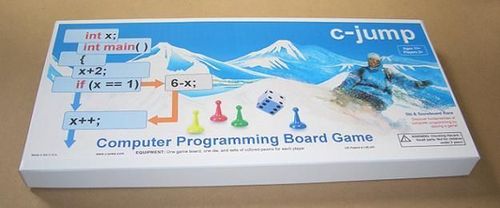
c-jump Computer Programming Board Game
c-jump Computer Programming Board Game Rulebook
Table of Contents
Table of Contents
Setup
Skiers and snowboarders line up at the start location and race along the ski trails, accordingly to each player's roll of die and board rules.
Spaces on the board are shown as squares. Each square has a statement of a rule, borrowed from programming language. Semicolons ";" separate rules from each other.
Keyword int creates integer variable x . In the game, x represents number rolled on the die. For example, if player rolls 5, then x becomes equal to 5. From this location, skiers move downhill accordingly to the number rolled on the die.
main is a name of the blue ski trail on the board. All computer programs have function named "main". Functions define computer operations. The skier can move downhill number of steps rolled on the die.
Opening brace "{" indicates beginning of a ski trail. Closing brace "}" ends the trail. The braces require no special calculation, and can be counted as free landing space.
Playing the Game
Player rolls the die and moves one of his/her skiers, counting off the number of squares. The game can be played with one or more skiers for each player. With multiple skiers of the same color on the board, players may choose any of their skiers to move.
Arithmetics
Before the move, if skier starts at a space with an arithmetic statement, players should calculate the number of steps by replacing "x" with the number rolled on the die. For example,
x+2 means "add 2 to x". The player must replace "x" with the number rolled on the die and add 2. If the player rolls 5, then number of steps becomes 7: 2 + 5 = 7.
Same rule applies to other statements with arithmetic expressions:
6-x means "subtract x from 6". 2*x means "2 times x". x+x means "x plus x".
x/x means "x divided by x". A number divided by itself equals one. Therefore, the player always gets to move one space from this location.
Increment x++
x++ means "increment x by one". The player should add one to the number rolled on the die. For example, if the number rolled is 4, the resulting number of steps is 5: 4 + 1 = 5:
Decrement x--
x-- means "decrement x by one". The player should subtract one from the number rolled on the die. If the number rolled is one, it becomes 0: 1 - 1 = 0.
If the player rolls 1, the skier cannot move on that turn.
Keyword if
if (x == 1) means "if x is equal to one". A double equals sign "==" compares two numbers for equality. The condition "(x == 1)" is true when the number rolled on the die equals one. In all other cases this condition is false.
When this condition is true, the skier enters orange ski trail on the right side of if. After entering the if pathway, the player is awarded a free roll and can only move the same skier, when playing with more than one piece per player.
When this condition is false, the skier must continue downhill, following the blue trail.
Similar rules apply to all other if statements on the board:
if (x > 1) means "if x is greater than one," which is true for 2, 3, 4, 5, 6 and false for 1. if (x < 5) means "if x is less than five," which is true for 1, 2, 3, 4 and false for 5 and 6.
Keyword else
The else keyword indicates a pathway that should be followed when condition of the previous if statement was false. From this location, a skier moves accordingly to the number rolled on the die.
while loop
while (x < 4) means "while x is less than 4". Keyword while tests the condition the same way if does. An orange arrow at the end of the while pathway points back to the "while" space, allowing skier to make a loop.
When condition "(x < 4)" is true, the skier enters the "while" pathway, counting off number of steps accordingly to the number rolled on the die. The player is then awarded one free roll and should move the same skier again.
When the condition is false, the skier must continue downhill along the blue trail.
The same rule applies to other while statements on the board. For example,
while (x > 0) means "while x is greater than zero". Since any number on the die is greater then zero, this pathway must always be entered by skiers starting at this location.
When exiting from any loop, skiers should continue downhill, following the blue ski trail.
Keyword goto
Keyword goto points skiers to the square labeled "jump:"
jump is a label that gives a name to a particular location on the board. Labels allow goto statements to point to various places in a computer program. From both of these locations, a skier moves accordingly to the number rolled on the die.
The switch
Starting at the switch statement location, skiers move to one of its labels. If number rolled on the die is 1, 2, or 3, the skier should move to the square labeled case 1:, case 2:, or case 3:, respectively. The player is awarded one free roll and moves the same skier again.
If the player rolls 4, 5, or 6, the skier follows the default pathway.
Keyword break
keyword break creates an exit from a loop or a switch. From this location, a skier moves the number of spaces rolled on the die.
Keyword continue
Keyword continue forces the skier back to while. The skier moves accordingly to the number rolled on the die. If there is more than one step in the move, the skier exits the loop and follows the blue trail.
Keyword return
return statement returns skiers back to the ski base. Regardless of a number rolled, the skier moves past the finish line.
Finishing the Game
To complete their goal, skiers must cross the finish line by exact number of steps, counting finish location as a square. If the number of steps is too big, the player must choose another skier, or skips the turn.
First player to move all skiers past the finish line is the winner!