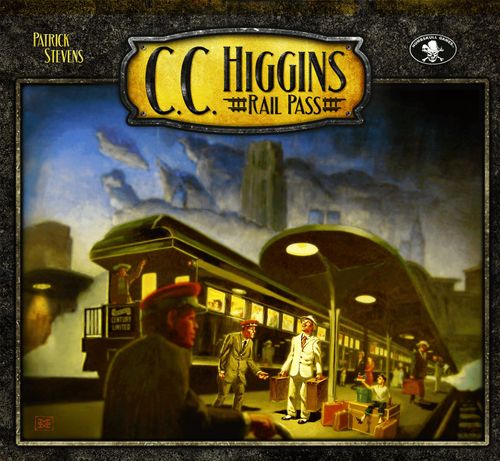
C. C. Higgins Rail Pass
C. C. Higgins Rail Pass Rulebook
Table of Contents
Table of Contents
Overview
C. C. Higgins Rail Pass is a railway game that lets you relive the same enthusiasm felt by the railroad executives during the spring of rail transport. Collect sets of train tickets running over the tracks of authentic United States railway companies of 1920.
Objective
The goal of the game is to earn points by reaching various localities and obtaining the most valuable Train Tickets. The tickets are divided into distinct sets by color, affiliation and type of railway. Whoever has the majority in a series receives additional points, and a further bonus is awarded to whoever completes the set.
Set Up
Choose a banker who will take care of the money and the Pass Cards.
Give $50 to each player.
Place the Train Tickets on the table, face up and divided by color.
Each player chooses a locomotive to place on the Chicago space and takes the Pay card of the corresponding color.
Players then place a Pay marker on each city indicated on their card:
- With 2, 3 or 4 players, all six cities are used.
- With 5 players, the first five cities are used.
- With 6 players, the first four cities are used.
Turn Order
Starting with a player of choice and proceeding clockwise, players move their train and obtain a Train Ticket.
Movement
On the first turn of the game, the first player may move the train to a single city at a distance of one from Chicago. In each of the following three turns, players may travel one more track segment than in the previous turn, until the maximum reachable limit is four for everyone.
Moving is never mandatory, and you must pay $1 for each track segment traveled, unless you are using a free move from a Train Ticket.
- With a Pass card (express), its holder may move one additional segment (see Pass Cards).
- When making a move, players may cover any distance along the railway, up to arriving at a city, freely choosing the direction to take at the switches.
- Ferries allow normal movement, on a par with railways.
- Trains do not block the movement of other players, and more than one train may stop in the same city.
- Train Tickets provide free moves in the turn following the one in which they are obtained: the number of moves indicated on them requires no payment.
Train Ticket, Front
Labels on the example card:
- Railway logo
- Colour (red, white, blue)
- Type of railway, colour and affiliation icon (Shortline), (Union Pacific)
- Affiliation
- Name, with indication of the railway type (Shortline)
- Number of free moves
The example card shows: year 1920, number 1427, affiliation "Union Pacific System", name "Oregon Short Line", "PASS" to "Mr. C.C. Higgins, Superintendent Motive Power, St. L.S.F. Ry., Springfield, Mo.", "Between all stations until December 31st 1920", "Valid only when countersigned by J.S. Sykes, President", and the number of free moves "2".
Expenses
Each turn represents a working day of a railway executive (amministratore delegato).
- Each track segment traveled costs $1.
- Food costs $2 per day.
- Lodging costs $2 per day.
- Telegraphing the head office costs $1.
If a player decides not to move, they must still pay for food, lodging and the telegraph. Expenses are paid after the movement and before receiving pay. There may be no exchange of money between players.
Obtaining Train Tickets
After moving (or after choosing to stay put) and paying expenses, the active player may obtain a Train Ticket by placing a Pay marker (dischetto) on the city logo and taking the corresponding card. The marker shows the other players that the card is no longer available.
Running Out of Money
If a player cannot cover their expenses, they must discard all remaining money and cannot obtain a Train Ticket. They may continue to move, but will not obtain tickets until the turn in which they are able to pay the expenses.
Pay
If a player ends the turn on one of their Pay markers, they remove it from the board and receive $50 from the bank.
The first player to reach their final destination ends the game (see End of Game).
Pass Cards
Pass cards (Carte Abbonamento) may be bought at any time during your turn, by paying the cost shown on them. Their bonus begins to apply in the same turn in which they are bought.
Some cards have an effect only east or west of the Mississippi (extended in this game to Canada). In that case, the position reached by the train at the end of the turn must be taken into account.
Pass cards cannot be exchanged.
Example Pass cards shown in the rulebook include the Private Railroad Car, the Western Union Telegraph Company card, the Pullman card, the Harvey Eating Houses "Free Meals" card, and the Dining Car card. The Dining Car card is labelled "Effect" (Company discount, free meals, good anywhere) and "Cost" ($45); the Harvey Eating Houses card is labelled with a cost of $25 and the note "Not good with express".
End of Game
When a player reaches their final destination, they obtain one of the Train Tickets still available and the current round is completed. The game also ends if all the tickets run out.
Scoring
At the end of the game, points are counted, keeping track of the different sets on the scoring table. Players score points for each Train Ticket:
- Three points per Ticket, if the set is complete.
- Two points per Ticket, if the player has more Tickets of that set than any other player.
- Otherwise, one point per Ticket.
A Ticket may score from one to three times, because it can belong to up to three different sets:
- Colour
- Type of railway ("Central", "Shortline")
- Affiliation ("Queen and Crescent", "Grand Trunk System")
Category Icons
Every logo on the board is accompanied by a symbol showing the set it belongs to. The colour of the square corresponds to that of the set, and each line of text indicates a distinct category. Sometimes the text indicates the type, other times the affiliation.
Affiliations
- Union Pacific System
- Southern Pacific System
- A. T. & S. F. System
- Pennsylvania System
- Queen & Crescent Route
- D. & R. G. W. System
- New York Central System
- Illinois Central System
- Flagler System
- Missouri Pacific Lines
- Ferrocarriles Nacionales
- Grand Trunk System
- K. C. M. & O. System
Types
- E: Electric Railroad
- C: Central Railroad
- S: Short Line Railroad
- COG: COG Railroad (mountain)
- SC: Scenic Railroad
- N: Narrow Gauge
- B: Belt Line Railroad
- T: Terminal Railroad
Counting Categories
The amount of text gives a first indication of the value of the Tickets:
- If there is no text, the Ticket scores points only once.
- If there is one line of text, it is counted twice.
- If there are two lines of text, it counts for three sets.
Examples:
- A Ticket marked with the Pennsylvania System icon and the "C" (Central) icon counts once for the maroon set, once for the Central set, and once for the Pennsylvania System set.
- The Northwestern Pacific Railroad was jointly owned by the A. T. & S. F. and the Southern Pacific, so its card scores for both affiliations.
Concessions
All information contained in the game is in the public domain, including the money and the Tickets.
Variants
Short Version
Money can be avoided by eliminating expenses and Pass cards. Players may travel up to four track segments per turn and receive a Ticket.
Long Version
Ignore the free moves shown on the front of the Tickets and use instead the map on the back, which shows in which cities it is possible to move without paying.
- The maps have a larger dot indicating the city where the Ticket is acquired.
- North is up, unless otherwise indicated.
- All the track segments depicted on all Tickets owned may be traveled without expense.
Historical Notes
Charles C. Higgins learned his trade at the Chicago, Burlington & Quincy Railroad from 1900. He was general manager of the St. Louis & San Francisco Railroad from 1916 to 1920. He died in 1920 while sleeping in his private car, struck by another train.