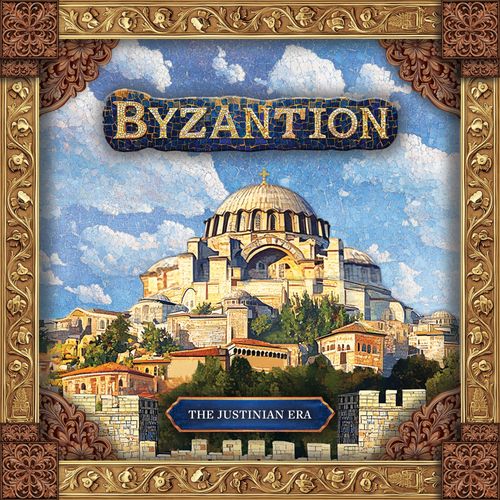
Byzantion: The Justinian Era
Byzantion: The Justinian Era Rulebook
Table of Contents
Table of Contents
Historical Names
In Byzantion we use a few words from antiquity. This paragraph details the use of these words, how they are pronounced and their meaning in the game.
- Auctoritas (aou-kto-ritas) derived from the Latin word for authority, in the game is a type of Resource.
- Civicus (kee-vee-cuss) derived from the Latin word for Citizens refers to civilian matters and civil order, in the game is a type of Resource.
- Demoi (dee-mee) are the four factions in the game. The word is used interchangeably with Players or Player.
- Diptych (deep-tikh) originaly a two-paneled altarpiece, it is used to track the game's Rounds.
- Doxa (doh–khsa) means glory, and the word is used for Victory Points.
- Dynamis (dee-nah-mees) means power. It refers to the action points of the game, the Dynamis Chips.
- Ecclesiastical (ek-lee-see-ash-tee-kal) derived from the Greek word for Church, in the game is a type of Empire Card.
- Emporion (emb-or-eeh-on) derived from the Greek word for trade, in the game is a type of Empire Card.
- Fides (fee-thes) derived from the Latin word for faith, in the game is a type of Resource.
- Frumentum (fru-ment-um) derived from the Latin word for grain, in the game is a type of Resource.
- Keimelion (kee-mee-lee-on) is a sacred relic and in the game represents one of the four items Players gain after choosing their Initiative.
Components
Printed component list (pages 5 to 7). Metal coin sets are listed on page 5; cardboard coin sets on page 6.
- 1 x Two Piece Box
- 1 x Neoprene Mat
- 1 x Chronicles of the Purple Throne History Book (40 pages)
- 1 x The Last Strategos: War and Treachery in Justinian's Empire (40 pages)
- 12 x Gold Coins (metal)
- 16 x Silver Coins (metal)
- 20 x Copper Coins (metal)
- 1 x Coin Pouch
- 1 x Rulebook (40 pages)
- (2 x 4) x Demoi Seals
- 4 x Keimelion
- 1 x Imperial Ring
- 1 x Diptych
- 40 x Ivory Caskets
- 40 x Empire Intrigue Cards
- 100 x Empire Cards
- 1 x Solo Reference Card
- 4 x Reference Card
- 4 x Keimelion Aid Card
- 25 x Quest Cards
- 30 x Event Cards
- 30 x Solo Event Cards
- 20 x Auctoritas
- 20 x Virtus
- 12 x Gold Coins (cardboard)
- 16 x Silver Coins (cardboard)
- 20 x Copper Coins (cardboard)
- 20 x Civicus
Goal of the Game
Byzantion is a competitive engine-building game in which players control the four Demoi of the Byzantine Empire. The Demoi are powerful factions of the Hippodrome holding political influence, each striving to gather the most Doxa (glory), represented by the Quadrigas racing along the Doxa Track around the board. Most Doxa is awarded to players who contribute resources to events, emerge victorious in those events, and complete their quest cards at the end of the game.
Game Overview
At the start of each Round, players begin by influencing the Emperor to select one of the two Event Options using their Auctoritas Resource. Next, players use their Actions to draft Cards with their Auctoritas, play them using Nomisma, and gather Resources, which they then contribute to complete the Event and potentially earn more Doxa than their rivals. Nomisma are not considered a Resource. Resources are: Auctoritas, Civicus, Virtus, Fides, Lapis, Lignum and Frumentum.
Bronze Coins represent 1 Nomisma, Silver Coins represent 5 Nomisma, and Gold Coins represent 10 Nomisma.
Most Doxa is awarded to Players who contribute Resources on Events, emerge Victorious in those Events, and complete their Quest Cards. The game is played in Rounds, and each round consists of three Phases:
- Event Phase – Starting with the player holding the Imperial Ring, players select their Initiative in clockwise order, gain their respective Keimelion, and place their Auctoritas vote on an Event Option.
- Action Phase – Players use their Dynamis chips (action points) to draw cards, play them, organize them into piles called Bandons, activate these Bandons to gain resources, and use the Market to buy and sell Resources.
- Resolve Phase – Players secretly bid the Resources that the selected Event requires, gain Doxa for each Resource contributed, and check if the total Resources Fulfill the Event's requirements to resolve either the Victorious or Defeated outcome. Then the Imperial Ring passes to the next Player, the Diptych slides down to the next event, and a new round begins.
Event Card
Setting Up the Events
Event Cards are divided into three chronological eras: Age I, Age II, and Age III. The Age is indicated on the back of each Event Card.
When setting up the game, decide on the Game Length.
Game Length Options:
- Standard Game: Select 6 Events (one from Age I, two from Age II and three from Age III) for a game of 6 Rounds.
- Marathon Game: Select 9 Events (three from each Age) for a game of 9 Rounds.
Shuffle the Event Cards and randomly select 2 or 3 Cards depending on the chosen Game Length -> Shuffle the Event cards into decks according to their Age, then randomly draw the corresponding number of Cards from each deck based on the chosen Game Length..
Place the Diptych to the left of the first Event. The game proceeds in Rounds, facing one Event per Round. After each Round, move the Diptych down so it is always to the left of the current Event.
Event Card Elements
The Event Card includes the following elements:
- Illustration of the Event
- Name of the Event
- Date of the Event
- Lore of the Event
- Territories for Miniatures to be placed
- Reward for the Victorious (highest Contributor) if the Event is Fulfilled
- Consequences for the Defeated (lowest Contributor) if the Event is Canceled
- Slot for Auctoritas placement for Option 1
- Name of Option 1
- Units placed if Option 1 is selected and the Event is Fulfilled
- Resources required to Fulfill the Event
Trial Events
Some Events do not offer two choices like other Events. Instead, they include an extra step after being Fulfilled. For full details on these Events, see page 26.
Empire Card
Setting up the Empire Cards
When setting up the game, and after Players have selected three Quest Cards to keep, each Player receives 9 random Empire Cards in their Hand.
- Each Player selects one Card to keep and passes the remaining Cards to the next Player in clockwise order.
- Repeat this process until each Player has 3 Cards remaining in their Hand and has selected 6 Cards to keep.
- Shuffle the remaining Cards from all Players together and place them face up in the Discard Pile.
- Each Player begins the game with the 6 Cards they selected.
How to use an Empire Card
During the course of the game you will play Empire cards from your hand to your play area by paying their cost in Nomisma.
Types of Empire Cards
A Card with two Type icons is considered to have both Types for any ruling that requires it.
The Empire Card types are: Palatine, Ecclesiastical, Stratiotika, Emporion, and Rustica.
Hero and Non-Hero Cards
An Empire Card is either a Hero Card or a non-Hero Card.
A Hero Card is identified by the number of laurel pairs on its Type icon:
- No laurel: Not a Hero Card.
- Laurels present: Hero Card of Level 1, 2, or 3.
Hero Cards have a Passive Ability that is triggered whenever its condition occurs. Non-Hero Cards have an Instant Ability that is resolved only once, immediately when the Card is Played. Hero Cards may also form Bandons (see page 20). All Hero and Non-Hero Card Abilities are optional to use.
The Empire Card includes the following elements:
- Illustration of the Empire Card
- Name of the Empire Card
- Cost to Play the Card
- Primary Type of Card
- Secondary Type of Card
- Primary Hero Level
- Secondary Hero Level
- Resources the Card Produces
- Text for Passive Ability (Hero Card) or Instant Ability (non-Hero Card)
Empire Intrigue Card
There is a special kind of Empire Cards, the Intrigue Cards. You can identify these cards because they do not have any Produce Icons. Intrigue Cards are played normally in the player area and remain there as they might be used by other cards. However their most important use is for their Instant ability which usually is powerful.
The three bullets below appear unlabelled in the right-hand column of page 11, above the Quest Card heading; they complete the sentence about when Intrigue Cards may be played.
- During the Bidding of a Trial Event.
- After the End of the Game before calculating the Doxa from Components, Cards and Quest Cards.
- During your Action.
The most important difference of Intrigue cards are that while all other Empire Cards require the Play Card Action and a Dynamis to be used, the Intrigue Cards may be played at any time even while it is not your Turn and do not require an Action to be played. Intrigue Cards are designed to be played during specific times. When using an Intrigue Card to cancel another Player's Action, you must play it immediately after the other Player declares their Action and before they begin Playing Cards, consuming Resources, or selecting Players for their Action. Moreover, you can use an Intrigue Card that Cancels other Cards to Cancel any other Intrigue Card, even one that also Cancels other Cards.
Examples:
There are Intrigue Cards that must be used:
- When you are Defeated or Victorious on an Event.
- In response of another Player's Intrigue Card in order to cancel it.
- During the Event Phase while using their Auctoritas to Influence the Emperor.
- While another Player is attempting an Action in order to cancel that Action.
Quest Card
When receiving Quests, choose 5 Quests Cards to keep and Discard 1. At the end of Age II, Discard 1 more Quest Card so you remain with 3 Quests Cards total. These Cards remain secret and are only Revealed at the end of the game to provide bonus Doxa. These hidden victory points can overturn the presumed winner and strongly influence strategic decisions throughout the game.
The Quest Card includes the following elements:
- Illustration of the Quest Card
- Name of the Quest Card
- Card ID
- The Quest, which defines how much Doxa a Player may Gain and under what conditions
Example: The Keeper of Schemes Card states: "If you have played the most Empire Intrigue Cards, Gain 5 Doxa."
A Player who keeps this Card will aim to play many Intrigue Cards and monitor how many Intrigue Cards others play to ensure they have the most by the end of the game.
Game Setup
The numbered items below follow the setup diagram on pages 12 and 13.
- Round Counter. Place the Diptych at the first (I) position.
- Three Spaces for you to place three random Age I Events.
- Three Spaces for you to place three random Age II Events.
- Three Spaces for you to place three random Age III Events.
- Doxa Track – Place your Quadriga here. The Player with the Imperial Ring places their Quadriga on number 5, and then, in clockwise order, the other Players place their Quadriga on numbers 6, 7, and 8.
- The four Player areas. Place your starting Resources, Dynamis Chips, and Demoi Seal here. Players start with 2 Auctoritas, and 5 Nomisma. Also, during the game, you will place all Empire Cards and Keimelion in this area. Players gain an amount of Dynamis Chips according to their Player count:
- 4 Players: 4 Dynamis
- 3 Players: 5 Dynamis
- 2 Players: 6 Dynamis
- The Byzantine Empire: This area is divided into six territories. All territories start empty and will hold the miniatures of all Fulfilled Events.
- The Initiative Track. See Page 14.
- The Market: Randomly place one of each Resource in the first seven slots.
- The Deck: Shuffle all Empire Cards, including the Intrigue Cards and place them face down. Then each Player Draws 9 Cards to begin Drafting. See Page 8.
The Imperial Ring
The Imperial Ring acts as the First Player token. At the end of each Round, pass the Imperial Ring to the next Player in clockwise order. The Imperial Ring determines the order in which Players place their Demoi Seals on the Initiative Track during the Event Phase.
Starting the Game
- The Imperial Ring is offered to the Player who most recently visited a museum.
- If no Player qualifies, give it to the Player who last read a historical book.
- If still tied, give it to the Player who last watched a historical documentary.
- If no one qualifies, you should not be really playing board games. Take a break and watch a historical documentary together! You have so many things to discover, and history has so many amazing things to teach us… The Imperial Ring goes to the first person to sit on the couch.
Rounds, Phases, and Turns
Rounds
The game is played over a series of Rounds equal to the number of Events. In each Round, the four Demoi work to Fulfill the current Event and prepare for future Events.
Game Length Options:
- Standard Game: Select 6 Events (one from Age I, two from Age II and three from Age III) for a game of 6 Rounds.
- Marathon Game: Select 9 Events (three from each Age) for a game of 9 Rounds.
The Three Phases
Every Round is divided into three distinct Phases.
Each Round consists of three Phases:
- Event Phase
- Action Phase
- Resolve Phase
Event Phase: The Demoi determine their Initiative Order for the Round and attempt to Influence the Emperor's choice of Event Options.
Action Phase: The Demoi take Turns to gather the Resources needed to Fulfill the chosen Event Option and strengthen their position for future Events.
Resolve Phase: The Demoi contribute toward the current Event and Gain Doxa for their efforts. Depending on the outcome, the Victorious or Defeated result is applied.
Taking Turns on the Action Phase
During the Action Phase, the Demoi take Turns performing various Actions to gather the Resources needed to Fulfill the current Event and strengthen their position for future Events.
Event Phase
Initiative Order
At the beginning of each Round, the Initiative Order must be determined. This order defines:
- The sequence in which the Demoi will attempt to Influence the Emperor during the Event Phase.
- The order in which Players will take Actions during the Action Phase.
Initiative Track
The Initiative Track has four positions labeled I, II, III, IV.
- Players place their Demoi Seals on any available position.
- All four positions remain available even in games with fewer than four Players.
Starting with the Player holding the Imperial Ring, Players place their Demoi Seals in any unoccupied position on the Initiative Track in clockwise order.
When a Player places their Demoi Seal in one of the available positions, they also receive the loot indicated by the Ivory Casket. This usually includes a Resource and some Nomisma. Occasionally, rare Ivory Caskets may grant an extra Dynamis, but only for that Round.
Choosing a Position
When selecting a position, consider three factors:
- Position
- Playing early is an advantage during the Action Phase because you can select Cards from the Offer or Resources from the Market before others.
- During the Event Phase, playing early is a disadvantage because your motives may be revealed early. It is always better to act later in the Event Phase.
- Ivory Caskets
- Each position reveals an Ivory Casket, which may contain valuable Resources you need.
- Keimelion
- Each position grants access to a unique Keimelion, offering a powerful ability for the Round. Choosing the right ability can be critical.
Ivory Caskets
At the beginning of each Round, remove the Ivory Caskets from the previous Round. Then place one Ivory Casket face down at random in each position. After placement, flip them to reveal their loot.
Do not remove the Ivory Casket after claiming its loot. Certain Card abilities may allow you to take this loot multiple times.
Keimelion
There are four Keimelion available, and the one you receive depends on the position where you place your Demoi Seal. Each Keimelion grants a unique ability for the Round.
Position I: Labaron – The Player holding the Labaron gains 1 extra Dynamis for this Round.
Position II: Chalice – The Player holding the Chalice gains a bonus based on the type of the current Event:
- If the Event is a Trial Event, see Page 26, and is Fulfilled, they gain 2 Resources of the type used for the Trial. These Resources must be used in the Trial or discarded.
- If the Event is not a Trial, they receive 2 Auctoritas that must be used during the Event Phase when Influencing the Emperor or are discarded.
Position III: Scepter – The Player holding the Scepter acts as the tiebreaker for all ties this Round. They decide the winner in any tie, such as when Influencing the Emperor, determining the highest or lowest Contributor, or resolving a Trial Event. If no one holds the Scepter this Round, this role goes to the Player holding the Imperial Ring for the Round.
Position IV: Robes – The Player holding the Robes gains double the Victorious Reward if they contributed the most Resources in an Event or suffers no Consequences if they are the lowest contributor, Defeated, in a cancelled Event.
Influencing the Emperor
When an Event offers a Choice, the Emperor must decide which of the two Options will be enacted. For example:
Should we shut down the Neoplatonic Academy in Athens, ending pagan philosophy and enforcing Christian dominance, or allow it to remain open?
Historically, in 529 AD, the Academy was closed by Justinian's decision. However, in this game, you have the power to rewrite history. You can Influence the Emperor to preserve Hellenic thought instead of silencing the Philosophers.
The Demoi will usually Influence the Emperor based on their motives.
- Option 1: Silencing the Philosophers requires 3 Fides.
- Option 2: Preserving Hellenic thought requires 2 Civicus and 1 Frumentum.
If a Player has invested in Fides Resources, they may prefer Option 1 to use what they have. At the same time, each Demoi is motivated by hidden Quest Cards. For example the Event's two Options are:
- Option 1 places 1 Priest and 1 Monk
- Option 2 places 1 Senator and 1 Merchant
A Player with a Quest Card granting extra Doxa for Ecclesiastical Units (such as Priest and Monk) would strongly favor Option 1.
Placing Auctoritas
Following the Initiative Order, the first Player may place any amount of Auctoritas on one of the two Options. Then the second Player continues, and so on, until all Players have placed their Auctoritas.
The Player who places the most Auctoritas when Influencing the Emperor receives 2 Doxa. If more than one Player is tied for first place, all tied Players receive 1 Doxa.
Once placed, Auctoritas cannot be changed or adjusted except by Intrigue Cards. When all Players have placed their Auctoritas the Option with the higher total wins. All Players must then gather the Resources required to Fulfill that Option during the Round.
Playing later in the Initiative Order is advantageous when Influencing the Emperor because you can see how much Auctoritas is already invested and decide whether to commit more or none at all if your preferred Option is already winning.
In case of a tie, the Player holding the Scepter resolves it. If no Player holds the Scepter this Round, the Holder of the Imperial Ring acts as the tiebreaker.
Page 17 illustrates the placement with an example: the First Player places 2 Auctoritas on Option 2, and the Second Player places 3 Auctoritas on Option 1.
Action Phase
Consume Dynamis
During the Action Phase, Players take Turns. On their Turn, a Player spends one Dynamis to perform one of six possible Actions. When all of a Player's Dynamis are consumed, they cannot take any more Actions and must pass. Play continues until no Player can perform an Action. Then, all used Dynamis are returned to each Player, and the next Phase begins.
The Six Actions
The six possible Actions a Player may perform are:
- Draw Cards
- Play Cards
- Activate a Bandon
- Sell Resources
- Buy Resources
- Reset the Market
A Player may perform any number of these Actions, in any order, as many times as they are able.
Discarding Cards
At any time during their Action, a Player may Discard any number of Cards from their hand into the Discard Pile, in any order. For each Card Discarded, the Player Gains 1 Auctoritas and 2 Nomisma. This does not count as an Action and does not require a Dynamis to be consumed.
Action: Draw Cards
To perform the Draw Action, place one of your Dynamis next to the Deck of Empire Cards. You then have three options:
- Pay 1 Auctoritas and Draw 2 Cards from the Deck.
- Pay 2 Auctoritas and Draw 1 Card from the Deck and 1 Card from the face-up Offer.
- Pay 3 Auctoritas and Draw 1 Card from the Deck and the topmost Card from the Discard Pile.
If a Card is Drawn from the Offer, immediately Draw a Card from the Deck and place it face-up in the empty position in the Offer. When the Deck of Empire Cards runs out of Cards, shuffle the Discard Pile to create a new Deck of Empire Cards.
Illustration caption (page 19): A Player pays 2 Auctoritas. They then Draw 1 Card from the Deck and 1 Card from the face-up Offer.
Action: Play Cards
To perform the Play Cards Action, place one of your Dynamis in your Player Area. You may then place any number of Cards from your hand face-up in your Player Area.
To Play these Cards, you must pay their cost in Nomisma. You may Play as many Cards as you want, as long as you have enough Nomisma to pay for all of them.
If you already have a Hero Card in Play that shares the same type as the Card being Played, you pay less Nomisma based on the Hero's Level:
- Level 3 Hero: Pay 3 Nomisma less
- Level 2 Hero: Pay 2 Nomisma less
- Level 1 Hero: Pay 1 Nomisma less
This discount applies to any number of Cards you Play, including other Heroes. Multiple Heroes do not stack; only the highest Level Hero provides the discount. A Hero Card that Offers a Discount to two types of Cards will Offer both Discounts to a Card that is of both types.
Hero Cards have a Passive ability, while all other Empire Cards have an Instant ability. When you Play a non-Hero Card, resolve its Instant ability immediately. If you Play multiple non-Hero Cards, resolve the Instant ability of each Card before Playing the next one.
With the "Play Cards" Action, you can play any number of Cards. The passive abilities of Heroes are immediately active when played and may affect Cards played on the same turn.
Hero Cards also give discounts immediately, even on other Cards played the same turn.
After all Cards are played, you then resolve the instant abilities of those Cards, one by one in an order of your choice.
Example: You must pay 9 Nomisma to Play Belisarius who is a Level 3 Hero on Stratiotika Cards and Level 2 Hero on Palatine Cards. You need to pay 5-3=2 Nomisma to pay for Military Secretary and Head of Fortifications and 5-2=3 Nomisma to pay for Commissioner of Food Supply since it is a Palatine Card and its discount is from the Level 2 Hero.
Form Bandons
After completing the Play Cards Action and resolving all Instant effects, you may form Bandons.
Forming a Bandon: Whenever you perform the Play Cards Action, you may Rearrange all Cards in your Player Area to form any Bandon you want. This means you can:
- Change the Hero Card in a Bandon
- Disband an existing Bandon
- Combine Cards from outside a Bandon with Cards from an existing Bandon to create a new one.
What is a Bandon? A Bandon is a set of Cards arranged with a Hero Card in front and up to a number of Cards behind it equal to the Hero's Level. These Cards must share the same type as the Hero. If the Hero has two types, the Bandon may include Cards from both types. Arrange the Bandon so all Produce Icons are aligned.
Example: Belisarius is a Hero Card with Stratiotika (Level 3) and Palatine (Level 2). He can form a Bandon with up to 3 Stratiotika Cards and 2 Palatine Cards.
In this example, Belisarius forms a Bandon with 2 Stratiotika Cards and 1 Palatine Card, for a total of 4 Cards. Belisarius is now considered both a Stratiotika and Palatine Bandon because it includes Cards of both types.
Abilities in a Bandon:
- Only the Passive ability of the Hero Card remains visible and usable.
- Instant abilities of other Cards have already been resolved and are no longer active.
- The Hero's Passive ability can be triggered at any time.
Multiple Heroes: You may place other Hero Cards under the first Hero Card in a Bandon. However, their Passive abilities are no longer visible and cannot be triggered. Only the top Hero's Passive ability applies.
Restriction: You may not use any Card or Bandon that has a Dynamis on top of it. Dynamis are placed on Cards or Bandons when Activating them (explained in the next Action).
Any Card or Bandon that has already been Activated this Round cannot be used to form a new Bandon or be removed from an existing one.
Action: Activate a Card or Bandon
To perform the Activate Card or Bandon Action, place one of your Dynamis on top of the chosen Card or Bandon. You may Activate exactly one Card or one Bandon this way.
When Activating a Card: The Card Produces the Resources shown by its Produce Icons.
When Activating a Bandon: All Cards in that Bandon Produce the Resources indicated by their Produce Icons.
Example: The Belisarius Bandon, when Activated, Produces:
- 3 Virtus
- 2 Civicus
- 1 Lapis
- 1 Frumentum
- 1 Nomisma
Activation Rules:
- A Card or Bandon may be Activated only once per Round using a Dynamis.
- A Card or Bandon can only have one Dynamis on top of it.
- Some abilities allow you to Activate a Card or Bandon without using a Dynamis. In that case, you may Activate a Card or Bandon that already has a Dynamis on it or Activate it for the first time without marking it with a Dynamis.
Action: Sell Resources
To perform the Sell Resources Action, place one of your Dynamis next to the Market Area. You may sell as many Resources as you are able.
The Market
The Market consists of up to seven different Resources placed in Market positions. There are two ways to sell Resources and you may perform both during your Sell Resources Action:
Option 1: Fill Missing Resources – Identify which Resources are missing from the Market. Place them in the leftmost empty position and Gain the indicated amount of Nomisma for each position.
Example: If the Market is missing Lapis and Civicus, you may:
- Place one Resource in the position marked 7 Nomisma and Gain that amount.
- Alternatively, place both Resources: one in the 7 Nomisma position and the other in the 8 Nomisma position, for a total of 15 Nomisma.
Option 2: Duplicate the First Resource – You may sell one Resource that matches the first Resource in the Market by placing it in the leftmost empty position and Gain that amount of Nomisma. You may only do this once per Action.
Example: If the first Resource in the Market is Lignum, you may place a Lignum in the position marked 9 Nomisma and Gain that amount.
After Selling: When you duplicate the first Resource, remove that first Resource from the Market. Then slide all other Resources one position toward the lesser Nomisma value.
Example: After sliding, the empty position will now be the one marked 9 Nomisma.
Action: Buy Resources
To perform the Buy Resources Action, place one of your Dynamis next to the Market Area. You may buy as many Resources as you are able.
How to Buy: Select the Resources you want from the Market. You may buy any number of Resources, but you must pay the Nomisma indicated by their position.
Example: A Player wants to buy 1 Civicus from the position marked 3 Nomisma and 1 Lapis from the position marked 6 Nomisma. They pay a total of 9 Nomisma.
After Buying: Slide all remaining Resources toward the lowest Nomisma value so that empty spaces are filled. The highest-value positions should remain empty.
Action: Reset the Market
To perform the Reset the Market Action, place one of your Dynamis next to the Market Area.
Steps:
- Remove all Resources currently in the Market.
- Take one of each Resource and place them randomly in the Market positions, leaving only the position marked 9 Nomisma empty.
Reward: For resetting the Market, you may immediately Draw one Card from the Deck.
Resolve Phase
Contributing Resources
By the end of the Action Phase, all Demoi have gathered as many Resources as possible and are ready to Contribute to the Event.
Each Player secretly places in their closed palm the Resources they wish to Contribute toward completing the Event. They may Contribute all required Resources, some, or none. Some Events may require you to Contribute some Nomisma as well as Resources.
Players cannot Contribute more of any Resource type than the Event requires.
Example: If an Event requires 2 Civicus and 1 Frumentum, a Player may Contribute 2 or 1 or none Civicus and 1 or none Frumentum. They cannot Contribute more than 2 Civicus or more than 1 Frumentum.
Once all Players are ready, everyone simultaneously reveals their hands. Then each Player Gains 1 Doxa for each Resource they Contributed. Progress your Quadriga along the Doxa Track to reflect the Doxa you have Gained.
Fulfilling an Event
As soon as all Contributions are Revealed and Players have gained Doxa for every Resource they Contributed, check if the Event was Fulfilled or Canceled.
Add all Resources together and compare them to the Event requirements. If the Resources meet the Event requirements, the Event is Fulfilled. If even one required Resource is missing and the combined Contribution of the Demoi does not supply it, the Event is Canceled. Extra Resources of other types do not affect the result.
Players present their Resources and Nomisma for Fulfillment of an Event in Initiative Order. Abilities that allow you to use a Resource as another must be declared at this point and cannot be changed.
In case of a tie, the Player holding the Scepter resolves it. If no Player holds the Scepter this Round, the Holder of the Imperial Ring acts as the tiebreaker.
Although the Demoi are "expected" to work together for the prosperity of the Empire, it is not uncommon to intentionally sabotage an Event if they know they will not be the least Contributor. Sometimes penalizing another Player is more profitable than gaining the reward yourself. Be cautious of shrewd politics.
If a Player cannot fully pay the Consequences because they lack enough Resources, they lose 1 Doxa for each Resource they cannot pay.
When Contributing Nomisma towards an Event, Gain 1 Doxa for every 2 Nomisma you Contribute.
If you do not have enough Nomisma to pay the Consequences of an Event, Lose 1 Doxa for every 2 Nomisma you cannot pay, rounded down.
Example: In the Event Guardian of the Siege of Rome, the Emperor was influenced to mandate raising the Aurelian Bulwark.
The Demoi must Gather 1 Virtus, 4 Lapis, and 1 Lignum.
If all Players combined have less than 4 Lapis or are missing either Virtus or Lignum, the Event is Canceled. If all 6 Resources are Contributed, the Event is Fulfilled.
If the Event is Fulfilled, the Player who Contributed the most Resources is the Victorious and gains the bonus indicated by the Event (in this example, 8 Auctoritas).
If the Event is Canceled, the Player who Contributed the least Resources is the Defeated and suffers the Consequences indicated by the Event (in this example, 9 Nomisma).
Placing Units
If the Event is Fulfilled, the Player who Contributed the most Resources—the Victorious—places the Units on the Board. The Event specifies exactly which Units should be placed and in which Area.
Example: In the Eternal Peace Treaty Event, the Victorious Player will place either 2 Merchants or 1 Siege Tower and 1 Legion in the yellow Area of the Map around the city of «ΔΑΡΑ». While the Prototype Map and Cards display city names in Byzantine writing, after valuable feedback from our Followers, the final game will feature the name of the AREA in English on both the Map and Cards for simplicity of play.
Trial Events
A special type of Event is the Trial Event. These Events do not offer two different options; the Emperor mandates how the Event will proceed.
In these Events, the Demoi do not invest Auctoritas to influence the Emperor. However, if the Event is successful, and after the highest Contributor has gained their reward for being Victorious, there is an additional stage.
All Players secretly Bid one specific Resource indicated by the Event. Then, in order from highest to lowest Contribution, they Gain extra Doxa.
In case of a tie, the Player holding the Scepter resolves it. If no Player holds the Scepter this Round, the Holder of the Imperial Ring acts as the tiebreaker.
Prepare for the Next Round
At the end of the Resolve Phase, Players prepare for the next Round by completing three tasks:
- Each Player Discards Cards until they have a maximum of 6 Cards in hand. For every Card Discarded, the Player Gains 1 Auctoritas and 2 Nomisma.
- Pass the Imperial Ring to the next Player in clockwise order.
- Move the Diptych to the next Event so it indicates the current Event. If there is no next Event and this was the final Event, proceed to the Achieving Victory chapter on page 28 to determine the winner.
Achieving Victory
Play End of Game Intrigue Cards
Some Intrigue Cards are designed to be played during the scoring phase at the end of the game. These Cards affect units on the board and can change the parameters that Quest Cards use to determine how much Doxa is awarded to Players.
To play these Cards, a Player must have enough Nomisma. If a Player does not have enough Nomisma, the only Action they can perform at this stage is to Discard a Card to Gain 1 Auctoritas and 2 Nomisma until they have enough to play the Card. You can Cancel End-of-Game Intrigue Cards normally with Intrigue Cancel Cards.
Antonina's Passive Ability does not work at the End of the Game.
Example: A Player may have a Quest that offers bonus Doxa for any Unit in Italy. They might have prepared by saving 4 Nomisma, enough to play the Empire Intrigue Card: Pilgrimage. This allows them to move 3 Ecclesiastical Units to Italy from other areas, gaining additional Doxa.
Gain Doxa from Resources and Cards
After all Intrigue Cards have been Played, Players count their remaining Resources and the total cost of Cards Played. At this stage, no more Intrigue Cards can be Played.
The Players with the highest totals gain bonus Doxa. All Players tied for a position (1st, 2nd, or 3rd) receive the displayed amount of Doxa:
Resources:
- 1st place: Gains 3 Doxa
- 2nd place: Gains 2 Doxa
- 3rd place: Gains 1 Doxa
Total Cost of Cards Played:
- 1st place: Gains 6 Doxa
- 2nd place: Gains 4 Doxa
- 3rd place: Gains 2 Doxa
Progress your Quadriga along the Doxa Track to reflect the Doxa you have Gained.
Reveal Quests
At this stage, each Player, in Initiative order, Reveals their hidden Quests. Reminder that no more Intrigue Cards can be Played at this point. For each Quest that a Player meets the requirements for, they Gain the amount of Doxa indicated on the Quest Card.
Example: The Quest Card: Power of Authority states that the Player Gains 2 Doxa for each Palatine unit on the board. If there is an Aqueduct, a Hippodrome, and 3 Senators on the board, the Player Gains 10 Doxa.
Progress your Quadriga along the Doxa Track to reflect the Doxa you have Gained.
Quadriga: First to Triumph
The Player whose Quadriga is furthest on the Doxa Track is the Winner of the game.
In case of a tie, the Player with the most Auctoritas among those tied is the Winner.
If there is still a tie, the Player with the most Nomisma wins.
If the tie remains, the will of the Emperor prevails, and both Players share the title of Winner.
Playing with Taktika
Taktika is the first expansion for Byzantion. It introduces a new layer of strategic depth, expanding the core experience with mechanics that place greater emphasis on the game map and the units. Through systems such as area control and the activation of powerful unit abilities, players gain access to unique tactical options that can decisively shape the course of the game.
This expansion is intended for experienced players. We strongly recommend incorporating Taktika only after becoming thoroughly familiar with the base game of Byzantion, as it significantly increases the game's complexity, length, and strategic demands.
What this Expansion Introduces
The Taktika Expansion introduces a new set of components.
- Patron Cards — These cards are designed to be drafted by the players before the start of the game and provide each player with unique abilities and setup options, making the game completely asymmetrical.
- Age IV Event Cards — The core game of Byzantion includes Events up to Age III. Taktika introduces a new Age featuring more challenging Events that require greater resources and are both highly rewarding and punishing.
- New Empire Cards — New Empire Cards, including Intrigue cards, are introduced to the game. These cards are designed to interact with the new area control mechanics and unit abilities introduced in the expansion.
- New Quest Cards — Secret Quest Cards award additional Doxa at the end of the game and are focused on the new mechanics introduced in this expansion.
- Unit Abilities — Each unit placed on the map has its own unique ability.
- New Components — More Demoi seals and resources are introduced to the game to meet the expansion's requirements for additional components.
All cards introduced in this expansion are marked with a star symbol, allowing you to easily add or remove them when playing with or without the expansion rules.
Now that we have covered what this expansion introduces, we can explore how the new rules of Taktika work.
Patron Cards
Each Patron Card has a unique symbol and name, starting Doxa, and setup instructions. In addition, it features an ability that helps with earning Doxa and another unique ability that alters how you interact with certain gameplay elements.
The Patron Card includes the following elements:
- Illustration of Patron Card
- Name of the Patron Card
- Patron Symbol
- Doxa Ability
- Starting Doxa
- Patron Ability
- Starting Resources
- Starting Miniature
Example: The Venetians start the game with 6 Doxa, place 1 Trading Ship in any area on the map, and begin with 2 Auctoritas and 15 Nomisma.
Drafting and Setup
Before the game begins, shuffle all Patron Cards and deal 3 to each player. Each player selects one Patron to keep and discards the rest. Once chosen, a Patron cannot be changed. Players then proceed with setup, starting with the player holding the Imperial Ring.
Tip: During gameplay, remember to activate the passive ability of your Patron Card whenever it is applicable.
Age IV Events
Age IV Events work the same way as all other Events, and they can either be a normal Event or a Trial. When drawing Events always shuffle Age IV Events in their own deck.
For a Standard Game, draw the following:
- 1x Age I Event Card
- 1x Age II Event Card
- 2x Age III Event Card
- 2x Age IV Event Card
For a Marathon Game, draw the following:
- 1x Age I Event Card
- 2x Age II Event Card
- 3x Age III Event Card
- 3x Age IV Event Card
New Keywords
The Taktika Expansion also introduces a new set of keywords.
- Search — When you are instructed to search for a specific type of Card, you reveal Cards from the top of the Deck, until you reveal a Card with that type. Place that Card on your hand and all others in the Discard Pile. For example, the Venetoi are instructed to search for an Ecclesiastical Card. They reveal cards from the top of the deck until they find the first Ecclesiastical Card. They then add that card to their hand and discard all other revealed cards.
- Steal — When you are instructed to steal a Card or Resource, remove that Card or Resource from the chosen player and add it to your own supply.
- Trade — When you are instructed to Trade, remove one Resource from your supply and gain one different Resource from the general supply.
Unit Activation and Movement
As an Action during your turn, you can spend 1 Dynamis: Choose an Area on the map. Activate one or more units in that Area. For each unit activated, you must pay 1 Auctoritas.
Step by Step Activation
- Select Units — Choose one or more units in the Area.
- Move Units — Each unit may move up to its Speed (shown on the reference card). Units may also be activated without moving.
- Use Ability — To use a unit's ability, you must: a. Have your Seal in the Area, and remove that Seal, in addition to paying any other costs. Each removed Seal allows only one unit ability to be used.
- Place Seal — After movement, you may place your Seal in the Area where the unit ends its movement. Units activated without moving may have a Seal placed in their starting Area.
- Area Limit — Each Area may contain only one Seal from each player.
When activating a unit, you may move it up to its Speed, shown by the Speed icon on the reference card, and then use its ability, provided that you have a Seal in that area. The abilities of each unit are as shown on the next page.
When a unit finishes its movement, you may place your Seal in that Area. A unit may be activated without moving; in this case, you may place your Seal in the Area where the unit started, as long as it remains there. Each Area may contain only one Seal per player. To use a unit's ability, you must remove your Seal from the unit's starting Area, in addition to paying all other costs. Only a single unit ability can be used per removed Seal.
Example (page 32, steps numbered as printed):
- The Venetoi want to place their Seal on Illyricum in order to activate the Monk unit.
- Using their first Action they would activate the Monk present in Italy, pay 1 Auctoritas and move him to Illyricum placing their Seal there.
- Then, during their next turn, they must use their action, pay 1 Auctoritas, remove their Seal from Illyricum, and choose to activate the Monk.
- They then pay 1 Fides to gain 2 Doxa, since there are now two units in the Area.
Tip: It is very important to plan ahead and move units to strategic Areas so that, when you need to activate a unit's ability, you already have both your Seal and the unit in the desired Area.
Unit Abilities
The unit list on page 33 has no printed heading in the source; it is transcribed here as the unit ability list.
- Senator — Pay 1 Civicus, then Activate production for a single Card you control for every Senator on the Area.
- Monastery — Pay up to 2 Fides to Gain 1 Dynamis for each Fides paid.
- Aqueduct — Pay 1 Civicus and select a player that also has a Seal in that area. Steal a Card from that player's Hand.
- Hagia Sophia — Choose an Age and look at 3 Events from outside the game, of the chosen Age. You may exchange any 1 future Event of the same Age with one of these 3 Events.
- Merchant — Trade 1 Resource with any 1 other Resource for each Merchant in the Area.
- Legion — Remove 1 Opponent's Seal from the Area.
- Caravan — Gain any 1 Resource for each Caravan on the Area.
- Cataphract — Remove 1 Seal from the Area. Then move again, if you do you may Remove 1 additional Seal from the new Area.
- Trading Ship — Gain 2 Nomisma for each Seal on the Map.
- Fortifications — Place 1 Virtus near the Fortifications with your Seal on top to remember it is yours. At any time, you may remove it to Cancel another Player's action. They do not lose their Dynamis.
- Priest — Pay 1 Fides. Name a Card type (Palatine, Stratiotika, Emporion, Ecclesiastical, Rustica), then Search and Draw a number of Cards of that type equal to the number of Priests in that Area.
Belisarius VS Narses
This experience introduces new rules for a more focused duel system, adding a new strategic dimension to the game. Players choose one of two heroes, Belisarius or Narses, and receive the corresponding hero deck. Play begins with the chosen hero already in the player's play area, and each hero grants unique abilities as dictated in the Special Rules section. Keep in mind that all standard rules of Byzantion apply unless overridden by the rules below.
Starting Decks
Before the game begins separate the following cards to create each player's starting deck.
- Belisarius Deck — Belisarius, Antonina, Germanic Mercenaries, Guard Captain, Imperial Guard, Elite Retainers, Palace Guard, Border Defence, Iron Custody, Medal of the Vanguard, Golden Laurels. Draw 5 Quest Cards: Select 4 to keep after Age II discard one more Quest.
- Narses Deck — Narses, Martin, Military Paymaster, Theodora, Border Defense, The Thieves Guild, The Emperor's Grace, Assassinate, Triumph of the Spirit, Bought Loyalty. Draw 5 Quest Cards: Select 4 to keep after Age II discard one more Quest.
How to Draft your Starting Deck
After each player receives the cards described in the paragraph above, they may draft additional cards to improve their starting deck. To do so, follow these rules:
- Draw 9 Cards face down and separate them into 3 equal piles without looking at them. Arrange these piles from left to right beneath the main deck.
- Starting with the player holding the Imperial Ring, look at the left-most pile of Cards. You may choose this pile and combine it with your Starting Deck. If you do not want to select this pile, place a Card face down on top of the pile from the deck and look at the next pile.
- Repeat this process until you either select a pile or run out of piles. If you run out of piles, draw 1 Card from the top of the deck.
- Then the next player repeats this process.
- After each player has completed three draft selections (from piles and/or the top of the deck), the draft ends. Shuffle all unselected cards into the deck and create the Offer following the standard Byzantion setup.
The Starting Deck is shuffled and kept separate. Once all cards in the Starting Deck have been drawn, it is depleted and can no longer be used; all subsequent card draws must be made from the main deck.
If you own the Taktika Expansion, you can Draft Patrons and use the Taktika rules for Unit movement and abilities. Each Player also gains an additional unique ability in the Special Rules section.
Special Rules
As mentioned above, all standard rules of Byzantion apply with the following changes:
- One player starts with Narses on their Player Area.
- One player starts with Belisarius on their Player Area.
- Belisarius and Narses can't be killed, removed, or flipped face down.
- Start of the Game — Draw 6 Cards from your Starting Deck.
- When you would Draw Cards from the Deck you may draw from your Starting Deck instead.
Belisarius Unique Ability
If you own the Taktika Expansion, Belisarius also grants an additional unique ability.
- Loyalty Above Gold — Once per round when you choose the Action: Play Cards, you may play a non-Hero Card without paying its Nomisma Cost.
- Elite Troops — Only available for the Taktika Expansion. When activating any Stratiotika Unit on the Map, you may pay 1 Virtus to place a Legion or a Cataphract. Use this ability only once per turn.
Narses Unique Ability
If you own the Taktika Expansion, Narses also grants an additional unique ability.
- Cunning Logistics — When playing any Intrigue Card, steal 1 Nomisma from your opponent.
- Strategic Maneuvers — Only available for the Taktika Expansion. When activating a Unit on the Map you may pay 1 Virtus to re-activate a Unit's ability an additional time. Use this ability only once per turn.
Solo Mode
"Great Emperor Justinian, the Empire calls upon your wisdom." Unrest sweeps across the provinces like wildfire, and distant drums of war thunder at the borders. Take up the crown, mighty ruler, and lead Byzantium toward greatness. We, your loyal servants, stand ready to carry out your will. In Solo Mode, you assume the mantle of Emperor Justinian I, facing each unfolding event alone. With no Demoi to vote and no rival factions to challenge your rule, the destiny of the empire rests entirely in your hands. Yet the twists of fate and hardships brought forth by each event revealed will test your resolve, your strategy, and your divine right to rule. Will you usher the Byzantine Empire into a new Golden Age… or watch it crumble into flames, as Nero once did before you? The fate of the empire lies with you, Emperor.
Goal of the Game
Starting from Age I, each round you will reveal an event that requires you to build units on the map to fulfill its demands. When building Units, you gain 1 Doxa for each resource spent. Unlike in a multiplayer game, building units on the map requires an Action (Dynamis) in solo mode. Your goal is to complete as many events as possible and accumulate the most Doxa by building units. Remember: if your Doxa ever reaches 0 or below, you immediately lose the game.
In this game mode, you will be compared to famous and infamous Roman Emperors of old, determining the fate of your legacy. Your final Doxa score will reveal how the empire will remember you.
- Defeat: 0 Doxa – "Your empire has fallen, and you are an emperor of ash."
- Nero: <20 Doxa – "I have done everything that I should, but the outcome is in the hands of fortune."
- Caligula: 21 - 25 Doxa – "Let them hate me, so long as they fear me."
- Titus: 26 - 30 Doxa – "I have made but one mistake."
- Trajan: 31 - 40 Doxa – "If I fulfill my duties, use it for me; if I fail, against me."
- Marcus Aurelius: 41 - 50 Doxa – "Waste no more time arguing what a good man should be. Be one."
- Julius Ceasar: 51 - 60 Doxa – "I came, I saw, I conquered." (printed as "Ceasar")
- Augustus: >60 Doxa – "I found Rome a city of bricks and left it a city of marble."
Setup
Standard Game
-
Prepare the Solo Event Decks
- Separate the Solo Event cards into Age I, Age II, and Age III.
- Shuffle each Age independently.
- For a Standard Game: Select 6 Events (one from Age I, two from Age II and three from Age III) for a game of 6 Rounds.
- For a Marathon Game: place 2 Age I Events, and 3 Age II and Age III Events.
- In both Standard and Marathon games, the first Age I Event slot remains empty.
- Reveal only the first Age I Event by flipping it face-up.
-
Prepare the Empire Deck
- Remove all Intrigue cards and Antonina from the deck.
- Shuffle the remaining Cards.
- Place the shuffled deck on its designated slot.
-
Prepare the Empire Deck
- Draw 8 cards from the Empire Deck.
- Place them face-up in the Offer.
-
Prepare the Empire Deck
- Draw 9 cards from the Empire Deck.
- Choose 6 cards to keep.
- Discard the remaining 3.
Marathon Game
For a Marathon Game, place 3 Events from each Age in their appropriate slots and reveal the first Event of Age I. Then continue setup as you would for a standard game.
Empire Cards That Work Differently
While most Empire Cards function exactly as they do in multiplayer games, some effects are adjusted for solo play to ensure compatibility with the solo rules. These adjustments are as follows:
-
Ignore Bonuses for Other Players – Any effect that grants bonuses to other players is ignored.
- Example: Glassblowers of Palestine normally allows you to draw 2 Cards and allows all other players to draw 1 Card. In solo play, you only resolve the effect that applies to yourself, draw 2 Cards, and the secondary effect is not applied.
-
Effects Targeting Other Players – Whenever a Card instructs another player to lose a resource or discard a Card, you instead gain that resource or draw a Card.
- Example: Telones of the Harbor Gate normally reads "All other players discard a card." In solo play, this changes to: "You draw a card."
-
Event Effects Applying to All Players – Whenever an effect would normally apply to "When Fulfilling an Event" it now applies to your action when building units.
- Example: When you have played The Two Silk Smugglers, whenever you build a Unit for example a Legion, you gain 1 Nomisma for each resource spent to build that unit.
This applies per unit built. If you build multiple units in the same action or in separate actions, you gain the full benefit for each.
Turn Structure — Solo Play
Event Phase
At the beginning of each turn, reveal the current Event if it has not already been revealed. Remember that in the first Round of the game, there is no Event to resolve. This makes it an ideal time to start building your engine and gathering resources for the Events to come.
Then, take actions until you run out of Dynamis.
Your goal during the round is to place on the map the miniatures required by the Event and pay any additional costs. You can also build units that will be required for future events if you are able to.
Without spending Dynamis, you may pay 3 Auctoritas to Reveal one of the future Events. You can reveal as many events as you want in a single Round.
Without spending Dynamis, you may pay 1 Auctoritas to place it on an Empire Card in the Offer. That Card will not be replaced during this round's Resolve Phase.
Finally, paying costs like Nomisma for Events is a free action that does not require Dynamis and can be performed at any time during the round. Keep in mind that no Doxa is awarded when paying such costs.
Action Phase
Each of the following 6 actions costs 1 Dynamis. During your turn, you may perform any of the following actions any number of times:
- Draw Cards — Draw cards as you would in a multiplayer game.
- Play Cards — Play cards normally, following standard multiplayer rules.
- Activate Cards and Bandons — Resolve effects following standard multiplayer rules with the exceptions mentioned above.
- Buy and Sell Resources in the Market — Follow standard multiplayer rules.
- Refill the Market — Refill the Market following standard multiplayer rules.
- Build Units — You may build any number of units. The cost for each unit is indicated on your Solo Reference Card. You may build any unit in any area on the map, regardless of the current Event's requirements. Remember that when building Units, you gain 1 Doxa for each resource spent. You may also move one unit to another area on the map for each unit built; you don't gain Doxa for moving units.
Example: During the Event Western Mediterranean Sea Route, the player successfully placed a Trading Ship in the Tyrrhenian Sea. As a result, the player is awarded 5 Nomisma. If no Trading Ship is present in the Tyrrhenian Sea, the player loses 2 Doxa instead.
Resolve Phase
When you run out of Dynamis and possible actions, check whether you have fulfilled the Event. If the required units have been placed in the indicated area, gain the Victorious condition; otherwise, you must suffer the consequences.
Discard all Cards from the Offer that do not have an Auctoritas on top and replace them with new Cards from the Deck. Remove all Auctoritas from the Cards in the Offer.
Finally, like in a multiplayer game you advance the Diptych to the next event and continue to the Event Phase of the next round.
Keimelion
The Keimelions are designed to provide powerful bonuses that scale as the game progresses. You can use them early for a quick boost and to fulfill an Event, but doing so may cause you to miss out on their full potential in the late game.
Once per turn, without spending Dynamis, you may also place a Demoi Seal on the Initiative Track to claim the corresponding Keimelion and Ivory Casket.
Keimelion Abilities for Solo
- 1st Place - Banner: When gaining the Banner, select a Bandon, gain 1 Dynamis for each Card in that Bandon.
- 2nd Place – Chalice: When gaining the Chalice, for each unit on the map gain 2 Nomisma.
- 3rd Place – Scepter: When gaining the Scepter, gain 1 Resource of your choice for each Event you have successfully fulfilled.
- 4th Place – Robes: When you gain the Robes, count the number of cards in your play area. Look at that many cards from the top of the deck. You may play 1 of these cards for free. Discard the remaining cards.
Once a Demoi Seal has been placed on the Initiative Track and the corresponding Ivory Casket and Keimelion have been used, they remain unavailable for the rest of the game.
Card Clarifications
Tribonian | Severus of Antioch | Junillus | Africanus | Germanus | The Two Silk Smugglers When Fulfilling an Event, you may use 1 Civicus as any other Resource once.
Clarification: You may select any one of the required Resources and substitute it with one Civicus instead. Example: An Event requires 1 Civicus, 2 Fides, and 1 Lapis. If you do not have enough Fides, you could pay 2 Civicus, 1 Fides, and 1 Lapis. You cannot use additional Civicus to replace the remaining Fides or Lapis. The same rule applies when substituting using other Resources, such as Fides or even Doxa.
Commissioner of Food Supply | Icon Crafters of Mount Sinai | Sculpture Shippers of Aphrodisia | Church Administrator | Treasurer | Military Provisioner | Fisherfolk of Lesbos You may Play another Card by paying 1 Civicus.
Clarification: After playing the Card that grants this instant ability, you immediately play another Card without paying any Nomisma or Dynamis. Instead, you pay 1 Civicus. The same rule applies when substituting payment with other Resources, such as Fides.
Mundus | Buzes | Artabanes | Martin When Gaining the Lavaron, Gain its Ivory Casket one more time.
Clarification: This Passive ability can be triggered at the start of the next Round, when you choose your Initiative Position. If you become the Holder of the stated Keimelion, you immediately receive the reward displayed on the Ivory Casket of the position you chose. The same rule applies to all other Keimelion, such as the Chalice, the Scepter, and the Robes.
Ecclesiastical Escort
Clarification: You play the Empire Card: Ecclesiastical Escort while taking the Play Card Action. After you finish playing all the Cards you want, you may immediately take another Action without consuming any Dynamis. Since you are not consuming Dynamis, this allows you to activate a Bandon without placing a Dynamis on top, which means you can activate it again later in the Round.
Cosmas Indicopleustes
Clarification: This Card allows you to instantly Buy or Sell exactly 1 Resource as soon as you play an Emporion Card, and before you play other Cards. Playing additional Emporion Cards will allow you to Buy or Sell more Resources. Buying or Selling Resources this way does not consume any Dynamis.
Peter Barsymes
Clarification: This Card is triggered when you Buy or Sell Resources on the Market, and it applies to every Resource you Buy or Sell.
Example: Selling 2 Resources will give you 2 Nomisma more, while buying 3 Resources will cost you 3 Nomisma less.
Procopius of Caesarea
Clarification: When performing the Action: Play Card and triggering the Passive Ability of Procopius, place the Dynamis you used to Play Cards on top of the Bandon that Procopius activated. If Playing multiple Rustica Cards, use additional Dynamis from the supply to mark multiple Bandons activated by Procopius. Multiple Bandons may be activated, but the same one cannot be activated twice.
Martin
Clarification: Martin [E048] is a Stratiotika Level 1 Hero. There is a printing mistake on the Card that does not show this.
Assassinate
Clarification: You may remove from the game any one Card that another Player has already played. This occurs after the Card has been played, and any instant effect has been resolved. If the Card is part of a Bandon, the other Player may immediately reform their Bandons with their remaining Cards.
Seduce
Clarification: You may flip face down any one Card that another Player has already played. This occurs after the Card has been played, and any instant effect has been resolved. If the flipped card is a Hero Card, its passive ability stops working until it is flipped face up again. While the Card is face down, the rest of the Bandon can be activated, but not this Card.
Purple Alignment | Price of Allegiance | Sword's Mandate Another Player must change their Auctoritas vote.
Clarification: Play this Intrigue Card as soon as a Player has placed their Auctoritas vote. By playing a Card with this effect, move all of the Player's Auctoritas to the other option of the Event.
Day of Holy Silence | Iron Custody A Player loses their Action.
Clarification: Play this Intrigue Card as soon as a Player declares their Action. That Action is canceled, and they do not act on their Turn. They may attempt the same Action on their next Turn if they still wish to, provided they have enough Dynamis.
Imperial Stockpile | Spoils of War | Episcopate Stockpile | Artisan's Reserve Choose a Player. They divide the loot into two parts as they wish. You choose one part to gain; they gain the other.
Clarification: Place the Resources named by the Card next to it. Then choose another Player. The chosen Player must divide these Resources into two piles. You then choose one of the two piles and receive the Resources in that pile. The other Player receives the remaining pile.
Senatorial Charge | Pilgrimage | March of Duty | Mercantile Envoy You may move up to 3 Palatine Units to any other area.
Clarification: At any time during the Game, or at the end of the Game, you may move up to 3 Palatine Units from any area of the Board to any other area. The Units must already be placed on the Board in order to move them. The same rule applies to all other types of Units.
Seal of Appointment | Banner's Call | Shepherds of the Faith | Rise of the Agora At the end of the game, you may place up to 2 Palatine Units in any area, if possible.
Clarification: Play this Intrigue Card at the end of the game. You may place 2 Palatine Units in any area of the map. The same rule applies to all other types of Units.
Index Glossary
Printed index with page references to the source rulebook.
- Action 18
- Action Phase 18
- Auctoritas 8, 17
- Bandon 21
- Bid 27
- Buy / Sell 23-24
- Cards 18-20
- Chalice 16
- Civicus 25
- Consequences 9, 26
- Contribute 25
- Deck 13, 19
- Defeated 26
- Demoi 3, 8
- Demoi Seals 14-15
- Diptych 9, 27
- Discard 18
- Discard Pile 13
- Doxa 3, 28
- Draw 19
- Dynamis 18
- Ecclesiastical 10
- Empire Card 10, 11
- Emporion 10
- Event 8-9
- Event Card 9
- Event Options 9
- Event Phase 15-17
- Fides 3, 17
- Frumentum 3, 25
- Fulfill 14, 17