Buttons
Buttons Rulebook
Table of Contents
Table of Contents
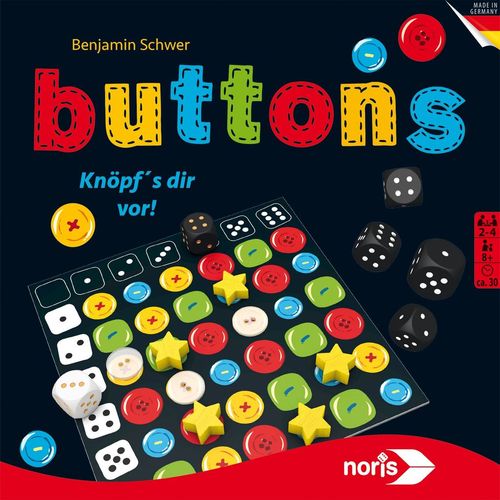
Game Contents
- 4 game boards with differing fronts and backs
- 6 dice
- 1 white die with gold pips
- 1 black die with gold pips
- 4 black dice with white pips
- 50 transparent buttons
- 60 yellow stars
- 4 button cards
- 1 set of rules
Each game board has 36 spaces. Each player's board also has a depot in the top left corner.
Aim of the Game
Each player skilfully tries to place buttons on their own game board and thus gain stars. The first player to lay 5 stars in a row or has at least 12 stars on their game board, wins the game.
Game Preparation
Each player chooses a game board and places it in front of them with any side face up. The 4 button cards are distributed among the players, so that each player receives one card.
The player with the red button on the button card is the starting player in the first round and places the dice in front of them. The buttons and stars are placed ready, so that they are within easy reach of all players. These form the pool.
(For 2 or 3 players, see Buttons for 3 Players and Buttons for 2 Players.)
Laying Rules for Buttons
In BUTTONS, players place buttons and stars on their game boards. The rules are easy and should be well noted:
- No more than one button may lie on any one space on the game board.
- Buttons may never lie beside each other, neither horizontally nor vertically.
- However, buttons may lie in a diagonal line to each other.
- No buttons may be laid on a space already occupied by stars – but may be laid adjacent to spaces with stars.
- Short and sweet: No buttons beside buttons!
Players may not lay a button, if by doing so they would break one of the laying rules.
Game Procedure
BUTTONS is played over a number of rounds. The first player of a round is always the player holding the button card picturing the red button.
When it's your turn, you must decide on one of the following actions:
ROLL THE DICE or OPT OUT
Rolling the Dice
On your turn, take all the dice lying in front of you and roll them. That's all six dice at the beginning of a round, but later it can be less!
Counting Up the Dice
All players can benefit from this roll:
If it's not your turn right now, you can only benefit from the dice with the gold pips. Whoever so wishes may take one button from the pool and lay it on the space in the row corresponding to the white die and in the column matching the black die (gold pips). But keep to the laying rules! You are not forced to lay a button.
Example: Emma rolls the dice. Now all other players may lay a button on the space in the fifth row and in the sixth column. The other players ignore the remaining four black dice.
If it's currently your turn, you can benefit from all the dice. But to do so, you must lay a button. Combine the white die with any black die, and subsequently you must lay a button from the pool onto the space in the row matching the white die and in the column corresponding to the black die. Keep to the rules for laying buttons here, too!
Earlier example: Emma must lay a button. The button must be placed in the fifth row – but Emma may choose whether she places it on the second, third, fifth or sixth space. She, too, must keep to the rules for laying buttons!
Laying Not Possible
Sometimes it can happen on your turn that you are not able to lay a button, since you would otherwise violate the laying rules. In this case, you have gambled your chances away! You must then:
- Remove all buttons from your game board and return them to the pool, and
- Take one of the black dice with white pips, just rolled, and place it on the depot at the top left of your game board.
With that, you are out of that round and must wait until the beginning of the next round. Until then, you may not place any buttons on your game board. The dice on your game board may also not be used by any other player until the end of that round!
Example: Emma has already placed some buttons and stars from previous rounds on her game board. She rolls the dice: Emma ought to place a button in the fifth row now, but by doing so would violate the laying rules. There is already a button lying on the space in the second column, the space in the third column is adjacent to a button, there's already a star lying on the space in the sixth column. Emma has gambled away her chances. She takes one of the black dice and places it in the depot at the top left. Then she removes all the buttons and returns them to the pool. She keeps the stars, however.
Unfortunately, players who have gambled and lost remain empty-handed! The stars gained are now distributed on the spaces, on which buttons have been laid in this round. The swapped buttons are returned to the pool.
Now, check and see whether any player has already collected enough stars to win the game (see End of the Game). If none of the players has collected enough stars, play another round.
Passing the Dice On
At the end of your turn and in a clockwise direction, pass the dice to the next player whose depot is still empty. It's now this player's turn.
If no other player has an empty depot, take another turn. You may choose between ROLLING THE DICE and OPTING OUT.
If all depots have a die in them, the round ends here (see also End of a Round).
Opting Out
If you already have at least one button on your game board, and are afraid of not being able to place a button during the action ROLLING THE DICE, you can decide to opt out of this round, to avoid losing everything. Take a black die with white pips and place it in the depot at the top left of your game board. You must now wait until the end of the round and may not lay any buttons on your game board until then. The dice on your game board may not be used by any other player until the end of that round!
In a clockwise direction, then pass the remaining dice to the next player whose depot is still empty. It's now this player's turn.
If all depots are occupied by a die, the round ends here (see also End of a Round).
End of a Round
A round ends as soon as each player has a die in their depot, no matter whether they have opted out or have gambled and lost. Now it's time to count up the score!
The players who opted out in good time now receive stars:
- 1 star for opting out in good time.
- 1 star for each symbol that you have covered at least three times with a button.
- 1 bonus star, if the player has covered up the symbol on his button card at least three times.
Preparation for the Next Round
Now all the players remove their remaining buttons from the game board and return them to the pool. Stars remain on their spaces!
Each player passes his button card to the player on their left. Remove all dice from the depots. The new starting player (the player with the red button on the card) takes the dice and begins a new round.
End of the Game
If, at the end of a round, a player has:
- 5 stars in a horizontal or vertical row, without any gaps (not diagonal), or
- 12 stars on the game board,
the game ends. This player wins the game.
Tie
If several players have simultaneously announced the end of the game, then the player with 5 stars in a row has won.
If more than one player has managed that, then the player able to place the most stars is the winner. If there is still a tie, then there is more than one winner.
If no one was able to lay 5 stars in a row, the player to have laid the most stars is the winner! In the event of a tie, the players share the victory.
Buttons for 3 Players
In a game with 3 players, one of the four button cards is removed from the game during set-up. Make sure that the starting player card is always in the game.
Otherwise, the same rules apply as for a game with four persons.
Buttons for 2 Players
If two persons play, each player receives two button cards instead of one. At the end of a round, hand both cards to your fellow player. If you opt out or gamble and lose, place two black dice with white pips in your depot. The other player now only has four dice left.
Otherwise, the same rules apply as for a game with four persons.
About the Designer
Benjamin Schwer first saw the light of day in Berlin in 1982 and became socialized with games of all kinds at an early age. His studies took him to Leipzig, where he played frequently and also studied philosophy and German to become a teacher. Apart from his wife, his eldest daughter also shares his passion for games. That motivates and spurs him on again and again, to occupy himself with games. BUTTONS is the seventh game he has published.