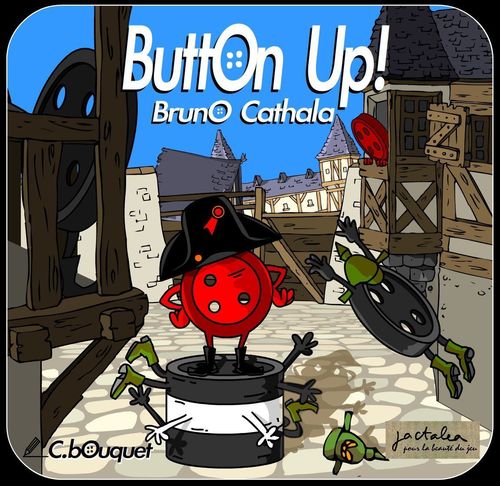
Button Up!
Button Up! Rulebook
Table of Contents
Table of Contents
Components
- 3 big red buttons representing the troops of Napoleon Buttonaparte
- 3 big black buttons representing the troops of Ludwig York von Buttonburg
- 3 big white buttons representing the spies, double agents who work for both armies
- 10 small black buttons (value 1) and 8 small red buttons (value 5) representing the victory points you receive at the end of each battle
- 1 round tile "the battle field", serving as well as playing help
- 2 square general tiles
- 1 rulebook
Aim of the Game
You play one of the two generals (Napoleon Buttonaparte in red or Ludwig York von Buttonburg in black). Your aim is to be the first to have gained 15 victory points at the end of a battle.
In order to get those victory points your troops have to be in the highest possible positions within the final pile at the end of a battle.
How to Play
1) Preparing the battle field
- Before you start the game, decide which general you want to play and put the correspondent general tile in front of you.
- Choose a start player (for example the oldest player).
- The start player puts the tile "battle field" in the middle of the table between himself and his opponent.
- He mixes the 9 buttons and puts them randomly in a circle around the battle field (thus the beginning of each battle is different).
Example of the starting position:
Now, the war of the buttons can really begin!
2) Movement
Beginning with the start player everybody informs the spies to start moving the troops.
The active player must choose a pile that contains at least one spy (white button). He takes the pile and drops the buttons one by one, starting with the one at the bottom, on the other piles. The player has to drop the buttons in a clockwise direction. In the first round every pile only consists of one button.
Example 1 (beginning of the match): The active player chooses pile A.
Example 2: The active player chooses pile B.
Additional move: If the last button is dropped on a button of the same color, the active player MUST play one more time. (In example 2 the active player must play again because the last button, a red one, was dropped on another red button.)
Special case: What happens if the chosen pile consists of more buttons than there are piles around the battle field?
In this case you still drop one button on each pile. The remaining buttons will be dropped on the last pile, without changing their order (Example C and D).
Annotation: If you drop more buttons on one pile you never get an additional move. In this case the color of the buttons does not matter.
Example D: The active player has dropped more than one button on the last pile. Even though he dropped a white button on a white button he does not get an additional move. It is the turn of the next player.
Reorganize the battle field: If the players want to, they can change the order of the piles so that the piles are arranged evenly around the battle field. However it is not allowed to change the order or the composition of the piles. (This action also never replaces the active player's turn!)
3) End of the match – End of the game – Score
Every battle ends when there is only one remaining pile in the middle of the table.
Example at the end of a battle: Each army has a value according to its position in the tower. Napoleon Buttonaparte: 1 + 2 + 9 = 12. Von Buttonburg: 3 + 5 + 6 = 14. Von Buttonburg wins this battle and gains 2 victory points (14-12).
Now every general verifies the value of his armies (amount of the heights of each of his buttons in the final pile). To simplify the calculation he puts his general tile next to the pile and adds up the values of his buttons. The markings will help you to see the positions better.
The general who has the most points gains a number of victory points equal to the difference of the sums of the two armies. He receives the correspondent number of buttons (victory points) and adds them to the victory points he might already have from former matches.
If the total amount of victory points is 15 or more, you win the game. If not you start a new round, like explained in paragraph 1. (Now, the general who has got the least points starts the next round.)
Example: Napoleon Buttonaparte: 1 + 4 + 9 = 14. Von Buttonburg: 3 + 6 + 7 = 16. Von Buttonburg wins this battle and gains 2 victory points (16-14).
4) Tactical considerations
The player who moves the last pile during a match always has an advantage. If both of the last piles contain a spy, the player can choose which pile he wants to put on top of the other. A match consists of exactly 8 turns, thus it is normally the second player who can decide the last movement. Consequently, the first player has an interest to get an additional move, whereas the second player tries to prevent his opponent from getting an addition move. If it is not possible for the second player to prevent the opponent's additional move he should try to get an additional move himself.