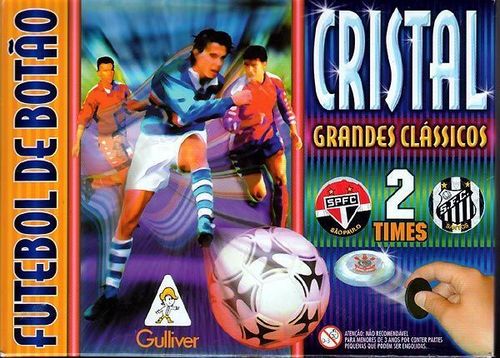
Button Soccer
Button Soccer Rulebook
Table of Contents
Table of Contents
- Number of Players
- Aim of the Game
- What Is a Goal?
- The Duration of the Game
- Board and Pieces
- 2) Set-Up
- 3) A Player's Turn
- 4) Shot on Goal
- 5) Manipulation of Buttons
- 6) Manipulation of the Goalkeeper
- 7) Kick-Off
- 8) Buttons Which Go Out of Bounds
- 9) Foul
- 10) Penalty Shots
- 11) Throw In/Corner Kick
- 12) Own Goal
Number of Players
Two players.
Aim of the Game
The team scoring the greater number of goals during a game is the winner. If both teams score an equal number of goals or if no goals are scored, the game is drawn. A penalty shoot-out or extra-time could be a way to decide drawn games if wished.
What Is a Goal?
A goal is scored when a shot has been declared (see section 4) and the whole of the ball passes over the goal line, between the goalposts and under the crossbar or as an own goal (see section 12).
The Duration of the Game
50 minutes, 2 halves of 25 minutes. Or, any agreed duration.
Board and Pieces
1a) Board Dimensions
The playing area must be rectangular. The length of the touchline must be greater than the length of the goal line.
1b) Pieces
A game is played by two teams, each consisting of 10 buttons in the shape of discs as well as one goalkeeper in the shape of a rectangular block with the dimensions of 38 mm X 60 mm X 20 mm, whose face measuring 20 mm x 60 mm must always be placed on the board. The ball is a biconvex disc with a diameter of 10 mm.
2) Set-Up
See section 7.
3) A Player's Turn
At their respective turn, each team has one (1) touch. A button is moved by pressing a pick, finger nail or comb (will be referred from now on as a pick) from on its edge to make it slide. A button can never be pushed or flicked.
4) Shot on Goal
Shots on goal are only allowed when the ball is entirely in the opponent's defensive half and it is the attacker's turn. The attacker must declare his intention to shoot before taking his/her turn. Once the attacker has declared his intention to shoot he/she must wait for the defender to position their goalkeeper and authorize the shot. If any part of the ball is touching the midline (if unsure, look from above), the shot on goal is not allowed. If a signal announcing the end of a period of play is given right after a shot on goal is announced (or a direct foul happens), the shot (or direct free kick) can still be taken. The shot ends when the ball stops moving. If that shot on goal caused a direct foul, the opponent will be allowed to take the direct free kick (see section 9).
A shot on goal is not allowed from: regular throw in, regular corner kick, kick off, indirect free kick, first touch of a 2 touches throw in, first touch of a 2 touches corner kick and first touch of a 2 touches free kick.
5) Manipulation of Buttons
Once the game has started buttons may be arranged in two situations only: after a goal is scored or at a goal kick. When arranging the buttons at a goal kick, a distance of at least 6 cm has to be kept from the opponent's buttons. At least 3 buttons have to be placed in the offensive half.
The order of arranging the buttons is as follows: first, the team taking the goal kick arranges his buttons on his offensive half. Second, the opponent arranges his buttons on his offensive half. The team taking the goal kick arranges his buttons on his defensive half and, finally, the opponent arranges his buttons on his defensive half. Any button touching the midline is considered to be in his team's defensive half.
These are the situations where the whole team can be manipulated but the team can also pick up a button to take a free kick, throw in or corner kick.
5.1)
A goal kick can be taken with the ball anywhere inside the penalty area. It is also a goal kick when the ball ends a turn inside the goal area (small box) or when it enters the goal but a goal was not scored.
5.2)
If the touch that caused the goal kick started on the defensive half of the team that kicked it out of bounds and the ball did not touch any other buttons (went straight out of bounds) and did not roll on its side, neither team can arrange their buttons.
6) Manipulation of the Goalkeeper
The goalkeeper has to always be placed entirely within the goal area (small box). It can be manipulated with the other players during kick off and goal kick. It can also be manipulated during his/her team's turn or when the opponent declares a shot on goal.
7) Kick-Off
Each team places 5 buttons within 6 cm (but not touching) the midline and 5 buttons anywhere on its defensive half. No buttons from the defending team are allowed inside the center circle. The team taking the kick off places 2 buttons inside of the half center circle located on their defensive half. One of the 2 buttons placed in the center circle is used for the opening kick-off. The team takes 2 consecutive turns. On the 1st touch, the ball must move forward and not leave the center circle and on the second touch (a different button must be used) the ball must leave the circle otherwise a technical foul is called. The team is not allowed to shoot on goal on either touch. In friendly matches, it is common practice to start each period and to restart the game after a goal with a goal kick rather than a kick off.
8) Buttons Which Go Out of Bounds
When a button goes out of bounds, it is placed back in the field touching the line from the outer side on the exact point where it left the field after the opposing team's next turn and cannot participate on its team's following turn. On the other hand, this button can always be used to take a direct or indirect free kick, throw in or corner kick.
When an opposing button ends a turn inside the goal area, it is placed inside the penalty area with its edge barely touching the goal area on the exact point where it entered the area. When a button of the same team ends a turn inside the goal area, it may be left where it is or it may be placed inside the penalty area with its edge barely touching the goal area also at the exact point where it entered the area depending its team's choice.
If the position where the player left the field or entered the goal area is blocked by another button or the ball, the button has to stay out of the field until that position clears.
9) Foul
A direct foul or a direct free kick will be called when:
- A button from the team taking the turn touches an opposing team's button or goalkeeper before or at the same time it touches the ball.
- The ball (while in bounds) touches or is touched by the pick or body of one of the players.
The free kick is taken from the spot of the foul.
9.1)
Buttons from the opposing team close to the spot of the foul are pushed away and placed 6 cm away from it. Buttons from the same team may or may not be pushed back according to the team's choice.
9.2)
If the foul is in the defensive half of the team taking the free kick, the team will be allowed to play 2 consecutive turns (2 touches). The second touch may be a shot on goal if the ball is in the offensive half (see section 4 above). If the ball touches an opposing player during the first turn, the team loses the second turn. The button who took the first touch, cannot take the second.
9.3)
If the foul is in the offensive half, a direct shot on goal can (and should) be taken or the team may choose to take a 2 touches free kick as above.
9.4)
A foul on the goalkeeper is taken with the ball placed anywhere inside the penalty area.
9.5)
Indirect fouls or indirect free kicks or technical fouls are called:
- When the ball stops on top of or under a button (against that button's team).
- During the kick off if the ball leaves the center circle after the first touch or doesn't leave it after the second (see section 7).
- When the ball is totally inside the triangle formed by the outer edges of 3 buttons from the same team that are 18 cm or less apart.
- When the ball is completely inside the rectangle formed by the outer edges of 2 buttons of the same team that are 6 cm or less apart and it is not cleared by the end of that team's turn. Or, if this happens again on the turn after the turn it was originally cleared.
- When any technical foul takes place (delay of game, improper conduct, etc.).
During these, the opposing players are still pushed back to 6 cm away from the ball. The team then takes a simple turn from the spot of the foul.
Special: Buttons that took a regular throw in, regular corner kick, kick off, indirect free kick, first touch of a 2 touches throw in, first touch of a 2 touches corner kick or first touch of a 2 touches free kick, cannot be played again before the ball has been touched by a different button in a subsequent turn. If this illegal move occurs, the buttons and ball should be repositioned and the turn replayed. The opposing team is advised to give a warning to prevent this from happening.
10) Penalty Shots
A penalty kick is awarded against a team which commits any of the offences for which a direct free kick is awarded, inside its own penalty area. Any button touching the penalty area's line is considered to be inside the penalty area. The penalty shot must take place in the following manner: buttons are removed from the penalty area and the ball is placed completely covering the penalty mark. First, the attacker places the button he will be using and then the defender properly places the goalkeeper on the line, which must be partially apparent in front of the goalkeeper.
11) Throw In/Corner Kick
A 2 touches throw in or corner kick is awarded if the ball is on the defensive half of the team taking the turn and it is shot straight out of bounds still within the defensive half without rolling on its side and without touching another button from the same or the opposing team. The 2 touches throw in or corner kick are taken exactly like the 2 touches free kick (see section 9). In all other situations, a regular throw in or corner kick is given against the team of the button which last touched or was touched by the ball. These are taken like the indirect free kick (see section 9).
12) Own Goal
An own goal is only awarded if from a defender's turn: The whole of the ball passes over the goal line, between the goalposts and under the crossbar. The ball started and never left the team's defensive half during its turn.