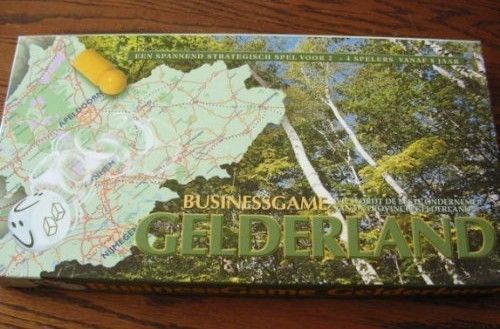
Business Game Amersfoort
Business Game Amersfoort Rulebook
Table of Contents
Table of Contents
Setup
-
Choose 2 pawns of the same colour and place them on the starting square of that colour.
-
Take 20 cards of your own colour and arrange the cards until 5 company logos appear. The player who first forms 5 companies may also begin.
Source note: the sheet specifies 20 cards and 5 logos. The BGG description of this game gives 25 tiles (5 sets of 4). The sheet's count of 20 is followed here.
Board and Dice
The board is a square grid with a border of arrows around its edge. The corners are marked with stars. The numbers in the margins are the reference numbers used to define plots of ground (see Rule 3 and Rule 5 below).
Each turn is taken with two dice, as set out under Rule 4.
Object of the Game (Rule 3)
Each player must try to place their companies as quickly as possible on the most favourable ground.
The value of a plot of ground is calculated by adding the numbers that describe it. In the example on the sheet (see the diagrams below), "ground A" is worth more than "ground B", and "company X" is worth more than "company Y".
The centre of the town therefore always yields the most points.
Moving the Pawns (Rule 4)
Two dice are always rolled.
- The number of pips on one die counts for one pawn.
- If a player rolls, for example, a 2 and a 3, they may move one pawn 2 squares and the other pawn 3 squares.
The pawns move along the full edge of the board. The direction is free to choose, and may still change during the game. However, the movement from one roll must be made in one direction.
Describing a Plot of Ground (Rule 5)
When 2 pawns describe a plot of ground, the player may do one of the following:
- a) Place a piece of their company on the plot.
- b) If a piece of their own company already stands there, take it back or turn it. A player may therefore only turn an already-placed card if the pawns describe that specific plot of ground again.
- c) If a piece of another player's company already stands there, the two players may roll dice for it. The player who rolls the highest number of pips takes control of the plot. The loser must make room for the winner and, if necessary, remove the card.
Doubles (Rule 6)
When the dice show a double, the player plays as normal, but may also roll the special dice:
- A. Laughing face: Move both pawns to any square of your choice. This describes a new plot of ground where the player may place, turn or remove a card.
- B. Extra turn: Take it immediately.
- C. Sad face: Skip the next turn.
Note printed on the sheet, above Rule 6: a complete company can no longer be gambled away.
End of the Game
As soon as one of the players has built all their companies, the game ends. The points of each player are added up (see Rule 3), counting only complete companies. The player with the highest total wins and is the best entrepreneur of the town.
Good luck!
Board Example Values
The sheet shows two example boards with the following values, calculated by adding the margin numbers that describe each plot or company:
- Ground A: 5 + 5 = 10
- Ground B: 3 + 2 = 5
- Company X: 11 + 10 + 10 + 9 = 40
- Company Y: 2 + 3 + 3 + 4 = 12
Règles du Jeu (French Version, Translated)
The French side of the sheet gives the same rules in French. It is transcribed here in English, section by section, as a parallel text. Where it differs from the Dutch text, the difference is noted.
-
2 to 4 players may take part in this game. (The Dutch text does not state a player count.)
-
Each player takes two pawns of one colour and places them on that colour's starting square.
-
Each player takes 20 cards of their own colour and groups them so as to obtain 5 company markers. The player who has formed 5 companies first starts the game.
-
The aim of the game is to place your companies on the city plan as quickly as possible. The margin figures of the reference systems determine the plots and make it possible to calculate their value. For example, the value of "ground A" is higher than that of "ground B", and the value of "company X" is higher than that of "company Y" (see figure). The greatest numbers of points are obtained in the centre of the town.
-
The game is always played with two dice and two pawns. The number of points obtained with one die applies to one pawn. If one of the dice thrown shows, for example, a 3 and the other a 2, the player may place one of their pawns on the 3 of the vertical row of figures and the other pawn on the 2 of the horizontal row of figures, or the reverse. Each player may choose the direction in which they move their pawns and may change it at any time during the game. However, the movement according to the number of points on each die must be made entirely in one direction. The pawns therefore always move at right angles to one another (see figure), so that they exactly define the ground in each phase of the game (see figure, grounds A and B).
-
When two pawns determine a plot of ground, the player may: a) place part of the mark of their company on it,
(The French text is cut off here by the bottom edge of the scan. Item b) is not visible and is not transcribed.)
Success!