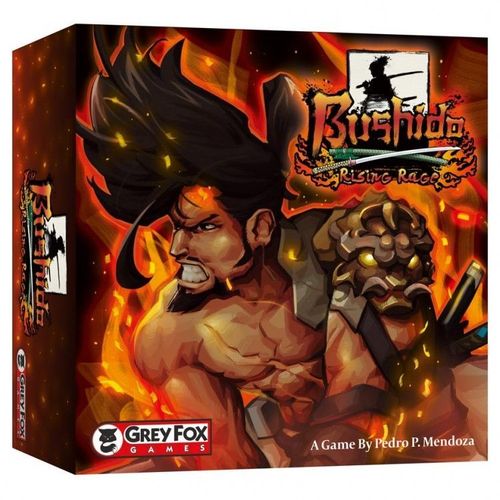
Bushido: Rising Rage
Bushido: Rising Rage Rulebook
Table of Contents
Table of Contents
Components
- 5 Rage Dice
- 23 Technique Cards
- 8 Weapon Cards (2 Sets of 4 Weapons)
Setup
The following steps should be followed before, and in addition to, the normal setup of a game of Bushido.
- Shuffle the 23 new Technique cards in with the Technique cards from your base game.
- Shuffle the 4 new Weapon cards in with each player's 6 original Weapon cards and place this randomized deck of Weapon cards near your Player Board.
- Add the 5 Green Rage dice to the pool of available dice.
Note: Cards from Rising Rage are marked with a Rising Rage icon so that they may be easily removed for future plays.
Gameplay
Most of the gameplay remains unchanged when playing with the Rising Rage expansion. The minor changes created by Rising Rage are noted in the sections that follow. Despite changes being relatively minor, playing with Rising Rage does significantly alter the feel and pace of duels in Bushido. We highly recommend that you play several games of Bushido without Rising Rage before mixing in the expansion.
Game Phases
When playing with Rising Rage, please note the addition of a new phase which occurs before the Train phase.
The flow of the game is now as follows:
- Prepare Weapon Selection
- Train
- Arm
- Duel
Prepare Weapon Selection
From the randomized deck of 10 Weapon cards created during setup, each player draws the top 3 cards and looks at them without showing their opponent. Then procees to the Train phase as normal.
When executing the Arm phase, you may only choose from the 3 Weapons drawn during the Prepare Weapon Selection phase. Keep this small selection of Weapons in mind as you draft your deck to make sure you are building toward a deck that complements 1 of the Weapons you have available.
Example: Player 1 has drawn Weapons that have higher token limits and abilities which can be activated using Armor tokens and/or Hit results. Considering this, Player 1 is likely to be trying to build a fairly balanced deck which allow them to regularly roll Hit and Armor results. They should probably focus on Fire and Earth School cards.
Player 2 has drawn Weapons that have lower token limits and abilities which can be activated using Evade and Armor results. Considering this, Player 2 is likely to be trying to build a more evasive deck and should probably focus on Air and Water School cards.
(The printed example is accompanied by two illustrations, labelled "Balanced Build" for Player 1 and "Evasive Build" for Player 2.)
Train
No changes occur in the Training phase. Players may still use the normal (or advanced) rules for drafting as laid out in the base game rule book.
Note: With a limited Weapon selection, it will be tempting to focus just on what you need but do not forget to keep an eye on your opponent and respond to the deck they are building as well. Flexibility remains a key component to good Bushido play.
Arm
When choosing your Weapon for The Duel, you may only choose from the 3 Weapons you drew during Prepare Weapon Selection. Apart from this restriction, no changes occur in the Arm Phase.
The Duel
1 Play a Technique or Change your Guard
When Boosting, players may now choose to add Rage dice (like any other color die) as a result of their Boosting. (Rage dice have the potential to provide Rage to-
(Editor's note: the printed sentence above ends mid-word at the foot of page 8 of the source. The source text does not complete it, and it is transcribed as printed here.)
Additionally, several of the new cards feature the discard keyword. When a card allows you to discard dice results, you must return those dice to the pool without resolving their normal effects in order to use them to activate the card's effect.
Example: The active player plays Heavy Cut in Mid Guard and rolls the following result: 1 red Hit, 1 grey Evade, and 3 grey Armor. They may now choose how they wish to resolve their dice. Do they collect 3 Armor tokens and refill their supply or do they discard 2 of those results to deal 1 direct damage and then only collect 1 Armor token? The ability to make that choice often makes Techniques with the discard keyword powerful dual purpose cards!
2 Roll Dice
This step remains unchanged.
3 Resolve Dice
The addition of the Rage dice add a new possible result to those provided by the dice in the base game:
- Add 1 Rage token to your Holding Area.
The Rage dice are not as specialized as the original 3 dice colors which are broken down into types based on what you are most likely to earn from them.
Instead, Rage dice provide all of the results possible on the other dice (with the exception of the Torii result) and also offer a new effect not seen on any of the other dice – Rage. When you resolve a die showing the Rage result, add 1 Rage token to your Holding Area.
As you can imagine, finding ways to quickly build your Rage can lead to very powerful strikes early in the game. Be careful not to overextend yourself however. Many warriors have found themselves vulnerable after an opponent successfully evades a reckless, Rage-fueled attack.
4 Resolve Damage
This step remains unchanged.
5 Collect Holding Area
This step remains unchanged.
6 Check for Game End
This step remains unchanged.
With these changes, you are ready to embrace your Rising Rage and focus it into further mastery of Bushido.