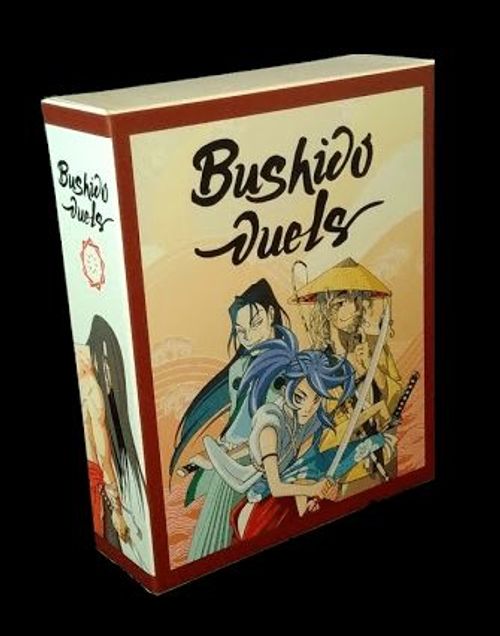
Bushido Duels
Bushido Duels Rulebook
Table of Contents
Table of Contents
Components
11 Cards for each of the 8 fighters (88 cards in total)
- 6 Standard Attack Cards
- 3 Special Attack Cards
- 1 Health Tracker Card
- 1 Mon Wheel Card
- 12 Dice, 6 white and 6 black
- 8 Health marker cubes
Setup
Decide which game type you want to play and follow the instructions.
- Bushido Duels: page 5
- Clash of the Clans: page 7
- Kyoto Grand Tournament: page 8
- Free for all: page 9
Rules
The game is played in pairs over several duel turns. The players select techniques trying to bluff and out-think their opponent, while trying to keep track of played cards and use their special techniques at precisely the right time.
Winning and Losing
To win in Bushido Duels you must Knock Out your opponent's fighter. This happens when an Attack Card's damage, effect or special rule causes your opponent's fighter's health to go below 1. The Knocked Out player loses the duel.
The Duel Turn
The Duel Turn is comprised of the following phases:
- The stance phase
- The attack phase
- The discard/refresh phase
The stance phase
- The fighters prepare and plan their attacks
The players choose an Attack Card they wish to play. Once a player has decided on a card they place it in front of them, face down.
The attack phase
- The fighters unleash their attacks
The players reveal their Attack Cards at the same time and compare the Mon symbols of the cards to determine which technique is offensive and which is defensive.
The Mon symbol in the card's upper left corner represents the technique and determines its placement in the Mon Wheel.
The Mon Wheel determines if your technique is offensive, defensive or if the attack was a tie. An offensive technique points towards the defensive ones.
Note: Counting clockwise from any Mon symbol. The next four symbols are always defensive in relation to the chosen Mon.
If both players played a card with the same Mon symbol, it's a tie and the cards are discarded directly. Neither of the players receives any damage.
Next, compare the Speed and Strength values of the Attack Cards.
The Speed value of an Attack Card is shown in white in the upper right corner. The value can either have a fixed value or a varying value indicated by a die symbol (see Using Speed and Strength dice). The value determines the speed of the Attack Card, the lower the value the faster the attack. To make sense of the Speed value, consider it the reaction time the fighter has when committed to the technique.
Transcriber's note: the printed Speed and Strength dice symbols are graphic icons in the source; they are rendered here as "die symbol" and identified from the Using Speed and Strength dice section.
The damage is determined by the Strength value shown as a black number or a die symbol in the upper right corner of the card. The higher the value the stronger the attack. Generally damage is inflicted by the offensive technique.
In the example above the defensive technique's Speed value (7) is not faster than the offensive technique's Speed value (6) and the offensive technique connects with full strength inflicting 7 points of damage.
Should the defensive technique be faster, the defensive technique will block or dodge the offensive technique either fully or partially. Subtract the defensive Attack Card's Strength value from the opponent's Attack Card's Strength value to determine the damage inflicted.
In this example the defensive technique is faster (4 compared to 6) and will hence block some of the incoming damage and only receive 2 points of damage (7 - 5 = 2). If the damage is reduced to 0 or below the player receives no damage.
Note: Tied values are never faster or stronger, nor do they trigger criterias on Special Attack Cards.
Keep track of your health by moving the Health Marker on the Health Tracker Card in front of you. If this causes a player to be Knocked Out the game ends, otherwise proceed to discard/refresh phase.
The discard/refresh phase
- The fighters regroup
Each player places the played Attack Card to the side, face down forming their discard pile. If this causes a player to have no Attack Cards left in their hand they pick up their discard pile to refresh their hand. A new duel turn then starts.
This will repeat until one of the fighters are Knocked Out.
Standard Attack Cards
Six of these cards are standard attacks, with varying strength and speed, known to all fighters.
Special Attack Cards
The final three cards are special attacks. While the Mon symbols are the same across all fighters their unique rules differ from fighter to fighter.
The rules are printed at the bottom of each Special Attack Card. Follow the instructions on the card when revealing them in the attack phase.
The rule text often contains a criteria, in the example above Fewer cards than opponent. If the player fulfils the criteria they follow the instructions under the criteria, if not they follow the instructions under Otherwise.
Note: If there is a conflict between a rule on an Attack Card and this rulebook the rule on the card takes precedence.
The Fight Deck
Each fighter has a Fight Deck comprised of nine Attack Cards, each of these has a Mon symbol identifying the technique. All fighters share the same set of Mon symbols.
Using Speed and Strength dice
The dice are six-sided with the numbers 1-3 twice. The Speed dice are white, and the Strength dice are black. Special Attack Cards sometimes requires the Speed and/or Strength values to be determined using dice. Simply roll the number of dice specified on the Attack Card and add the results together.
Example: Adam rolls 3 Speed dice (White) and 4 Strength dice (Black). The results are 1, 2, 2 for the Speed dice and 2, 3, 3, 1 for the Strength dice. By adding the respective dice results together Adams Attack Card has a Speed value of 5 (1+2+2=5) and a Strength value of 9 (2+3+3+1=9).
Choosing a fighter at random
Place an Attack Card from each of the fighters and shuffle them together. Each player draws a face down card and reveals it. This is their chosen fighter. Take the 9 Attack Cards, Health Tracker Card, Health Marker and the Mon Wheel Card belonging to that fighter.
Starting Health
Place the Health Tracker Card on the table in front of you and position the Health Marker on position 20.
Choosing an Opponent
Who has insulted you and questioned your honor?
Each player rolls 3 dice and adds their results together. The player with the highest result gets to challenge an opponent first. Any ties are re-rolled.
The player who was challenged can accept or refuse. Should the challenged player refuse, the dishonor of doing so reduces their health by 2. This is accumulative for each challenge they refuse. Should a player's Health be reduced below 1 in this way that player is removed from play as the fighter is dishonored beyond redemption.
The player issuing challenges continues until an opponent accepts. The remaining players then issue challenges in the order established by the dice rolls until all players have an opponent.
Example: Adam refused 2 challenges before finally accepting a challenge. Each time he refused a challenge he lowered his health by 2 on his health tracker card. This results in a starting health of 16 in his duel.
Play Modes
Bushido Duels
(2, 4, 6 or 8 players)
Your honor has been questioned! There is only one way to settle the score and that is to Duel!
Pick a fighter of your choice or choose one at random.
Picking a fighter of your choice: Take the 9 Attack Cards, the Health Tracker Card, a Health Marker and the Mon Wheel Card belonging to that fighter.
Choosing a fighter at random: Place an Attack Card from each of the fighters and shuffle them together. Each player draws a face down card and reveals it. This is their chosen fighter. Take the 9 Attack Cards, Health Tracker Card, Health Marker and the Mon Wheel Card belonging to that fighter.
Winning the Game
A Duel is over when one of the player's fighter has been Knocked Out. When the duels are over all players left standing have won!
"The score has been settled and your honor has been restored!"
Clash of The Clans
(4, 6 or 8 Players)
Two clans are set to wage war on each other. The prelude to this is the altercation that is about to take place right now!
"As you walk across the marketplace you spot a rival clan entering the market. Grasping your swords, you prepare to defend yourselves and the honor of your clan. - Attack!"
Pick a fighter of your choice or choose one at random.
Picking a fighter of your choice: Take the 9 Attack Cards, the Health Tracker Card, a Health Marker and the Mon Wheel Card belonging to that fighter.
Choosing a fighter at random: Place an Attack Card from each of the fighters and shuffle them together. Each player draws a face down card and reveals it. This is their chosen fighter. Take the 9 Attack Cards, Health Tracker Card, Health Marker and the Mon Wheel Card belonging to that fighter.
Starting Health
Place the Health tracker card on the table in front of you and position the Health Marker on position 20.
Choosing your Clan
Roll 3 dice and add the results together. Divide the players into two clans by putting the half with the highest rolls in one clan and the rest in the other clan. Should there be a tie for the last spot in a clan the tied players re-roll their results until the spot is filled.
Example: Adam, Lisa, Carl, Steve, Lucy and Jill (six players) have decided to play Clash Of The Clans. They each roll three dice and add their results together. The results are: Adam: 8 (3+3+2); Lisa: 6 (1+3+2); Carl: 5 (1+1+3); Steve: 5 (2+1+2); Lucy: 4 (1+1+2); Jill: 3 (1+1+1). Since there are six players, each clan will have three fighters. Adam and Lisa rolled the highest and are put together in one clan while Lucy and Jill rolled the lowest and are in the other clan. Carl and Steve both rolled a total of 5 and re-roll their dice. Carl: 6 (2+1+3); Steve: 7 (3+1+3). Steve joins Adam and Lisa and Carl teams up with Lucy and Jill.
Choosing an opponent
Roll 3 dice. The player with the highest result gets to challenge an opponent in the opposite clan first.
The player who was challenged can accept or refuse. Should the challenged player refuse, the dishonor of doing so reduces their health by 2. This is accumulative for each challenge they refuse. Should a player's health be reduced below 1 in this way that player is removed from play as his fighter is dishonored beyond redemption.
The player issuing challenges continues until an opponent accepts. The remaining players continue to issue challenges in the order established by their dice roll until all players have an opponent.
Adjusting Health
Before a duel starts players that refused one or more challenges must adjust the starting health of their fighter.
Example: Adam refused 2 challenges before finally accepting a challenge. Adam moves the Health Marker from 20 to the number 16. This is the health his fighter will have at the start of the duel.
The Duels
The players pair up with their opponent and start their duels.
Advancing
The victorious players continue the fighting. They restore their health to the maximum value of 20 (their honor has been restored) and repeat the choosing an opponent process.
Any fighter without an opponent must wait on the sidelines until the next round or victory for the clan.
Example: Adam and Lisa won their duels while Lucy from the opposing clan won hers. They all restore their health to 20. They each roll three dice. The results are: Adam: 4 (1+1+2); Lisa: 5 (2+2+1); Lucy: 4 (2+1+1). Lisa won the roll and challenges the only opponent left, Lucy. They Duel while Adam waits to see if their clan wins or if he must face Lucy in another duel.
Winning the Game
When there's only one clan left standing the battle is over.
Clash of the Clans Hardcore
This variant plays exactly as The Clash of the Clans except that during the advance step the players that weren't Knocked Out continue the fighting without restoring their health between duels. Repeat the choosing an opponent process (refusing challenges can lower your health further).
The Kyoto Grand Tournament - The Crowning of a Kensei
(4 or 8 Players)
It's time for the Kyoto Grand Tournament. Fighters from across the islands are gathering to take part in this prestigious Tournament held once every 10 years.
Who will win and be worthy of the title of Kensei / Sword Saint?
Pick a fighter of your choice or choose one at random.
Picking a fighter of your choice: Take the 9 Attack Cards, the Health Tracker Card, a Health Marker and the Mon Wheel Card belonging to that fighter.
Choosing a fighter at random: Place an Attack Card from each of the fighters and shuffle them together. Each player draws a face down card and reveals it. This is their chosen fighter. Take the 9 Attack Cards, Health Tracker Card, Health Marker and the Mon Wheel Card belonging to that fighter.
Starting Health
Place the Health Tracker Card on the table in front of you and position the Health Marker on position 20.
Choosing an opponent
Take an Attack Card from each of the participating fighters and shuffle them together. Draw cards randomly in pairs.
Advancing
The winners of the duels advances to the next round. Your health is restored between duels. If there are more than two players left repeat the choosing an opponent process.
Winning the game
The last player standing is the winner of the Kyoto Grand Tournament.
Hardcore Tournament
Plays the same way as the Kyoto Grand Tournament, except that after advancing the players that advance does NOT restore their health.
Free for All
(3+ players)
Warning: This is a game type that should only be attempted after you've played a couple of duels since this is chaos ramped up to 11.
In this chaotic skirmish the players will have to try to outlast their opponents not knowing from where the next attack will come.
"You all eye each other. Who should you attack first? Is a temporary alliance possible? Can anyone really be trusted? All these questions race through your head as the signal sounds. Everyone leaps into action! Who will be left standing? There can be only one!"
Each player chooses a fighter or selects one at random in the same way as in "Bushido Duels", page 4.
Each players Health Tracker Card is placed in front of them.
The Free for all turn works a bit differently from the normal duel turn. It consists of the following phases:
- Stance phase
- Brawl phase
- Select active player
- Resolve Attack Cards using the normal attack phase rules
- Clean up/discard/refresh phase
- Go back to select active player until all cards are resolved.
Stance phase
Instead of the normal stance phase, each player selects an Attack Card and at the count of three they place their chosen Attack Card in front of the opponent they wish to attack.
Example: Adam has 1 card in front of him. Lisa has 2 cards in front of her. Carl has 1 card. Lucy has none.
Proceed to the brawl phase.
Brawl phase
The brawl phase is a chaotic extension to the normal attack phase where each player may be involved in fights with one or more players.
Select active player
The player with the most Attack Cards becomes the active player, in case of a tie, roll off. In the example above Lisa is the active player since she has the most cards (2) in front of her.
Resolve Attack Cards
The active player (Lisa) will resolve one attack phase for each Attack Card in front of them, comparing them to the card they've played. A total of two attack phases in the example above. The active player resolves the attacks in any order they wish.
Example: Lisa first selects the card from Carl, losing some health but still is in good shape. Then turns her attention to the card from Lucy resulting in an offensive technique causing 5 points of damage.
Had Lisa instead placed her card in front of Carl (illustrated above), she would now discard it since she has already fought Carl once this turn.
If a player is Knocked Out before all Attack Cards are resolved, the unresolved cards are regarded as ties for game purposes and no damage is dealt or received.
Note: Each fight (pairing) is an independent attack phase. Meaninging rolls, comparisons of Criterias, Speed and Strength values are made independently for each of the opponents' cards.
The other players involved in the fight checks if they will be involved in a future fight or if they can discard their cards.
Example: In the example Carl will still be involved in a fight with Adam so he'll retrieve his card, while Lucy is done fighting for this turn and takes her card and places it in her discard pile.
Clean up
After all Attack Cards in front of the active player has been resolved clean up is perfomed.
In case the active player has a card in front of one of the other players involved in this fight, discard the card following normal rules otherwise leave it where it is.
Example: In the example on page 8 Lisa will leave her card where it is, in front of Adam.
Select a new active player
Example: After the first round of the brawl phase, both Adam and Carl has 1 card in front of them. They roll off to determine the new active player. Adam rolls higher and is the new active player. Even though he will later fight with Carl he will only resolve his Attack Card against the card in front of him. In the example above, Lisa's card.
Adam's technique is offensive in this pairing but only manages to deal 2 points of damage. Lisa is done fighting for this turn and discards her card. Adam's card is in front of Carl so it remains where it is.
The last active player is Carl. Adam's technique is offensive in this pairing an inflicts 5 points of damage.
New Stance phase
Once no more cards are left to be resolved the brawl phase is over the players still standing starts a new stance phase, selecting cards from their remaining hand.
Winning the Game
When there is only one fighter left standing the skirmish is over.
"You have done it! Was it skill? Luck? Manipulation? Or perhaps a combination? Whatever the case you have outlasted your opponents and is the one true victor of the free for all."
Fighters
Section heading added by the transcriber: the printed pages carry no heading over the fighter profiles. The fighter biographies and quotes are flavour text and are left out; each fighter's name, archetype, age and the Special Attack Cards note are reproduced as printed.
Aguni Gin
- Archetype: "The Swift"
- Age: 18
Special Attack Cards: Whether it's quickly dodging incoming attacks, performing two attacks at once or deliver an unblockable strike faster than the enemy can react to, speed is the key. However, should she fail to be fast enough her special techniques are far less effective.
Takata Shigeru
- Archetype: "The Wanderer"
- Age: 40
Special Attack Cards: Takata Shigeru's special techniques are stronger on the defense than on the offense. Can he outlast his opponent or will his laidback attitude be his downfall?
Hamasaki Shinso
- Archetype: "The Highborn"
- Age: 26
Special Attack Cards: Hamasaki Shinso's special techniques are based around his absolute belief in his own ability. To fuel his attacks, he limits himself and toys with his opponent. This increases his power but could also leavbe him vurnerable to certain attacks.
Harada Nobusuke
- Archetype: "The Bruiser"
- Age: 29
Special Attack Cards: Harada Nobusuke is able to deal massive amounts of damage should he be able to connect with his attacks. However due to his battle raged state and reckless fighting style he is exceptionally vulnerable should his blade fail to hit its mark.
Tengan Shunso
- Archetype: "The Manipulator"
- Age: 25
Special Attack Cards: Tengan Shunso is able to manipulate his opponent. These mind games reduces the opponent's alternatives and makes Shunso's attacks more effective. The attacks may not be the most lethal, but this skillset, used to full effect, could prove quite crippling for an unwary opponent.
Nashio Naomi
- Archetype: "The Lethal Rose"
- Age: 24
Special Attack Cards: Distraction is key in Nashio Naomi's fighting style. An opponent's effectiveness is reduced as her special techniques targets their Speed and Strength, making her a deadly opponent not to be taken lightly.
Marameda Anzai
- Archetype: "The Warlord"
- Age: ??
Special Attack Cards: His abilities are at their strongest when his opponents are at their weakest. Given the upper hand Marameda Anzai is a tough opponent to defeat.
Nakashima Noshi
- Archetype: "The Thrillseeker"
- Age: 36
Special Attack Cards: The more damage Nakashima Noshi has taken the stronger he becomes. Will the opponent be able to finish him off before Noshi can retaliate with his most devastating attacks?