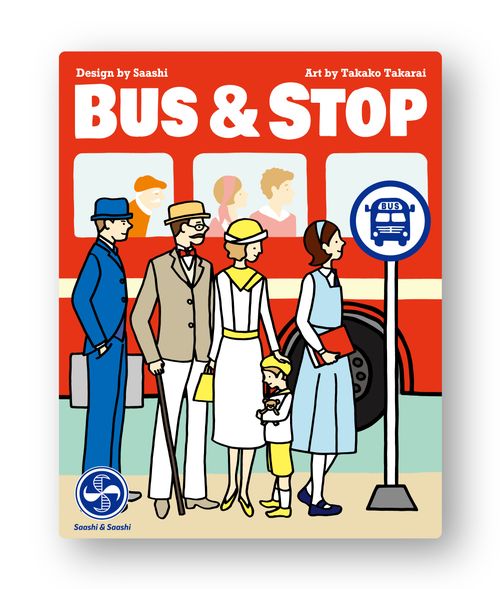
Bus & Stop
Bus & Stop Rulebook
Table of Contents
Table of Contents
Components
- 100 Passenger Cards
- 25 Commuters — 5 in each color (Blue, Red, Green, Yellow, Purple)
- 25 Students — 5 in each color (Blue, Red, Green, Yellow, Purple)
- 20 Parents with Children — 4 in each color (Blue, Red, Green, Yellow, Purple)
- 20 Tennis Players — 4 in each color (Blue, Red, Green, Yellow, Purple; 2 illustrations, in 4 types, treated identically)
- 10 Senior Citizens — 2 in each color (Blue, Red, Green, Yellow, Purple)
- Each Passenger Card shows a Passenger Type icon, a Color (background and icon color), and a Card back.
- 18 Destination Cards
- 16 A-Destination Cards (4 each, in 4 types): Office Building, School, Theme Park, Tennis Court — each card shows a Score (back).
- 2 B-Destination Cards: Station — each card shows a Score (back).
- Rules in English, Japanese & Chinese.
Aim of the Game
You will compete to make the most pleasing bus route for your passengers. On your turn you can either Pick Up passengers, putting them on your bus, or "Drop Off" by removing passengers to earn a destination card. When you Pick Up passengers you choose 1 Color of Passengers at the bus stop and take ALL of those passengers. Your bus has a passenger limit. You can not choose a color that would put you over that limit. The game ends when the bus stop can not be refilled or when only a certain number of Destination Cards remain.
Setup
All cards are used in each game, regardless of the number of players.
-
Sort the A-Destination Cards into 4 stacks, by type. Each stack will have 4 cards. Overlap these cards, by type, so everyone can see how many of each are remaining.
-
Place the 2 B-Destination Cards in a stack next to the A-Destinations. Overlap them, to show the number remaining.
-
Shuffle all 100 Passenger Cards together facedown, to form a Deck. Place this Deck near the center of the table.
Note: Please make sure all 100 Passenger Cards are well shuffled for the best game experience.
-
Take 5 Passenger Cards from the top of the Deck, and place them face up in row. We will call this row the Bus Stop.
How to Play
On your turn, choose 1 action: Pick Up or Drop Off.
In Bus & Stop players choose to either Pick Up or Drop Off. The Pick Up action takes passengers from the bus stop (shared area), and puts them in your bus (personal area). Do the Drop Off action to use your passengers to earn a destination card.
Pick Up Action — Collect Passengers
You choose 1 color of passenger, and take all the passengers of that color from the bus stop, and place them in front of you. You must take all the passengers of the chosen color. Add the passengers to any spot on your bus (a 5x2 grid in front of you). Your bus's capacity is 10 passengers.
Senior citizens score immediately: instead of adding a Senior Citizen passenger to your bus, take it directly and it counts toward your score right away rather than taking up a seat.
After you take passengers from the Bus Stop, refill the row back up to 5 cards from the top of the Deck.
Drop Off Action — Earn a Destination Card
Earn 1 destination card by removing passengers from your bus. You need to have passengers on your bus that match the requirements of the destination card.
Skedaddle (Other Player's Optional Action)
When a player chooses the Drop Off action, the other players may choose to have 1 of their passengers Skedaddle. This gives a small point advantage, but it means that player has fewer passengers to transport. As the game progresses, choose wisely how many passengers, and which ones, you have Skedaddle. Each passenger that skedaddled earns 1 point.
Simple Rules & Interesting Choices
The aim is to load passengers onto your bus, and smoothly drop them off at their destination. The game end may approach sooner than you expect, but if you end the game with no passengers on your bus then you can earn a "depot bonus", so carefully choose which passengers to pick up. It is important to use your optional Skedaddle action well on your opponents' turns.
"Bus & Stop" is an enjoyable, light card game where simple rules give you an opportunity to use interactive tactics. With its short playing time of about 15 minutes it can be enjoyed repeatedly together by adults as well as kids.
Destination Card Reference
Each Destination Card shows the number of matching passengers you must remove from your bus on its front, and the score you earn on its back. Reading the number/score pairs printed on the physical cards for each type:
- Office Building (Commuters): 4 → 6, 5 → 10, 6 → 14, 7 → 20.
- School (Students): 4 → 6, 5 → 10, 7 → 20, 9 → 14.
- Theme Park (Parents with Children): 3 → 4, 4 → 7, 5 → 11, 6 → 15.
- Tennis Court (Tennis Players): 2 → 3, 4 → 8, 9 → 16.
- Station (B-Destination Card; its icon shows the 5 passenger colors together, indicating a set of differently-colored passengers): 3 → 2, 4 → 3, 5 → 4.
Each stack of A-Destination Cards holds one card at each of its printed thresholds; once a stack's card at a given threshold has been claimed, that exact number/score pairing is no longer available from that stack.
End of the Game
The game ends when the bus stop can not be refilled from the Deck, or when only a certain number of Destination Cards remain (see Aim of the Game, above). If you end the game with no passengers left on your bus, you earn a depot bonus. Passengers that skedaddled during the game are worth 1 point each. Add up your points from claimed Destination Cards, skedaddled passengers, and any depot bonus; the player with the most points wins.
Note on completeness: the exact final-round procedure, the precise Destination Card count that triggers the end of the game, and the exact depot bonus score are printed on the reverse side of the physical rulebook insert, which could not be located in any online source (see the source note under Table of Contents). Everything above is transcribed from officially published Saashi & Saashi text and card art; no scoring numbers have been invented to fill this gap.