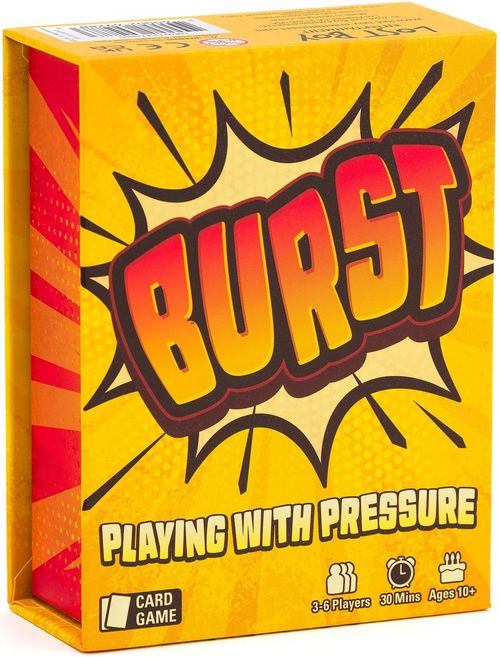
Burst
Burst Rulebook
Table of Contents
Table of Contents
Game Overview
Every card has a number ranging from -3 to 15. You can hold a max of three cards. Each round, you either draw a card from the deck or play a card faceup. Faceup cards are placed in a communal row next to the deck. If you play a card that brings the total value of the row over twenty-one, you burst. If you burst, the round ends and you receive zero points. All other players collect the points in their hand.
Components
90 Cards (Note: There are more lower-numbered cards than higher-numbered cards.)
Card Quantity
| Card | Quantity |
|---|---|
| -3 | 2 |
| -2 | 3 |
| -1 | 5 |
| 0 | 9 |
| 1 | 8 |
| 2 | 8 |
| 3 | 7 |
| 4 | 7 |
| 5 | 6 |
| 6 | 6 |
| 7 | 5 |
| 8 | 5 |
| 9 | 4 |
Game Setup
- Players sit in a circle.
- Shuffle the deck and place facedown in the center.
- Each player starts with no cards.
- Make a scorepad with each player's name.
- To determine the starting player, each player cuts the deck. Highest card goes first. Turns proceed clockwise.
Turn Overview
On your turn, perform one of these options:
- Option 1: Draw a card from the deck.
- Option 2: Play a card from your hand by adding it to the row.
You can never have more than three cards in your hand.
- If you start your turn with three cards, you must play a card from your hand.
- If you start your turn with no cards, you must draw a card from the deck.
You should not let other players see your hand, although players must be able to see how many cards you are holding.
You cannot pass.
The Row
When cards are played, they are placed faceup in a row next to the deck. There is only one row. It is communal and needs to be within reach of all players. The cards should not overlap, as players will need to add up the total value of all the numbers in the row.
After you play a card, state out loud the total value of all the cards in the row.
Example: a row of 1, 3, 0, 1, -2, 4. The total value of the row equals seven.
Example: a row of 1, 0, 0, 1, -3. The total value of the row equals negative one.
Scoring
When a player is forced to play a card that brings the total value of the row over twenty-one, it is known as bursting. If a player bursts, the round ends and that player receives zero points. Each of the other players receives points based on the total value of the cards in their hand. The goal is to get the most points.
Example: a row of 1, 4, 3, 2, 9, 7 (total 26). Player 1 holds 9 and 8; Player 2 holds 11, 3 and 4; Player 3 holds 10 and -1. Player 1 was forced to play a seven and burst. Player 1 receives zero points. Player 1 score: 0. Player 2 score: 18. Player 3 score: 9.
How to Play
- The starting player takes their turn. Turns proceed clockwise.
- When a player bursts (brings the total value of the row over twenty-one), the round ends.
- Add each player's score to their running total.
- Before the next round begins, shuffle all the cards and restack the deck. The player who burst starts the next round.
How to Win
When any player reaches 100 points, the game ends. The player with the most points wins.
Example scores by round:
| Round | Player 1 | Player 2 | Player 3 |
|---|---|---|---|
| 1 | 0 | 18 | 9 |
| 2 | 22 | 0 | 11 |
| 3 | 7 | 15 | 0 |
| 4 | 16 | 21 | 0 |
| 5 | 0 | 7 | 18 |
| 6 | 0 | 13 | -2 |
| 7 | 17 | 0 |
In this example, Player 2 wins.
Action Cards
In addition to having numbers, some cards have special actions which must be followed when played. There are four special actions:
- The order of play reverses.
- Discard a card from the row.
- Take a card from the row and put that card in your hand.
- Discard all cards from the row that have the same value as this card.
If the action on a card cannot be followed when played, the action is ignored.
When an action card is played, it cannot be removed on that same turn.
The total value of the row is not counted until the action card is played and the action on that card has been followed.
If a card is discarded, it is not used for the remainder of the round.